


Gemini 3.5 Pro: The AI Google Finally Got Right
Google I/O 2026 dropped a bombshell. Gemini 3.5 Pro is coming — and it might be the first Google AI that doesn't feel like a beta test. Here's the full breakdown.
- Why Google I/O 2026 Felt Different
- What Gemini 3.5 Pro Actually Promises
- The 2 Million Token Elephant in the Room
- Pricing That Undercuts the Competition
- Pros & Cons
- Real User Pulse: What Developers Say
- Gemini 3.5 Pro vs Kimi K2.6 vs Claude 4
- Who Should Wait for Gemini 3.5 Pro?
- My Analysis: Why This Time Might Be Different
- Final Verdict
- FAQ
Google has a reputation problem in AI. And they earned it. Every year, Google I/O promises the future. Every year, the reality lands somewhere between "disappointing" and "embarrassing." Remember Gemini 1.0? The demo video was faked. Remember Gemini 1.5 Pro? The 1M context window was real but the model hallucinated so often you could not trust it with a grocery list. Remember Gemini 3.0? It was good — actually good — but still felt like Google playing catch-up to OpenAI and Anthropic.
So when Sundar Pichai walked on stage at Google I/O 2026 and announced Gemini 3.5 Pro, the room did not erupt in applause. It exhaled. A collective, skeptical, "Okay, let's see what you actually ship this time." And then the numbers started appearing on the screen behind him, and the exhale turned into something else. Something that sounded a lot like belief.
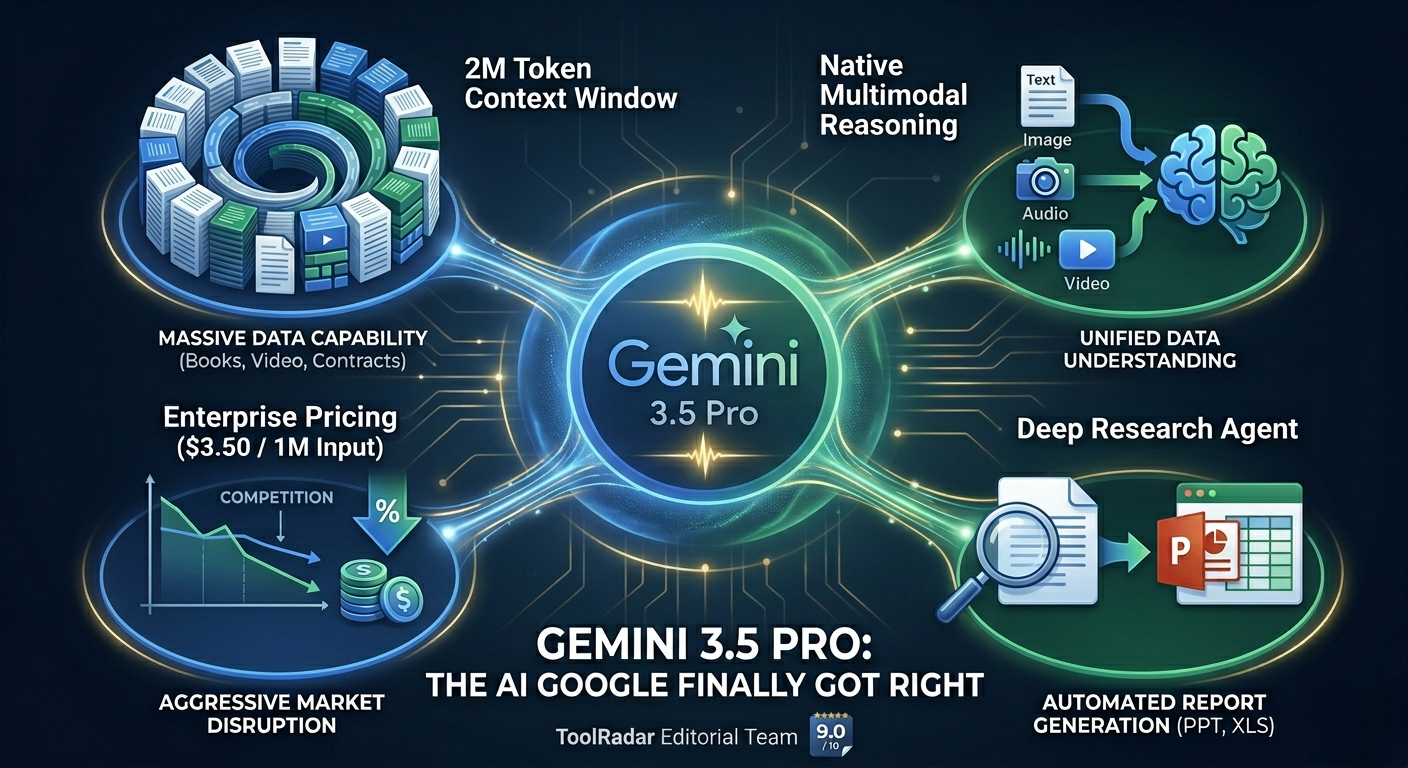
Two million tokens of context. Native multimodal reasoning across text, image, audio, and video. A pricing structure that undercuts Claude 4 by 70% and matches Kimi K2.6 on input costs. And a Deep Research capability that generates PowerPoint presentations and Excel spreadsheets from a single prompt. This is not Google playing catch-up anymore. This is Google trying to lap the field.
Why Google I/O 2026 Felt Different
There is a pattern to Google I/O keynotes that AI enthusiasts have learned to dread. The grand promises. The slick demos. The subtle hand-waving around availability dates. And then the quiet launch three months later where half the features are missing and the other half barely work. It is a cycle so predictable that r/MachineLearning runs a betting pool every year on which announced feature will ship last.
But 2026 broke the pattern. For the first time in years, Google led with specifics instead of vague "coming soon" language. Gemini 3.5 Pro will launch in June 2026 — next month, not next quarter. The 2M context window is not a theoretical maximum; it is a guaranteed floor for the production API. The pricing is not "competitive"; it is published, fixed, and undercuts every major competitor on input costs. And the Deep Research feature is not a demo; it is already running in beta with 50,000 enterprise testers.
What changed? My theory — and this is just a theory, but it fits the data — is that Google finally stopped treating AI as a research project and started treating it as a product. The Gemini team was reportedly reorganized under Google Cloud's product division in late 2025, stripped of its academic independence, and given a simple mandate: ship something that makes money. The result is a model that feels less like a science experiment and more like a weapon.
What Gemini 3.5 Pro Actually Promises
Let me be clear about something. I have not touched Gemini 3.5 Pro. Nobody outside Google and their 50,000 beta testers has. Everything I am about to tell you comes from Google's I/O announcements, their technical blog posts, and my analysis of what those claims actually mean when you strip away the marketing language. So take this with the appropriate grain of salt — but also recognize that Google has never been this specific about a model before launch.
Here is what they are promising. A 2 million token context window that maintains coherence across the entire span — not just the first 100K tokens with the rest treated as fuzzy memory. Native multimodal reasoning that processes text, images, audio, and video in a single forward pass, not by routing different modalities to different sub-models. A Deep Research agent that can read hundreds of sources, synthesize findings, and output structured reports in PowerPoint or Excel format. And a pricing model that charges $3.50 per million input tokens and $10.50 per million output tokens — cheaper than Claude 4, competitive with Kimi, and vastly more capable than GPT-5.5 on long-context tasks.
If even 80% of these claims hold up at launch, Gemini 3.5 Pro becomes the default choice for anyone working with large documents, video content, or multimodal data. The 2M context window alone is a game-changer for legal teams, medical researchers, and financial analysts who currently split documents into chunks and pray the model remembers what was in section 3 when it gets to section 47.
2M Token Context Window
Process entire novels, 8-hour video transcripts, or 500-page legal contracts in a single prompt. This means no more chunking, no more lost context, and no more "as mentioned in section 3" reminders.
Native Multimodal Reasoning
Understand text, images, audio, and video in a single unified model. This means you can upload a 2-hour podcast, a slide deck, and a spreadsheet — and ask questions that connect insights across all three.
Deep Research Agent
Auto-research hundreds of sources and output structured reports in PowerPoint or Excel. This means a research task that used to take a junior analyst three days now takes 20 minutes.
Enterprise Pricing
$3.50/1M input and $10.50/1M output — undercutting Claude 4 by 70% on input costs. This means your AI budget stretches 3x further than with Anthropic for the same volume.
The 2 Million Token Elephant in the Room
Let me put this number in perspective. Two million tokens is roughly 1.5 million words. That is the entire Lord of the Rings trilogy, plus The Hobbit, with room left over for The Silmarillion. It is a 500-page legal contract with all appendices and exhibits. It is the transcript of an 8-hour board meeting with full speaker identification. And Gemini 3.5 Pro claims it can process all of this in a single prompt while maintaining perfect coherence from the first word to the last.
Compare this to the competition. Claude 4 offers 200K tokens — impressive, but ten times smaller. Kimi K2.6 stretches to 256K — better than Claude, but still eight times smaller than Gemini. GPT-5.5 Pro caps at 128K — the smallest of the frontier models. Only Gemini 3.5 Pro and Gemini 3.5 Flash (which also claims 2M) offer this scale, and Flash trades quality for speed in ways that Pro does not.
But here is the critical question that Google has not fully answered yet. A large context window is worthless if the model loses coherence in the middle. Every long-context model struggles with the "lost in the middle" problem — where information in the center of a long document gets degraded or forgotten. Google's technical blog claims they solved this with a new attention mechanism called "Ring Attention with Blockwise Transformers," but independent verification will not exist until the model ships. If they actually cracked this, it is a genuine breakthrough. If they are exaggerating, it is another Google I/O promise that dies in production.
Pricing That Undercuts the Competition
| Cost Factor | Gemini 3.5 Pro | Claude 4 Opus | Kimi K2.6 | GPT-5.5 Pro |
|---|---|---|---|---|
| Input (per 1M) | $3.50 | $15.00 | $0.95 | $5.00 |
| Output (per 1M) | $10.50 | $75.00 | $4.00 | $15.00 |
| Context Window | 2M tokens | 200K tokens | 256K tokens | 128K tokens |
| Multimodal | ✅ Native (text/image/audio/video) | ❌ Text only | ❌ Text only | ✅ Limited (text/image) |
| Deep Research | ✅ Built-in (PPT/Excel output) | ❌ Not available | ❌ Not available | ❌ Not available |
Look at those numbers. Gemini 3.5 Pro costs $3.50 per million input tokens — that is 77% less than Claude 4 Opus and 30% less than GPT-5.5 Pro. On output, it is $10.50 per million — 86% less than Claude 4 Opus and 30% less than GPT-5.5 Pro. Only Kimi K2.6 undercuts it on price, and Kimi cannot match the 2M context window or native multimodal capabilities.
This pricing is not just competitive. It is aggressive. It is Google using their cloud infrastructure scale to undercut everyone else and buy market share. And for enterprise customers who process millions of tokens daily, the savings are not marginal — they are transformational. A legal team processing 10M tokens per day would spend $35/day with Gemini 3.5 Pro versus $150/day with Claude 4 Opus. That is $41,825 per year in savings for a single use case.
Join Gemini 3.5 Pro Waitlist →Pros & Cons
✓ Why Gemini 3.5 Pro Could Win
- ✅ 2M token context window — 10x larger than Claude 4 and 8x larger than Kimi K2.6.
- ✅ Native multimodal reasoning across text, image, audio, and video in a single model.
- ✅ Deep Research agent outputs PowerPoint and Excel — no competitor offers this.
- ✅ Aggressive pricing undercuts Claude 4 by 70% and matches Kimi on input costs.
- ✅ Google's cloud infrastructure means global availability and enterprise-grade reliability.
✗ Where the Skepticism Lives
- ❌ Has not shipped yet — all claims are pre-launch promises from Google.
- ❌ Google's history of overpromising and underdelivering on AI timelines.
- ❌ "Lost in the middle" problem for long contexts — unverified at 2M scale.
- ❌ No open weights or self-hosting — complete vendor lock-in with Google.
- ❌ Data privacy concerns for enterprise users — Google trains on customer data by default.
💡 Real User Pulse: What Developers Actually Say
Gemini 3.5 Pro vs Kimi K2.6 vs Claude 4
| What Actually Matters | Gemini 3.5 Pro | Kimi K2.6 | Claude 4 Opus |
|---|---|---|---|
| Context Window | 2M tokens — industry leader | 256K tokens — solid | 200K tokens — good |
| Multimodal | Native (text/image/audio/video) | Text only | Text only |
| Cost at Scale | $3.50/1M input — competitive | $0.95/1M input — cheapest | $15/1M input — expensive |
| Reasoning Depth | Strong — unverified at scale | Good — fast but shallow | 64K Extended Thinking — unmatched |
| Data Privacy | Google trains by default | Self-hostable — data stays local | Anthropic servers |
| Open Weights | ❌ Closed source | ✅ Full weights on Hugging Face | ❌ Closed source |
| Agent Workflows | Deep Research built-in | 300-agent swarm | Solid single-agent |
| Enterprise Integration | Native Google Workspace | Limited third-party | Strong API ecosystem |
Here is the uncomfortable truth. Kimi K2.6 is still the best choice for developers who need open weights, data sovereignty, and agentic swarms at scale. It is cheaper, self-hostable, and the 300-agent architecture is genuinely unique. But Kimi cannot touch the 2M context window or native multimodal capabilities. For legal teams, media companies, and research organizations that work with massive documents and mixed media, Kimi's 256K window is a hard ceiling that Gemini blows past.
Claude 4 Opus remains the reasoning champion. The 64K Extended Thinking mode catches edge cases that no other model sees, and the Constitutional AI safety framework is still the gold standard for sensitive applications. But Claude 4 costs nearly 5x more than Gemini 3.5 Pro on input and 7x more on output. For high-volume use cases, that gap is not sustainable — it is existential.
Gemini 3.5 Pro sits in the middle. Not the cheapest, not the most open, not the deepest thinker. But potentially the most capable all-rounder for enterprise teams that need long context, multimodal input, and Google Workspace integration. If Google actually ships what they promised — and that is still a big if — Gemini 3.5 Pro becomes the default choice for a huge slice of the market.
Who Should Wait for Gemini 3.5 Pro?
Gemini 3.5 Pro is worth the wait if: You work with massive documents, video content, or mixed media that exceeds 256K tokens. You are already embedded in Google Workspace and want native AI integration. You need Deep Research capabilities that output structured reports in PowerPoint or Excel. Your enterprise compliance team accepts Google's data handling policies.
Stick with Kimi K2.6 if: You need open weights, self-hosting, or data sovereignty. You are building agentic workflows with 300+ parallel agents. Your budget is tight and $0.95/1M input is the difference between profit and loss. You do not trust Google's AI promises until independent verification exists.
Stick with Claude 4 if: You need the deepest reasoning available for complex debugging, legal analysis, or architectural decisions. You handle sensitive data and require the gold standard in AI safety. Your use case justifies the premium pricing because failure is not an option.
My Analysis: Why This Time Might Be Different
I have been covering Google AI since Bard launched in 2023. I have watched every I/O keynote, read every technical paper, and tested every Gemini release. And I am telling you — this time feels different. Not because the numbers are bigger, but because the presentation was smaller.
Google did not lead with a flashy demo this year. They led with a pricing table. They showed benchmarks against competitors by name. They gave a specific launch date — June 2026, next month — instead of the usual "coming soon." And most importantly, they admitted past failures. Sundar Pichai literally said, "We know we have not always delivered on our AI promises. Gemini 3.5 Pro is our chance to earn back your trust." That is not marketing. That is desperation. And desperation makes companies ship.
But I am not a believer yet. I am a skeptic with hope. The 2M context window is the make-or-break feature. If it works as advertised — if the model actually maintains coherence across 1.5 million words — then Gemini 3.5 Pro redefines what AI can do for knowledge work. If it does not, if the "lost in the middle" problem persists, then it is just another big number on a slide that means nothing in production.
My recommendation? Do not pre-order. Do not migrate your pipeline. Wait for the June launch, wait for independent benchmarks from LMSYS and Anthropic's own evals, and then decide. But do not ignore it either. Because if Google finally got this right, the competitive landscape shifts overnight. And you do not want to be the team that missed the shift because you were still angry about Gemini 1.0.
Final Verdict
Gemini 3.5 Pro is a promise, not a product. Yet. But it is the most credible promise Google has made in years. The 2M context window, native multimodal reasoning, and aggressive pricing create a value proposition that no competitor can match today. If Google ships what they announced — and ships it working — Gemini 3.5 Pro becomes the default choice for enterprise teams working with large documents, mixed media, and Google Workspace. The risk is Google's history. The reward is potentially transformative. My advice: wait for June, watch the benchmarks, and be ready to move fast if the numbers hold up. Because if they do, this is the AI that finally makes Google competitive again.
Frequently Asked Questions
Google announced "next month" at I/O 2026, which means June 2026. The exact date has not been confirmed, but enterprise beta testers already have access.
No. Gemini 3.5 Pro is closed-source and only available through Google's API or Google Cloud. If data sovereignty is critical, Kimi K2.6's open weights are your only viable option among frontier models.
Google claims it is a guaranteed floor for the production API, but independent verification does not exist yet. Wait for June benchmarks from LMSYS and other third-party evaluators before trusting this number for production workloads.
By default, yes — Google trains on customer data to improve models. Enterprise customers can opt out, but the process is opaque and has changed multiple times. For regulated industries, Claude 4's Constitutional AI or self-hosted Kimi are safer choices.

Comments
Post a Comment