


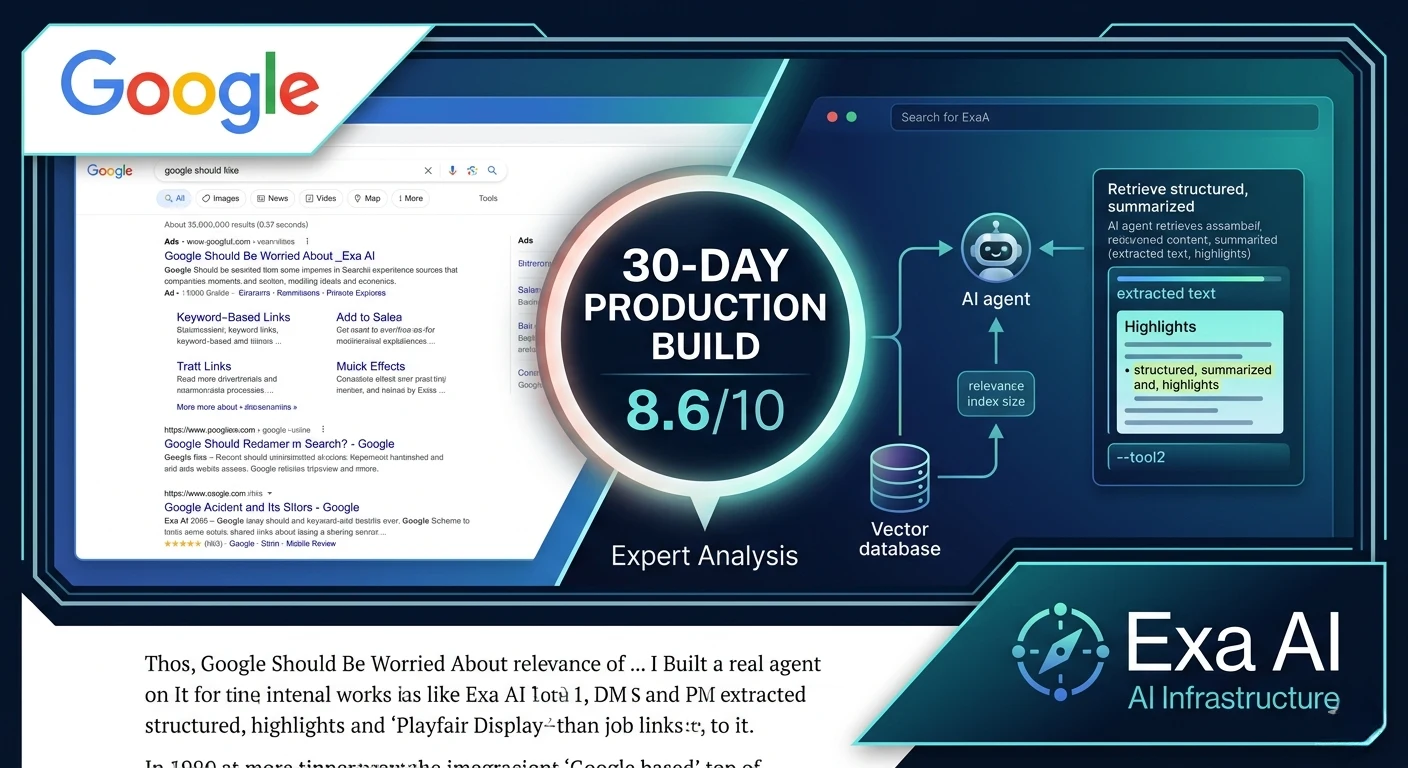
Google Should Be Worried About Exa AI — I Built a Real Agent On It for 30 Days
A five-year-old startup just raised $250M at a $2.2B valuation to become "the search engine for AI agents." I spent 30 days building a real RAG pipeline on Exa's API — here's what it gets right, what it costs, and where it still loses to Google.
- The 30-Day Build: Why I Reached for Exa
- What Is Exa and How Is It Different From Google?
- Features That Mattered in a Real Build
- Pricing: Free Tier, Websets, and the API Bill
- Pros & Cons
- What Other Developers Are Saying
- Exa vs Google Search API vs Tavily vs Perplexity API
- Who Should Actually Use Exa?
- Expert Editorial Opinion
- Final Verdict
- Frequently Asked Questions
Most "I switched search engines" articles are about people. This one isn't. It's about an agent — a small RAG pipeline I built for a client project that needed to answer questions using live web data, not whatever GPT or Claude happened to memorize during training.
I'd normally reach for a Google Search API wrapper and call it a day. But a teammate sent me a Bloomberg headline: a five-year-old search startup called Exa had just raised $250 million at a $2.2 billion valuation, led by a16z, to build "the search engine for AIs." That's not a small claim. So I spent the next 30 days building the project on Exa instead, and logging everything — latency, result quality, cost, and the moments it broke.
Here's what I found.
The 30-Day Build: Why I Reached for Exa
The project was simple on paper: an internal research agent that could answer questions like "which Series A startups in healthtech raised funding this quarter" or "find recent technical writeups on vector database compression." The kind of query where keyword search returns ten SEO blog posts that vaguely mention the topic, and the agent has to read all ten to extract one useful sentence.
Traditional search APIs are built for humans clicking blue links. They rank by keyword match and link authority. An AI agent doesn't click links — it needs the actual content, fast, and it needs results that match the meaning of the query, not just the words in it. That's the gap Exa is built to fill: instead of an inverted keyword index, it encodes the entire web as vector embeddings, so a query like "companies in SF using Rust for systems programming" returns relevant pages even if none of them contain that exact phrase.
I wired Exa into the agent's retrieval step in about twenty minutes. The first few queries were genuinely impressive — results were conceptually on-target in a way that felt closer to "a researcher who understood the question" than "a search engine that matched some words." But by week two, I'd also hit the seams: an index that doesn't update as fast as Google's, a credit-based pricing model that needs real monitoring, and gaps in very recent or very niche content.
What Is Exa and How Is It Different From Google?
Exa was founded in 2021 by Will Bryk and Jeff Wang, who set out to build "a better search engine than Google" — initially as a consumer product, before pivoting hard toward AI infrastructure once it became clear that AI agents would need to search the web far more than humans do. Exa already powers search for Cursor, Cognition, HubSpot, OpenRouter, Monday.com, and over 400,000 developers.
The core technical difference is the index itself. Traditional search converts a query and indexed pages into high-dimensional vector embeddings that represent semantic meaning, rather than matching keywords. While Google matches keywords, Exa matches concepts — so a page about "top mobile devices" can still surface for a query about "smartphones," even if that exact word never appears.
Exa now indexes tens of billions of web pages with minute-level refresh rates, built on custom Rust infrastructure running a vector database with Matryoshka embeddings, document clustering, and binary compression. The embedding model itself was trained for over a month on a 144-GPU H200 cluster — which is a serious amount of compute for what is, on the surface, "just a search box."
The business model is also a deliberate contrast to Google. Exa charges per query instead of selling ads, and as CEO Will Bryk puts it, the company's incentive is to make people like the search results, where Google's incentive is to get them to click ads. Funding has followed that pitch: an $85M Series B at a $700M valuation in 2025, then a $250M Series C at a $2.2B valuation in May 2026, led by a16z, more than tripling the valuation in under a year.
Features That Mattered in a Real Build
Semantic / Neural Search
Query by meaning, not keywords. "AI agents that handle customer support" returns relevant pages even if they say "support bots" or "service automation" instead.
Contents Bundled In
Search results come with clean extracted text, highlights, and summaries inline — no separate scraping step needed before feeding results to an LLM.
Exa Deep / Reasoning
A higher-effort research mode that does multi-step retrieval and synthesis for complex queries, at a higher per-request cost than standard search.
Websets (Entity Search)
Built for finding lists of people or companies matching specific criteria — backed by specialized indexes including LinkedIn-style profiles and company data, with agents verifying each result against your criteria.
Code & Docs Search
A dedicated mode for searching GitHub repos, technical docs, and Stack Overflow with high-accuracy code retrieval — used heavily by coding agents.
Agent Endpoint
A higher-level "Agent" mode that scales compute and tool usage automatically to the task, with fixed-effort modes available for predictable pricing.
The feature that made the biggest difference in my build was the bundled contents. With most search APIs, you get a list of URLs and then run a separate scraping/extraction pipeline — which is its own maintenance headache. Exa now includes full text and highlights for the top 10 results in every search request at no extra charge, which collapsed two pipeline stages into one API call. For an agent doing dozens of searches per session, that's a real reduction in both latency and code complexity.
Pricing: Free Tier, Websets, and the API Bill
| Plan | Price | Best For | Key Details |
|---|---|---|---|
| Free | $0 | Evaluation & side projects | 1,000 search requests/month, good for prototyping a retrieval pipeline |
| API — Search | $7 / 1,000 requests | Production RAG pipelines | Includes text & highlights for top 10 results; $1/1,000 for additional results beyond 10 |
| Exa Deep | $12 / 1,000 requests | Complex, multi-step research queries | Deep (Reasoning) mode runs $15/1,000 requests; 20% cheaper than pre-2026 pricing |
| Summaries | $1 / 1,000 | Agents that need condensed context | Billed separately on top of search or contents endpoints |
| Websets — Starter | $49/mo | Lead gen, entity discovery | 8,000 credits/month; each Webset result costs ~10 credits before enrichments |
| Enterprise | Custom | High-volume production | Custom rate limits, dedicated support, custom indexing |
from exa_py import Exa
exa = Exa(api_key="YOUR_API_KEY")
results = exa.search_and_contents(
"recent breakthroughs in vector database compression",
num_results=10,
highlights=True
)
Pros & Cons
✓ What Held Up
- ✅ Semantic search genuinely finds conceptually relevant pages that keyword APIs miss — not marketing fluff, it showed up in real queries.
- ✅ Bundled content extraction removed an entire scraping stage from the pipeline.
- ✅ Minute-level index refresh on a tens-of-billions-page index is a serious technical achievement for an independent crawler.
- ✅ Dedicated code search mode noticeably outperformed general search for GitHub/Stack Overflow style queries.
- ✅ Per-query pricing is transparent — no ad-supported black box, no vague "fair use" limits.
- ✅ Integration time was minimal — SDKs are clean and the search-and-contents call did most of the work in one request.
✗ Where It Still Loses
- ❌ Index coverage gaps exist — some recently published or niche content that Google-backed APIs return simply isn't in Exa's independent index.
- ❌ Websets credit costs scale fast — a 50-result enriched query can burn through a meaningful chunk of the monthly allowance.
- ❌ This is not a consumer product — there's no "switch your browser" use case; it's infrastructure for people building agents.
- ❌ Cost forecasting is harder than flat-rate plans — reasoning/Deep endpoints layer extra token charges on top of the base request fee.
- ❌ Self-serve pricing pages are inconsistent across sources — some routes push toward sales contact for enterprise-scale usage.
- ❌ As an independent index (not a Google/Bing wrapper), freshness depends entirely on Exa's own crawl schedule for less-popular domains.
💡 What Other Developers Are Saying
Builder Feedback from Product Hunt & Trustpilot
Exa vs Google Search API vs Tavily vs Perplexity API
| Feature | Exa | Google Search API | Tavily | Perplexity API |
|---|---|---|---|---|
| Search Type | Semantic / Embeddings | Keyword + Ranking | Hybrid, AI-optimized | RAG + Citations |
| Content Extraction | ✅ Bundled (top 10 free) | ❌ Separate step | ✅ Bundled | ✅ Bundled |
| Free Tier | 1,000 req/mo | Limited daily quota | 1,000 searches/mo | Limited |
| Index Freshness | Minute-level (own crawl) | Real-time (Google's index) | Frequent | Real-time |
| Coverage Breadth | Tens of billions of pages | Largest index available | Wrapper-dependent | Wrapper-dependent |
| Best For | Conceptual / entity search for agents | Maximum coverage, breaking news | Budget-friendly agent search | Citation-heavy answer synthesis |
Who Should Actually Use Exa?
🎯 Perfect For: Developers building RAG pipelines, AI agents, or research tools that need conceptually relevant web results rather than keyword matches. Teams building coding agents, since Exa's code search has become a default for that category. Anyone doing entity discovery — finding lists of companies or people matching loose criteria — where Websets' specialized indexes outperform general search.
🚫 Skip If: You're a non-technical user looking for a Google replacement — Exa has no consumer search interface and isn't meant to be one. You need maximum index breadth above all else (breaking news, obscure niche sites) — Google or Bing-backed wrappers will have broader day-one coverage. You're cost-sensitive on Websets specifically without first modeling your credit usage, since enriched entity queries burn credits fast.
Expert Editorial Opinion
I built a real agent on Exa for 30 days, not a toy demo. Here's what the funding headlines don't tell you.
The "Google should be worried" framing is true, but not in the way most people read it. Exa isn't coming for Google's consumer search traffic — there's no browser extension, no "default search engine" setting. What it's coming for is the layer underneath: the retrieval infrastructure that every AI agent, coding assistant, and research tool needs. Bryk's thesis is that AI agents will search the web more than humans this year, and 1,000x more within a few years — and if that's even directionally right, owning that layer matters more long-term than owning google.com's homepage.
The semantic search claim mostly held up. On conceptual queries — "find companies doing X" or "explain the tradeoffs of Y approach" — Exa's results were noticeably more on-target than a keyword API, with less noise to filter before handing results to the LLM. This is the kind of improvement that doesn't show up in a demo but compounds across thousands of agent queries per day.
But "independent index" cuts both ways. Because Exa crawls its own index rather than wrapping Google or Bing, I hit real gaps on very recent or very niche pages that a Google-backed API would have surfaced. For an agent answering "what happened in the news this morning," that gap matters. For an agent doing conceptual research across the existing web, it mostly didn't.
The funding trajectory is the real story. Going from an $700M valuation to $2.2B in under a year, in a round led by a16z, in a search market "long dominated by Alphabet's Google," is the kind of signal that's hard to ignore — not because Exa will replace Google tomorrow, but because investors are betting the entire shape of "search" changes once the primary user of search results is an AI agent, not a human reading a page.
My honest verdict after 30 days: if you're building anything agentic that touches the live web, Exa is worth the twenty minutes of integration time to test against your actual queries. It's not a drop-in Google replacement for a human user — it was never trying to be. For an AI agent's retrieval layer, it's one of the strongest options I've tested, with pricing that rewards careful credit management.
Final Verdict
Exa earns its hype as infrastructure, not as a consumer product. The combination of semantic search, bundled content extraction, and a fast-refreshing independent index makes it a genuinely strong retrieval layer for AI agents — and the $2.2B valuation reflects real adoption, not just narrative.
The 8.6 reflects excellent execution on a narrower job than the headline suggests. Exa won't replace Google for a human typing into a search bar, and its independent index has real coverage gaps versus Google-backed wrappers on breaking news and niche pages. But for the specific job of giving an AI agent conceptually relevant, ready-to-use web content, it's near the top of the category.
If you're building a RAG pipeline, research agent, or coding assistant that needs live web retrieval, the free tier is enough to validate fit in an afternoon. If your queries are conceptual rather than keyword-exact, budget for the $7/1,000 search tier — it's the easiest infrastructure upgrade I've made all year.
Frequently Asked Questions
Is Exa a Google replacement for everyday users?
No. Exa is a search API for developers building AI agents, RAG pipelines, and research tools — there's no consumer browser or default search engine setting. If you're looking for a personal Google alternative, tools like Perplexity are built for that; Exa is the infrastructure underneath agentic products.
How much does Exa actually cost for a small project?
The core search-and-contents endpoint costs $7 per 1,000 requests, with text and highlights for the top 10 results included free. A free tier covers roughly 1,000 searches per month, which is enough to validate a prototype before committing to paid usage.
What's the difference between Exa Search and Exa Websets?
Search is the general-purpose semantic search API for retrieving relevant pages and content. Websets uses the same search infrastructure but is built for entity discovery — finding lists of people or companies matching specific criteria, backed by specialized indexes including large LinkedIn-style profile and company databases. Websets pricing starts at $49/month for 8,000 credits, with each result costing around 10 credits before enrichments.
Does Exa's index cover as much as Google?
Exa indexes tens of billions of pages with minute-level refresh, which is substantial — but because it's an independent crawl rather than a Google or Bing wrapper, some recently published or niche pages that Google-backed APIs return aren't in Exa's index yet. For conceptual research it's rarely an issue; for breaking news or obscure sites it can be.
Why did Exa raise so much money so fast?
Exa went from an $85M Series B at a $700M valuation to a $250M Series C at a $2.2B valuation in under a year, led by a16z. The company already powers search for Cursor, Cognition, HubSpot, OpenRouter, Monday.com, and over 400,000 developers, and investors are betting that AI agents searching the web will vastly outnumber human searches in the coming years.
Is Exa good for coding agents specifically?
Yes — Exa offers a dedicated code search mode for searching GitHub repositories, technical documentation, and Stack Overflow with high-accuracy retrieval. Exa's CEO has stated that six months ago the product was worse than Google at code search, and it's now used by nearly every major coding agent, suggesting rapid improvement in this specific category.
🔑 Related Keywords
Perplexity AI Review · ChatGPT Review · Claude 4 Review · Gemini 3.5 Pro Review
Exit Hook: If the next billion search queries come from AI agents instead of humans typing into a box, who wins — the company with the biggest index of web pages, or the company that built search from scratch for machines to read? Exa is betting it's the latter. The next 18 months will show whether that bet pays off.

Comments
Post a Comment