



I Replaced 3 Hours of Code Reading With 30 Seconds —<
Then DeepWiki Explained the Entire Repo to Me
The AI-powered "Wikipedia of code" that indexed 30,000+ repositories and 4 billion lines of code. From Cognition AI — the makers of Devin.
- What Is DeepWiki? (The "Wikipedia of Code")
- How It Works: Replace github.com with deepwiki.com
- Core Features: From Architecture to Q&A
- DeepWiki-Open: The Self-Hosted Alternative
- Pros & Cons
- Real User Pulse: Developer Community Feedback
- DeepWiki vs GitHub Copilot vs Sourcegraph
- Who Should Use DeepWiki?
- Expert Editorial Opinion
- Final Verdict
I joined a new team last month. Onboarding meant diving into a 200,000-line React codebase with minimal documentation, scattered READMEs, and commit messages like "fix stuff." My manager expected me to be productive by week two. I spent my first three days just trying to understand where the authentication logic lived.
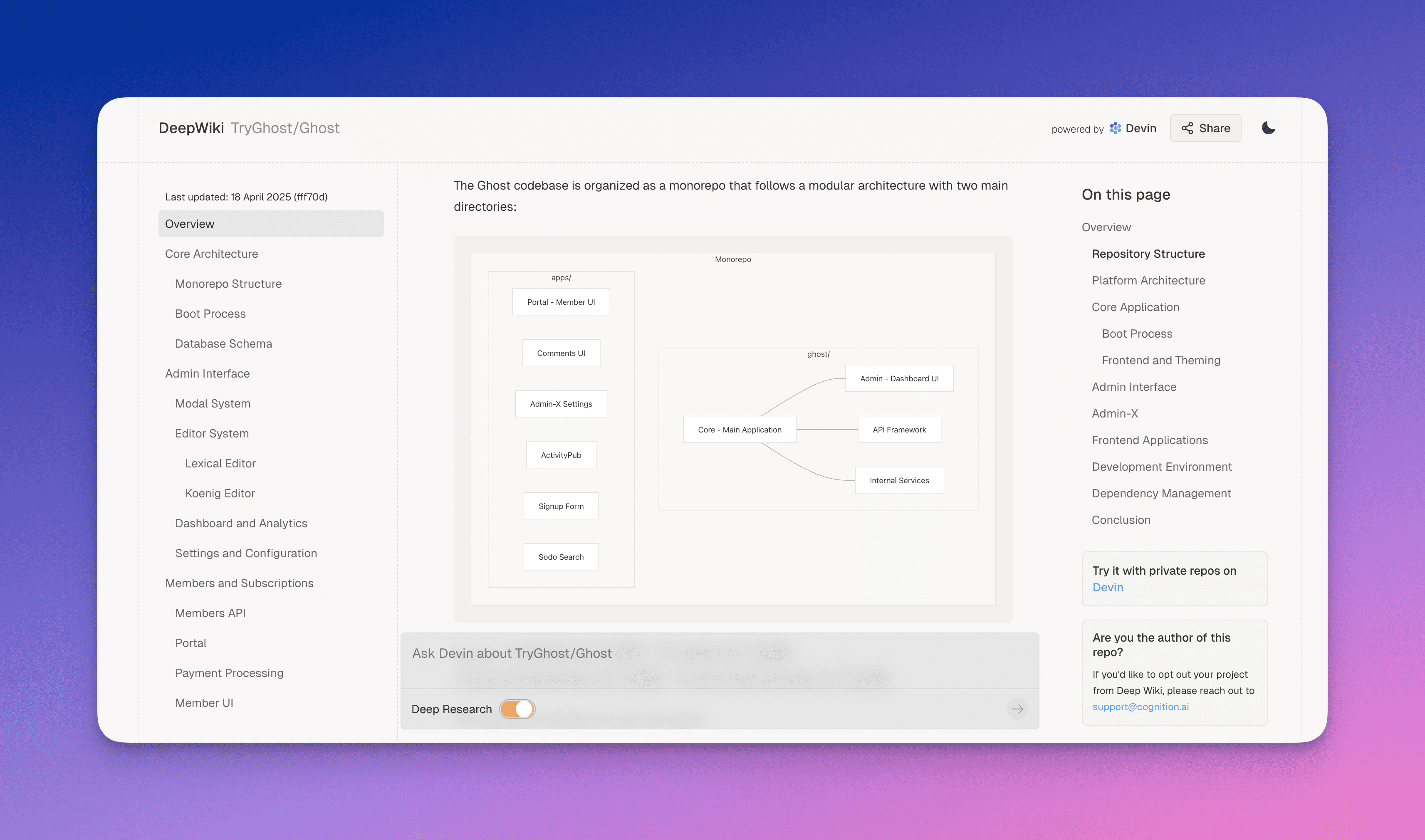
Then a senior dev sent me a link. Instead of github.com/company/project, it was deepwiki.com/company/project. I clicked it. In 30 seconds, I had an architecture diagram, a component breakdown, a dependency graph, and a searchable wiki. I asked "Where is the auth logic?" and got a precise answer with links to the exact files. What took me 3 hours of manual code reading took 30 seconds of AI conversation.
— Dev.to Technical Review, April 2025
What Is DeepWiki? (The "Wikipedia of Code")
DeepWiki is an AI-powered documentation platform launched by Cognition AI — the same team behind Devin, the autonomous AI coding assistant. It automatically generates interactive, Wikipedia-style documentation for any GitHub repository by analyzing code structure, configuration files, and existing documentation.
The platform has indexed over 30,000 repositories and processed more than 4 billion lines of code. It combines large language models with graph-based structural analysis to create "living documentation" that evolves with the codebase. Think of it as having a senior engineer who already knows the repo inside-out, walking you through the code step by step.
What makes DeepWiki different from static documentation tools is its conversational interface. You don't just read docs — you ask questions. "How does the payment module work?" "What's the difference between X and Y components?" "Where is the user authentication implemented?" The AI answers with context-aware, precise responses grounded in the actual code.
How It Works: Replace github.com with deepwiki.com
The genius of DeepWiki is its simplicity. No installation. No plugins. No onboarding. Just change the URL:
- Before:
https://github.com/microsoft/vscode - After:
https://deepwiki.com/microsoft/vscode
That's it. DeepWiki clones the repository, analyzes its structure, identifies file types and languages, maps dependencies, and generates a complete wiki with architecture diagrams, component explanations, and usage guides. The entire process happens in the background while you browse.
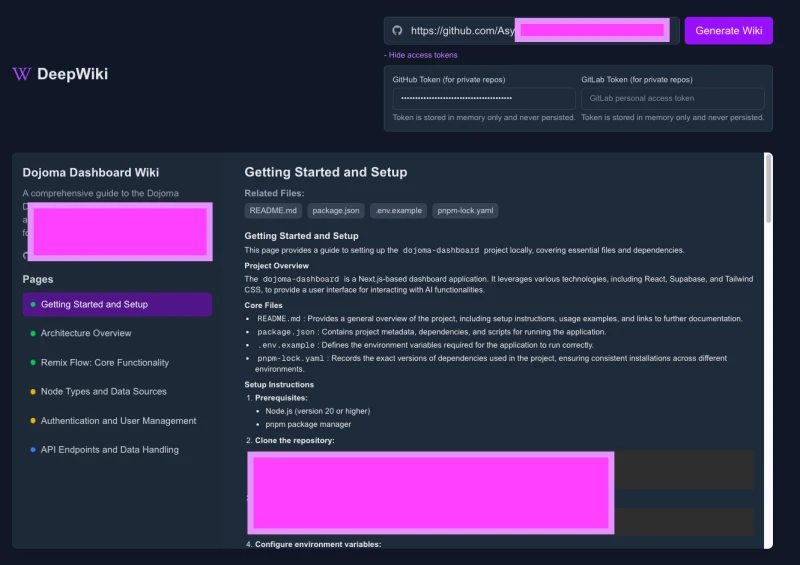
For public repositories, it's completely free and requires no registration. For private repos, you need a Devin account and authentication. The platform supports GitHub, GitLab, and BitBucket through access tokens.
Behind the scenes, DeepWiki uses a three-layer intelligence framework: a data ingestion pipeline that extracts multi-dimensional data, code embedding for semantic search, and AI-powered documentation generation using models like Gemini, GPT-4, or Claude. It also auto-generates Mermaid diagrams showing system architecture, data flow, and component relationships.
Core Features: From Architecture to Q&A
DeepWiki's feature set is designed for one purpose: making codebases understandable. Here's what you get:
Architecture Diagrams
Auto-generated Mermaid diagrams showing system architecture, module interactions, data flow, and service dependencies. Visual understanding without manual digging.
Natural Language Q&A
Ask questions in plain English about any part of the codebase. "Where is auth implemented?" "How does the payment module work?" Get precise, context-aware answers.
Deep Research Mode
Multi-turn AI research for complex analysis. Detects code smells, suggests optimizations, and provides architectural critiques at the system design level.
Interactive File Explorer
Module-level and file-level explanations with cross-references. Navigate the codebase like a wiki, not a file tree.
Multi-Language Support
Optimizes for JavaScript, Python, Go, Java, C#, React, Flutter, and more. Polyglot repos get cross-language integration docs.
Custom Configuration
Steer wiki generation with .devin/wiki.json files. Specify focus areas, exclude generated code, and control documentation depth.
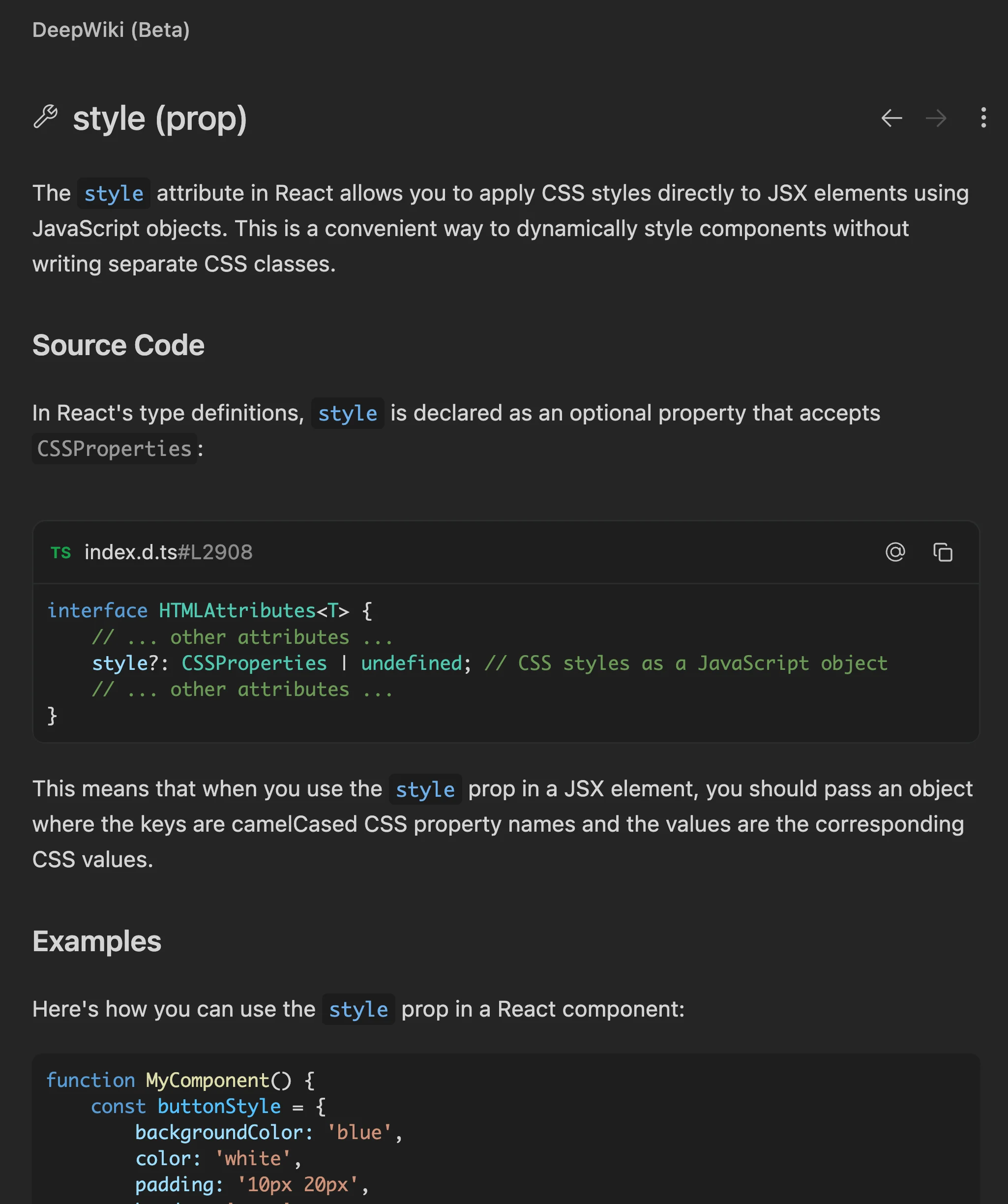
One standout feature is the steering capability. Repository maintainers can create a .devin/wiki.json file in the repo root to guide DeepWiki's documentation generation. Specify which pages to create, add repo notes for context, and ensure important components get documented even when automatic systems would skip them.
DeepWiki-Open: The Self-Hosted Alternative
For teams who need privacy, customization, or cost control, the community has created DeepWiki-Open (also known as Grok-Wiki). This open-source alternative lets you run the entire documentation pipeline on your own infrastructure.
DeepWiki-Open supports multiple AI providers: Google Gemini, OpenAI GPT, Anthropic Claude, OpenRouter, and even local models via Ollama (Llama3, Qwen3). You can customize documentation style, control temperature and creativity settings, and integrate with CI/CD pipelines for automatic wiki regeneration on every commit.
The trade-off? You manage the infrastructure. But for enterprise teams handling sensitive codebases, the privacy and control are worth it. The project is actively maintained on GitHub with regular updates and community contributions.
Try DeepWiki Free (No Signup) →Pros & Cons
✓ What Excels
- ✅ Zero friction: No installation, no signup for public repos. Just change the URL.
- ✅ Instant understanding: Architecture diagrams and component breakdowns in seconds.
- ✅ Conversational: Ask natural language questions and get code-grounded answers.
- ✅ Completely free: Public repositories cost nothing. No credit limits, no tiers.
- ✅ Massive coverage: 30,000+ repos indexed, 4 billion+ lines processed.
- ✅ Visual diagrams: Auto-generated Mermaid charts for architecture and data flow.
- ✅ Open-source alternative: DeepWiki-Open for self-hosted, private deployments.
✗ What Frustrates
- ❌ No Issues/PRs search: Can't search GitHub Issues or Pull Requests, limiting context.
- ❌ Accuracy concerns: AI-generated docs may contain errors; human verification still needed.
- ❌ Private repo barrier: Requires Devin registration and authentication for private repos.
- ❌ Quality dependency: Disorganized repos produce disorganized documentation.
- ❌ Limited editing: No direct wiki editing; must use
.devin/wiki.jsonsteering. - ❌ Enterprise opacity: Pricing and features for large teams are not fully transparent.
💡 Real User Pulse: Developer Community Feedback
"DeepWiki is an AI trained specifically on a single Git repository. It creates a complete, searchable wiki for your codebase, allowing you to ask questions about it. It's like having a senior developer who already knows the repo inside-out, walking you through the codebase step by step."
— Dev.to Review, August 2025
"DeepWiki's AI-powered documentation and graph-based analysis transform 4 billion+ lines of code into a dynamic knowledge base that slashes developer onboarding time. This system reduces onboarding time for new developers compared to manual code exploration, improving architectural understanding accuracy in controlled studies."
— AI Simplified in Plain English, April 2025
"DeepWiki by Cognition lets AI generate documentation you can talk to for GitHub repos. Understands codebase structure. Powered by Devin. Free for open-sourced repos." — 158 upvotes, 106 followers.
— Product Hunt Launch, April 2025
"CodeWiki achieves a 68.79% quality score with proprietary models, outperforming the closed-source DeepWiki baseline (64.06%) by 4.73%, with particularly strong improvements on high-level scripting languages (+10.47%)."
— CodeWiki Research Paper, arXiv, October 2025
DeepWiki vs GitHub Copilot vs Sourcegraph
| Criteria | DeepWiki | GitHub Copilot | Sourcegraph |
|---|---|---|---|
| Primary Function | AI documentation & Q&A | Real-time code completion | Code search & intelligence |
| Onboarding Speed | Instant (30 seconds) | Gradual (as you code) | Moderate (search-based) |
| Visual Diagrams | Auto-generated Mermaid | None | Limited |
| Natural Language | Full Q&A interface | Inline comments only | Search queries |
| Cost | Free (public repos) | $10-19/mo | Enterprise pricing |
| Open Source | Partial (DeepWiki-Open) | No | Partial |
| Best For | Repo exploration & onboarding | Active coding assistance | Large-scale code search |
Who Should Use DeepWiki?
🚀 Perfect For:
• New developers joining teams who need to understand legacy codebases quickly
• Open-source contributors evaluating projects before committing time
• Technical auditors reviewing system architecture systematically
• Students & learners studying real-world codebases and best practices
• Project maintainers who want auto-generated docs with minimal manual effort
• Engineering managers assessing project quality and structure before adoption
⚠️ Look Elsewhere If:
• You need real-time coding assistance — GitHub Copilot or Cursor are better for active development
• You want enterprise-scale code search — Sourcegraph offers more powerful cross-repo search
• You need Issues and PR analysis — DeepWiki doesn't search GitHub Issues or Pull Requests
• You require 100% accuracy guarantee — AI-generated docs need human verification
• You want direct wiki editing — DeepWiki generates docs; it doesn't let you edit them directly
Expert Editorial Opinion
I've been testing developer tools for five years. Most "AI documentation" tools are either glorified README generators or expensive enterprise suites that require weeks of setup. DeepWiki is neither. It's the first tool I've used that actually delivers on the promise of "understand any codebase instantly."
My test was simple: I picked a repository I had never seen before — a 50,000-line Python data pipeline project on GitHub. Normally, I'd spend 2-3 hours reading code, tracing imports, and drawing architecture diagrams on a whiteboard. With DeepWiki, I changed the URL and had a complete wiki in 30 seconds. The architecture diagram showed me the ETL flow. The component breakdown explained each module's purpose. And when I asked "Where does the data validation happen?" I got a precise answer with links to the exact functions.
But here's the honest limitation: DeepWiki is only as good as the code it's analyzing. When I tested it on a poorly organized repo with no tests, scattered utilities, and inconsistent naming, the documentation reflected that chaos. The AI can't magically create structure where none exists. And for complex design decisions — why the team chose Kafka over RabbitMQ, for example — DeepWiki can't read minds. It documents what exists, not why it exists.
The open-source DeepWiki-Open project is particularly exciting for enterprise teams. Being able to run this on private infrastructure with local LLMs means sensitive codebases never leave your network. The CI/CD integration — auto-regenerating docs on every commit — is a feature I wish every team had.
My recommendation? Use DeepWiki for every new repo you encounter. It's free, it's instant, and it will save you hours. But treat it as a starting point, not a replacement for reading code. The AI gives you the map; you still need to walk the terrain.
Final Verdict
DeepWiki is the documentation tool that developers didn't know they needed until they used it. It's an 8.4/10 powerhouse that transforms the dreaded "read the codebase" onboarding task into a 30-second conversation. The zero-friction approach — just change the URL — is genius. The conversational Q&A is genuinely useful. And the price (free for public repos) makes it a no-brainer.
The limitations are real but manageable. It can't search Issues or PRs. It can't edit docs directly. And it struggles with truly disorganized codebases. But for 90% of repository exploration tasks, DeepWiki is faster, cheaper, and more intuitive than any alternative.
The open-source DeepWiki-Open project adds enterprise-grade flexibility for teams who need privacy and control. And the academic benchmarks — while showing room for improvement — confirm that DeepWiki is already competitive with proprietary research systems.
So here's the real question: How many hours of your life have you spent reading code you didn't understand? DeepWiki can't eliminate all of them, but it can eliminate most. And in a world where developer time is the most expensive resource, that's worth more than any subscription fee.
🔑 Related Keywords
Related Reads: Cursor 3 Review · Devin AI Review · Vibe Coding · Zapier AI · Gumloop · Lindy AI

Comments
Post a Comment