


Hyper3D Rodin Review 2026: The AI 3D Generator That Beat 9 Competitors
10 billion parameters. PBR textures in 4 seconds. Production-ready topology out of the box. In independent benchmarks, Rodin ranked #1 ahead of Meshy, Tripo, and every other AI 3D tool on the market. But the premium pricing asks a question: is the quality worth the cost?
In a crowded field of AI 3D generators, one tool keeps winning the head-to-heads. An independent benchmark by CyberFox Agency tested nine platforms on identical prompts — sci-fi helmet, medieval sword, cartoon character, photorealistic sneaker, low-poly tree — and scored each on geometry, textures, speed, workflow fit, and price-to-value. The winner was not Meshy AI. Not Tripo. Not Luma or Hunyuan. It was Hyper3D Rodin, scoring 8.5 to 9.5 out of 10 — well ahead of every competitor.
Built by Deemos Technologies (the team behind SIGGRAPH-recognized papers CLAY and BANG), Rodin Gen-2 is a 10-billion-parameter diffusion transformer that generates production-ready 3D assets from text or images in approximately 4 seconds. The output includes clean quad topology, proper UVs, 4K PBR textures (albedo, roughness, metallic, normal), and export to all major formats. But the platform operates on a freemium model where generation is free and unlimited — you only pay when you download a model you are satisfied with. For indie developers, that means zero risk to experiment. For studios, that means predictable per-asset costs. For everyone else, it raises a question: if Rodin is this good, why is anyone still using the alternatives?
What Is Hyper3D Rodin?
Hyper3D Rodin is a generative AI tool for creating high-quality 3D models, developed by Deemos Technologies Inc. and incubated at Shanghai University of Science and Technology. It is the flagship product in the Hyper3D ecosystem, which also includes OmniCraft for model editing and ChatAvatar for creating realistic 3D faces.
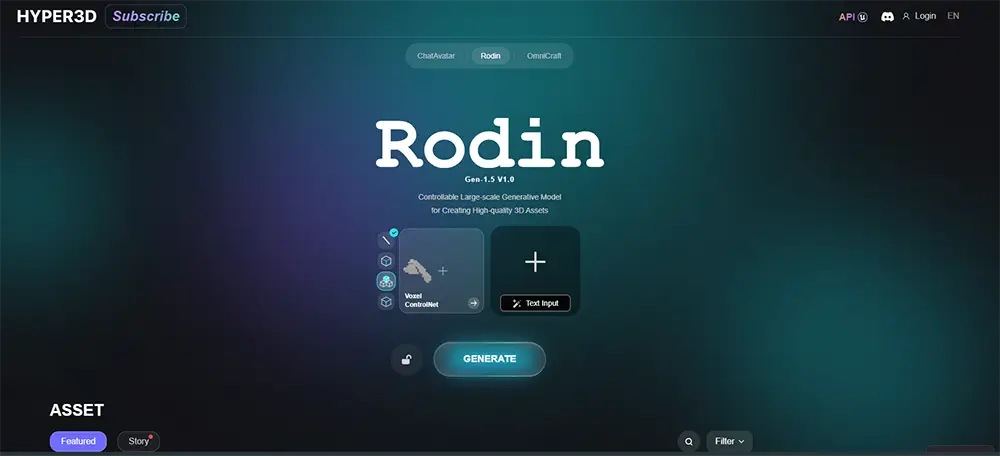
Rodin transforms text prompts and images into 3D models with PBR (Physically Based Rendering) textures in seconds, powered by over 1.5 billion parameters using the Diffusion Transformer architecture. The Gen-2 engine runs on 10 billion parameters, delivering 4x quality improvement over previous versions. With Gen-2.5, texture generation moved to a truly 3D-native paradigm where colors and materials are generated directly on the surface of the 3D model itself — eliminating the seams, projection artifacts, and multi-view inconsistency that plague competitors who use 2D workarounds.
The platform targets game developers, animators, virtual reality designers, and increasingly — e-commerce brands converting product photography into interactive 3D models. Native plugins for Blender, Unity, and Unreal Engine mean the pipeline from generation to engine is nearly frictionless.
Key Features
4-Second Generation
Rodin generates models in approximately 4 seconds with native quad-mesh topology and 4K PBR textures. The Gen-2.5 update pushed this to ~4 seconds for geometry and ~5 seconds for full model with textures. Speedy mode exists for faster iteration, though initial results may need review before professional use.
3D-Native PBR Textures
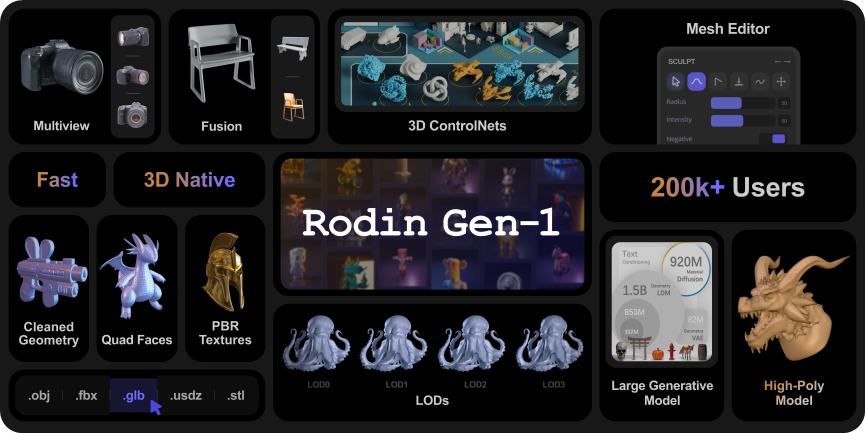
Unlike competitors using 2D projection workarounds, Rodin generates PBR textures directly on the 3D surface. Output includes albedo, roughness, metallic, and normal maps — all auto-generated and ready for Unity, Unreal, and Blender. The result is full-angle consistency with no seams or projection artifacts in occluded regions.
Multi-Image Fusion
Upload up to 5 reference images from different angles, and Rodin automatically treats them as multi-view captures of a single object. The first image drives material generation; subsequent images improve geometric accuracy. Cross-object feature fusion allows combining elements from different references — a capability no other tool handles as cleanly.
Topology & Format Control
Choose between quad meshes (4K, 8K, 18K, 50K faces) for sculpting and rigging, or triangle meshes (2K, 20K, 250K, 500K) for game engines. Export to GLB, FBX, OBJ, USDZ, or STL. Optional T/A-pose enforcement keeps characters rigging-ready. Bounding box constraints ensure consistent proportions across asset libraries.
Faithful vs. Creative Modes
"Faithful" mode is optimized for real-world, physically consistent images — ideal for product photography and e-commerce. "Creative" mode is more robust to imperfect inputs like AI-generated concept art with subtle perspective inconsistencies. Most workflows default to Creative; product visualization defaults to Faithful.
Free Generation, Pay to Download
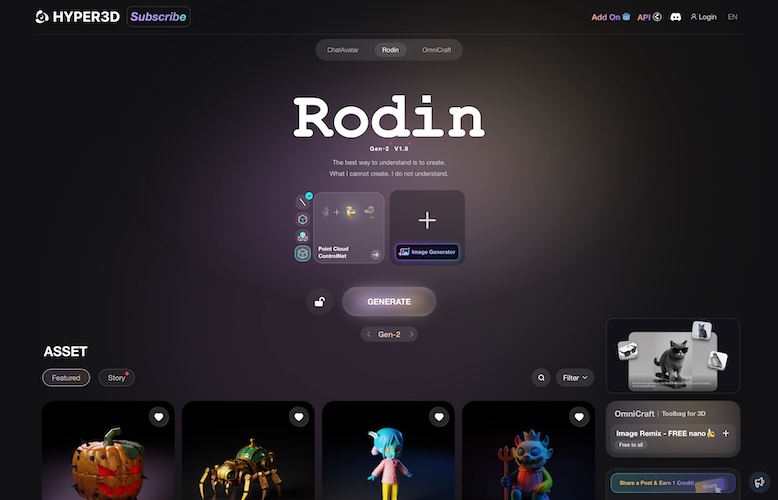
Generate unlimited models for free. Preview, rotate, inspect. Only pay when you download a model you are satisfied with. This eliminates the credit anxiety that plagues competitors. API pricing starts at $0.30-0.40 per generation via WaveSpeedAI or fal.ai, with subscription plans starting at $30/month.
Pricing: The Real Math
| Plan | Price | Key Features |
|---|---|---|
| Free | $0 | Unlimited generation, 10 private assets, public gallery, pay only to download |
| Education | $15/mo | Creator benefits at education pricing, requires verification |
| Creator | $30/mo | ~60 models, multi-image to 3D, HD textures, 20 geometry redos, 6 material redos |
| Business | $120/mo | ~416 models, API access, 4K textures, 50 geometry redos, 15 material redos |
| Enterprise | Custom | Custom deployment, team controls, private on-premise, custom LoRA |
Per-model costs at different scales:
| Method | Cost per Model | Best For |
|---|---|---|
| API (WaveSpeedAI) | $0.30 | High-volume automation |
| API (fal.ai) | $0.40 | Integration with existing pipelines |
| Creator Plan | ~$0.50 | Indie developers, small teams |
| Business Plan | ~$0.29 | Studios, API workflows |
| Direct Credits | $1.50 | Occasional use, no commitment |
| HighPack Add-on | 3x base cost | 4K textures, high-poly models |
💡 Compare to competitors: Meshy AI charges ~$0.40 per textured model on Pro plan. Tripo AI charges ~$0.20 per model on Turbo. Sloyd AI charges effectively $0.015 per model on unlimited plan. Rodin's per-model cost is higher, but the quality gap is measurable — in CyberFox's benchmark, Rodin's sci-fi helmet had crisp panel lines where competitors blurred them, and the sneaker was the closest match to reference of any tool tested.
 Try Hyper3D Rodin Free →
Pros & Cons
✓ What Users Love
- ✅ #1 ranked in independent benchmark (8.5-9.5/10)
- ✅ Production-ready geometry with clean quad topology
- ✅ 3D-native PBR textures — no seams or artifacts
- ✅ Multi-image fusion for accurate reconstruction
- ✅ Free unlimited generation — pay only to download
- ✅ 4-second generation speed
- ✅ Native plugins for Blender, Unity, Unreal
- ✅ T/A-pose enforcement for rigging-ready characters
✗ What Users Hate
- ❌ Premium pricing vs. free alternatives
- ❌ Struggles with complex organic shapes (fingers, intricate details)
- ❌ Subscription management UI needs improvement
- ❌ Speedy mode produces results needing review
- ❌ No auto-rigging (still "coming soon")
- ❌ 2-5 minute generation on highest quality settings
- ❌ Education plan requires verification
- ❌ Direct credits expensive at $1.50 each
💡 Real User Pulse: Verified Reviews
Rodin vs Meshy vs Tripo vs Sloyd
| Feature | Rodin | Meshy AI | Tripo AI | Sloyd AI |
|---|---|---|---|---|
| Benchmark Rank | #1 (8.5-9.5/10) | #2 | #3 | N/A (parametric) |
| Per-Model Cost | $0.30-0.50 | ~$0.40 | ~$0.20 | ~$0.015 (unlimited) |
| Generation Time | ~4 sec | ~60 sec (8 previews) | ~100 sec (v3.0) | ~5-60 sec |
| PBR Textures | 3D-native, no seams | 2D projection | Base only | Limited |
| Topology | Clean quads, proper UVs | Needs cleanup | Clean quads | Game-ready built-in |
| Auto-Rigging | ❌ Coming soon | ✅ Yes | ✅ Yes | ❌ No |
| Multi-Image Input | ✅ Up to 5 images | ⚠️ Limited | ⚠️ Limited | ❌ No |
| Free Generation | ✅ Unlimited | ❌ Credits only | ❌ Credits only | ❌ Limited |
When to choose each:
Pick Rodin if you need final hero assets with production-ready quality. The 3D-native PBR textures, clean quad topology, and multi-image fusion make it the best choice for assets that drop directly into game engines or film pipelines without cleanup. The "generate free, pay to download" model means you can iterate endlessly without budget anxiety. The tradeoff: higher per-model cost and no auto-rigging yet.
Pick Meshy AI if you iterate constantly inside Blender or Unity and need auto-rigging. Eight preview generations in ~60 seconds let you explore variations fast. The 500+ game-ready animations and established plugins make it ideal for rapid prototyping. For final hero assets, most Meshy users still finish in Rodin.
Pick Tripo AI if you are a game developer on a budget. At ~$0.20 per model on Turbo, it is the cheapest path to game-ready output with clean topology and auto-rigging. Stylized options (LEGO, voxel, cartoon) are a bonus. The 200 credits/month cap feels tight for active development, but the value per credit is high.
Pick Sloyd AI if you need unlimited environment props, weapons, and architectural elements at scale. The parametric approach produces guaranteed game-ready topology with predictable costs, but you are limited to template variations — you cannot generate "anything" like you can with Rodin or Meshy.
Who Should Use Hyper3D Rodin?
✅ Ideal For: Game developers and animators who need production-ready hero assets without cleanup. If you are building an indie game and need a sci-fi helmet with crisp panel lines, a medieval sword with clean engravings, or a photorealistic sneaker that matches your reference exactly — Rodin is the only tool that delivers out of the box. Film and TV pipelines benefit from the 18K/50K quad mesh options and T/A-pose enforcement for downstream rigging. E-commerce brands converting product photography to interactive 3D models are an emerging use case where Rodin outperforms purpose-built tools. The free generation model means you can experiment with zero risk; the pay-to-download model means you only pay for assets you actually use.
❌ Look Elsewhere If: You are a hobbyist on a tight budget. Sloyd AI at $15/month for unlimited generation is 4x cheaper per asset at scale. If you need auto-rigging today, Meshy AI and Tripo AI both offer it while Rodin lists it as "coming soon." If you iterate constantly and need eight previews in 60 seconds, Meshy's speed wins. If you need stylized output (LEGO, voxel, cartoon), Tripo's options are unmatched. And if you only need simple environment props and do not care about texture quality, Sloyd's parametric approach is faster and cheaper. Rodin is a premium tool for premium use cases — using it for basic tasks is like hiring a Formula 1 driver to deliver pizza.
Expert Editorial Opinion
The 3D-Native Advantage Is Real. Rodin's Gen-2.5 texture generation is not a marketing gimmick — it is a genuine technical breakthrough. Most AI 3D tools (including Meshy and Tripo) use a 2D workaround: generate multi-view renders, then project them onto the mesh. This causes seams, blurred backsides, and inconsistent details in unseen areas. Rodin generates colors and materials directly on the 3D surface. The result is visible in side-by-side comparisons: Rodin's textures hold up under rotation where competitors show tearing. For production assets that need to look correct from every angle, this is not a nice-to-have — it is a requirement.
Is the Premium Pricing Justified? At $0.30-0.50 per model, Rodin is 2-3x more expensive than Tripo and 20x more expensive than Sloyd at scale. But the benchmark data supports the premium. In CyberFox's independent test, Rodin scored 8.5-9.5/10 while Meshy (the #2) scored significantly lower. The sci-fi helmet had crisp panel lines. The sword had clean engravings most tools blurred. The sneaker was the closest match to reference. For a studio building a game with 50 hero assets, the difference between Rodin and Meshy is not $200 vs $400 — it is 50 assets that need zero cleanup vs 50 assets that need 2-3 hours each. At $100-150/hour for 3D artist time, Rodin pays for itself on the first project.
The E-Commerce Wildcard. Rodin was never built for e-commerce, yet it is quietly becoming the best tool for converting product photography into interactive 3D models. Furniture brands, jewelry retailers, and fashion houses are piloting workflows where a single product image becomes a fully rotatable 3D asset — or even an AR placement. This eliminates expensive 3D photography studios and compresses weeks of production into minutes. The question this raises is bigger than Rodin: in an era where general-purpose AI outpaces specialized software, are vertical-specific 3D tools already obsolete before they mature?
The Missing Auto-Rigging. Rodin's biggest gap is auto-rigging — listed as "coming soon" since Gen-2 launched. For character artists, this is a significant limitation. Meshy and Tripo both offer auto-rigging today, meaning a character generated in those platforms can be animated immediately. A character generated in Rodin needs manual rigging or external tools. Deemos Technologies has promised this feature repeatedly, but until it ships, character workflows are split: generate in Rodin for quality, then rig in Blender or retarget in Mixamo. The extra step costs time that some teams cannot afford.
The Verdict on "Generate Free, Pay to Download." This pricing model is Rodin's most user-friendly feature and its most underappreciated competitive advantage. Competitors force you to burn credits on every generation, including the ones you discard. Rodin lets you generate 20 variations, inspect each, and pay only for the one you keep. For iterative creative work, this is transformative. A concept artist exploring 50 helmet designs pays nothing for the 49 rejects. A product photographer testing 10 angles pays only for the best one. The model aligns incentives correctly: Rodin wins when you win, not when you waste credits.
Final Verdict
Hyper3D Rodin is the best AI 3D generator on the market in 2026 — and the most expensive worth buying. The 10-billion-parameter Gen-2 engine, 3D-native PBR textures, and production-ready topology deliver measurable quality advantages that justify the premium pricing for professional workflows. Independent benchmarks confirm what users report: Rodin generates assets you can drop into a game engine, film pipeline, or e-commerce platform without cleanup.
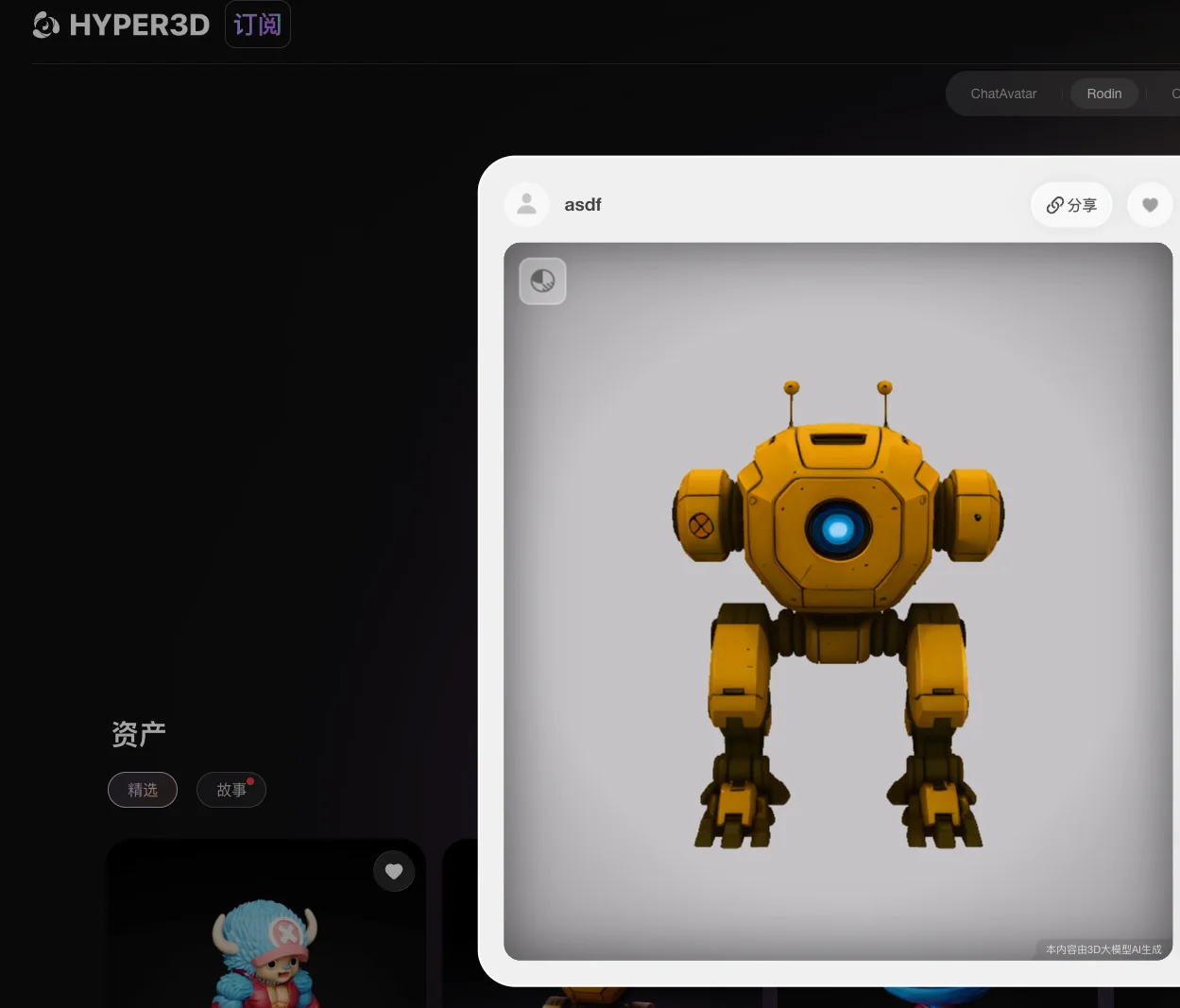
The "generate free, pay to download" model eliminates the credit anxiety that plagues competitors, making Rodin genuinely risk-free to experiment with. The multi-image fusion, T/A-pose enforcement, and format flexibility cover every major production use case. The only significant gaps are auto-rigging (still pending) and complex organic shapes (fingers, intricate details) where all AI 3D tools struggle.
Recommended for: Game developers, animators, film pipelines, and e-commerce brands needing production-ready 3D assets. Not recommended for: Hobbyists on tight budgets, teams needing auto-rigging today, or projects requiring only basic environment props where Sloyd's unlimited plan is 20x cheaper.
🔗 Related ToolRadar Reviews
More tools from AI 3D Generation
- Sloyd AI Review 2026: Unlimited 3D Models
- Text to Pokemon: 3D Cartoon Generation
- Spline Review 2026: 3D Design Tool
- Uizard Review 2026: AI Design Tool
- KiraArt: All-in-One AI Creative Suite
- Can a Non-Designer Build a Prototype?
- From Sketch to Photorealistic with AI
- Google Stitch: Napkin Sketch to App
❓ Frequently Asked Questions
Would you pay 20x more per model for production-ready quality out of the box?
For a hobbyist building a single scene, Sloyd's $15 unlimited plan is the obvious choice. For a studio shipping a game with 50 hero assets, Rodin's $0.30 per model pays for itself in the first day of artist time saved. The question is not whether Rodin is good — the benchmark proved that. The question is whether your project needs hero assets or just placeholders. Your answer determines whether Rodin is your next subscription or your next skip.
Test Rodin Free →
Comments
Post a Comment