


Trigger.dev Review: The Open-Source Background Jobs Platform That Actually Handles Long-Running AI Workflows
Backed by Y Combinator and Standard Capital with $20.3M in funding, Trigger.dev lets TypeScript developers write reliable background jobs and AI agent workflows in plain async code — no timeouts, no infrastructure to manage, no DSLs to learn.
Every TypeScript developer who's tried to run an AI workflow on AWS Lambda or Vercel Functions has hit the same wall: the 15-second timeout limit. You can't summarize a document, process a video, run a multi-step LLM chain, or orchestrate an AI agent in 15 seconds. So developers either over-provision long-running servers, bolt together fragile queue workarounds, or give up on the feature entirely. Trigger.dev was built to eliminate that wall.
Founded in London in 2022 by Matt Aitken (a two-time Apple App of the Year winner) and backed by Y Combinator and Standard Capital's inaugural fund — led by Dalton Caldwell, the longest-serving YC partner, and Paul Buchheit (creator of Gmail, inventor of "Don't Be Evil") — Trigger.dev has grown to serve over 30,000 developers running hundreds of millions of task runs per month. Its v4 release in 2025 completed the platform's evolution from background jobs framework to full AI agent runtime, adding Realtime streaming, human-in-the-loop waitpoints, and MicroVM-based infrastructure for faster cold starts. Updated June 2026.
What Is Trigger.dev?
Trigger.dev is an open-source platform for building and running background jobs, scheduled tasks, and AI agent workflows in TypeScript — without execution timeouts, without managing infrastructure, and without learning a new programming model. You write plain async TypeScript functions wrapped in a task() call, deploy via CLI, and Trigger.dev handles everything else: scheduling, automatic retries, priority queues, concurrency management, OpenTelemetry-based tracing, and real-time observability from a hosted dashboard. The platform runs your tasks inside containers that stay alive as long as your work requires — whether that's 30 seconds or 6 hours — solving the core limitation of serverless platforms for AI and data-heavy workloads. It supports self-hosting under Apache 2.0 or runs on their managed cloud infrastructure with a free tier.
Key Features
Zero Timeout Execution
Tasks run inside containers for as long as needed — 30 seconds or 6 hours — with no cold-start penalties. Directly solves the core failure of AWS Lambda and Vercel Functions for AI workloads. Checkpoint-resume execution means tasks survive infrastructure failures mid-run and pick up exactly where they left off.
Durable Retries & Queues
Built-in retry logic, idempotency keys, priority queues, and concurrency controls make your background tasks production-grade from day one. Checkpointing means tasks survive infrastructure failures mid-run. You define retry strategies in code, not configuration files.
Human-in-the-Loop Waitpoints
Programmatically pause any workflow mid-execution to wait for human approval, external webhook callbacks, or another task's completion — then resume exactly where it stopped. Essential for AI agent pipelines with review gates, compliance checkpoints, or multi-approval workflows.
Realtime Streaming API
Stream live task progress and LLM output directly to your frontend application. Turns background jobs into reactive, real-time experiences without polling or WebSocket complexity. Subscribe to a running task and see token-by-token LLM responses in the browser.
Python Build Extension
Call Python scripts from inside TypeScript tasks using the Python build extension — the platform handles installing Python and your dependencies during the build step. Run FFmpeg, ML models, or data processing scripts alongside your TypeScript orchestration layer.
Full Observability & Tracing
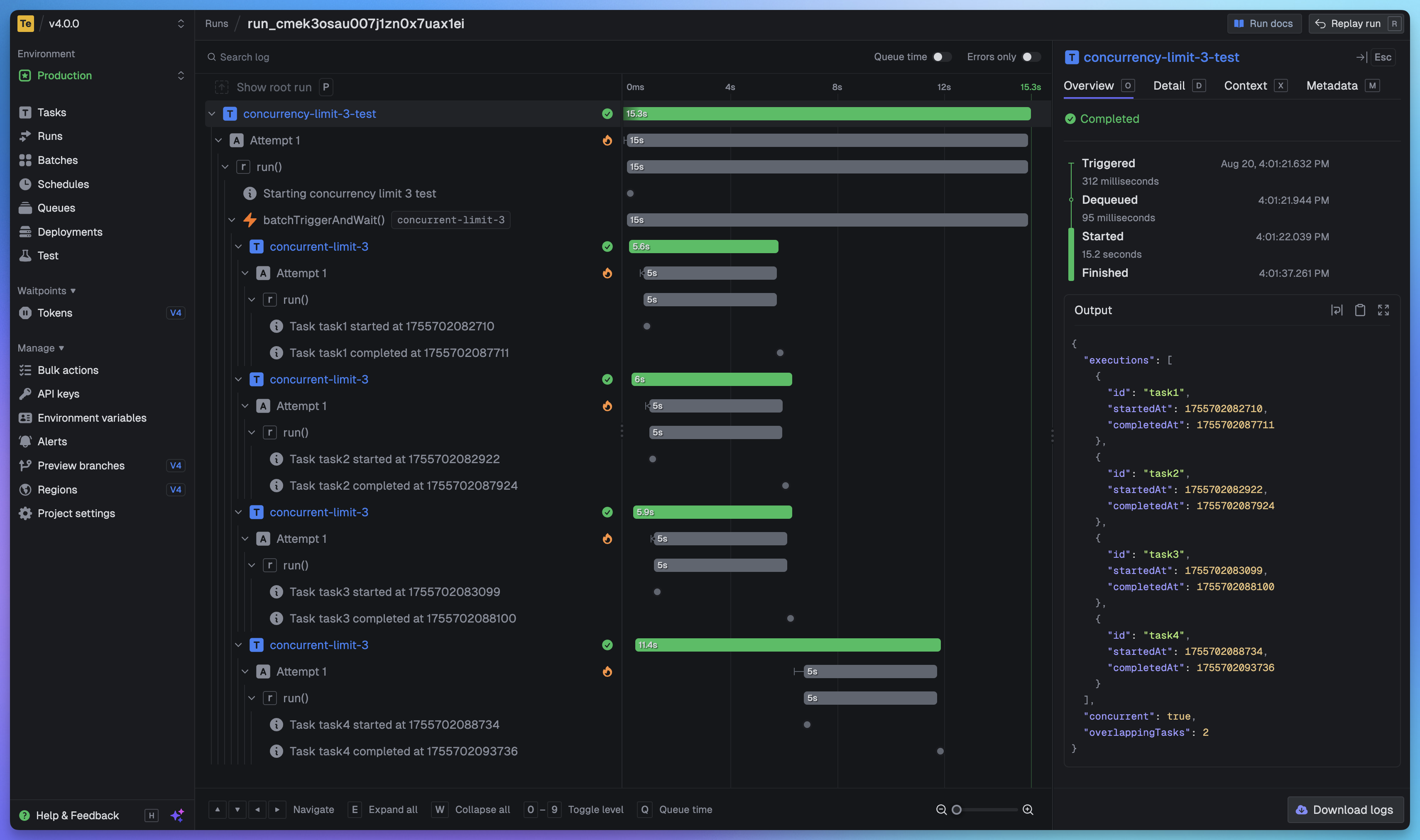
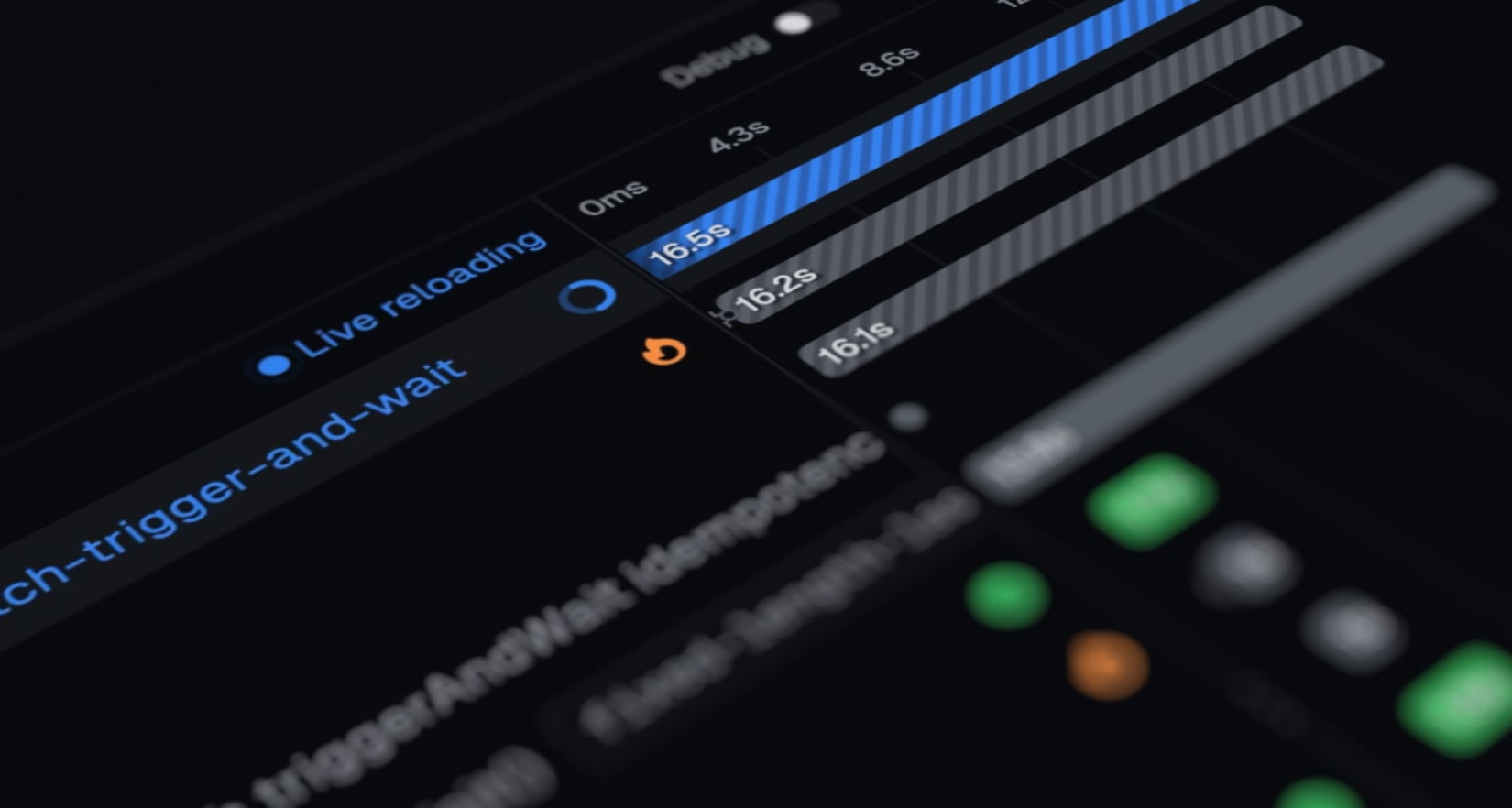
Every task run has full tracing and logs via OpenTelemetry. View exactly what happened at every step in a visual trace tree. Configure error alerts to catch bugs fast. The dashboard shows queue depth, concurrency usage, and compute consumption in real time.
Pricing Plans
| Plan | Price | Included | Best For |
|---|---|---|---|
| Free | $0/mo | $5 compute credit, 20 concurrent runs, unlimited tasks, community support | Prototypes, side projects, low-volume testing |
| Hobby | $10/mo | $10 compute credit, 50 concurrent runs, 7-day log retention | Side projects moving to production |
| Pro | $50/mo | $50 compute credit, 200 concurrent runs, 30-day logs, Slack support | Production teams with AI workloads |
| Enterprise | Custom pricing | SOC 2, SSO, RBAC, AWS PrivateLink, priority support, custom SLA | Large teams with compliance requirements |
Source: Trigger.dev official pricing page and Pangea.app analysis, June 2026. Compute billed per second by machine size — from $0.0000169/sec (Micro: 0.25 vCPU) to $0.00068/sec (Large 2x: 8 vCPU / 16 GB). Plus $0.000025 per invocation ($0.25 per 10K runs). Dev environment runs are never charged. Self-hosting is free under Apache 2.0. Add-on concurrency: $10/mo per 25 additional runs.
Start Building Free on Trigger.dev →Pros & Cons
✓ What Works
- ✅ Zero execution timeouts — tasks run for hours if needed, unlike Lambda or Vercel
- ✅ Free tier available — $5/month compute credit, no credit card required to start
- ✅ 100% open-source (Apache 2.0) — self-host on your own infrastructure for free
- ✅ Realtime streaming API — stream LLM output live to frontend without extra tooling
- ✅ Human-in-the-loop waitpoints — pause workflows for approval, resume exactly where they stopped
- ✅ Exceptional developer experience — plain TypeScript, no DSLs, no YAML, no special config
✗ What Doesn't
- ❌ TypeScript-only for core SDK — Python support is secondary (call Python scripts from TypeScript tasks)
- ❌ Free tier burns quickly on AI workloads — most production teams need the $50/mo Pro plan within weeks
- ❌ Queue starvation not auto-resolved — mixed-priority teams must configure concurrency carefully
- ❌ v3-to-v4 migrations temporarily double concurrency consumption against plan limits
- ❌ 7 employees total (per PitchBook) — small team supporting a rapidly growing platform
💡 Community Feedback: What Users Actually Say
How It Compares to Alternatives
| Feature | Trigger.dev | Inngest | Temporal | AWS Lambda |
|---|---|---|---|---|
| Starting Price | Free ($0) | Free ($0) | Self-hosted free | Free (pay per use) |
| Paid Plans From | $10/mo | $75/mo | Custom | Usage-based |
| Timeout Limit | None — runs forever | None | None | 15 min max |
| Open-Source | YES — Apache 2.0 | YES | YES — Apache 2.0 | NO |
| Human-in-the-Loop | Native (waitpoints) | Limited | Possible but complex | None |
| Realtime Streaming | YES — v4 API | NO | NO | NO |
| Best For | AI agents, TypeScript devs | Event-driven, real-time | Enterprise batch processing | Short tasks, serverless |
Trigger.dev occupies a unique position in the workflow orchestration landscape. Temporal is the enterprise battle-tested choice — created by Uber engineers, it handles mission-critical batch processing at massive scale but requires significant infrastructure expertise. Inngest is the event-driven specialist with strong real-time capabilities and a larger pre-built integration library, but at $75/month entry pricing it's significantly more expensive than Trigger.dev's $10/month Hobby tier. AWS Lambda is the default serverless choice for short tasks under 15 minutes, but hits the timeout wall that Trigger.dev was specifically built to eliminate. For TypeScript developers building AI products, Trigger.dev's combination of zero timeouts, native human-in-the-loop support, Realtime streaming, and developer-first pricing makes it the strongest starting point in 2026.
Who Should Use Trigger.dev?
Best For: TypeScript and full-stack developers building AI-powered SaaS products who need reliable long-running task execution — AI content pipelines, document processing, video/audio manipulation, large CSV jobs, multi-step LLM chains, and AI agent orchestration. Teams migrating off fragile self-hosted cron jobs, BullMQ setups, or over-provisioned servers who want a managed platform with full observability. GTM Engineers building complex, multi-system automations that break no-code tools at scale. Startups and side projects that want to start free and scale to production without rewriting infrastructure.
Consider Alternatives If: You're a Python-first team — Temporal or Celery may be a better native fit. You need a visual no-code workflow builder — n8n or Zapier are more accessible. You're running simple, short tasks under 15 seconds with no concurrency needs — standard serverless functions are cheaper and simpler. You need enterprise-grade batch processing at massive scale with dedicated infrastructure teams — Temporal is the battle-tested choice. You want the largest pre-built integration library — Inngest has more connectors out of the box.
Expert Editorial Opinion
Trigger.dev solves a real and growing problem as AI features become standard in SaaS products. The core insight is simple: AI workflows don't fit the serverless execution model. LLM chains, document summarization, multi-agent orchestration, and video processing all take longer than 15 seconds — often much longer. Trigger.dev's container-based execution model sidesteps this entirely, and the developer experience of writing plain async TypeScript (no DSLs, no YAML, no special configuration) is genuinely the lowest-friction path to reliable background jobs available today. The "Timeout Tax" — the hidden cost of fighting serverless limits instead of building features — is a real cost that most teams underestimate until they hit it.
The v4 release is significant. The Realtime API and Waitpoints transform Trigger.dev from an infrastructure tool into an AI product primitive. Streaming LLM responses directly to the browser from a background task, or pausing an agent mid-workflow for human review, are exactly the patterns that production AI products need — and that serverless platforms can't support. The MicroVM-based infrastructure upgrade also means faster cold starts, which was the one meaningful performance gap versus competitors. As of June 2026, the platform is executing hundreds of millions of agent runs per month and has passed 13,000+ GitHub stars — validating both the technical approach and the market demand.
The $16M Series A led by Standard Capital — the inaugural fund from Dalton Caldwell (YC's longest-serving partner) and Paul Buchheit (creator of Gmail, inventor of "Don't Be Evil") — is a serious signal. These are investors who have seen every phase of developer infrastructure and chose Trigger.dev. The seed round already included founders from Supabase, Raycast, Instabug, Dropbox, and PagerDuty — a who's who of developer tools. With 30,000+ developers already running hundreds of millions of tasks per month, the platform has proven it can handle production scale. The only caveat is team size: PitchBook reports only 7 total employees, which is remarkably lean for a platform supporting this volume — though the open-source community and YC network likely help compensate.
The pricing gap is where Trigger.dev genuinely wins. At $10/month for Hobby and $50/month for Pro, it's 6–7x cheaper than Inngest's entry point ($75/month) and infinitely more accessible than Temporal's enterprise pricing. The free tier with $5 compute credit and no credit card requirement removes all friction to start. For a solo developer or small team building AI features, the cost of Trigger.dev is negligible compared to the engineering time saved from not building queue infrastructure, retry logic, and observability from scratch. The compute billing model (per second by machine size) is transparent and predictable — you pay for what you use, not per execution.
Does it deserve a 9.2? The technology is genuinely differentiated — zero timeouts, checkpoint-resume, native human-in-the-loop, Realtime streaming, and plain TypeScript DX are a powerful combination that no competitor matches at this price point. The open-source Apache 2.0 license means you're never locked in. The investor pedigree is exceptional. The only real limitations are the TypeScript-only core (Python is secondary), the small team size, and the fact that free tier credits burn fast on AI workloads. For TypeScript developers building AI products, Trigger.dev is the background execution layer to build on in 2026. For everyone else, the free tier is a zero-risk way to see if the model fits your stack.
Final Verdict
Trigger.dev is the best open-source background jobs and AI workflow platform for TypeScript developers today. The zero-timeout execution model solves a real and painful infrastructure limitation, the developer experience is exceptional, the free tier makes it zero-risk to start, and the v4 Realtime API and Waitpoints unlock a class of AI agent patterns no other background jobs platform supports natively. At $10/month for production Hobby use and $50/month for Pro, the pricing is among the most competitive in developer infrastructure. The $20.3M total funding from Y Combinator and Standard Capital, the 30,000+ developer community, and the hundreds of millions of monthly task runs confirm this is a production-grade platform, not an experiment. For TypeScript teams building AI products, this is a 9.2 out of 10.
🔗 Related ToolRadar Reviews
More tools from AI Developer Tools
- Is Aider the Best Free AI Coding Assistant in 2026?
- Why Developers Are Switching From VS Code to Cursor in 2026
- v0.dev vs Bolt.new vs Cursor: Which AI Coding Tool Wins in 2026?
- Forget GitHub Copilot — Cursor 3 Just Changed Everything
- Can an AI Agent Really Browse the Web for You? The Browser Agent Showdown
- Build a Complete App From a Single Prompt — No Coding Required
- Zapier AI Review 2026: The Automation Tool That Thinks For You
- Gumloop: Build AI Workflows Without Writing a Single Line of Code
❓ Frequently Asked Questions
What would you build if your background jobs never timed out?
Trigger.dev turns that question from fantasy into infrastructure. The free tier is waiting — no credit card, no commitment, just plain TypeScript and a container that runs as long as your AI needs.

Comments
Post a Comment