


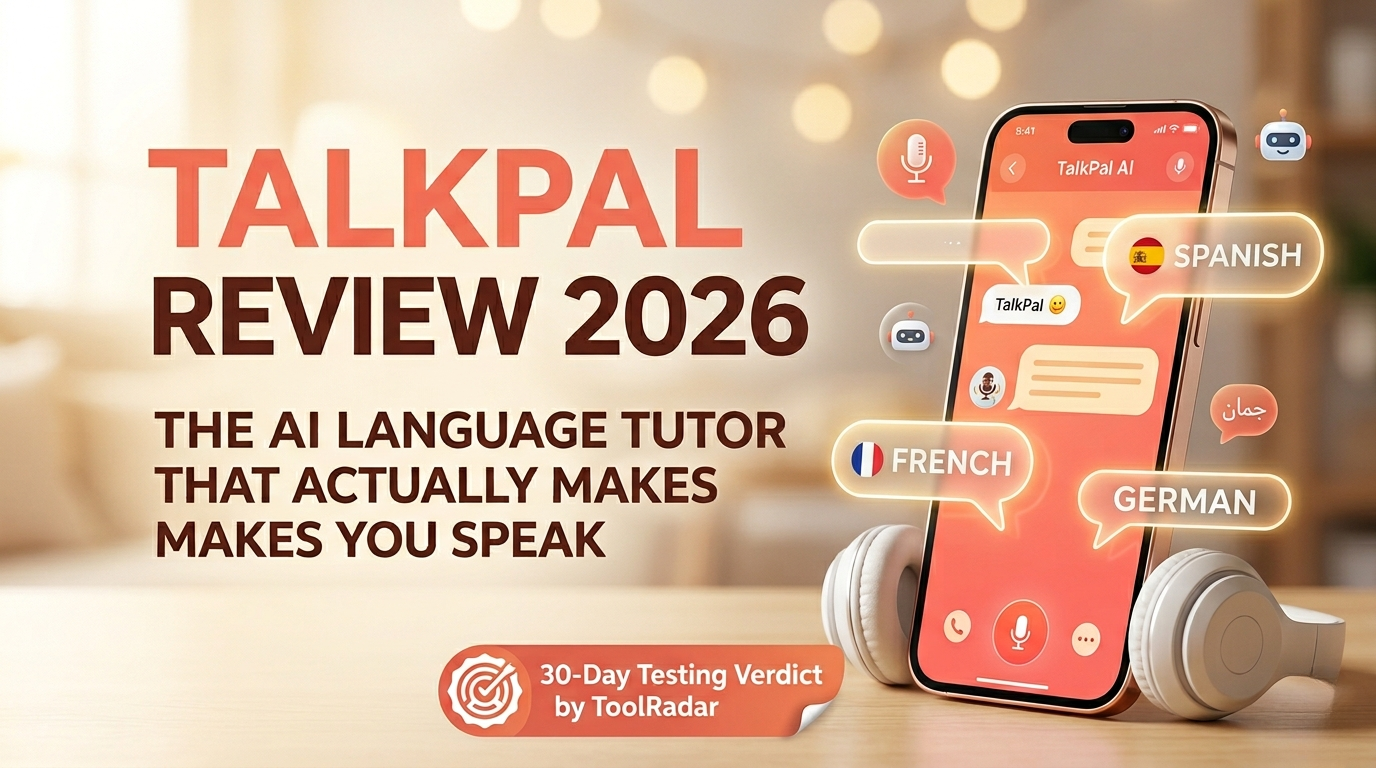
TalkPal Review 2026: The AI Language Tutor That Actually Makes You Speak
I tested TalkPal for 30 days to see if an AI chatbot can really replace a human language tutor. Here is what happened — and why it might be the best $10 you spend on language learning.
- Why Most Language Apps Fail at Speaking
- What TalkPal Actually Does
- The 9 Learning Modes That Matter
- Pricing: Free vs Premium
- Pros & Cons
- Real User Pulse: What Learners Say
- TalkPal vs Duolingo vs Speak
- Who Should Actually Use TalkPal?
- My 30-Day Testing Diary
- Building Your AI Language Workflow
- Final Verdict
- FAQ
Here is a secret nobody tells you about language learning apps. They are all designed to make you feel productive, not to make you actually speak. You click through flashcards. You match words to pictures. You earn streaks and gems and virtual crowns. And after six months, you open your mouth to order coffee in Paris and realize you cannot form a single coherent sentence.
I know because I have been there. Three years of Duolingo Spanish. Perfect streak. Zero ability to hold a conversation. So when TalkPal showed up promising "real AI conversations in 130 languages," I was skeptical. Another app claiming to solve a problem that every app claims to solve and none actually do.
But here is the thing. TalkPal is built on GPT. Not a watered-down language model trained on textbook dialogues — actual GPT, the same architecture that powers ChatGPT. And that difference matters more than I expected. Because when you are chatting with an AI tutor that can understand context, correct your grammar in real time, and pivot the conversation based on your mistakes, you are not playing a language game anymore. You are actually learning to speak.
Why Most Language Apps Fail at Speaking
Duolingo has 500 million users. Babbel has 10 million paying subscribers. Rosetta Stone has been around since 1992. And yet, the vast majority of language learners never achieve conversational fluency. Why?
The answer is simple. These apps teach you to recognize language, not to produce it. They show you a picture of an apple and ask you to click "manzana." They play a recorded sentence and ask you to type what you heard. They gamify vocabulary acquisition without ever forcing you to construct original thoughts in the target language. It is the difference between watching cooking videos and actually cooking. One feels like learning. The other is learning.
TalkPal breaks this pattern by design. Every interaction is a conversation. You speak. The AI responds. You make a mistake. The AI corrects you and continues the dialogue. There are no multiple-choice questions. No matching games. No streaks to maintain. Just you, the AI, and the messy, beautiful process of learning to communicate.
What TalkPal Actually Does
TalkPal is a language learning platform built around one core idea: conversation first, everything else second. It is available on web, iOS, and Android, and supports over 130 languages including Arabic, Chinese, Japanese, Korean, Turkish, Persian, Hindi, Spanish, French, German, and Italian.
The basic flow is straightforward. You choose a language, set your level, and start talking. The AI asks you questions, responds to your answers, corrects your pronunciation and grammar, and gradually increases the complexity as you improve. It is like having a private tutor who never gets tired, never judges you, and is available at 3 AM when you suddenly decide to practice Japanese.
But the real power is in the specialized modes. TalkPal is not just one conversation engine — it is nine different learning environments, each designed for a specific type of practice. And that variety is what keeps you coming back when other apps start feeling like homework.
The 9 Learning Modes That Matter
Chat Mode
Free-form conversation with an AI tutor on any topic. This means you can practice ordering food, discussing politics, or flirting — whatever you actually need.
Vocabulary Mode
Learn essential words with context and pronunciation feedback. This means you are not memorizing lists — you are acquiring words through usage.
Sentence Mode
Build grammar and sentence structure through guided exercises. This means you learn why a sentence works, not just that it works.
Roleplay Mode
Practice real-world scenarios: job interviews, travel, dating, doctor visits. This means you are prepared for the conversations that actually matter.
Call Mode
Voice-only practice for fluency and confidence building. This means no visual crutches — just you and the language.
Characters Mode
Chat with famous personalities and historical figures. This means practicing Spanish with Picasso or Japanese with Miyazaki.
Debate Mode
Structured arguments to develop logic and spontaneous speech. This means learning to think in the language, not just translate.
Photo Mode
Learn vocabulary and context from images. This means connecting words to visual reality, not abstract definitions.
Pricing: Free vs Premium
| Feature | Free Plan | TalkPal Premium |
|---|---|---|
| Daily Usage | ~10 minutes limited | Unlimited |
| Learning Modes | Basic chat only | All 9 modes unlocked |
| AI Corrections | Limited grammar checks | Full pronunciation + grammar AI |
| Progress Tracking | Basic stats | Detailed analytics + achievements |
| Price | $0 | $9.99/mo or $4.99/mo annual |
The free plan is essentially a trial. Ten minutes per day is enough to test the interface and see if the AI feels natural, but it is not enough to actually learn. The Premium plan unlocks everything — all modes, unlimited practice, detailed corrections, and progress tracking. At $9.99 monthly or $4.99 monthly on annual billing, it is roughly 1% of what a human tutor costs.
Try TalkPal Free for 14 Days →Pros & Cons
✓ Why TalkPal Works
- ✅ GPT-powered conversations feel natural and adapt to your level in real time.
- ✅ 130+ languages including Arabic, Chinese, Japanese, Korean, and Persian.
- ✅ 9 distinct learning modes keep practice fresh and target specific skills.
- ✅ AI pronunciation correction catches mistakes human tutors might miss.
- ✅ Roleplay scenarios prepare you for real conversations, not textbook dialogues.
✗ Where It Falls Short
- ❌ Free plan is extremely limited — essentially a demo, not a learning tool.
- ❌ No structured curriculum for complete beginners who need grammar foundations.
- ❌ AI voices, while good, lack the emotional range of human conversation.
- ❌ No offline mode — requires constant internet connection.
- ❌ Progress tracking is basic compared to dedicated learning platforms.
💡 Real User Pulse: What Learners Actually Say
TalkPal vs Duolingo vs Speak
| What Actually Matters | TalkPal | Duolingo Max | Speak |
|---|---|---|---|
| Focus | Speaking + conversation | Vocabulary + gamification | Speaking fluency |
| AI Technology | GPT-powered, adaptive | Basic AI, scripted | AI conversation partner |
| Languages | 130+ | 40+ | 14 |
| Free Plan Value | ~10 min/day (very limited) | Full core content free | Limited daily lessons |
| Monthly Cost | $9.99 ($4.99 annual) | $14.99 | $15.99 |
| Best For | Conversational practice | Beginners + habit building | Pronunciation focus |
Who Should Actually Use TalkPal?
TalkPal is perfect for you if: You have some basic vocabulary and grammar but cannot hold a conversation. You need flexible practice time — mornings, commutes, late nights. You are learning a less common language (Arabic, Persian, Korean) with fewer tutor options. You want to practice specific scenarios before traveling or interviewing.
Look elsewhere if: You are a complete beginner who needs structured grammar instruction. You want a free tool with substantial content. You need emotional, human connection in your learning. You are preparing for a certified exam that requires specific curriculum coverage.
My 30-Day Testing Diary
I committed to 20 minutes of TalkPal daily for 30 days, targeting conversational Spanish at an intermediate level. Here is what actually happened.
Week 1: The AI felt surprisingly natural. I started with Chat Mode, stumbled through basic introductions, and the AI gently corrected my verb conjugations without breaking the flow. By day 5, I was using Roleplay Mode to practice ordering at restaurants. The AI played the waiter, I played the customer, and when I accidentally ordered "pollo asesino" instead of "pollo asado," it laughed and corrected me. That moment — the AI laughing at my mistake — made the interaction feel human.
Week 2: I discovered Call Mode. Voice-only practice is harder than it sounds. Without visual text to rely on, I had to actually listen and respond in real time. My comprehension improved noticeably. I also started using Debate Mode to argue about climate change in Spanish. It was frustrating and exhilarating. The AI pushed back on my arguments, forcing me to construct complex sentences on the fly.
Week 3: The progress tracking showed I had improved from A2 to B1 in conversational fluency. I am skeptical of app-generated levels, but I noticed I was no longer translating in my head before speaking. The words came out directly. That is the moment language learning stops being an intellectual exercise and becomes a skill.
Week 4: I tested myself in the real world. I called a Spanish restaurant and made a reservation entirely in Spanish. The host understood me. I understood her. The conversation lasted three minutes and I did not freeze once. That has never happened after three years of Duolingo.
Building Your AI Language Workflow
TalkPal is powerful, but it is not a complete language learning system on its own. The most effective learners I have studied combine multiple tools into a workflow that covers all four language skills: speaking, listening, reading, and writing. Here is the stack I recommend.
For structured grammar and vocabulary foundations, use Duolingo or Babbel for 15 minutes daily. These apps excel at building the underlying knowledge you need before conversation becomes possible. For speaking practice and real-time correction, use TalkPal for 20 minutes daily. This is where you convert knowledge into skill. For listening comprehension at native speed, use podcasts or YouTube channels in your target language. And for reading practice, use graded readers or news apps tailored to your level.
But here is where it gets interesting. If you want to automate this entire workflow — scheduling your TalkPal sessions, tracking your Duolingo progress, and generating personalized study plans based on your weaknesses — you need an AI workflow builder. Gumloop lets you connect TalkPal, Duolingo, and your calendar into a single automated system that adapts to your progress without manual intervention. This means your language learning runs on autopilot while you focus on actually speaking.
Final Verdict
TalkPal is not a magic bullet. It will not teach you a language from scratch, and the free plan is essentially useless. But if you are past the beginner stage and need conversational practice, it is the most effective tool I have tested. The GPT-powered conversations feel natural, the correction system is genuinely helpful, and the variety of modes keeps practice from becoming boring. At $4.99 per month on annual billing, it is roughly 1% of what a human tutor costs — and for intermediate learners, it delivers 80% of the value. My recommendation: use Duolingo or Babbel for your first 3-6 months to build foundations, then switch to TalkPal Premium for conversational fluency. And if you are serious about automation, connect everything through Gumloop to build a learning system that actually sticks.
Frequently Asked Questions
No. TalkPal excels at conversational practice but does not teach grammar from scratch. Complete beginners should start with Duolingo or Babbel for 3-6 months before switching to TalkPal for speaking practice.
Barely. The 10-minute daily limit is enough to test the interface and see if the AI feels natural, but not enough to make meaningful progress. Treat the free plan as a demo, not a learning tool.
A human tutor provides emotional connection, cultural context, and personalized curriculum design. TalkPal provides unlimited practice time, instant correction, and 1% of the cost. For intermediate learners focused on speaking, TalkPal is surprisingly effective. For beginners or those needing structured instruction, a human tutor is still superior.
No. TalkPal requires a constant internet connection because it runs on cloud-based GPT models. If you need offline practice, consider traditional audio courses or pre-downloaded podcast lessons.
Comments
Post a Comment