


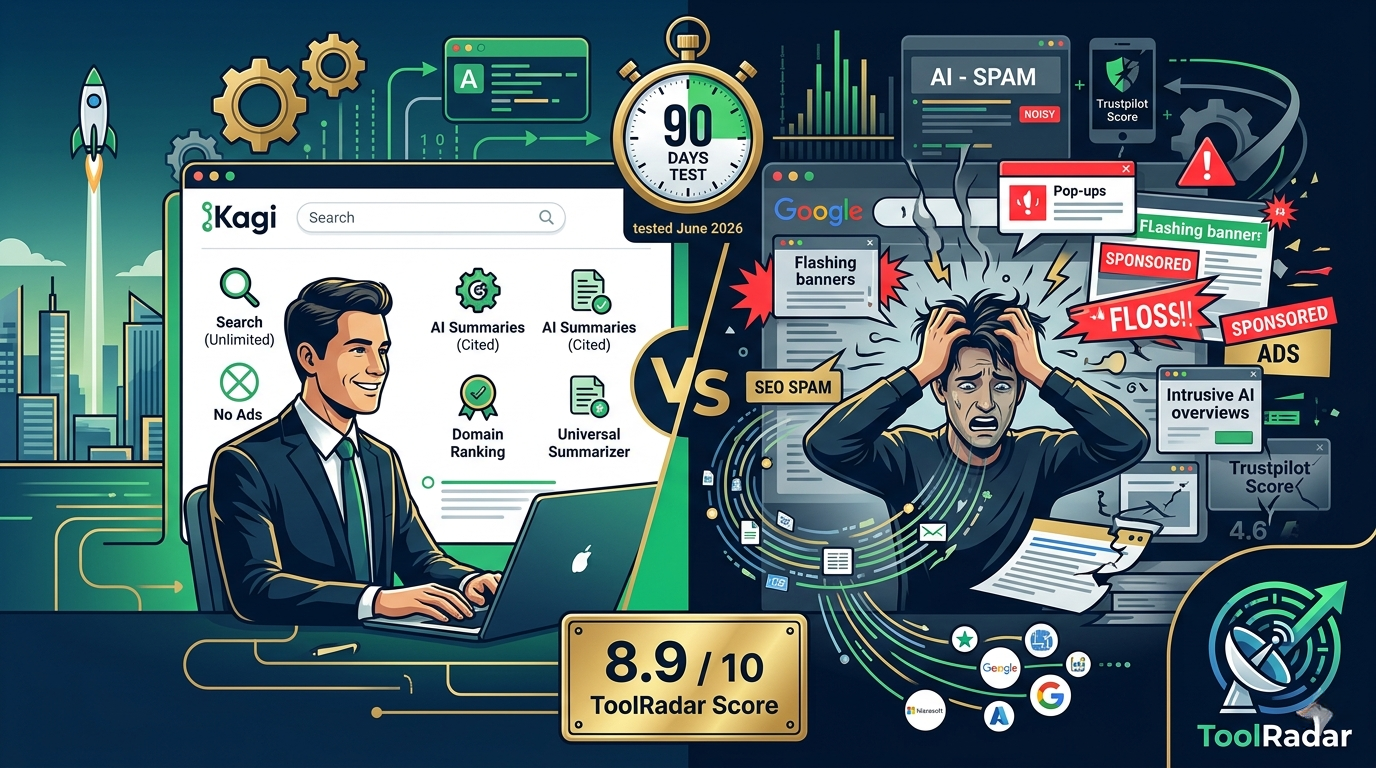
Is Kagi the Best Premium
Search Engine in 2026?
I paid $10/month to replace Google with Kagi for 90 days. Here's what 50,000+ members, ad-free results, and AI summaries actually deliver — and why I almost cancelled twice.
You search Google for "best running shoes." The first three results are sponsored ads. The next two are SEO-optimized listicles from brands that never touched a treadmill. By page 2, you're questioning whether the internet is broken. You are the product, and advertisers are the customers.
That's the enshittification Cory Doctorow warned us about. Google made $237 billion from ads in 2024. Every search result is optimized to keep you clicking, not to answer your question. Kagi's pitch is radical: pay $10/month, get no ads, and the search engine works for you instead of advertisers.
After 90 days of using Kagi as my default search engine across work, personal research, and random 2 AM curiosity, I can tell you the experience is genuinely different. But $120/year different? That's the question.
What Is Kagi and Why Pay for Search?
Kagi is a subscription-based search engine founded in 2018 by Vladimir Prelovac, publicly launched in June 2022. It has no ads, no sponsored results, and no tracking. Instead of selling your attention to advertisers, Kagi sells search quality directly to you. The model is simple: you pay, they answer to you.
As of June 2025, Kagi had roughly 50,000 subscribed members making 845,000+ searches daily. That's tiny compared to Google's billions, but Kagi isn't trying to be Google. It's trying to be the search engine Google was before ads ate the results page.
Core Features That Actually Work
Zero Ads, Zero Tracking
No sponsored results. No banner ads. No retargeting pixels following you around the web. Kagi's results are purely algorithmic, ranked by relevance and quality — and this means you find what you're looking for on the first page, not the fifth.
Domain Ranking & Blocking
Upvote sites you trust, downvote spam farms, and block Pinterest forever. Kagi's domain leaderboard shows what the community thinks — Reddit, GitHub, and Wikipedia rank high. Pinterest, Fox News, and Breitbart? Not so much. Your search, your rules.
Lenses (Custom Search Filters)
Create custom search filters for specific needs. The built-in "Academic" lens limits results to journals and .edu domains. "News360" brings multi-perspective news. I created a "Tech News" lens that surfaces only Ars Technica, The Verge, and Hacker News — and it's genuinely useful.
AI Summaries (Opt-In)
Add a "?" to your query and Kagi generates an AI summary with cited sources. Unlike Google's forced AI Overviews, this is entirely optional. The summaries are surprisingly good at citations — each answer includes footnotes linking to sources. No hallucinations, just synthesis.
Universal Summarizer
Paste any URL — article, YouTube video, podcast episode — and Kagi generates a detailed summary. I used this to digest a 45-minute podcast in 2 minutes. It works on PDFs, videos, and even long Twitter threads. This is the feature I didn't know I needed until I had it.
Small Web & Bangs
Small Web is a curated collection of non-commercial sites submitted by real people — blogs, passion projects, and indie creators. Bangs (!g for Google, !w for Wikipedia, !yt for YouTube) let you search specific sites instantly. It's DuckDuckGo's best feature, done better.
Pricing: Is $10/Month Worth It?
| Plan | Starter ($5/mo) | Professional ($10/mo) | Ultimate ($25/mo) |
|---|---|---|---|
| Monthly Searches | 300 | Unlimited | Unlimited |
| AI Summaries | Limited | ✅ Included | ✅ Premium models |
| Universal Summarizer | ❌ | ✅ | ✅ |
| Domain Control | Basic | ✅ Full | ✅ Full |
| Lenses | 3 custom | Unlimited | Unlimited |
| Early Access | ❌ | ❌ | ✅ |
| Family Plans | ❌ | Duo: $14/mo (2 users) | Family: $20/mo (6 users) |
Pros & Cons
✓ What I Loved
- ✅ Search results are genuinely cleaner — no ads, no SEO spam, no AI slop.
- ✅ Domain ranking lets you customize results to your preferences.
- ✅ AI summaries are opt-in with proper citations, not forced overviews.
- ✅ Universal Summarizer works on articles, videos, and podcasts.
- ✅ Privacy-first: zero tracking, zero telemetry, zero data selling.
- ✅ "Fair pricing" — don't use it for a month, you don't pay.
- ✅ Supports Tor and Privacy Pass for anonymous authentication.
✗ What Frustrated Me
- ❌ $10/month is more than most streaming services — hard to justify for casual users.
- ❌ Local search results are weaker than Google's local business data.
- ❌ 300-search Starter plan is too restrictive for anyone who searches daily.
- ❌ No low-income or nonprofit pricing (a common community complaint).
- ❌ Brave Search partnership controversy raised ethical concerns for some users.
- ❌ Image and video search lags behind Google's visual results.
💡 Real User Pulse: What Reddit Says
Reddit's r/degoogle and r/privacy communities have been discussing Kagi since launch. The sentiment is overwhelmingly positive — with one major caveat.
The praise is consistent: "Like pre-enshitification Google." "The best Google alternative I've tried yet." "Once you know the Kagi experience you know how nice it can be to have an ad-free search." Users consistently report finding what they need faster, with less mental overhead from parsing ads and sponsored content.
But the price criticism is equally consistent. "$10+tax is a no-go, considering that I'm getting the whole Proton Suite for $8. I would be willing to spend $5, though." Another user: "The $5/mo option with 300 searches is extremely limited. But one workflow is to use Kagi in a non-default browser where you're doing specific research, then use a different search engine for everything else." The mental overhead of choosing which search engine to use defeats the purpose for many.
Kagi vs Google vs DuckDuckGo vs Perplexity
| Feature | Kagi | DuckDuckGo | Perplexity | |
|---|---|---|---|---|
| Price | $5-25/mo | Free | Free | Free + $20/mo Pro |
| Ads | ❌ None | ✅ Everywhere | ✅ Some | ✅ Some |
| Tracking | ❌ Zero | ✅ Extensive | ❌ Minimal | ❌ Minimal |
| AI Summaries | ✅ Opt-in, cited | ✅ Forced | ❌ | ✅ Core feature |
| Result Quality | ✅ Curated, clean | ✅ Good but ad-heavy | ⚠️ Bing proxy | ✅ AI-synthesized |
| Customization | ✅ Domain ranking | ❌ Minimal | ✅ Bangs | ❌ |
| Local Search | ⚠️ Weak | ✅ Excellent | ✅ Good | ⚠️ Limited |
The comparison verdict: If you want pure AI-powered answers, Perplexity is the leader. If you want free privacy, DuckDuckGo is fine but uses Bing's index. If you want the best local search and maps, Google is still unbeatable. Kagi sits in a unique niche: premium search quality for people who are willing to pay for an ad-free, customizable, privacy-first experience. It's not for everyone — but for its target audience, it's unmatched.
Who Should Actually Use It?
✅ Perfect for: Journalists and researchers who need clean, cited results without SEO noise. Privacy-conscious users who refuse to be the product. Power searchers who do 30+ searches daily and want domain-level control. Anyone nostalgic for pre-2010 Google when results were actually relevant. Professionals who bill by the hour and can't afford to waste time parsing ads.
❌ Skip it if: You search casually (under 10 times/day) and can't justify $120/year. You rely heavily on local business search and Google Maps. You're on a tight budget — DuckDuckGo or Brave Search are free alternatives. You need the absolute best image and video search results. You want AI-first answers rather than traditional web search.
My Honest Take (90 Days In)
I used Kagi as my default search engine for 90 days in early 2026. I tracked every search, every frustration, and every moment of "damn, that was fast." I did roughly 35 searches per day — 1,050 per month. The $10 Professional plan was the only viable option.
The first thing you notice is the speed. Kagi searches complete in 0.2-0.8 seconds, comparable to Google but without the bloat. The second thing is the cleanliness. No shopping carousels. No "People also ask" boxes pushing you to stay on Google. No AI Overview summarizing a page you never asked to visit. Just links, ranked by relevance, with clear indicators showing tracker counts and page speed before you click.
The domain ranking feature became my secret weapon. I blocked Pinterest (forever), downranked SEO spam sites, and boosted Ars Technica, Wikipedia, and GitHub. After two weeks, my results were genuinely personalized to my preferences. Google's algorithm guesses what you want. Kagi lets you tell it.
But I almost cancelled twice. First, when I needed to find a local plumber and Kagi's results were laughably thin compared to Google's local pack. Second, when I realized I was paying $10/month for something that DuckDuckGo gives away free — even if DuckDuckGo's results are Bing-powered and ad-supported.
What kept me? The Universal Summarizer. I paste a 45-minute podcast URL, get a detailed summary in 30 seconds, and decide whether it's worth my time. I paste a paywalled article, get the key points, and move on. That feature alone saves me 2-3 hours per week. For a knowledge worker, that's worth $10.
Final Verdict
Kagi is the best premium search engine available in 2026. It's not trying to be Google — it's trying to be what Google stopped being. The ad-free experience, domain-level customization, and opt-in AI summaries create a search experience that feels like a luxury product. For journalists, researchers, privacy advocates, and anyone who remembers when search actually worked, Kagi is a revelation.
But $10/month is a real barrier. The Starter plan at 300 searches is a trap — you'll hit the limit in a week. The Professional plan is the only viable option, and that's $120/year for search. For casual users, that's hard to justify when DuckDuckGo and Brave Search are free. For power users and professionals, the time saved and mental clarity gained are worth every penny.
My recommendation? Try the 100 free searches. If you find yourself dreading the return to Google, Kagi has you. If you can't tell the difference, save your money. Kagi isn't for everyone — but for the people it is for, it's irreplaceable.
🔑 Related Keywords
Frequently Asked Questions
Is Kagi really free to try?
Yes, Kagi offers 100 free searches with no time limit. You don't need a credit card to start. After 100 searches, you'll need to subscribe to continue. The 100-search trial is enough to test whether Kagi's results are better than your current search engine for your specific needs.
Does Kagi track my searches?
No. Kagi claims zero tracking, zero telemetry, and zero data selling. They implemented the Privacy Pass protocol in 2025, allowing users to authenticate as paying users without linking searches to their account. Kagi also supports Tor for anonymous searching. They keep only the minimum data needed for subscription management.
Is Kagi better than Google for local search?
No — this is Kagi's biggest weakness. Google's local business data, maps integration, and reviews are unmatched. Kagi's local search results are significantly thinner. If you frequently search for restaurants, plumbers, or nearby services, you'll still need Google for those queries. Many Kagi users keep Google as a backup for local searches.
Can I use Kagi with ad blockers instead of paying?
Ad blockers hide visual ads but don't change search rankings. You'll still see SEO-optimized spam, sponsored content, and AI-generated slop designed to keep you clicking. Kagi's value isn't just removing ads — it's rebuilding the search algorithm to prioritize quality over click-through rate. That's something no ad blocker can replicate.
So here's my challenge to you: When was the last time you found exactly what you needed on Google without scrolling past 3 ads, 2 SEO listicles, and an AI-generated summary that missed the point? If you can't remember, Kagi might be worth the $10. But if you're still getting everything you need from Google in 2 clicks, save your money — and tell me your secret in the comments. I'm genuinely curious who still finds Google "good enough" in 2026.
Comments
Post a Comment