


Opik Review 2026: The Open-Source LLM Observatory That Catches Hallucinations Before Your Users Do
Built by Comet ML — the NYC company behind $70M in funding and a decade of ML experiment tracking — Opik is the Apache 2.0 open-source platform for LLM observability, evaluation, and automated prompt optimization with 18,000+ GitHub stars.
Every developer who's shipped an LLM application to production has lived the same nightmare: everything works in your test environment, then a user asks a slightly different question and your AI hallucinates a fact, leaks sensitive data, or goes completely off-topic. You have no visibility into what happened, no trace of the model's reasoning chain, and no systematic way to catch it before the next user sees it. Traditional application monitoring tools — Datadog, New Relic, Sentry — are blind to LLM-specific behavior. They see HTTP requests and response times, but they don't see hallucinations, prompt injections, or RAG retrieval failures. Opik was built to solve exactly this gap.
Named after Ernst Öpik, the Estonian astronomer who spent his career finding objects hidden in the darkness of space, Opik is the open-source LLM observability and evaluation platform from Comet ML — a company founded in 2017 in New York City that has raised $70M and spent a decade building ML experiment tracking infrastructure for data science teams. Released under Apache 2.0, Opik brings that same rigorous experiment-tracking philosophy to LLM applications: trace every call, evaluate every output, and optimize continuously. In just over a year since launch, it has grown to 18,000+ GitHub stars and is now trusted by teams at Pattern, Replit, and across the Comet ML ecosystem for production LLM monitoring.
What Is Opik?
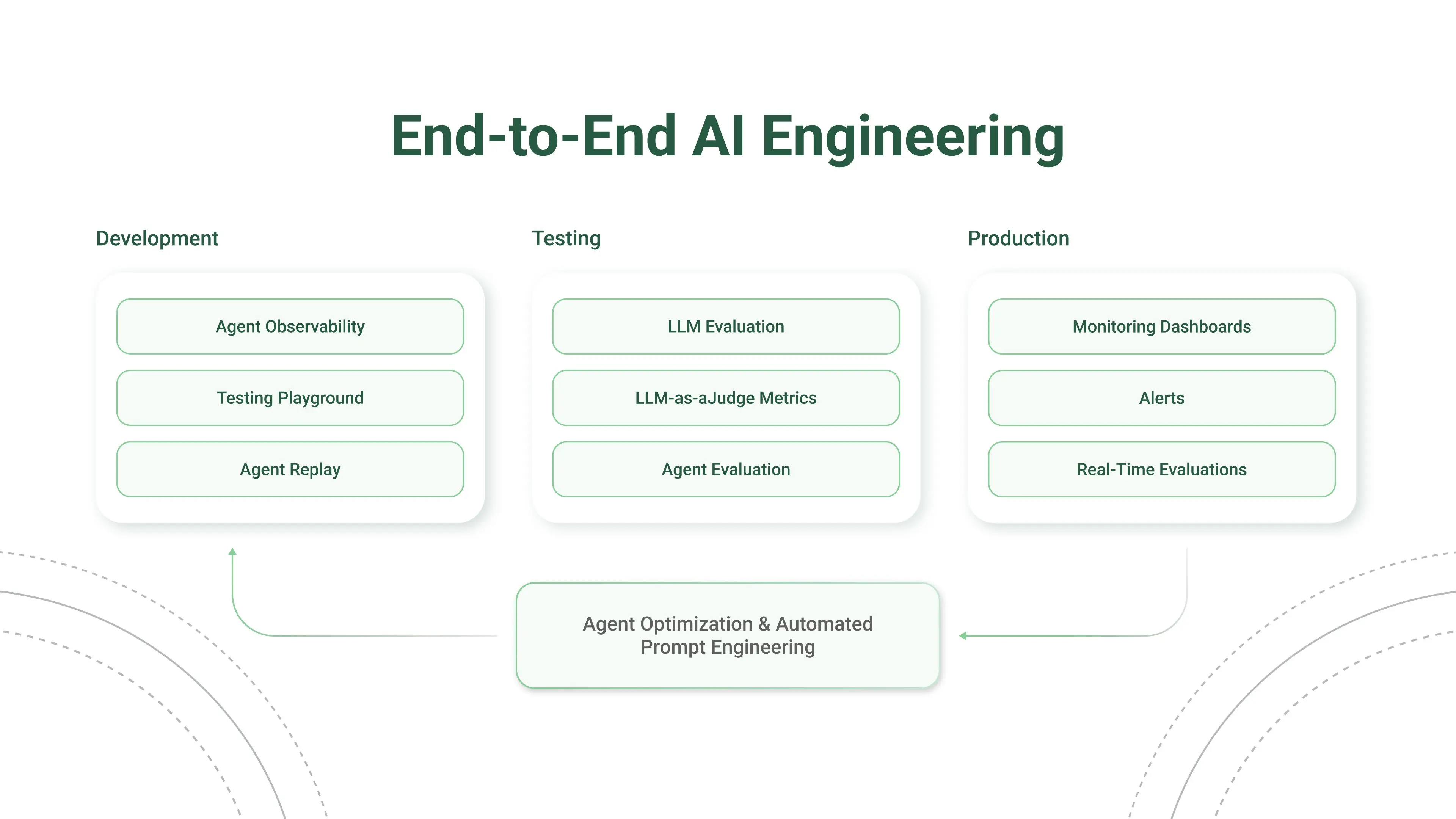
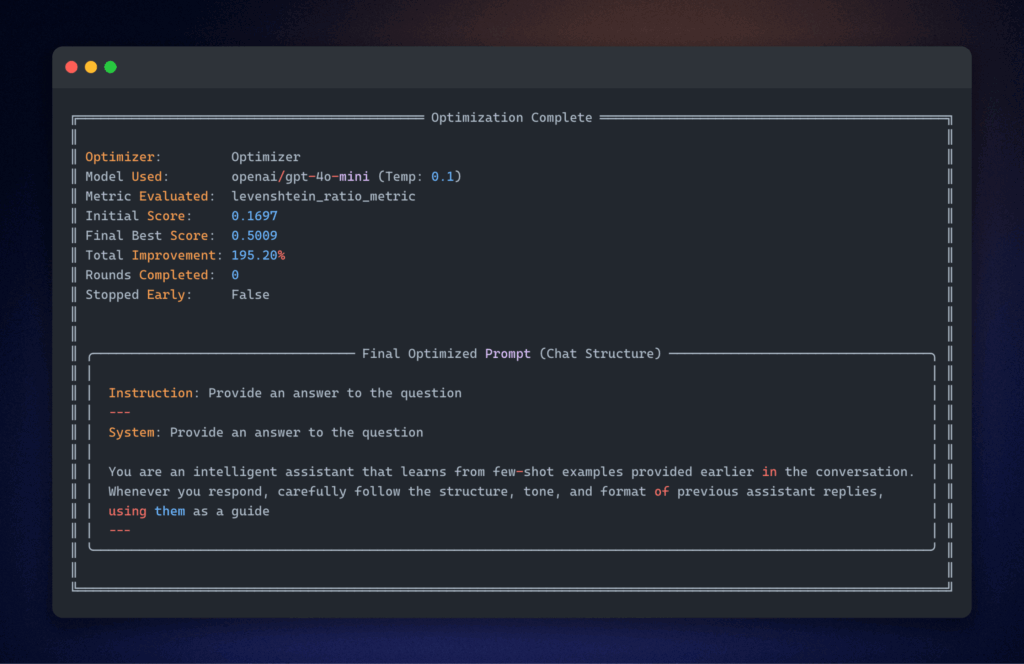
Opik is an open-source platform designed to streamline the entire lifecycle of LLM applications — from development tracing through production monitoring to automated optimization. It empowers developers to evaluate, test, monitor, and optimize their models and agentic systems through a unified interface. At its core, Opik provides five integrated capabilities: comprehensive tracing that logs every LLM call, tool invocation, and agent step with full context including token counts, latency, and cost tracking; advanced evaluation with 30+ built-in metrics including LLM-as-a-judge scoring for hallucination detection, moderation, RAG assessment (Answer Relevance, Context Precision), and heuristic checks; the Agent Optimizer — an open-source SDK using six optimization algorithms (meta-prompting, few-shot tuning, Bayesian parameter search, evolutionary search, and tool/MCP optimization) to automatically improve prompts and agents without manual trial and error; real-time guardrails that scan inputs and outputs for PII leakage, off-topic answers, and policy violations; and a Prompt Playground for live testing, model comparison, and systematic prompt iteration.
The platform is model-agnostic and framework-agnostic, integrating natively with OpenAI, Anthropic, AWS Bedrock, Google Gemini, Groq, Mistral, DeepSeek, xAI Grok, and frameworks including LangChain, LlamaIndex, CrewAI, AutoGen, DSPy, Google ADK, and Flowise AI. It also supports OpenTelemetry for integration with existing observability stacks, and offers an MCP Server for direct IDE integration with Claude Code, Cursor, and VS Code Copilot — allowing developers to read traces, score outputs, and run experiments from chat without touching the UI.
Key Features
Comprehensive LLM Tracing
Tracks every LLM call, tool invocation, and agent step with detailed context during development and production. Includes token counts, latency metrics, cost breakdowns, and conversation threading. The @track decorator wraps any Python function for automatic instrumentation. Thread-level grouping displays multi-turn conversations as cohesive units in the UI.
30+ Built-in Evaluation Metrics
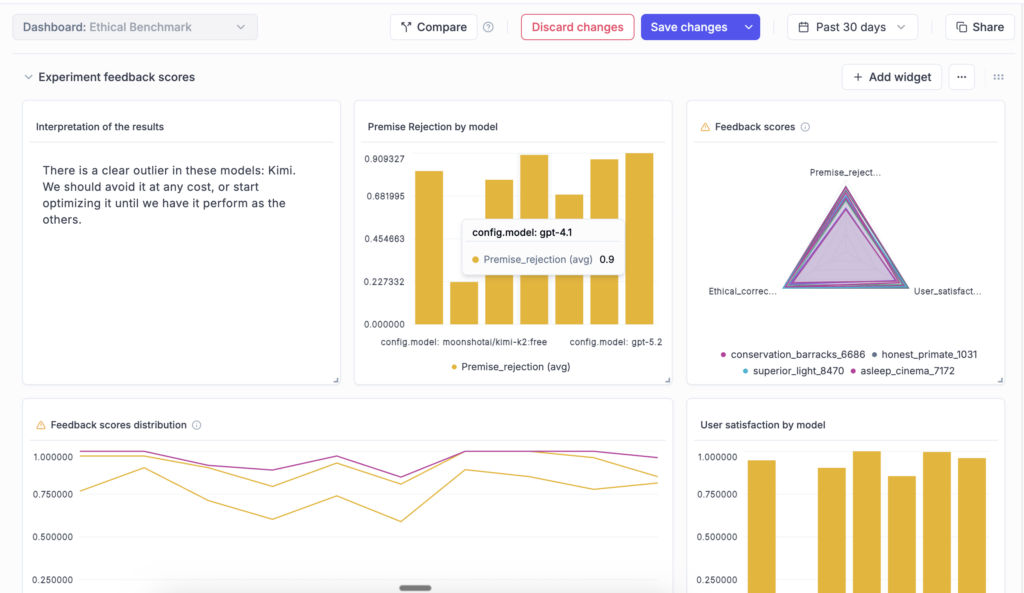
LLM-as-a-judge scoring for hallucination detection, moderation, and RAG assessment (Answer Relevance, Context Precision). Heuristic evaluators for format validation and rule-based checks. Online Evaluation Rules automatically score production traffic in real-time. PyTest integration enables CI/CD pipeline evaluation. Seed evaluation datasets directly from production traces.
Agent Optimizer (6 Algorithms)
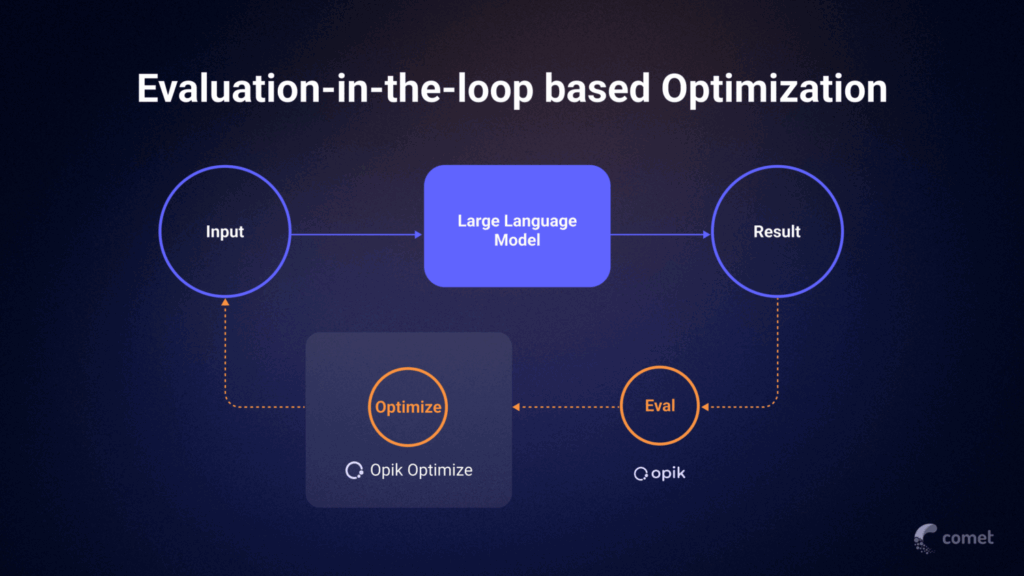
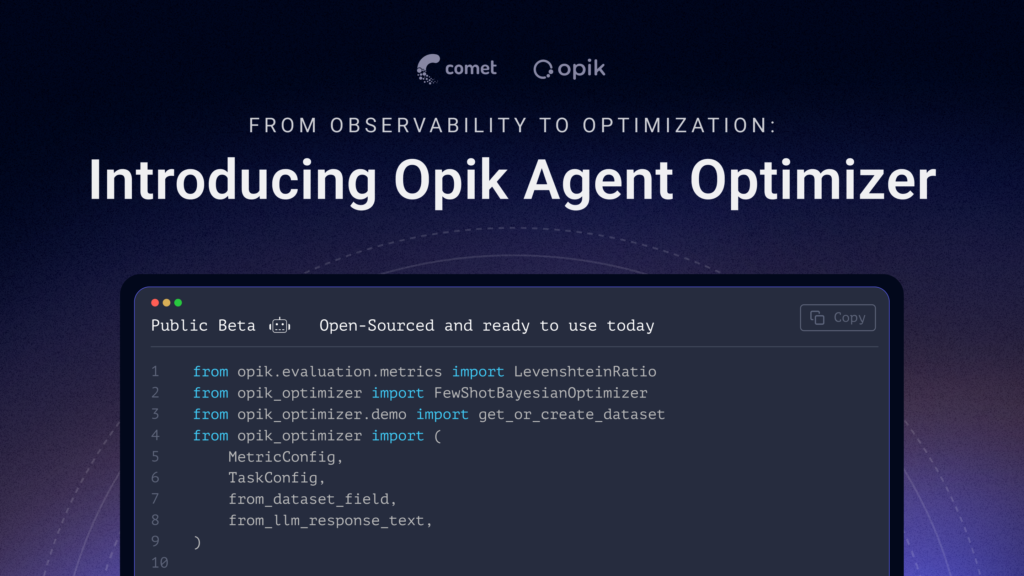
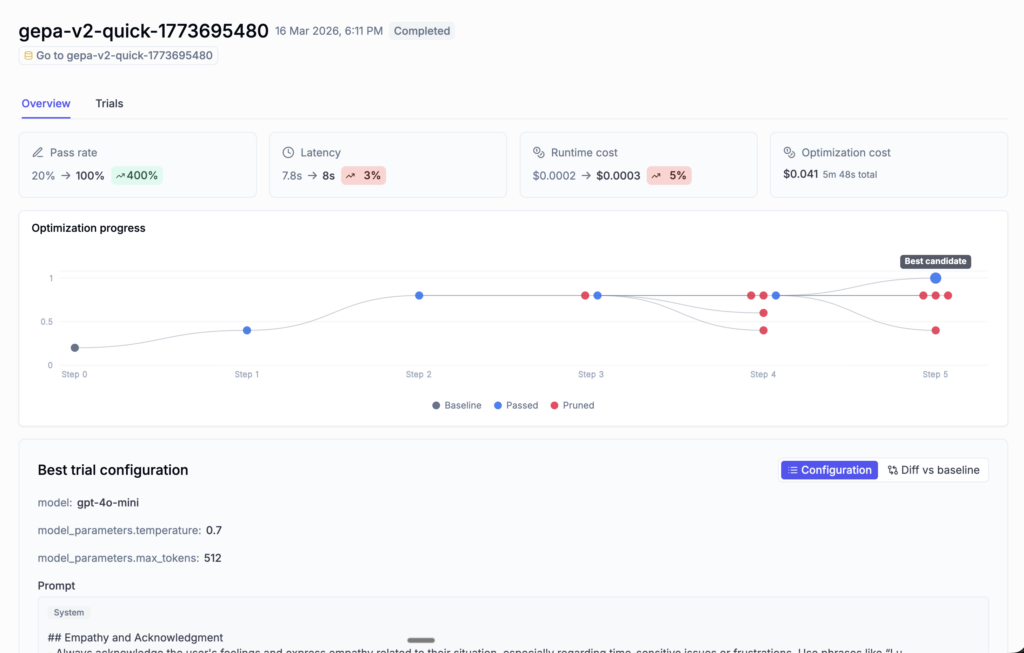
An open-source SDK that automatically improves prompts and agents using meta-prompting, few-shot tuning, Bayesian parameter search, evolutionary search, and tool/MCP optimization. Define an objective and the optimizer iterates to find better configurations — eliminating manual trial-and-error. Multi-prompt optimization tunes entire agent systems simultaneously.
Real-Time Guardrails
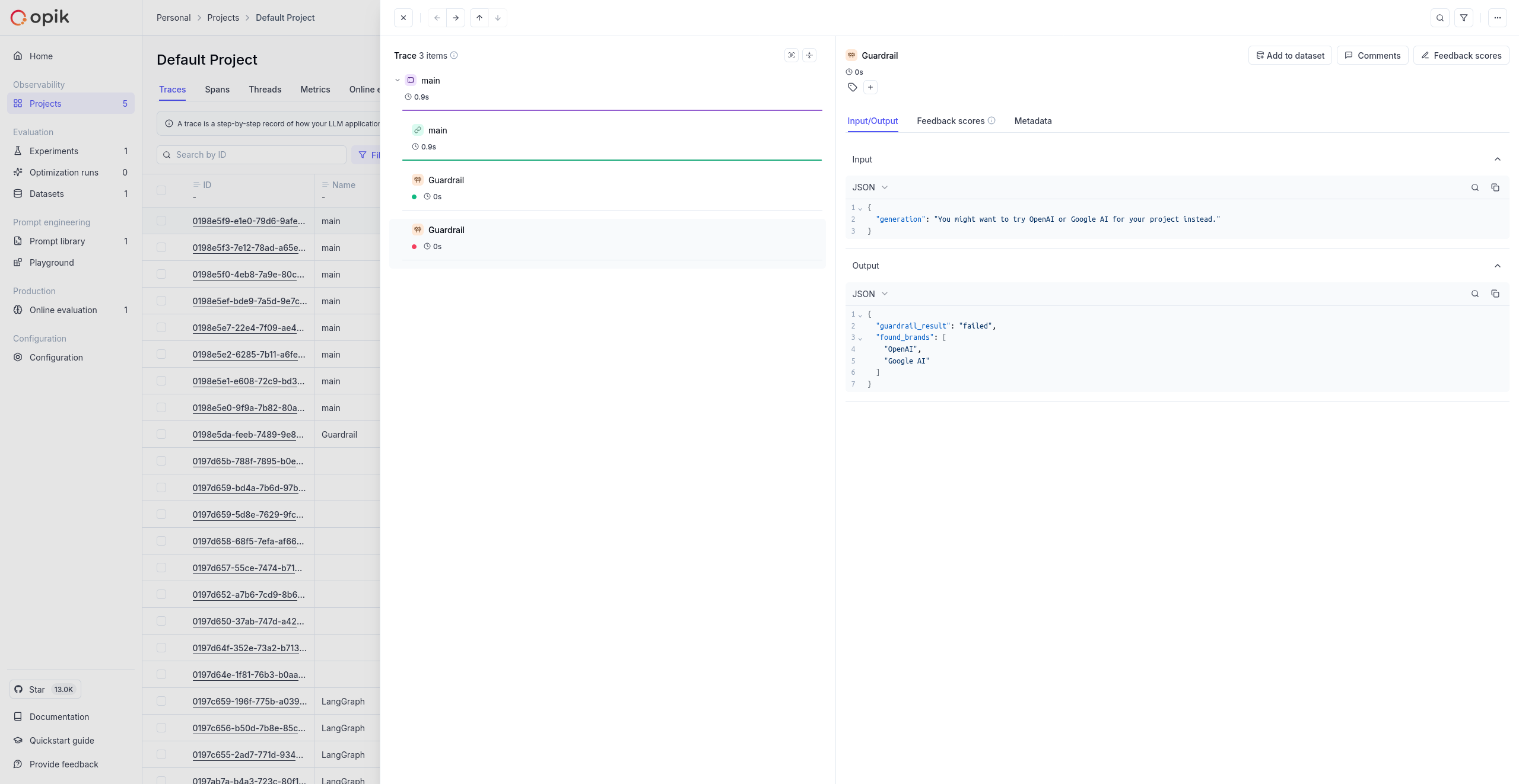
Scans LLM inputs and outputs in real-time for PII leakage, off-topic answers, sensitive data exposure, and policy violations. Built for the "residual risks" that general providers don't cover. Native guardrails for self-hosted deployments ensure compliance without cloud dependency. Configurable blocking, masking, or alerting actions.
Pricing Plans
| Plan | Price | What's Included |
|---|---|---|
| Open-Source (Self-Hosted) | Free | Apache 2.0 — Full feature set, Docker/Kubernetes deployment, unlimited traces, unlimited team members, complete evaluation library, guardrails, and Agent Optimizer |
| Comet Cloud Free | Free | Generous solo tier with usage limits, no credit card required, managed infrastructure, automatic updates, community support |
| Comet Cloud Pro | $39/user/month | Higher usage quotas, priority support, advanced analytics, team collaboration features, custom retention policies |
| Enterprise | Custom pricing | SSO, RBAC, dedicated support, SLA guarantees, on-premise deployment options, custom integrations, audit compliance |
Note: Academic users receive free Pro access. Self-hosted infrastructure costs typically run $800–1,900/month for medium-scale deployments (compared to $3,000–4,000/month for equivalent Langfuse self-hosted setups). All plans include unlimited team members.
Start with Opik Free →Pros & Cons
✓ What Makes It Shine
- ✅ True Apache 2.0 open-source — no vendor lock-in, full transparency, community contributions welcome
- ✅ Agent Optimizer with 6 algorithms — automatic prompt improvement that no competitor offers
- ✅ Thread-level multi-turn evaluation — score entire conversations, not just individual calls
- ✅ Native guardrails for self-hosted deployments — security without cloud dependency
- ✅ 40M+ traces/day capacity — proven production scale with responsive UI
✗ Where It Falls Short
- ❌ Newer platform with thinner ecosystem — fewer guides, tutorials, and third-party integrations than Langfuse
- ❌ No native production alerting — lacks threshold-based alerts and webhook notifications (LangSmith has this)
- ❌ Self-hosting requires DevOps expertise — Docker/Kubernetes setup not trivial for small teams
- ❌ Experiment tracking advantage only relevant if you're already in the Comet ML ecosystem
💡 Community Feedback: What Developers Say
How It Compares to Alternatives
| Feature | Opik | Langfuse | LangSmith |
|---|---|---|---|
| License | Apache 2.0 | MIT (core) | Proprietary |
| GitHub Stars | 18,000+ | 23,000+ | N/A (proprietary) |
| Agent Optimizer | YES (6 algorithms) | NO | NO |
| Native Guardrails | YES (self-hosted) | NO | NO |
| Thread-Level Evaluation | YES | Sessions (partial) | NO |
| Production Alerting | NO | Metrics API only | YES native |
| Cloud Pro Price | $39/user/mo | ~$29/mo | $39/seat + traces |
| Framework Depth | 12+ agents | All major + OTel | LangChain native |
Opik's comparison table reveals a clear strategic position: it trades ecosystem maturity for evaluation depth and open-source freedom. Langfuse has the largest open-source community (23,000+ stars) and the most mature self-hosting documentation, making it the default choice for teams that want proven open-source observability. LangSmith offers the most polished production experience with native alerting, managed deployment, and the deepest LangChain integration — but at the cost of vendor lock-in and escalating pricing. Opik occupies a unique niche: it's the only platform with automated prompt optimization (Agent Optimizer), the only one with native guardrails for self-hosted deployments, and the only one with thread-level conversation evaluation. For teams that prioritize evaluation rigor and open-source flexibility over production alerting maturity, Opik is the strongest choice. For teams that need turnkey production monitoring with alerts and managed infrastructure, LangSmith remains ahead. For teams that want the largest community and most mature self-hosting guides, Langfuse is the safe bet.
Who Should Use Opik?
Best For: AI engineering teams (5–200 developers) building LLM applications, RAG pipelines, and agentic systems who need deep observability and systematic evaluation without vendor lock-in. Teams already using Comet ML for traditional ML experiment tracking who want to extend that workflow to LLM evaluation. Startups and mid-market companies that need production-grade monitoring but can't afford LangSmith's per-seat-plus-traces pricing model. Research teams and academic labs who need advanced evaluation metrics (hallucination detection, RAG relevance, moderation scoring) at zero cost. DevOps-heavy teams with Kubernetes expertise who want to self-host their entire observability stack for data residency and compliance reasons.
Consider Alternatives If: You need production alerting with threshold-based notifications and webhook integrations — LangSmith's native alerting is significantly more mature. You're building exclusively with LangChain/LangGraph and want the tightest possible integration — LangSmith is purpose-built for this ecosystem. You want the largest open-source community with the most mature documentation and self-hosting guides — Langfuse's 23,000+ stars and extensive tutorials make it the safer choice. You're a small team with no DevOps capacity who needs a managed solution immediately — LangSmith's cloud offering or Langfuse's Hobby tier will get you running faster. You only need basic tracing without evaluation or optimization — Helicone or a simple OpenTelemetry setup may be sufficient and lighter.
Expert Editorial Opinion
Opik represents the most intellectually honest approach to LLM observability in the market today. While competitors are building dashboards that show you what happened, Opik is building a system that helps you understand why it happened and how to fix it. The Agent Optimizer is the standout feature — six optimization algorithms that automatically tune prompts and agents is not a nice-to-have, it's a fundamental shift from manual debugging to systematic improvement. In a market where most teams are still A/B testing prompts by hand, Opik's automated optimization is a genuine competitive advantage.
The Comet ML pedigree matters more than most buyers realize. Experiment tracking is not a feature — it's a discipline. Comet spent a decade teaching data scientists to log every hyperparameter, compare every run, and reproduce every result. Opik applies that same rigor to LLM applications: every prompt version is tracked, every evaluation score is logged, and every production trace feeds back into the experiment dataset. This creates a closed loop that most LLM observability tools simply don't have. The connection between development experiments and production monitoring is where Opik's architecture shines.
The limitations are real and worth weighing. Opik's lack of native production alerting is a significant gap for teams that need to know immediately when their AI agent starts degrading. LangSmith's threshold-based alerts and PagerDuty integrations are genuinely useful for mission-critical applications. Opik's community is growing fast but still smaller than Langfuse's, which means fewer Stack Overflow answers, fewer third-party tutorials, and more self-reliance when things break. And the self-hosting requirement, while freeing, is a burden for teams without Kubernetes expertise.
The pricing structure is refreshingly straightforward. $39 per user per month for Pro, with a genuinely usable free tier and free self-hosting, makes Opik accessible to teams that would be priced out of LangSmith's per-seat-plus-traces model. The academic free Pro access is a smart move that builds long-term loyalty. For a three-year total cost of ownership analysis, Opik sits in the middle: approximately $31,200 over three years for a self-hosted team (infrastructure + maintenance) versus $17,124 for Langfuse cloud and $38,040 for LangSmith. The break-even point depends on your team's DevOps capacity and your tolerance for vendor lock-in.
One question remains: can Opik close the alerting gap before it becomes a dealbreaker for enterprise buyers? The roadmap is public, the GitHub issues are active, and the Comet team has a track record of shipping fast. But production alerting is not a feature you can bolt on — it requires robust infrastructure, reliable delivery, and mature incident management integrations. If Opik solves this in the next 12 months, it becomes the clear leader for evaluation-focused teams. If it doesn't, LangSmith will retain its advantage for mission-critical deployments.
Final Verdict
Opik is the best open-source LLM observability and evaluation platform for teams that prioritize systematic quality improvement over passive monitoring. The Agent Optimizer is a genuinely unique feature that no competitor offers. The Apache 2.0 license, 40M+ traces/day capacity, and 30+ built-in evaluation metrics make it production-ready for most use cases. The thread-level conversation evaluation and native self-hosted guardrails address real gaps in the competitive landscape. The limitations — no native alerting, thinner ecosystem, and DevOps-heavy self-hosting — are real but manageable for the target audience. For AI engineering teams that want to move from "vibes-based" development to metric-driven optimization, this is an 8.9 out of 10 — the most evaluation-focused tool in its category.
🔗 Related ToolRadar Reviews
More tools from AI Developer Tools
- Mastra AI Review: The TypeScript Agent Framework That Wants to Be the Rails for AI
- Is Aider the Best Free AI Coding Assistant in 2026?
- Why Replit Agent Is One of the Hottest AI Coding Tools Right Now
- v0.dev vs Bolt.new vs Cursor: Which AI Coding Tool Wins in 2026?
- Forget GitHub Copilot — Cursor 3 Just Changed Everything
- Devin AI 2026: The End of Junior Developers?
- Gumloop: Build AI Workflows Without Writing a Single Line of Code
- Zapier AI Review 2026: Automation Tool That Actually Thinks
❓ Frequently Asked Questions
So here's the real question: are you still debugging your LLM app by reading raw JSON logs and hoping you spot the hallucination?
Because Opik just proved that LLM observability isn't about watching what your AI does — it's about systematically improving why it does it. The only question left is whether you'll keep guessing, or start measuring.

Comments
Post a Comment