


Is Google ADK the Best Framework for Building Production-Ready AI Agents in 2026?
Google open-sourced the exact framework it uses to build Agentspace and Customer Engagement Suite. But should you bet your production infrastructure on it?
- What Is Google ADK and Why Did Google Open-Source It?
- Key Features: Multi-Agent Architecture Done Right
- Pricing: Free Framework, Cloud Costs Apply
- Pros & Cons: The Developer Reality
- Real User Pulse: What Reddit & Trustpilot Say
- How It Compares to LangGraph, CrewAI & OpenAI Agents SDK
- Who Should Build on Google ADK?
- Expert Editorial Opinion
- Final Verdict
- Related ToolRadar Reviews
- Frequently Asked Questions
Imagine building an AI agent that can research a topic, draft a report, send it to your team via Slack, update a Notion database, and schedule a follow-up meeting — all while maintaining persistent memory across sessions and handling errors gracefully without human intervention. That is the promise of Google Agent Development Kit (ADK), the open-source framework that Google itself uses to build production agents like Agentspace and the Customer Engagement Suite. Launched at Google Cloud NEXT 2025, ADK has quietly accumulated over 18,700 GitHub stars and become one of the most serious contenders in the AI agent framework space.
But here is what makes ADK genuinely different from the dozens of agent frameworks that launched in 2025: this is not a third-party tool built to work with Google Cloud — it is the exact framework Google uses internally. When a framework is good enough for the company that built the underlying models, the infrastructure, and the cloud it all runs on, that is a meaningful signal. The flip side is equally important: adopting ADK is not just a technical decision — it is a bet on Google's ecosystem, roadmap, and continued investment in the agent space. This review breaks down everything you need to know: what ADK does, where it excels, where it frustrates, and whether you should build your next agent on it.
What Is Google ADK and Why Did Google Open-Source It?
Google ADK is an open-source, code-first agent development framework released under the Apache 2.0 license. It ships in four languages — Python, TypeScript, Go, and Java — and introduces an event-driven runtime architecture that orchestrates agents, tools, and persistent state into cohesive applications. Unlike simple request-response wrappers around LLMs, ADK treats agents as long-running processes with memory, error handling, and multi-step reasoning capabilities. The framework supports both single-agent and multi-agent architectures, with a primary agent capable of orchestrating and delegating to specialized sub-agents through the Agent2Agent (A2A) protocol. ADK 2.0, released in early 2026, introduced a graph-based workflow runtime with support for routing, fan-out/fan-in, loops, retry logic, state management, dynamic nodes, human-in-the-loop, and nested workflows — making it one of the most feature-complete agent frameworks available.
Key Features: Multi-Agent Architecture Done Right
Native Multi-Agent Architecture with A2A Protocol
ADK's multi-agent system allows you to compose specialized teams of agents that collaborate and delegate tasks naturally. The Agent2Agent (A2A) protocol enables a primary agent to orchestrate sub-agents — whether local or remote — without exposing internal memory or proprietary logic. This is not theoretical: Google's own Agentspace uses this exact architecture to handle complex enterprise workflows. The A2A protocol is open and interoperable, meaning ADK agents can communicate with agents built on other frameworks that implement the same protocol. For enterprises building modular agent systems where different teams own different capabilities, this interoperability is critical — it prevents the framework silos that plague most agent deployments.
Graph-Based Workflow Runtime (ADK 2.0)
ADK 2.0 introduced a graph-based workflow runtime that transforms agent development from scripting to engineering. You can define complex workflows with routing decisions, parallel execution (fan-out/fan-in), retry logic with exponential backoff, persistent state management across sessions, dynamic node insertion, human-in-the-loop approval gates, and nested sub-workflows. This means an e-commerce agent can check inventory in parallel across multiple warehouses, retry failed payment processing automatically, escalate to a human for high-value orders, and maintain cart state across a multi-day shopping session — all defined declaratively in code rather than improvised through prompt engineering.
Model-Agnostic with 30+ Native Integrations
While ADK works natively with Gemini through the Vertex AI integration, it is genuinely model-agnostic via LiteLLM bridge support. You can use OpenAI's GPT-4, Anthropic's Claude, Meta's Llama, Mistral AI, Cohere, AI21 Labs, and many others without rewriting your agent logic. The integration ecosystem covers GitHub, Notion, Stripe, Pinecone, ElevenLabs, and 30+ other platforms — adding a new connector takes roughly ten lines of code according to developers on DEV Community. This model-agnostic design is rare among vendor frameworks: most optimize for their parent's models and treat competitors as second-class citizens. Google's willingness to support rival models through ADK suggests confidence that Gemini will win on merit rather than lock-in.
Bidirectional Audio & Video Streaming + ADK Web
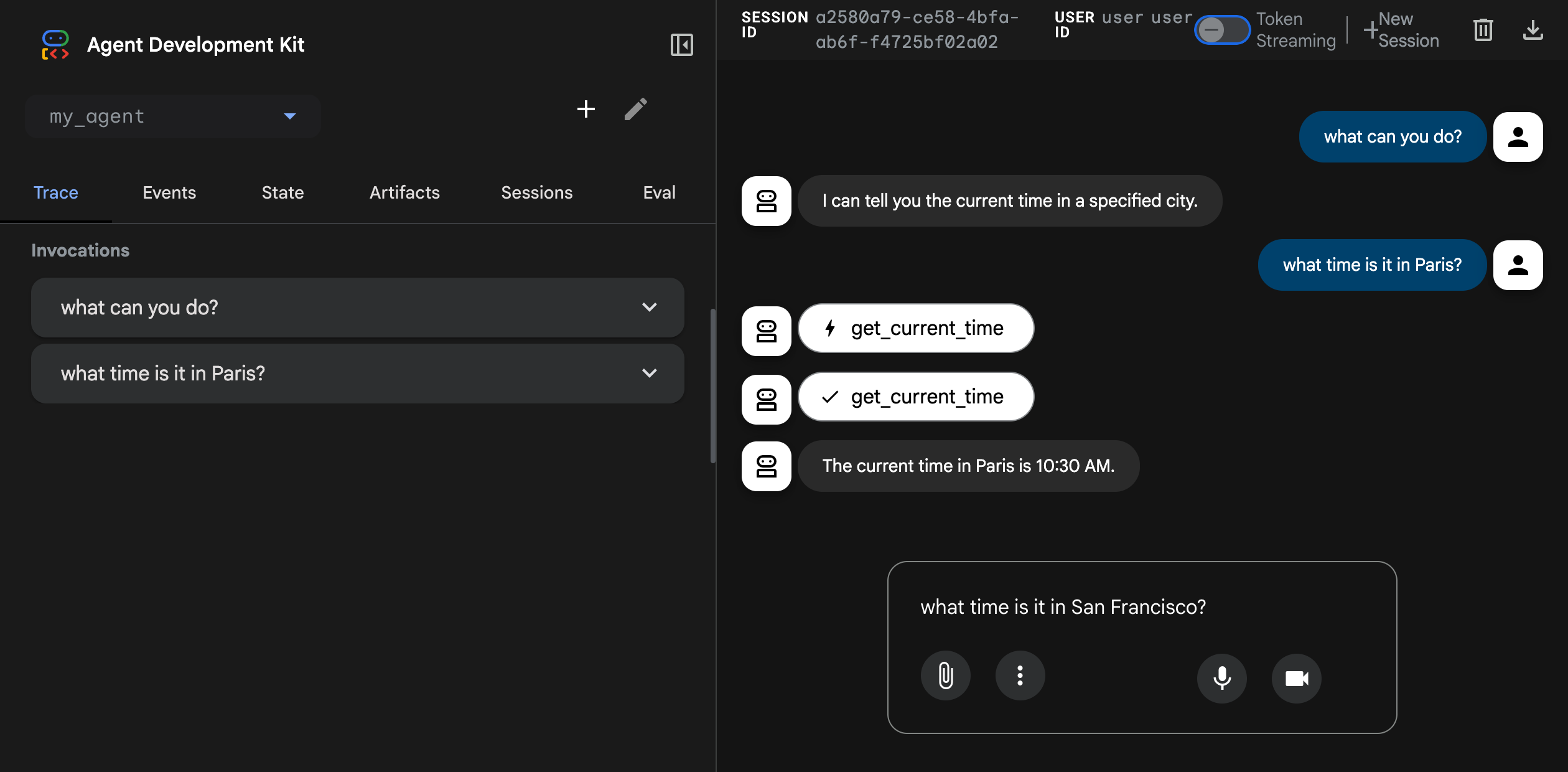
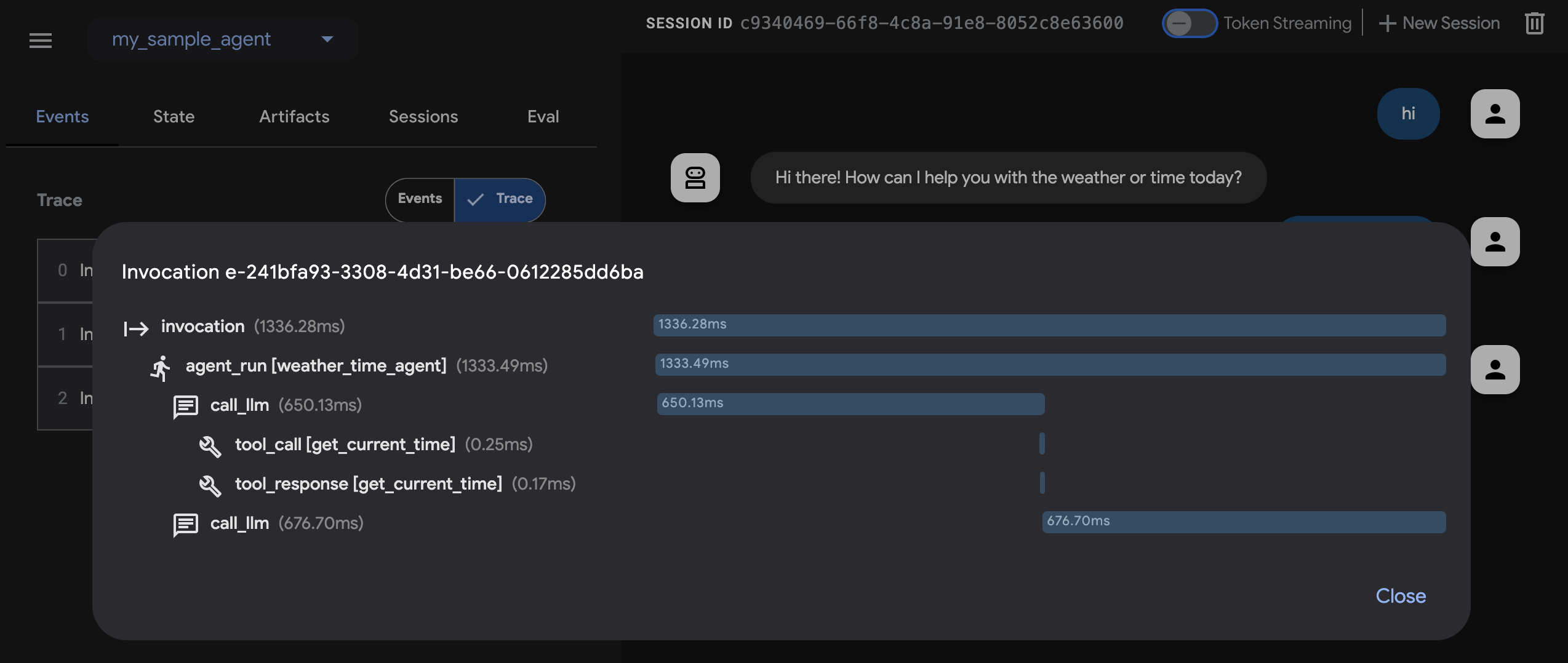
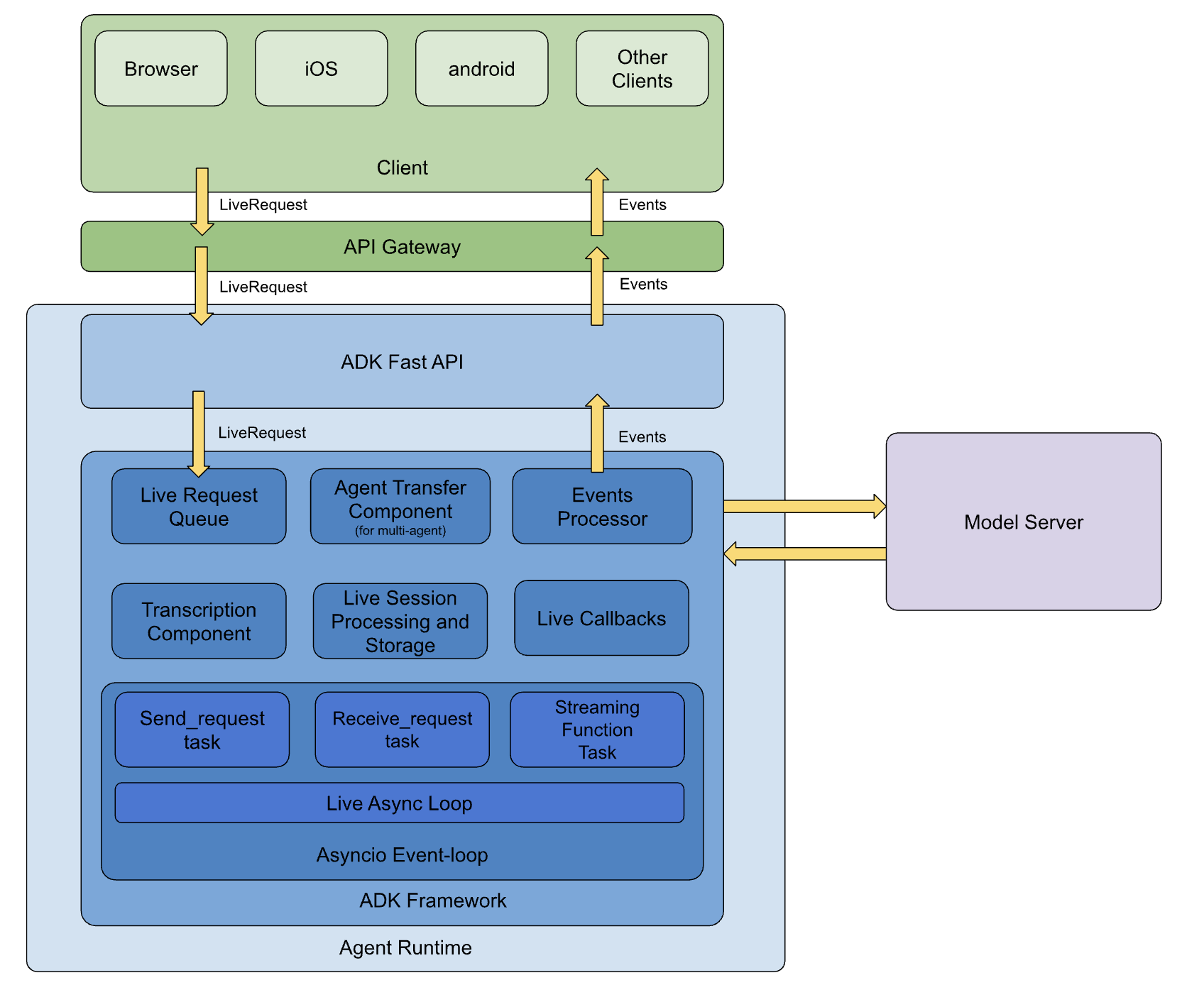
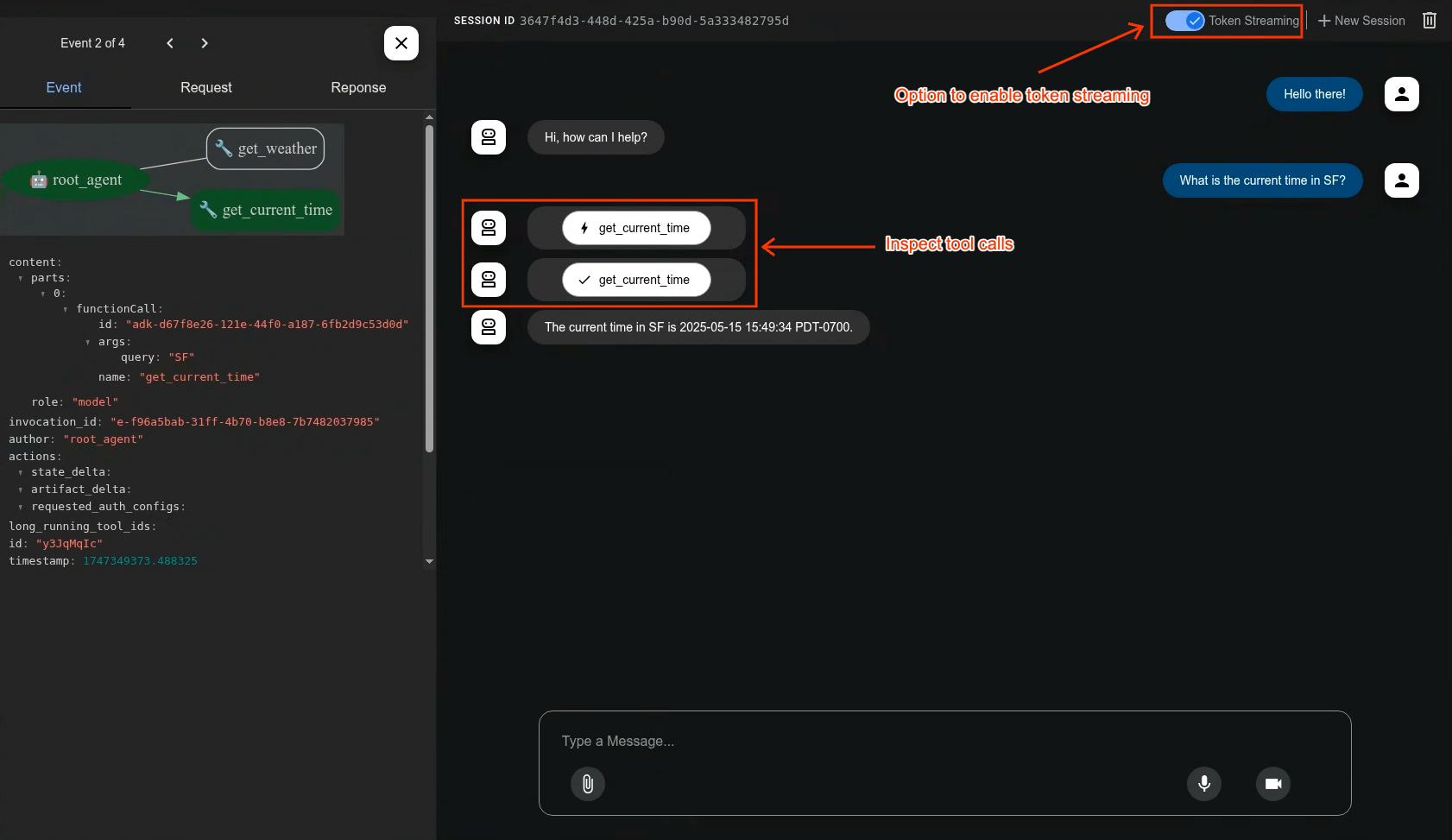
ADK supports bidirectional audio and video streaming through the Gemini Live API, enabling natural multimodal conversations that go beyond text interaction. An agent can see what your camera sees, hear what your microphone captures, and respond with synthesized voice — all in real-time. This is not a demo feature: it is the same capability powering Google's customer engagement products. For developers, the built-in ADK Web interface provides a browser-based debugging environment where teams can inspect events, traces, and artifacts within the runtime. You can watch an agent reason step-by-step, see which tools it called and why, inspect the state at any point, and replay sessions for debugging — a level of observability that most agent frameworks simply do not provide.
Pricing: Free Framework, Cloud Costs Apply
| Component | Cost | Details |
|---|---|---|
| ADK Framework | Free | Open-source under Apache 2.0. Python, TypeScript, Go, Java. Run locally with no cloud setup. |
| Vertex AI Agent Engine | Pay-per-use | Managed runtime for production. Billed under standard Google Cloud compute and Vertex AI pricing. |
| Gemini API Calls | Per-token | Free tier via Google AI Studio for experimentation. Production billed via Vertex AI or AI Studio. |
Pros & Cons: The Developer Reality
✓ What Works
- ✅ Same framework Google uses internally — unprecedented production validation and long-term commitment signal
- ✅ Native multi-agent architecture with A2A protocol for interoperable, modular agent systems
- ✅ Model-agnostic via LiteLLM — works with Gemini, GPT-4, Claude, Llama, and 30+ other models
- ✅ Built-in ADK Web debugging interface with event tracing, state inspection, and session replay
✗ What Frustrates
- ❌ Only one built-in tool per agent — cannot combine Google Search with custom functions without wrapper agents
- ❌ ADK 2.0 introduces breaking API changes incompatible with 1.x sessions — migration friction for production teams
- ❌ Code-first by design with no visual builder — completely inaccessible to non-developers
💡 Real User Pulse: What Reddit & Trustpilot Say
How It Compares to LangGraph, CrewAI & OpenAI Agents SDK
| Feature | Google ADK | LangGraph | CrewAI |
|---|---|---|---|
| Architecture | Event-driven + Graph-based | Graph-based state machine | Role-based crew system |
| Multi-Agent | Native A2A protocol | Supported via subgraphs | Role delegation |
| Model Support | Gemini + 30+ via LiteLLM | Any LangChain-compatible | Any LLM via adapters |
Who Should Build on Google ADK?
Ideal Users: Enterprise engineering teams building production agent systems that need to scale. If you are architecting a multi-agent platform where different teams own different capabilities — one team for customer support, another for inventory management, a third for analytics — ADK's A2A protocol and modular design prevent the silos that destroy most agent deployments. Google Cloud-native teams will find the Vertex AI integration seamless, with managed runtime, monitoring, and scaling handled automatically. Developers who need multimodal capabilities (audio, video, real-time streaming) will find ADK's Gemini Live API integration unmatched by any competitor. And teams that value observability will appreciate the built-in ADK Web debugging interface that most frameworks charge extra for.
Look Elsewhere If: You need a visual builder or no-code interface — ADK is code-first by design and completely inaccessible to non-developers. If you are a solo developer or small team building a simple single-agent prototype, CrewAI's lower learning curve and faster iteration will serve you better. Teams heavily invested in AWS or Azure may find the Google Cloud dependency problematic for production deployment, though ADK runs locally for development. And if you need complex custom state persistence beyond what ADK's session management provides, LangGraph's state machine architecture offers more flexibility at the cost of complexity.
Expert Editorial Opinion
Google ADK represents a fundamental shift in how we should evaluate agent frameworks. Most frameworks are judged on features: does it support multi-agent? Can it handle tool calling? What models does it support? ADK passes all these tests, but its real significance lies elsewhere — it is the first major framework where the vendor's own production systems run on the exact same code that developers download. When Google builds Agentspace on ADK, it is not a marketing claim — it is a guarantee that the framework has been battle-tested at enterprise scale with real users, real errors, and real edge cases. This is unprecedented in the agent framework space, where most tools are built by startups or research labs and then marketed as "production-ready" without the scars to prove it.
The multi-agent architecture deserves particular attention because it solves a problem that most frameworks ignore: agent interoperability. The A2A protocol allows agents to communicate across organizational boundaries without exposing internal memory or proprietary logic. A bank's fraud detection agent can delegate to a credit bureau's risk assessment agent, receive a verdict, and incorporate it into its own decision — all without either agent knowing the other's internal reasoning. This is not a minor technical feature; it is the foundation for enterprise agent ecosystems where different vendors, departments, and even competitors can collaborate through standardized protocols. Google's decision to open-source A2A alongside ADK suggests a strategic bet that agent interoperability will matter more than agent isolation.
The model-agnostic design through LiteLLM integration is another standout feature that distinguishes ADK from vendor-locked competitors. While the framework works natively with Gemini, it supports OpenAI's GPT-4, Anthropic's Claude, Meta's Llama, Mistral AI, and many others without code changes. This is not charity — it is confidence. Google believes Gemini will win on merit, and removing lock-in removes the primary objection that enterprise buyers raise when evaluating vendor frameworks. The integration ecosystem is equally impressive: GitHub, Notion, Stripe, Pinecone, ElevenLabs, and 30+ other platforms with connectors that take roughly ten lines of code to implement. For teams building agents that need to interact with existing business systems, this ecosystem coverage is a genuine competitive advantage.
Final Verdict
Google ADK earns an 8.7 out of 10 as the most production-validated agent framework available in June 2026. Its native multi-agent architecture with A2A protocol, graph-based workflow runtime, model-agnostic design through LiteLLM, and built-in multimodal streaming capabilities place it ahead of competitors on technical merit alone. The fact that Google uses ADK internally for Agentspace and Customer Engagement Suite provides unprecedented trust signals for enterprise buyers. The built-in ADK Web debugging interface, extensive integration ecosystem, and transparent pricing model further strengthen its position. However, the code-first design excludes non-developers entirely, the one-tool-per-agent limitation forces workarounds for complex use cases, and ADK 2.0's breaking changes create migration friction for early adopters. Most importantly, adopting ADK is a bet on Google's ecosystem — a bet that has paid off for some products and ended painfully for others. For enterprise engineering teams with Google Cloud infrastructure and the technical sophistication to handle its complexity, ADK is the best agent framework available. For everyone else, it is a powerful tool with enough caveats to warrant careful evaluation before commitment.
🔗 Related ToolRadar Reviews
More tools from AI Agent Framework
❓ Frequently Asked Questions
Are You Ready to Bet Your Agent Infrastructure on Google?
Google ADK offers unmatched production validation and technical depth — but at the cost of ecosystem lock-in. Will you trust Google with your agent architecture, or is the risk of future deprecation too high for your team?
Explore Google ADK →
Comments
Post a Comment