


Can AI Really Match Your Art Style?
I Tested Scenario's Custom Model Training
From $6M seed funding to 35M+ monthly searches: how Scenario became the creative AI infrastructure for game studios, marketers, and solo artists in 2026.
I've spent years watching AI art tools promise "style consistency" and deliver... well, chaos. Midjourney gives you stunning one-offs. DALL-E 3 nails text and composition. But ask either of them to generate 50 character portraits in the same art style, and you'll get 50 different styles. That's the nightmare every game studio faces: beautiful assets that don't look like they belong in the same game.
Scenario claims to solve this. Founded in 2021 by Emmanuel de Maistre and Hervé Nivon, the platform raised $6 million in seed funding from Play Ventures, Anorak Ventures, and even Twitch founder Justin Kan. Their pitch? Train AI on your own art, then generate unlimited assets that actually match your style. I spent two weeks testing it. Here's what happened.
— Emmanuel de Maistre, Co-founder & CEO, Scenario
What Is Scenario? (Beyond the Hype)
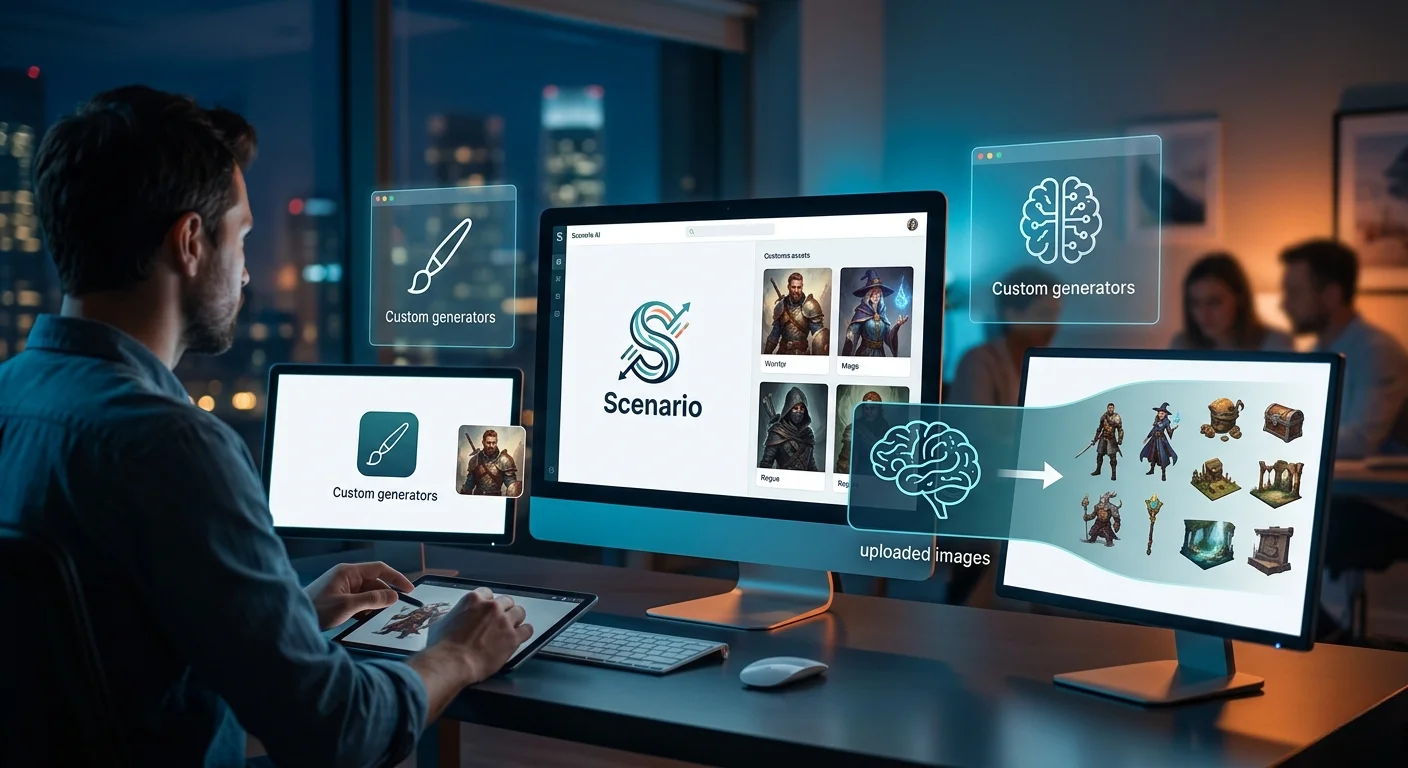
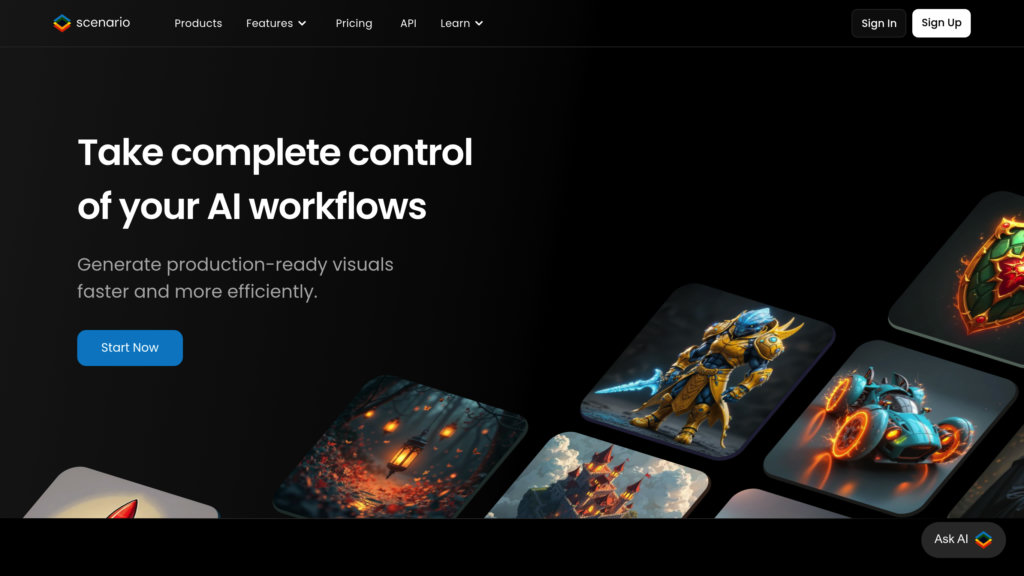
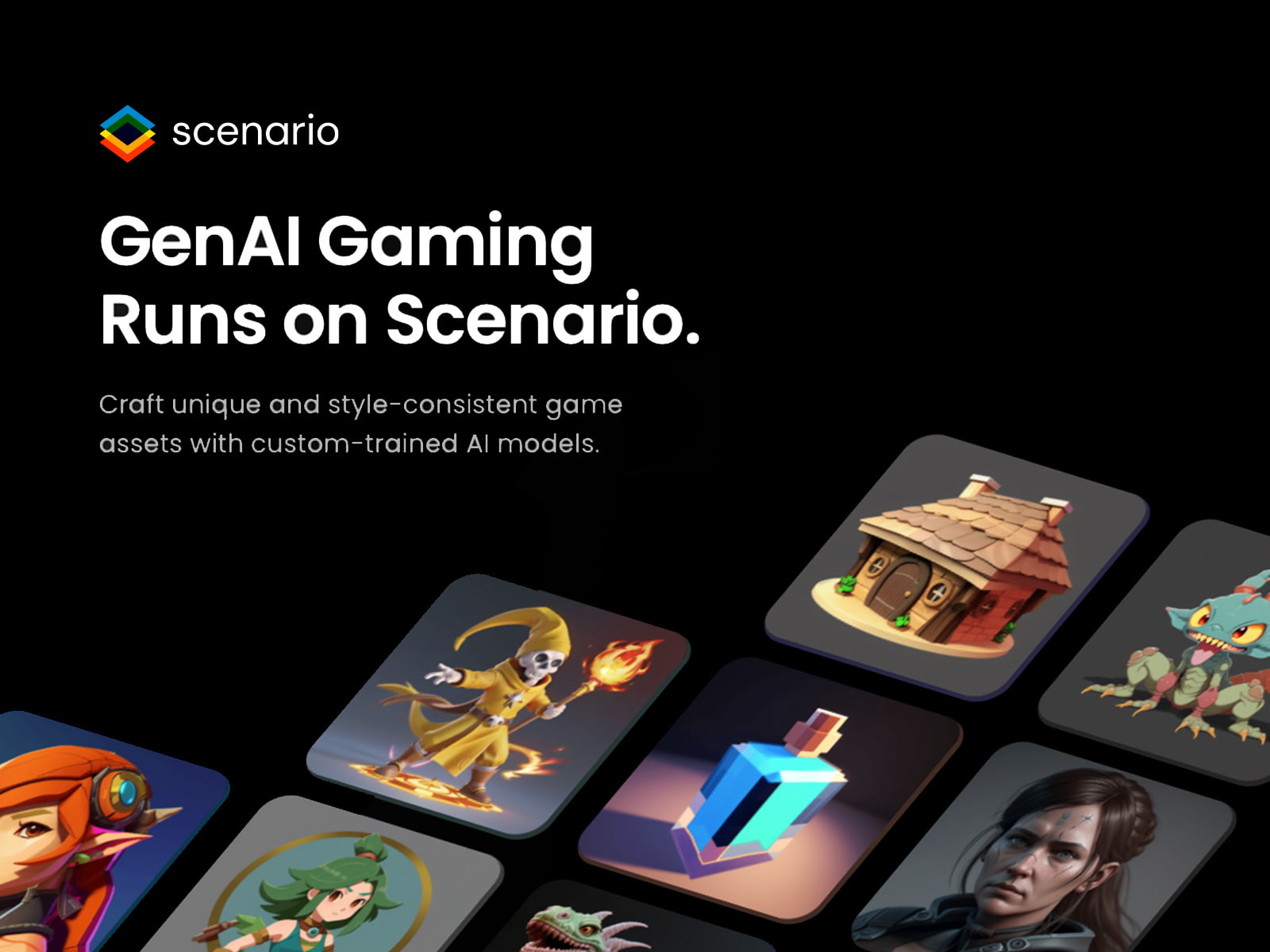
Scenario is not another generic AI image generator. It's a creative AI infrastructure built specifically for teams that need production-ready, on-brand visual assets at scale. The platform supports 2D images, video generation, 3D model creation, 360° immersive environments, and even audio generation — all from a single interface.
What separates Scenario from the pack is its custom model training. Instead of relying on generic datasets scraped from the internet (the legal and ethical minefield that got Stability AI sued by Getty Images), Scenario lets you upload your own artwork — characters, environments, props, UI elements — and trains a private AI model that learns your specific style.
The result? Assets that look like they came from your art team, not from an AI lottery. The platform is SOC 2 Type II certified, offers SSO/SAML support, and doesn't claim ownership over your generators or generated images. Your IP stays yours.
The Killer Feature: Custom Model Training
Here's how it works in practice. I uploaded 15 character portraits I had commissioned for a hypothetical RPG — a mix of warriors, mages, and rogues in a painterly fantasy style. Scenario's engine took about 20 minutes to train a custom generator. Then I started prompting.
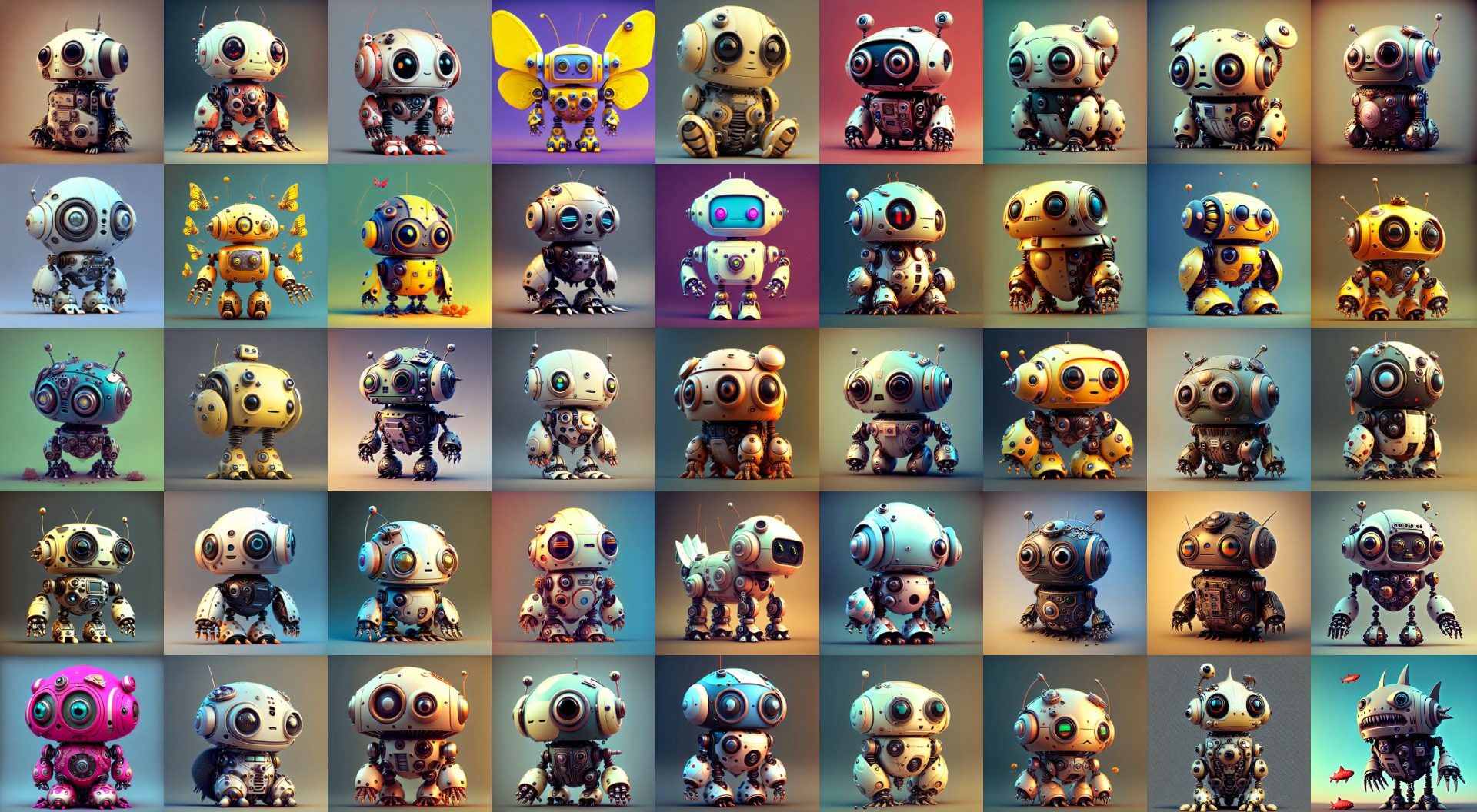
"A dwarven blacksmith with a braided beard, holding a glowing hammer." The result? A character that looked like it belonged in the same universe as my originals. Same brushwork, same color palette, same proportions. I generated 20 more characters. Every single one maintained the style. That alone is worth the price of admission for any game studio.
The training process is surprisingly accessible. You need just 10-20 images to build a functional generator. Upload your assets, add descriptive tags, and let the AI learn. The more images you provide, the better the model — though de Maistre warns that too many can increase training time without proportional benefits.
But here's the ethical angle that matters: because you're training on your own art, Scenario sidesteps the copyright controversy plaguing tools like Midjourney. Red Meat Games, developer of Moriarty, explicitly chose Scenario over Midjourney for this reason. "Our artists have drawn all of these things, and we're training Scenario to create more versions of our characters... We're not using Scenario to replicate subjects, objects and style. We're using it to generate new art in real time."
2026 Feature Arsenal
Scenario's feature set has exploded since its 2023 launch. Here's what's available as of June 2026:
Image Generation
Text-to-image and image-to-image with models like Flux, Gemini 3.0, and Seedream Edit. Style-consistent outputs from custom-trained models.
Video Generation
Veo 3.1 and Runway Aleph integration. Define start/end frames, add multiple references, and generate consistent video motion from text or images.
3D Asset Generation
Hunyuan 3D 3.0 converts images into detailed 3D models with PBR textures. Export-ready in minutes. Multi-view inputs supported.
Audio Generation
Create SFX, ambient music, and expressive speech from text prompts. Sync any voice to video. New as of 2026.
Precision Editing
Retouch, inpaint, restyle, and upscale with style preservation. Edit with prompts using Kontext, GPT, or Gemini. Background removal and expansion.
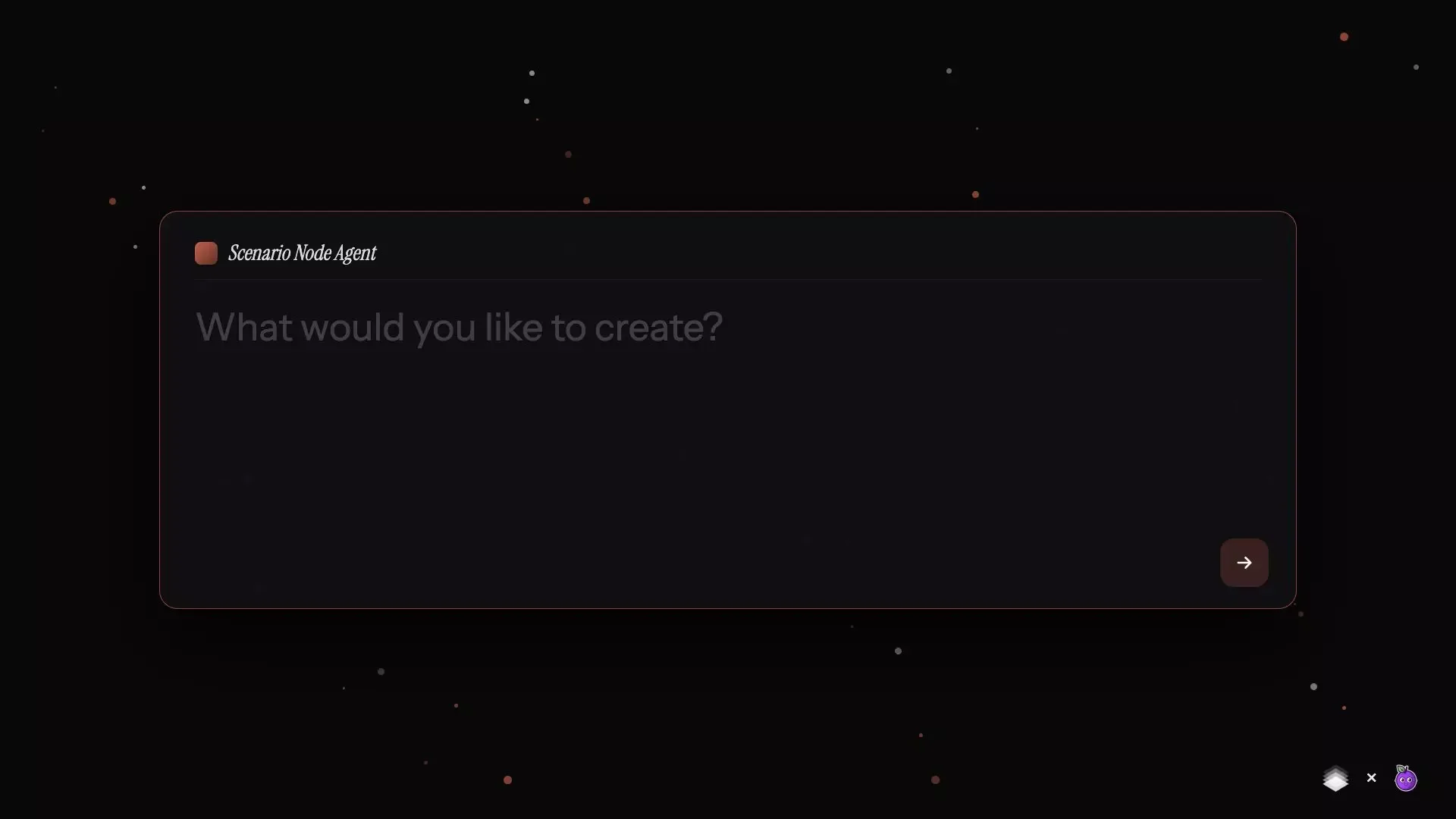
Scenario Node Agent
Turn complex workflows into one-click apps. Automate asset pipelines with custom node-based workflows your whole team can run.
Other standout tools include ControlNet for pose and structure guidance, Depth Mode for spatial accuracy, IP Adapter for style transfer, and Sketch-to-Render for rapid concept visualization. The platform also offers a Unity plugin and full API access for pipeline integration.
Pricing: Compute Units Explained
Scenario uses a hybrid model: monthly subscription + Compute Units (CUs). Think of CUs as tokens you spend on AI operations. The catch? They don't roll over. Use them or lose them.
| Plan | Monthly CUs | Key Features | Price |
|---|---|---|---|
| Free | 50 daily | Basic models, public generations, community support | $0 |
| Starter | 1,500 | Private generations, 50GB storage, community support | $10/mo |
| Pro | 5,000 | Custom model training, priority queue, 500GB, ticket support | $30/mo |
| Max | 10,000 | Multi-user workspaces, 1TB+ per seat, activity dashboard | $50/mo |
| Enterprise | Flexible | SSO/SAML, SOC 2, custom integrations, dedicated account team | $125+/user |
Cost benchmarks: a standard image generation costs ~5 CUs. An upscale ~15 CUs. Training a custom model? 100-500+ CUs. The Pro plan's 5,000 CUs yield roughly 1,000 Flux images or 333 upscales per month.
Pros & Cons
✓ What Excels
- ✅ Style consistency: Custom-trained models maintain your art direction across hundreds of assets.
- ✅ Ethical training: Uses your own data, sidestepping copyright controversies plaguing Midjourney.
- ✅ All-in-one platform: 2D, video, 3D, audio, and editing in one interface.
- ✅ Enterprise-ready: SOC 2, SSO, API access, Unity plugin, and custom integrations.
- ✅ Fast training: Custom models ready in ~20 minutes with just 10-20 images.
- ✅ Real results: Trusted by Ubisoft, Unity, Scopely, and Tripledot Studios.
✗ What Frustrates
- ❌ Unpredictable costs: Credit system with no rollover makes budgeting difficult.
- ❌ 3D limitations: Still optimized primarily for 2D; complex 3D workflows need refinement.
- ❌ Learning curve: Fine-tuned control requires understanding sampling steps, LoRAs, and ControlNet.
- ❌ Credit waste: Failed generations still cost CUs. Iterative experimentation gets expensive.
- ❌ Pro plan gate: Custom model training locked behind $30/mo tier. No free trial for training.
- ❌ Browser-heavy: No dedicated desktop app. Performance depends on browser stability.
💡 Real User Pulse: What Studios & Developers Say
"Creativity drives everything we do. Scenario AI has transformed our asset production (art, UI, videos, marketing) helping us work faster, smarter, and at higher quality. With a small team, we've launched games loved worldwide, and Scenario has been a true game-changer."
— Scenario.com Testimonial, 2026
"Our artists have drawn all of these things, and we're training Scenario to create more versions of our characters. We're not using Scenario to replicate subjects, objects and style. We're using it to generate new art in real time, because we're trying to give our game long term replayability. We have a small team of artists, and this can be very helpful for studios who have a small team and want a greater output."
— GamesIndustry.biz Interview, 2024
"At launch, 5,000 people had signed up for the platform and 20,000 more were on a waitlist. The closest competitors would be generative AI art tools such as Midjourney, DALL-E 2 and Stable Diffusion. But as sophisticated as these images are, they are still evolving to fit the controlled use cases required for the gaming industry, and many users still struggle with keeping a high consistency of the outputs."
— TechCrunch, January 2023
"Scenario is unparalleled for 'speed to market.' However, for extremely complex, high-fidelity AAA titles, the abstraction layer might feel limiting for veteran C++ or C# developers. It is perfect for those who want to use AI to make games without getting bogged down in syntax."
— GitHub Discussion, April 2026
Scenario vs Midjourney vs DALL-E
| Criteria | Scenario | Midjourney | DALL-E 3 |
|---|---|---|---|
| Style Consistency | Custom-trained models | Style reference (limited) | Style prompt (unreliable) |
| Training Data | Your own art | Scraped internet data | Licensed + generated |
| Legal Safety | High (own IP) | Controversial | Moderate |
| Output Quality | Production-ready | Stunning artistic | High fidelity |
| 3D Support | Hunyuan 3D, PBR textures | None | None |
| Video Support | Veo 3.1, Runway Aleph | None | None |
| Best For | Game studios, brand consistency | Artistic exploration | General creative tasks |
| Starting Price | Free (50/day) | $10/mo | Included with ChatGPT |
Who Should Use Scenario?
🚀 Perfect For:
• Game studios needing style-consistent assets at scale (characters, environments, props, UI)
• Marketing teams producing on-brand visuals for campaigns, social media, and ads
• Animation studios speeding up storyboarding and background generation
• Indie developers with small art teams who need to multiply their output
• Brand managers who need visual consistency across hundreds of generated assets
• Educators teaching game art and AI-assisted creative workflows
⚠️ Look Elsewhere If:
• You need one-off artistic masterpieces without style constraints — Midjourney wins here
• You want predictable monthly costs — the credit system can surprise you
• You're building AAA 3D games with complex rigs and animations — 3D support is still maturing
• You need general-purpose AI for text, code, and analysis — this is visual-only
• You want completely free unlimited generation — the 50 daily credits cap is tight
Expert Editorial Opinion
I've tested dozens of AI art tools. Most are toys. A few are useful. Scenario is one of the rare ones that's genuinely transformative for a specific use case.
Here's what nobody tells you: the magic isn't in the image generation — it's in the custom model training. When I trained Scenario on my 15 character portraits, the first generated image made me pause. It wasn't just "good AI art." It looked like it came from the same artist. Same brush strokes, same color theory, same proportional quirks. That's the difference between a tool and a workflow.
But let's be real about the downsides. The credit system is annoying. I burned through 200 CUs experimenting with sampling steps before I understood what worked. Failed generations still cost you. And the 3D feature, while impressive for quick prototypes, isn't ready for production game assets with complex topology.
The comparison with Midjourney is unfair to both tools. Midjourney is an artist's playground — beautiful, surprising, inconsistent. Scenario is a studio's production line — reliable, consistent, purposeful. If you're an indie artist exploring aesthetics, Midjourney is more fun. If you're a studio art director who needs 50 NPC portraits by Friday that all look like they belong in the same game, Scenario is the only logical choice.
My honest recommendation? Start with the free plan. Test the daily 50 credits. If the workflow clicks, upgrade to Pro for custom training. But track your CU usage religiously — the "use it or lose it" model can burn a hole in your budget if you're not careful.
Final Verdict
Scenario is the AI art tool that finally delivers on the promise of "style consistency." For game studios, marketing teams, and any creative operation that needs branded visuals at scale, it's an 8.5/10 powerhouse. The custom model training is genuinely game-changing — turning AI from a random image generator into a disciplined member of your art team.
But it's not for everyone. The credit system is a budgeting headache. The 3D features are promising but immature. And if you're a solo artist exploring aesthetics rather than shipping assets, Midjourney's creative freedom might serve you better.
The bottom line? Scenario isn't trying to replace your artists. It's trying to multiply them. And for studios that understand the difference, that's worth every Compute Unit.
So here's the question: Are you building a brand, or exploring an aesthetic? If it's the former, Scenario belongs in your pipeline. If it's the latter, keep looking.
🔑 Related Keywords
Related Reads: Midjourney Review · Nano Banana 2 · Flux 1 Review · Ideogram 3.0 · Vibe Coding · Rosebud AI

Comments
Post a Comment