



Mastra AI Review: The TypeScript Agent Framework That Wants to Be the "Rails for AI" — and Might Actually Pull It Off
Built by the creators of Gatsby and backed by $35M from Spark Capital, Y Combinator, Paul Graham, and the founders of Vercel, Replit, and Dropbox — Mastra is the open-source TypeScript framework for building AI agents that actually ships to production.
Every TypeScript developer who's tried to build a production AI agent has hit the same wall: LangChain was built for Python, AutoGen is a Microsoft research project, and stitching together the Vercel AI SDK with your own memory, workflow, and observability layers takes weeks before you write a single line of product logic. Mastra was built to eliminate that wall — and in less than 18 months, it's become the fastest-growing JavaScript framework ever measured by npm download velocity.
Founded in San Francisco in late 2024 by the three co-creators of Gatsby — Sam Bhagwat (CEO), Shane Thomas (CPO), and Abhi Aiyer (CTO) — Mastra graduated from Y Combinator's Winter 2025 batch, hit the front page of Hacker News in February 2025 (exploding from 1,500 to 7,500 GitHub stars in a single week), shipped v1.0 in January 2026, and closed a $22M Series A led by Spark Capital in April 2026 — bringing total funding to $35M. It's now trusted in production by engineering teams at Replit, PayPal, SoftBank, Brex, Sanity, Adobe, and Marsh McLennan.
What Is Mastra AI?
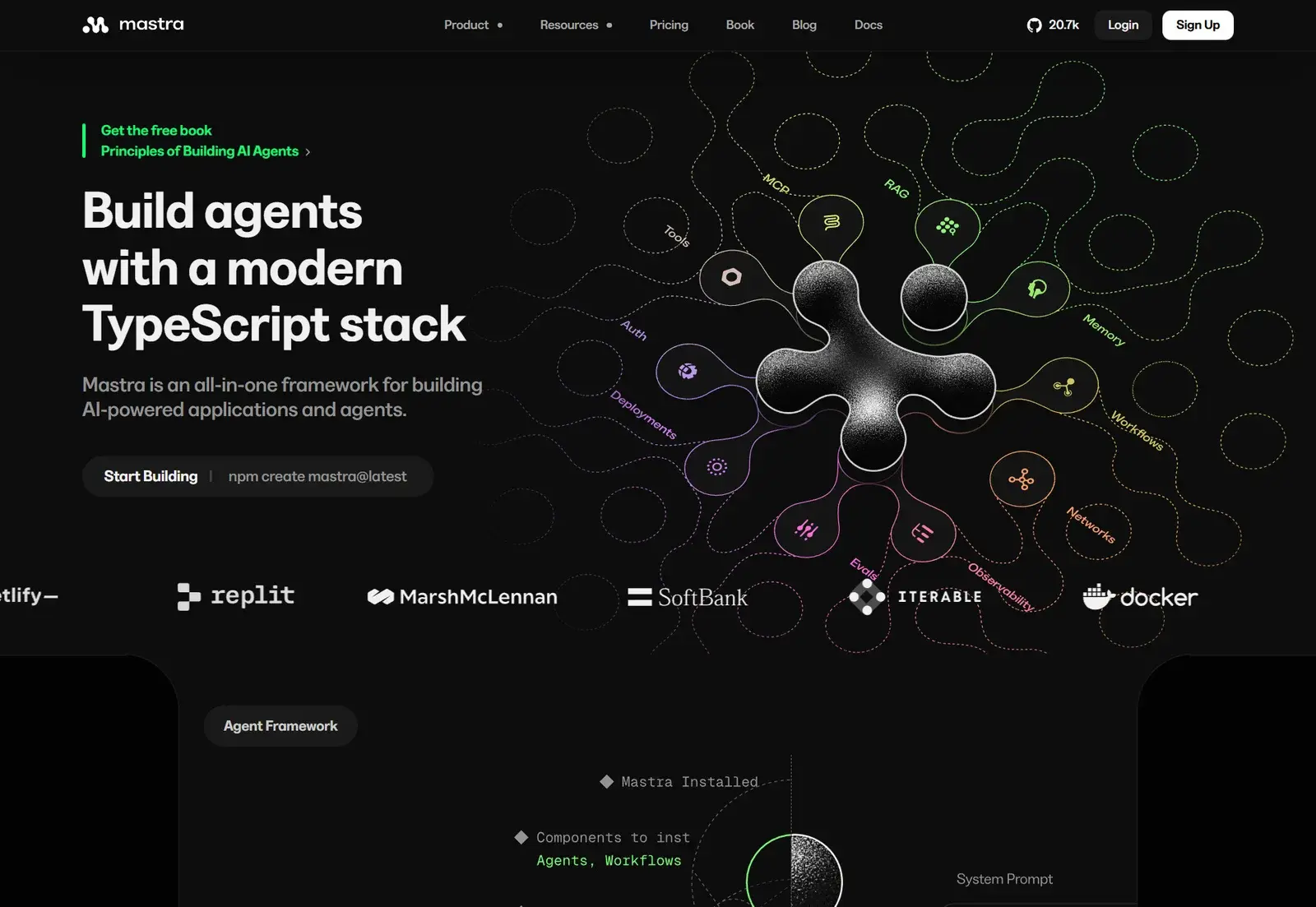
Mastra is an open-source TypeScript framework that gives developers every primitive needed to build production-grade AI agents and applications in a single, unified package — without stitching together half a dozen libraries that were never designed to work together. At its core, Mastra provides: typed agents that reason about goals and call tools autonomously; durable multi-step workflows with sequential, parallel, and conditional execution; persistent memory that learns about users over time with Observational Memory; a unified model router connecting 3,300+ models from 94+ providers via a single interface; built-in evals and observability with OpenTelemetry tracing; human-in-the-loop workflow suspension; and Mastra Studio — a local and cloud-based IDE for testing, debugging, and tuning agents without touching code. The entire framework runs in any Node.js or Bun environment and integrates natively with Next.js, React, Hono, Express, and Fastify.
Key Features
Unified Agent Primitives
Define typed agents with instructions, models, tools, and runtime behavior in a single object. Agents reason about goals, decide which tools to call, and iterate until the task is complete — all in plain TypeScript with full IDE autocomplete. No boilerplate, no configuration files scattered across your project.
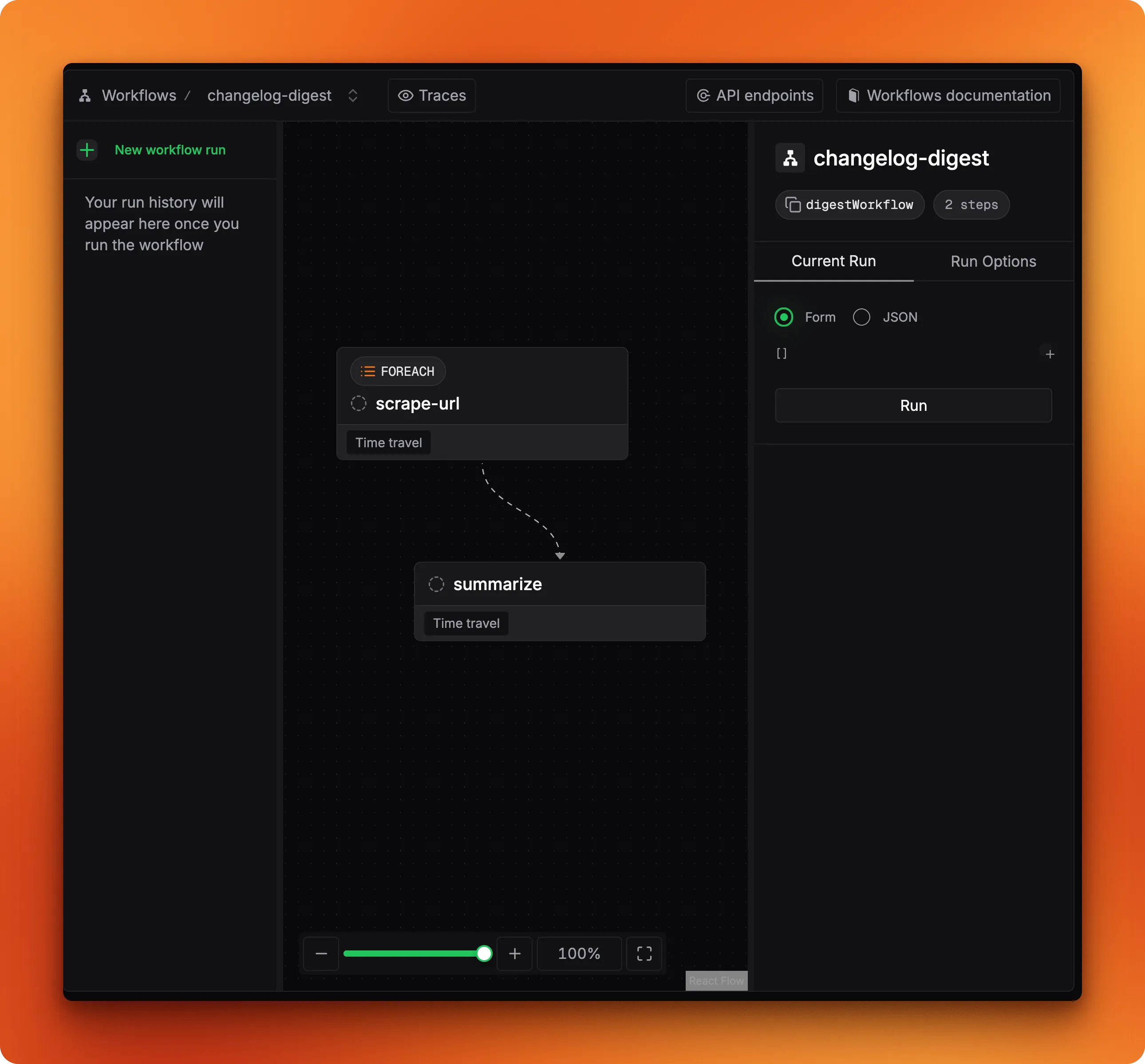
Durable Graph-Based Workflows
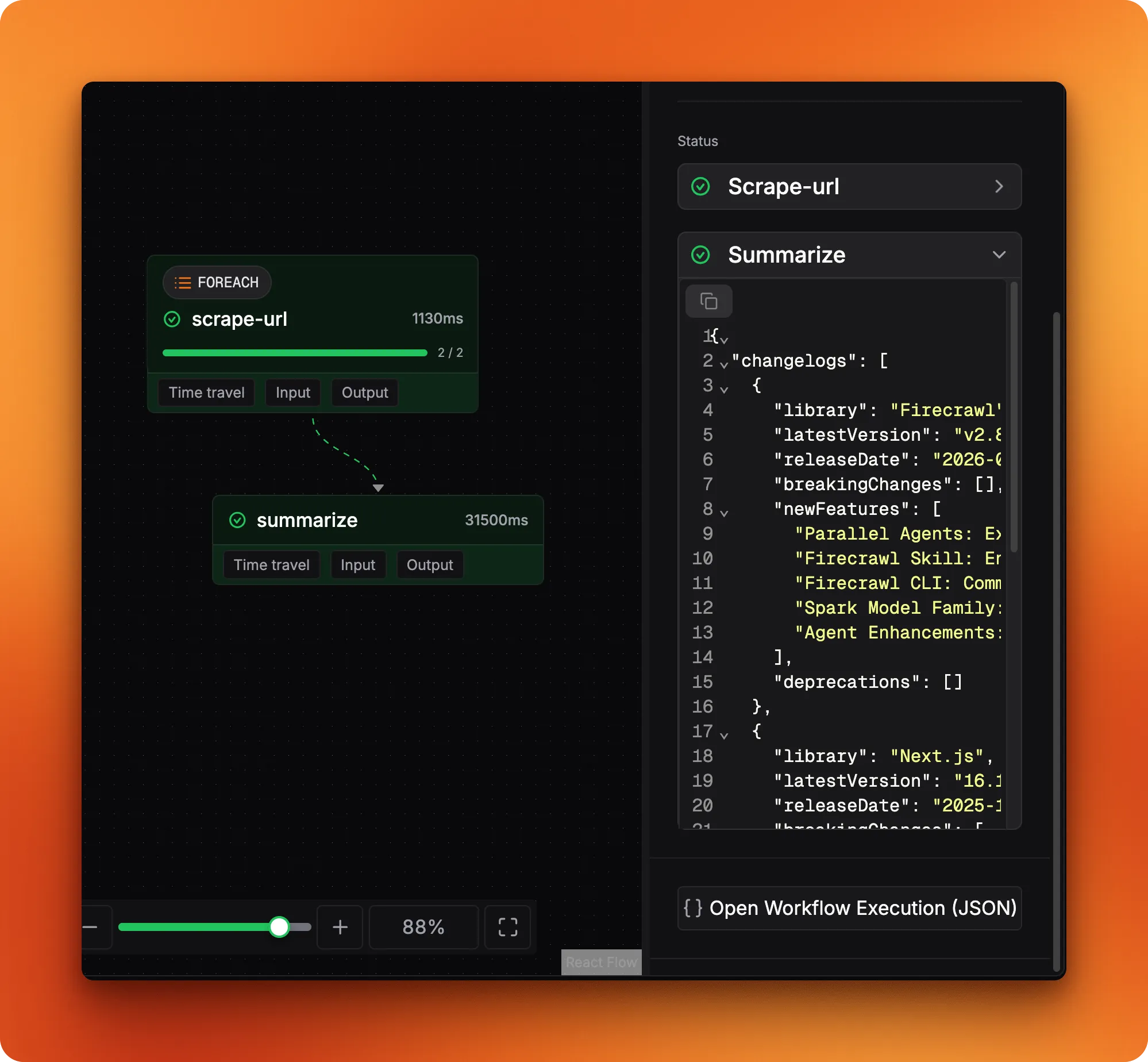
Orchestrate complex multi-step processes with .then(), .branch(), .parallel(), and .foreach() — mixing agent calls and deterministic code at each step. Any step can suspend for human approval and resume exactly where it stopped. State persists across restarts, so your workflows survive server deployments.
Observational Memory
A human-inspired memory system that scores ~95% on LongMemEval. Persists conversation context, learns user preferences automatically, and keeps context windows stable — even across long sessions. Two background agents (Observer and Reflector) compress old messages into dense observations, cutting token costs 4-10x.
3,300+ Model Router
Connect to OpenAI, Anthropic, Gemini, DeepSeek, Groq, Mistral, Llama, Ollama, and 90+ more providers through a single interface with automatic fallbacks, IDE autocomplete for model names, and zero config switching. Change providers by changing one string — no refactoring required.
Pricing Plans
| Plan | Price | What's Included |
|---|---|---|
| Open-Source (Self-Hosted) | Free | Apache 2.0 — Full framework, build and deploy anywhere, unlimited agents and workflows |
| Platform Starter | Free | Unlimited users and deployments — Mastra Studio cloud, observability dashboard, one-command deployment |
| Platform Teams | $250/month per team | Higher observability event limits, CPU time, data egress, and memory token quotas |
| Enterprise | Custom pricing | On-prem / VPC deployment, RBAC, SSO, audit logs, SLA support, dedicated engineer |
Pros & Cons
✓ What Makes It Shine
- ✅ 100% open-source under Apache 2.0 — self-host entirely for free
- ✅ Third-fastest-growing JS framework ever — 300K+ weekly npm downloads in one year
- ✅ All-in-one — agents, memory, workflows, evals, observability in a single package
- ✅ Mastra Studio — built-in visual IDE for testing and debugging agents without code
✗ Where It Falls Short
- ❌ TypeScript-only — Python developers should use LangChain, CrewAI, or AutoGen
- ❌ Rapidly evolving — some APIs still shifting; v3-to-v4 migrations required attention
- ❌ Platform cloud pricing ($250/mo Teams) is new — pricing details still maturing
- ❌ Smaller pre-built integration library than LangChain — more DIY tool authoring required
💡 Community Feedback: What Developers Say
How It Compares to Alternatives
| Feature | Mastra AI | LangChain | CrewAI | Vercel AI SDK |
|---|---|---|---|---|
| Language | TypeScript native | Python (JS port) | Python | TypeScript |
| Full Framework | YES — all-in-one | NO — piece together | PARTIAL | NO — LLM layer only |
| Built-in Studio | YES | NO | NO | NO |
| GitHub Stars | 22K+ | 100K+ | 44K+ | 14K+ |
| Memory System | Observational (95% LongMemEval) | Basic vector store | Short-term task memory | None built-in |
| Workflow Engine | Graph-based with suspend/resume | LangGraph (separate) | Task-based flows | None |
Mastra's comparison table reveals a clear pattern: it trades ecosystem breadth for depth and developer experience. LangChain has 100K+ stars and a massive integration library, but it's a collection of loosely coupled Python utilities with a JavaScript afterthought. CrewAI excels at multi-agent task orchestration but lacks the unified framework architecture. The Vercel AI SDK is excellent for frontend LLM integration but stops at the LLM layer — it doesn't handle memory, workflows, or observability. Mastra is the only option that gives TypeScript developers a complete, opinionated, production-ready agent framework out of the box. The developer experience benchmark from NextBuild (Dec 2025) scored Mastra 9/10 versus LangChain's 5/10 — a gap that reflects the fundamental architectural difference between a framework built for TypeScript and one ported to it.
Who Should Use Mastra AI?
Best For: TypeScript and full-stack developers building AI-powered SaaS products, internal copilots, customer support agents, research pipelines, and automation workflows. Teams already using Next.js, React, or Node.js who want to add AI agents without switching languages or adding a Python layer. Engineering orgs at Series A–C stage (50–500 employees) with TypeScript-native stacks who want production-grade AI infrastructure without hiring a dedicated ML team. Startups that need to ship AI features in weeks, not quarters, and want a framework that handles the hard infrastructure decisions by default.
Consider Alternatives If: You're a Python-first team deeply invested in the PyTorch or Hugging Face ecosystem — LangChain, CrewAI, or AutoGen will serve you better. You need a no-code or low-code visual builder — n8n or Gumloop are better fits. You only need basic LLM integration without agents, memory, or workflows — the Vercel AI SDK alone is simpler and lighter. You're building a research prototype where rapid iteration matters more than production stability — Smolagents or OpenAI's Agents SDK might be faster to spin up.
Expert Editorial Opinion
Mastra represents the most significant open-source developer tool in the AI agent space right now — and the trajectory backs it up. The Gatsby team spent a decade building a framework that hundreds of thousands of TypeScript developers adopted. They've applied exactly the same philosophy to AI: opinionated defaults, conventions over configuration, tight ecosystem integration, and a built-in developer experience layer (Mastra Studio) that most frameworks treat as an afterthought. The result is a framework where you can have a working agent in minutes, not days.
The investor roster for the $13M seed round and $22M Series A is a statement. Paul Graham, Guillermo Rauch (Vercel), Amjad Masad (Replit), Arash Ferdowsi (Dropbox), and Spark Capital — the firm that backed Twitter, Slack, and Linear — don't invest in projects speculatively. They invest in products they believe will become the default infrastructure layer for a generation of developers. The comparison to Rails is apt: Rails didn't win because it was the most powerful web framework, it won because it made the 80% use case effortless. Mastra is doing the same for AI agents.
The Hacker News thread from December 2025 where a 20-year veteran developer compared LangChain to "left-pad" and Mastra to "Next.js" is telling. The developer community has been waiting for a TypeScript-native AI framework with the same level of production polish they expect from their other tooling. Mastra's 22,000 GitHub stars, 300,000 weekly downloads, and enterprise deployments at PayPal and SoftBank confirm that wait is over. For TypeScript teams building AI products in 2026, Mastra is the framework to bet on.
One question remains: does the $250/month Teams tier make sense without a free tier for small teams? The Platform Starter is genuinely free with unlimited users, but the jump to $250 for Teams is steep for bootstrapped startups. The open-source self-hosted option removes this concern entirely, but cloud convenience comes at a price. For most teams, the free Starter tier plus self-hosted framework is more than enough to validate and scale before considering the paid tier.
Another consideration: Mastra's APIs are still evolving rapidly. The v1.0 release in January 2026 brought breaking changes, and the team ships multiple updates per week. This is a strength for early adopters who want cutting-edge features, but it requires teams to budget for migration work. The detailed changelogs and active Discord community (5,500+ members) mitigate this, but it's a factor for conservative engineering orgs.
Final Verdict
Mastra AI is the best open-source TypeScript framework for building production AI agents available today. The all-in-one architecture (agents, memory, workflows, evals, observability, Studio) eliminates weeks of infrastructure setup. The 3,300+ model router removes vendor lock-in entirely. The Apache 2.0 license and free Platform Starter tier make it zero-risk to start. And the Spark Capital Series A and $35M total funding signal the team has the resources to sustain and accelerate a multi-year roadmap. For TypeScript developers building AI products, this is a 9.3 out of 10.
🔗 Related ToolRadar Reviews
More tools from AI Developer Tools
- Is Aider the Best Free AI Coding Assistant in 2026?
- Why Replit Agent Is One of the Hottest AI Coding Tools Right Now
- v0.dev vs Bolt.new vs Cursor: Which AI Coding Tool Wins in 2026?
- Forget GitHub Copilot — Cursor 3 Just Changed Everything
- Devin AI 2026: The End of Junior Developers?
- The Devin Killer: Why Open-Source AI Is Winning
- Gumloop: Build AI Workflows Without Writing a Single Line of Code
- Zapier AI Review 2026: Automation Tool That Actually Thinks
❓ Frequently Asked Questions
So here's the real question: are you still stitching together Python libraries and praying your TypeScript AI agent doesn't break in production?
Because Mastra just proved that "convention over configuration" isn't a web development concept — it's the future of AI infrastructure. The only question left is whether you'll be an early adopter or a latecomer catching up.

Comments
Post a Comment