


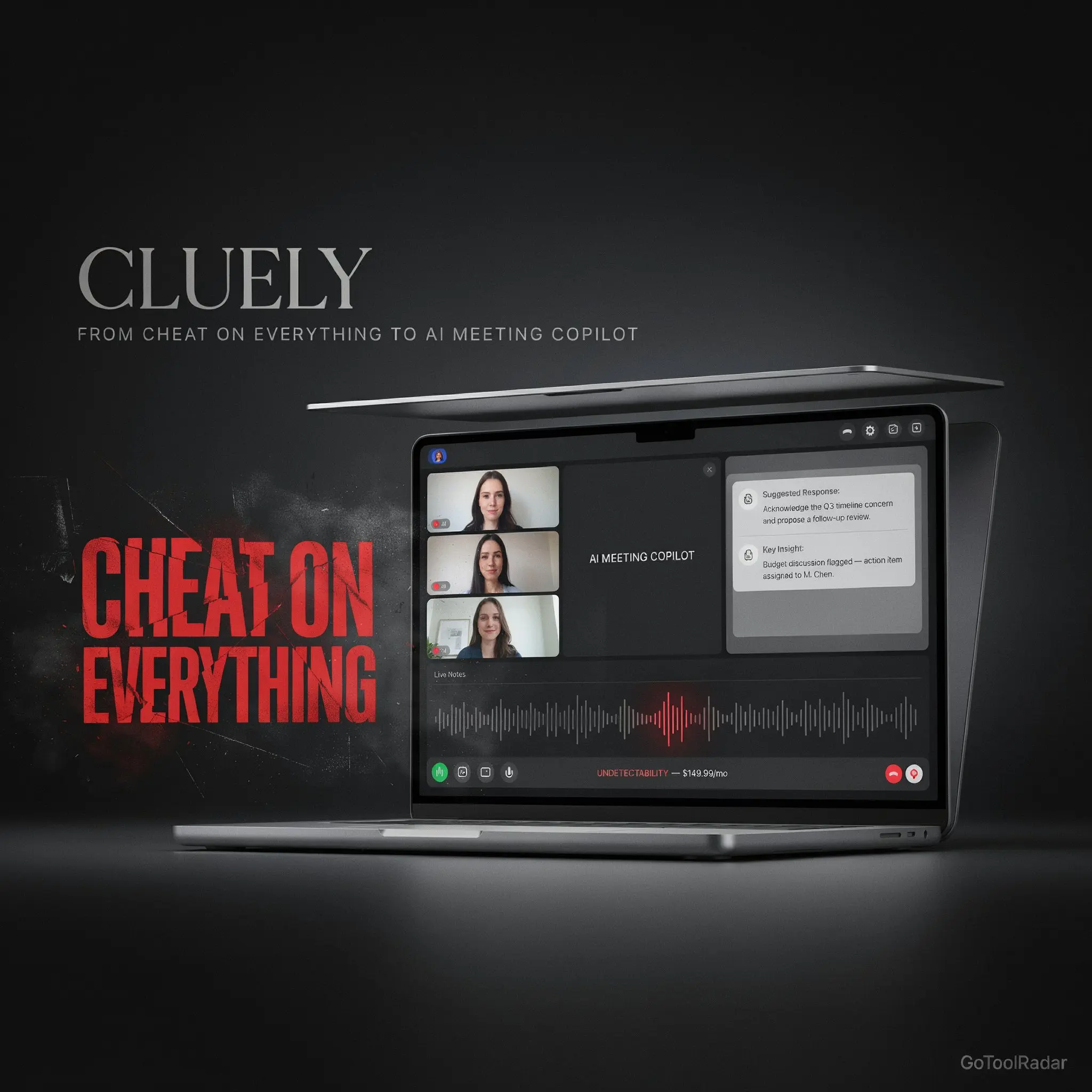
Cluely Review 2026: From "Cheat on Everything" to AI Meeting Assistant
Cluely built its brand promising covert AI help during interviews and calls. In 2026, it markets itself as a meeting copilot — but the controversial DNA is still visible in its pricing, and in its founder's own admitted lie about revenue.
📋 Table of Contents
Cluely review 2026: if you wrote this review as "an AI cheating app," you'd be describing 2025. If you wrote it as "a meeting assistant," you'd be missing why anyone remembers the name. Cluely raised $15 million from Andreessen Horowitz by selling the idea of covertly cheating on interviews and conversations. In 2026, it wants to be thought of as a real-time meeting copilot instead. Its most expensive plan is still called "Undetectability," and costs $149.99 a month.
This review covers what Cluely's product actually does today, its current pricing and the surprisingly large jump to its top tier, a public revenue-lie admission from its own CEO, a widely repeated but disputed data-breach claim, and how it compares to the meeting-AI competitors it's now positioning itself against. It's built from Cluely's own site and terms of service, original TechCrunch reporting, and independently verified third-party coverage — not a claim of hands-on testing of the product itself unless stated otherwise.
From "Cheat on Everything" to Meeting Copilot
Cluely's origin story is unusually direct about its intent. Founders Roy Lee and Neel Shanmugam were reportedly suspended from Columbia University after building and promoting Interview Coder, a tool designed to help users cheat during technical job interviews. That controversy became the launchpad: Cluely debuted in April 2025 with the tagline "Cheat on Everything" and a viral video of Lee using the tool to fake knowledge on a date. The company raised $5.3 million in seed funding, then $15 million in a Series A led by Andreessen Horowitz two months later — a16z's own investment post framed Cluely not as a cheating tool but as an early example of "proactive multimodal AI assistants."
By June 2025, cheating-on-interviews language had already started disappearing from Cluely's website. The tagline shifted to "Everything You Need. Before You Ask." By 2026, the company's blog was explicitly positioning the product against Otter, Fireflies, and Fathom as a real-time meeting assistant that helps "during the call, not after" — the opposite of the transcribe-then-summarize model those tools are built around. The cheating association didn't vanish from public perception, though — Reddit discussions in 2026 still show people asking whether Cluely's use in interviews can be detected, alongside others discussing it purely as a meeting productivity tool.
The $150 Question: What "Undetectability" Costs
This is the detail that undercuts the "we're just a meeting assistant now" framing more than anything else. Cluely's current pricing has three tiers: Starter (free, with limited AI responses and notetaking), Pro ($19.99/month), and Pro + Undetectability ($149.99/month, or roughly $44.99/month billed annually). The screen-share invisibility feature — the one that makes an overlay stay hidden from what other participants see when someone shares their screen — isn't in the $19.99 Pro plan at all. It's locked to the top tier, at close to 7.5 times the price of Pro on monthly billing.
Multiple independent pricing breakdowns published in 2026 confirm the gap and note it isn't prominently disclosed in Cluely's front-facing marketing — people frequently discover the real cost of the feature they came for only after digging into the pricing page. Some 2026 testing has found the undetectability claim itself holds up technically (the overlay genuinely doesn't appear in screen shares or recordings on that tier), but that same testing also measured real-world response times of 5-10 seconds against Cluely's advertised 300ms — a gap that matters a great deal if the use case is staying convincing in a live conversation.
The CEO Admitted He Lied About Revenue
In summer 2025, Roy Lee told TechCrunch that Cluely had reached $7 million in annual recurring revenue. On March 5, 2026, he posted on X that the number was false, calling it "the only blatantly dishonest thing I've said publicly online" and issuing what he called a formal retraction. The actual figures he shared alongside the admission: roughly $2.7 million in consumer ARR (with a $3.8 million run rate) and $2.5 million in enterprise ARR — combined, closer to $5.2 million than the claimed $7 million, real revenue and real growth, just meaningfully inflated in the public number.
Worth noting precisely because Lee's own retraction wasn't fully straight either: he described the original TechCrunch interview as stemming from "a random cold call from some woman asking about numbers," but TechCrunch's reporting shows the interview was proactively arranged by Cluely's own PR team, who emailed the reporter offering Lee for an interview. Lee's public response to the criticism that followed was an unapologetic, expletive-filled video rather than a further apology — consistent with a stated growth philosophy that treats controversy itself as a distribution channel rather than a problem to manage quietly.
A Breach Claim That May or May Not Be Real
This is a claim worth walking through carefully rather than repeating uncritically, because the sourcing is genuinely murky. Numerous review and comparison sites — several of them, notably, publishing content for directly competing "interview copilot" products — describe a mid-2025 incident in which a group calling itself "Ivy Dark Agent" allegedly exposed data from more than 83,000 Cluely users, including interview transcripts and screenshots, after admin credentials were reportedly left in a public GitHub repository.
Here's the problem: at least one independent investigation traced the claim back to a single anonymous Medium post and found no corresponding entry in Have I Been Pwned, the standard reference database security researchers use to verify breach claims. That doesn't prove the incident didn't happen — HIBP isn't exhaustive, and Cluely has not, to this review's knowledge, issued a clear public statement confirming or denying it. But it does mean this specific figure should be treated as an unverified, widely repeated claim rather than a confirmed fact, and readers should be skeptical of any source — including several cited as "evidence" for it — that has a direct commercial incentive to make a rival AI-assistant product look unsafe.
The Compliance Cloud
Separately from the disputed breach claim, there's a real, TechCrunch-confirmed story worth knowing if you're evaluating Cluely's security posture: in March 2026, an anonymous whistleblower's investigation alleged that Delve — a compliance-automation startup that issued SOC 2, ISO 27001, and similar certifications to hundreds of clients — had been generating audit conclusions before evidence was even reviewed, using unaccredited firms to rubber-stamp the results. TechCrunch confirmed the allegations were serious enough that Y Combinator removed Delve from its portfolio and that other Delve clients suffered separate security incidents afterward.
Whether Cluely specifically relied on Delve for its own compliance claims isn't something this review can confirm from a primary source — the only source connecting the two is a third-party blog, not Cluely's own disclosure or a mainstream outlet naming Cluely specifically. What's fair to say is broader and still relevant: 2026 was a bad year for trusting SOC 2 and ISO badges at face value industry-wide, and any AI tool's compliance claims — Cluely's included — are worth verifying against the actual issuing auditor rather than taking the badge as self-explanatory.
What Cluely Actually Does
Real-Time Listening
Cluely listens to live conversation audio and reads on-screen context, then surfaces an answer in an overlay when the user presses a keyboard shortcut — assistance during the call, not after it.
No Meeting Bot
Unlike Otter, Fireflies, or Fathom, Cluely doesn't join calls as a visible participant — it captures audio at the device level, working across Zoom, Google Meet, Microsoft Teams, Webex, and Slack calls.
Post-Meeting Notes
Generates meeting notes and suggested next steps after the call ends, and lets users ask questions about past meetings — functionally similar to what dedicated notetakers offer.
12+ Languages
Cluely states support for more than 12 languages, alongside claims of 300ms response time and 95% transcription accuracy — company-reported figures without independent benchmark confirmation.
| Plan | Price | What it includes |
|---|---|---|
| Starter | $0 | Limited AI responses, limited meeting notetaking, custom instructions, file uploads |
| Pro | $19.99/mo | Unlimited AI responses and notetaking, latest AI models, priority support — no undetectability |
| Pro + Undetectability | $149.99/mo | Everything in Pro, plus a screen-share-invisible overlay — roughly $44.99/mo billed annually |
Cluely vs. Otter vs. Granola vs. Fireflies
| Tool | Core Approach | Meeting Capture |
|---|---|---|
| Cluely | Real-time in-call assistance, notes after | Device-level, no visible bot |
| Otter | Transcription and post-meeting summaries | Bot joins the call |
| Fireflies | Meeting intelligence with sales/workflow integrations | Bot joins the call |
| Granola | AI notepad built around the meeting, not during it | Device-level, no visible bot |
Granola is the closest structural comparison, since both avoid the visible-bot approach — but the philosophies still diverge. Granola's core idea is an AI notepad that helps you organize what happened; Cluely's core idea is live, in-the-moment assistance while the conversation is still happening, with notes as a secondary output. Otter and Fireflies remain the more established, transcription-first options, with larger integration ecosystems and a more conventional trust profile, unclouded by the controversy history covered above.
Strengths and Real Limitations
✓ What Cluely Gets Right
- ✅ A genuinely different mechanism — live, in-call assistance rather than only after-the-fact summaries
- ✅ No visible meeting bot, working across Zoom, Meet, Teams, Webex, and Slack calls
- ✅ A real, if limited, free Starter tier to test the core workflow
- ✅ 2026 independent testing confirms the top-tier undetectability feature works technically as advertised
✗ Where to Be Careful
- ❌ The company's own CEO admitted publicly to fabricating a headline revenue figure in 2025
- ❌ The feature the brand is most associated with is gated behind a $149.99/month tier, priced far above every direct competitor
- ❌ Independent 2025 testing (Business Insider, The Verge) found hallucinations, latency, and reliability issues; 2026 third-party testing still measured 5-10 second lag against a claimed 300ms
- ❌ A widely repeated 83,000-user breach claim traces to a single unverified anonymous source and isn't confirmed in standard breach databases — treat it as disputed, not settled
- ❌ Privacy page language ("we don't train on your data") sits alongside broader Terms of Service authorization for Free/Pro customer data to be used in AI/ML training unless separately agreed otherwise
- ❌ Reported 24-hour, video-proof refund windows and billing complaints in independent coverage
Who Cluely Is Actually For
Setting aside the interview-cheating use case this review does not endorse, Cluely's legitimate audience is people who want live, in-the-moment AI assistance during sales calls, customer support conversations, or fast-moving meetings — a genuinely different job than a transcription tool solves. Anyone specifically drawn to the product because of its "undetectable" positioning should understand plainly that using AI assistance covertly in a job interview, exam, or professional evaluation without disclosure is a decision with real ethical and, in many contexts, contractual or academic-integrity consequences — this review describes what the product does, not a recommendation to use it that way.
For legitimate meeting-assistant use, Cluely is a weaker choice right now than better-established, less controversy-laden alternatives unless its specific real-time-during-the-call mechanism is something you specifically need and can't get elsewhere — the trust issues detailed above (the ARR admission, the disputed breach claim, the compliance uncertainty) are real reasons to weigh it more cautiously than a comparably priced competitor without that history.
Expert Editorial Opinion
The honest way to read Cluely in 2026 isn't "reformed cheating app" or "still secretly a cheating app" — it's a company that discovered controversy is a distribution channel, built an entire growth strategy around that insight, and is now trying to keep the audience that controversy bought while selling a more legitimate-sounding product to a broader market. Those two goals are in real tension, and the pricing structure makes that tension visible in a way no amount of rebranded messaging can paper over: the feature that made Cluely famous is still there, still central to the product, and now costs 7.5 times more than the "normal" plan.
The ARR admission is the single most important data point in this review, and not because $7 million versus $5.2 million is a large gap in absolute terms — plenty of startups round optimistically. It matters because of what it reveals about decision-making under pressure: Lee had a PR team proactively pitch a journalist, gave a specific false number in that interview, let it circulate for nine months, and when he finally corrected it, misdescribed how the interview came about in the same breath as the correction. That's a pattern, not an isolated slip, and it's a reasonable basis for extra skepticism toward every other unverified claim the company makes — including the 95% accuracy and 300ms latency figures cited earlier in this review.
The disputed breach claim deserves unusually careful treatment, and I want to be explicit about why this review didn't just repeat it as fact the way a lot of other coverage has. Several of the loudest sources for the 83,000-user figure are themselves selling competing "interview copilot" products with an obvious financial interest in making Cluely look unsafe. That doesn't make the claim false — but it's exactly the kind of unverified, source-thin, competitively-motivated claim that responsible coverage should flag rather than amplify. Readers deserve to know both that the claim exists and widely circulates, and that it hasn't been independently confirmed through standard breach-verification channels.
What's genuinely interesting, separate from all the controversy, is that the underlying product bet — real-time assistance during a conversation instead of only after it — is a legitimate and differentiated idea. Sales reps, support agents, and people in fast-moving meetings have a real use case for in-the-moment AI help that Otter's after-the-fact model doesn't serve. It's a shame, in a sense, that the most interesting part of this story is buried under so much that has nothing to do with product quality.
Would I recommend it? For the legitimate real-time-assistance use case, cautiously, and only after weighing the trust issues above against better-established alternatives that don't carry the same baggage. For anyone drawn to the product specifically for its "undetectability," this review isn't the place for that guidance — the honest, complete answer includes real ethical and consequential risk that a pricing table can't capture.
Final Verdict
Score band: Under 6.0 — Do not buy at current pricing: a legitimately differentiated real-time-assistance mechanism undermined by a self-admitted revenue lie, a steep, poorly disclosed price jump for the product's signature feature, and unresolved trust and compliance questions that better-established competitors don't carry.
| Dimension | Weight | Score /10 | Why |
|---|---|---|---|
| Technical quality | 30% | 6.0/10 | A genuinely different real-time mechanism, offset by both older independent testing and 2026 third-party checks finding real latency gaps versus advertised figures |
| Price-to-value | 25% | 6.0/10 | A reasonable $19.99 Pro tier undercut by a 7.5x price jump, not prominently disclosed upfront, for the feature the brand is built around |
| Maturity & documentation | 20% | 5.0/10 | A two-year-old, evolving product with real functionality, weighed down by a founder's admitted public dishonesty about a headline business metric |
| Ceiling & flexibility | 15% | 7.0/10 | Broad platform support (Zoom, Meet, Teams, Webex, Slack) and a genuinely distinct real-time-plus-notes workflow give this real room to be useful |
| Honesty of positioning | 10% | 4.0/10 | The admitted ARR fabrication, the gap between privacy-page language and broader Terms of Service training authorization, and an unresolved compliance-certification cloud industry-wide all weigh against this dimension |
Weighted calculation: (6.0×0.30) + (6.0×0.25) + (5.0×0.20) + (7.0×0.15) + (4.0×0.10) = 5.75, shown as 5.8.

Comments
Post a Comment