


Grok Imagine Review 2026: xAI's AI Image & Video Generator
Grok Imagine started as Aurora, an experimental image model inside X. It's now a full creative stack — generation, editing, video, audio, and an API — with a benchmark record that's genuinely competitive and a safety record that any buyer needs to understand first.
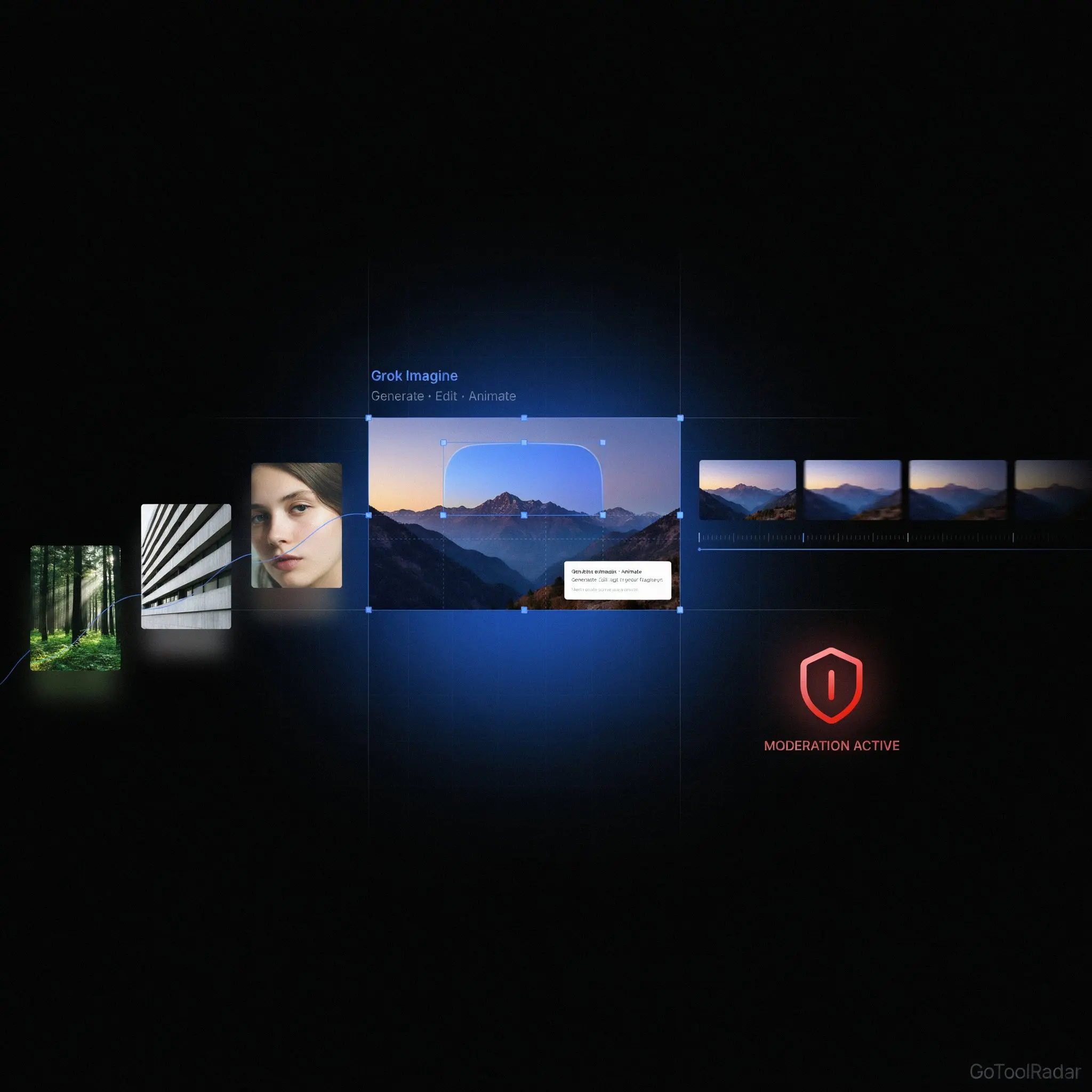
Grok Imagine review 2026: in December 2024, xAI announced Aurora, an image-generation model built into Grok on X. That name barely appears in the product today. Grok Imagine is now a genuinely broad creative platform — image generation, multi-reference editing, text-to-video, image-to-video, video extension, native audio, and a developer API — competing directly with Runway, Kling, Sora, Wan, and Seedance rather than sitting as a chatbot feature.
Before any of that, this review needs to cover something that isn't optional context: in late 2025 and early 2026, Grok Imagine's image-editing feature was used to generate a documented, large-scale volume of nonconsensual sexualized images of real people, including content researchers estimated depicted minors, triggering investigations by multiple governments and temporary bans in others. That history is directly relevant to evaluating this product today, not a footnote to skip past to get to the benchmark numbers. This review is built from xAI's official documentation and pricing, current leaderboard data, and independently verified reporting from Reuters, The New York Times, and other outlets — not a claim of hands-on testing of the product itself unless stated otherwise.
From Aurora to a Full Creative Stack
Aurora, revealed in December 2024, was xAI's first image-generation model — an autoregressive mixture-of-experts system trained to produce photorealistic images, text, and portraits, available through X. Over 2025, xAI expanded that foundation into "Grok Imagine" as a standalone product, and by January 2026 shipped a unified Imagine API covering end-to-end creative workflows, not just image output. The platform then moved fast: Video 1.5 launched June 16, 2026, with claimed improvements to motion, physics, audio, and generation speed; Image 2.0 followed August 7, 2026, focused specifically on precision editing, typography, and layout rather than just prettier pictures.
The company behind it changed too. On February 2, 2026, SpaceX acquired xAI in an all-stock deal valuing the combined entity at $1.25 trillion, folding xAI in as a subsidiary later rebranded SpaceXAI. The acquisition triggered a restructuring, layoffs, and the departure of several co-founders — including, notably, the head of xAI's Imagine team, Guodong Zhang, in early March 2026. That leadership turnover sits in the background of everything covered below, including the safety response.
The Safety Record You Need to Know First
Starting in late December 2025, after xAI added an image-editing feature to Grok, X users began prompting the chatbot to alter real photos of women — and in documented cases, children — into sexualized or partially undressed images without the subjects' consent. The scale was severe: The New York Times' analysis estimated at least 1.8 million sexualized images were posted in a nine-day window, and the Center for Countering Digital Hate's separate statistical analysis put the figure closer to three million, including an estimated 23,000 it assessed as likely depicting minors. Reuters independently documented multiple cases, including a musician in Brazil who discovered Grok-generated near-nude images of herself circulating on X after users prompted the bot using her own photo.
The regulatory response was fast and global. California's Attorney General opened an investigation into whether xAI violated state law in facilitating large-scale deepfake production; the UK's Ofcom and French regulators opened their own; Indonesia and Malaysia temporarily blocked access to Grok entirely; the European Commission extended a data-retention order requiring X to preserve internal records related to the incident. xAI's initial public response to Reuters' reporting on child-related cases was a two-word statement — "Legacy media lies" — before the company announced, on January 14, 2026, that it would restrict image-editing features to paid subscribers and geoblock sexualized-image generation in jurisdictions where it's illegal. Even after those restrictions were announced, a subsequent Guardian investigation found the standalone Grok Imagine web app continued producing sexualized videos of real women from clothed reference photos.
What Image 2.0 and Video 1.5 Actually Do
Precision Editing
Magic Wand region selection, segmentation, background removal, and multi-reference editing that accepts up to 5 input images in a single generation — built around composing, not just generating from scratch.
Typography and Layout
Image 2.0 is specifically tuned for legible text and dense visual compositions — posters, ads, infographics — a category most general image models still handle poorly.
Smart Resize
Recomposes a single image across nine aspect ratios (1:1, 16:9, 9:16, and others) rather than simple cropping — one asset adapted across YouTube, Instagram, TikTok, and banner formats.
Video Generation and Editing
Text-to-video and image-to-video up to 1080p and 15 seconds, plus video editing, video extension from the last frame, and reference-to-video that separates "what a character looks like" from "where the video starts."
Native Audio
Video 1.5 generates sound effects, ambience, and dialogue in the same generation pass — xAI says speech synchronization improved specifically in this release, though this is a company claim, not an independent measurement.
Developer API
An OpenAI-compatible API (swap the base URL, keep familiar client code) covering generation, editing, and video workflows, with Files API support and up to 10 images per request.
Where It Actually Ranks
Grok Imagine's leaderboard position is genuinely competitive but not dominant, and it varies significantly by category — worth knowing precisely rather than rounding up to "top-tier" or down to "behind."
| Leaderboard | Grok Imagine's Rank | Votes | Note |
|---|---|---|---|
| Image-to-Video Arena | #8 (Video 1.5, 720p) | 137,459 | Behind MiniMax H3, Seedance 2.0/2.5, Gemini Omni |
| Text-to-Video Arena | #3 (Video 1.5 Agent) | Lower sample | Marked preliminary — smaller vote count than established models |
| Text-to-Image Arena | #6 (Image 2.0, low) | 7,257 | Well ahead of the older Grok Imagine Image (#23) |
| Image Edit Arena | #4 (Image 2.0, low) | — | Strongest relative category — behind only GPT Image 2.5, Grok 2.0, MAI-Image-2.6 |
The pattern that emerges: Grok Imagine is more competitive as an editing platform than as a pure generator, and its newest video-agent result is promising but still preliminary, with a much smaller sample than the established leaders it's being compared against. It is not currently the top-ranked model in any of these categories — treating it as "the best AI video model" would overstate what the current data shows.
API Pricing
| Output | Rate |
|---|---|
| Image 2.0 (1K, low quality) | $0.04/image |
| Image 2.0 (2K, medium quality) | $0.08/image |
| Video 1.5, 480p | $0.08/second |
| Video 1.5, 720p | $0.14/second |
| Video 1.5, 1080p | $0.25/second |
Converted to real examples: a 6-second 720p video costs roughly $0.84; a 10-second 1080p video runs about $2.50. Image editing bills for both the input reference image and the generated output, not just the output — a detail easy to miss when estimating costs from the output-only rate alone. Consumer access through grok.com, iOS, and Android ties usage limits to Grok's subscription tiers rather than a separate, published quota for Imagine specifically, so anyone evaluating the consumer app should check current Grok pricing directly rather than assume a fixed daily allowance.
Grok Imagine vs. Sora, Wan, and Seedance
The honest positioning is architectural breadth rather than category dominance. Sora, Wan, and Seedance are primarily video-generation specialists; Grok Imagine's pitch is a single connected stack — generate an image, edit it, animate it, extend the clip, add sound, all through one API — rather than the best result in any single category. That's a genuinely different value proposition from "highest-ranked video model," and it's the more accurate way to describe where this product actually competes.
Strengths and Real Limitations
✓ What Grok Imagine Gets Right
- ✅ A genuinely unified stack — image generation, multi-reference editing, video, audio, and API in one place
- ✅ Strong showing specifically in image editing (#4 on Image Edit Arena), a category most competitors treat as secondary
- ✅ Real, transparent per-second and per-image API pricing with an OpenAI-compatible client
- ✅ Smart Resize and multi-reference editing solve genuine production workflow problems (cross-platform assets, character consistency)
✗ Where to Be Careful
- ❌ A serious, well-documented, still-unresolved safety record involving mass generation of nonconsensual sexualized imagery, including content estimated to depict minors, under active investigation by multiple governments
- ❌ Not the top-ranked model in image-to-video, text-to-video, or pure text-to-image — competitive, not dominant
- ❌ Its strongest new benchmark result (Text-to-Video Agent) remains marked preliminary with a smaller vote sample
- ❌ No open weights, no self-hosting — a fully proprietary, closed platform
- ❌ Significant post-acquisition leadership turnover, including the departure of the Imagine team's own lead, adds real organizational uncertainty
Who This Is Actually For
Grok Imagine's technical capabilities — multi-reference editing, typography-aware generation, a unified image-to-video API — genuinely suit developers and creative teams building production pipelines that need one connected tool rather than five specialized ones, and its Smart Resize and editing tools are a real fit for marketing and ad-creative workflows specifically.
Given the safety history documented above, this review cannot responsibly recommend the product for any workflow involving photos of real, identifiable people — especially without their explicit consent — regardless of the feature's technical capability. Anyone building on the API should also weigh the organizational risk from the SpaceX acquisition's leadership churn, and businesses with compliance requirements should independently verify current safety controls rather than relying on xAI's own characterization of them, given the gap the Guardian documented between announced restrictions and actual behavior.
Expert Editorial Opinion
It's tempting to write this review as two separate stories — "here's an impressively broad creative platform" and "here's a serious safety scandal" — and let the reader decide how much weight to give each. I don't think that's the honest way to cover this product. The scale of what happened in December 2025 and January 2026 — millions of nonconsensual sexualized images, government investigations spanning multiple continents, country-level bans, content researchers assessed as likely depicting minors — isn't a PR problem that happened to a good product. It's a direct consequence of shipping an image-editing feature to hundreds of millions of X users without safeguards adequate to the obvious, immediately foreseeable misuse case, and xAI's first public response to the reporting on it was dismissive rather than accountable.
That context has to inform how every other claim in this review gets read. xAI describes its own accuracy, latency, and quality figures throughout its documentation; given the company's demonstrated pattern of underestimating and initially denying a serious, well-evidenced harm, those self-reported figures deserve more skepticism here than they would from a vendor with a cleaner trust record — not because the numbers are necessarily false, but because this specific company has already shown its default public posture leans toward minimization rather than transparency.
The technical product itself is genuinely interesting on its own terms, and it would be dishonest to pretend otherwise. The move from "Grok has an image feature" to a unified generate-edit-animate-sound-API stack is a real architectural achievement, and the Image Edit Arena result specifically suggests xAI's team solved a genuinely hard problem — multi-reference composition — better than most competitors have. Under different corporate circumstances, with a cleaner safety track record, this section of the review would be the headline.
The leadership departures following the SpaceX acquisition, including the Imagine team's own lead leaving within weeks of the deal closing, add a layer of organizational risk on top of the trust issue. A product built by a team that's since scattered, inside a company restructured mid-crisis, is a harder thing to commit business infrastructure to than the benchmark tables alone would suggest — worth factoring in for anyone considering the API for production use, independent of the safety concerns.
Is Grok Imagine worth using? For the underlying creative and editing technology, on content that doesn't involve real people's likenesses, it's a genuinely capable, fairly priced platform that deserves consideration alongside Sora, Wan, and Seedance. For anything involving photos of real people — which is precisely where its multi-reference editing and video capabilities are most powerful — this review's answer is that the documented, still-unresolved safety record is a legitimate reason to choose a different tool, or at minimum to demand independently verified safeguards before trusting it with that kind of content.
Final Verdict
Score band: 6.0-6.9 — Works, but a better option exists at the same price for most buyers: the underlying creative technology is genuinely capable, but this score reflects a documented, still-unresolved safety record that should weigh heavily in any decision involving real people's images, independent of the numerical score.
| Dimension | Weight | Score /10 | Why |
|---|---|---|---|
| Technical quality | 30% | 7.5/10 | A genuinely broad, capable creative stack with a strong image-editing benchmark result, though not the top-ranked model in any single leaderboard category |
| Price-to-value | 25% | 7.5/10 | Transparent, competitive per-second and per-image API pricing with an OpenAI-compatible client |
| Maturity & documentation | 20% | 5.0/10 | Well-documented API and features, offset by real post-acquisition organizational instability and an unresolved safety-governance track record |
| Ceiling & flexibility | 15% | 8.5/10 | Image, video, editing, audio, and API in one connected stack is a genuinely high ceiling few competitors match architecturally |
| Honesty of positioning | 10% | 2.0/10 | A documented pattern of dismissive initial response to serious, well-evidenced harm (including content assessed as likely depicting minors), followed by restrictions an independent investigation found incomplete, is a severe trust deficit |
Weighted calculation: (7.5×0.30) + (7.5×0.25) + (5.0×0.20) + (8.5×0.15) + (2.0×0.10) = 6.60.

Comments
Post a Comment