


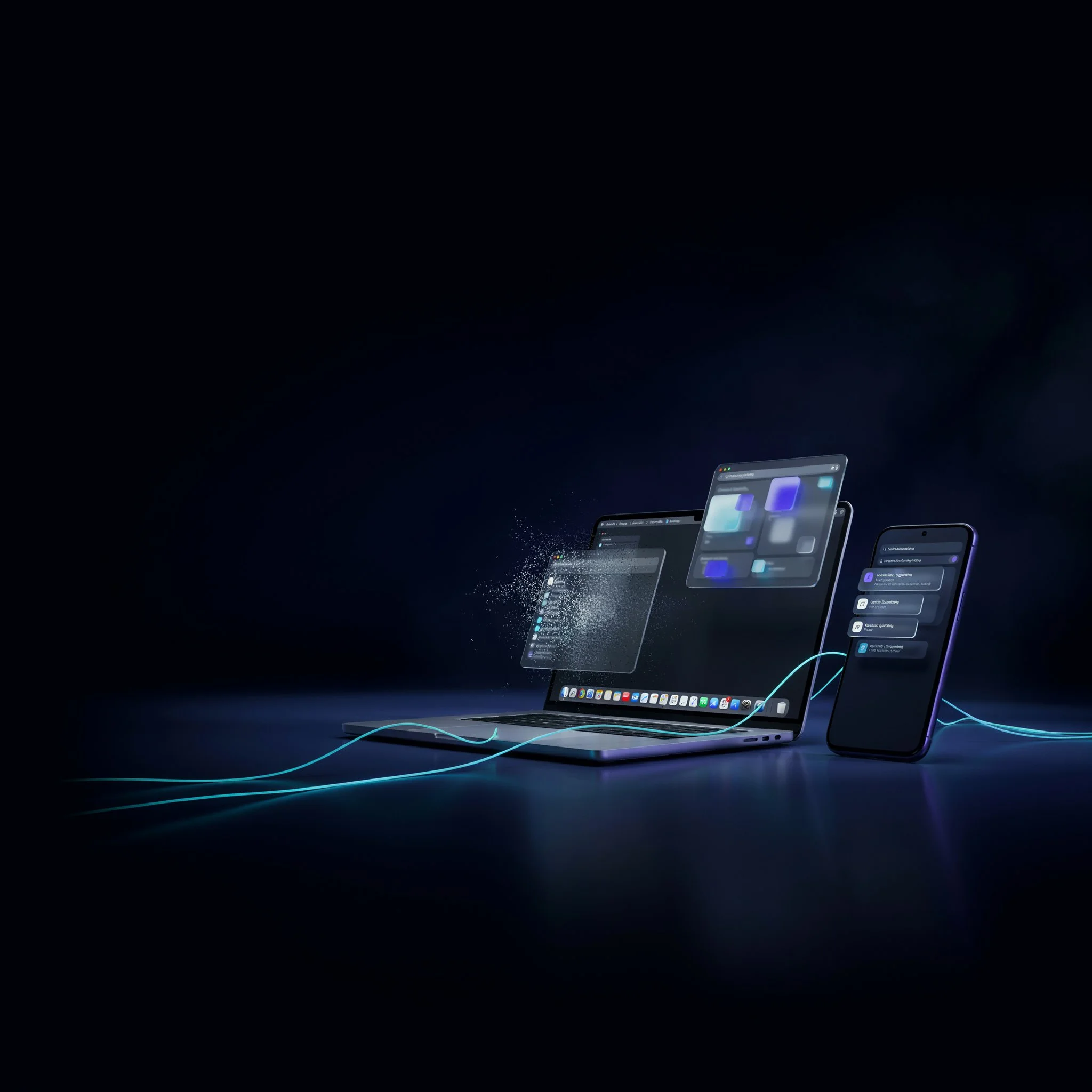
Is AI Actually Disappearing? Inside 2026's Shift From Chatbots to Invisible, Ambient Intelligence
Apple, Google, and Microsoft are all racing to pull AI out of the chat box and into the operating system itself — a look at what's actually shipping versus what's still a promise.
For roughly three years, "AI" meant a text box. You opened an app, typed a prompt, and waited for a reply. That model is quietly being dismantled by the same companies that built it. In 2026, the biggest AI announcements from Apple, Google, and Microsoft aren't about smarter chatbots — they're about making the chatbot optional, folding intelligence directly into autofill fields, browser tabs, notification centers, and the cursor itself.
This piece isn't a review of a single tool, because there isn't one yet that defines this shift. It's a confidence-rated look at how far "invisible AI" has actually progressed — separating what's shipping on real devices today from what's still a keynote slide or a rumored gadget.
That's the pitch, at least. Whether the industry can deliver it without confusing users who suddenly can't tell what the AI just did on their behalf is a separate question — one this article tries to answer honestly rather than optimistically.
Where Invisible AI Is Already Running
Autofill That Reads Your Life, Not Just Your Clipboard
Google's Gemini Intelligence bundle for Android includes a Personal Intelligence layer that pulls details from on-device personal sources to complete forms automatically — booking a parking spot, updating a shipping address, or checking product stock without the user typing anything into a chat window.
The Browser That Acts, Not Just Answers
Gemini in Chrome now works across open tabs to compare and summarize sources, and Google has begun rolling out an "auto-browse" capability designed to carry out small multi-step tasks — like booking an appointment — directly from the browser sidebar, without the user narrating each step.
Writing and Notifications That Summarize Themselves
Apple Intelligence's systemwide Writing Tools proofread and rewrite text inside Mail, Notes, Pages, and third-party apps without a separate assistant window, while Priority Notifications quietly triage and summarize incoming alerts so the most relevant ones surface first.
A "Systems" Layer, Not a Feature
Microsoft has framed its direction publicly as a "Golden Age of Systems" — adaptive infrastructure across Windows and Office that responds to context rather than waiting for explicit commands. It's a broader, more enterprise-leaning bet than a single AI feature, and it's still earlier in public rollout than Apple's or Google's consumer-facing pieces.
A Screenless Device — Still Unshipped
Reporting throughout early 2026 has described a voice-first, screenless hardware project from OpenAI, developed with designer Jony Ive's studio LoveFrom, aimed at a "Fall 2026" launch. As of this article's publish date, no public prototype has shipped — it belongs firmly in the "watch, don't assume" category.
Apple vs. Google vs. Microsoft's Approach
Built around Private Cloud Compute, which processes server-side requests on Apple silicon and does not retain the content of those requests. At WWDC26, Apple confirmed it is now blending Google's Gemini models into its own foundation layer for heavier reasoning tasks, while keeping the on-device, privacy-first architecture as the default. The trade-off is pace: several outlets covering the June 2026 announcements noted that a meaningful share of the new Apple Intelligence features will likely go unused simply because they're easy to miss inside existing apps.
The most aggressively shipped of the three. Google has already pushed cross-tab summarization, agentic auto-browse, and Android autofill into general availability across multiple regions through 2026, ahead of Apple's equivalent features reaching most users. The cost is transparency: because Gemini is cloud-first, more of the "thinking" happens off-device than with Apple's approach, which is a real consideration for privacy-sensitive users.
Less a shipped feature set than a stated direction from CEO Satya Nadella — adaptive systems across Windows and the Microsoft 365 stack that respond to context instead of explicit prompts. It's the vaguest of the three commitments right now, largely because Microsoft's rollout is weighted toward enterprise and Copilot integrations rather than a single consumer-visible moment like WWDC or a Chrome update.
The Trade-Offs Nobody Advertises
Who Should Actually Care Right Now
Worth watching closely if: you're a product or marketing professional tracking how OS-level AI changes user expectations, a developer building anything that needs to plug into these emerging platform layers, or someone who wants to understand new device permissions before they get toggled on by default during the next software update.
Can safely wait if: your current chatbot-based workflow already works well for you, you'd rather see independent security audits of these "always listening for context" features before enabling deeper permissions, or you don't have the bandwidth right now to test beta ambient features that are still rolling out region by region.
Expert Editorial Opinion
The evidence that "invisible AI" is a real shift, not just a marketing phrase, is genuinely strong. Three separate companies with three different incentive structures — Apple's privacy-first hardware business, Google's ad-and-search business, and Microsoft's enterprise-software business — have independently converged on the same conclusion within the same twelve months: users don't want to manage an AI, they want the outcome without thinking about the AI at all.
But strong directional evidence isn't the same as mature execution, and that gap is where most of the current coverage gets too generous. Apple's own announcements at WWDC26 leaned heavily on architecture — Private Cloud Compute, a redesigned Siri, a partnership with Google for heavier reasoning — while several tech outlets covering the event independently flagged that a large share of the actual feature list will go unnoticed by ordinary users simply because nothing in the interface tells them it exists. Google's Gemini Intelligence is shipping faster and more visibly, but it's also the most cloud-dependent of the three, which quietly shifts more of the privacy calculation off the device and onto trust in Google's infrastructure. Microsoft's framing is the most ambitious in language and the least concrete in what's actually available to a regular user today.
There's also a control paradox worth sitting with: the more invisible the AI becomes, the harder it is to notice when it's wrong. A chatbot that gives a bad answer is obviously wrong — you read the text. An autofill system that quietly books the wrong appointment or an OS layer that summarizes a notification incorrectly fails silently, and most users won't think to double-check something they never explicitly asked for.
The rumored screenless hardware project tied to OpenAI and designer Jony Ive is the clearest illustration of how much of this trend is still speculative. It's a compelling story — a device with no screen, built by the person who helped define the iPhone's interface — but as of this article's publish date it remains unshipped, and coverage of it should be read as informed reporting, not confirmed product fact.
So is this worth following in 2026? Yes, without much hesitation. Is it worth changing how you work around today, before independent audits and wider public rollout have had time to catch problems? For most people, probably not yet — this is a trend to track closely, not a product category to commit to.
If the AI disappears, who do you actually trust to notice when it's wrong?
That's the question every "invisible AI" pitch conveniently skips — and the one worth asking before turning on the next default permission.
Final Verdict
This score rates the strength and consistency of the evidence behind the "invisible AI" trend — not a single product. It reflects three factors: how many independent, credible sources confirm the direction (strong — three major platforms, separately verified announcements); how mature the actual shipped features are today (moderate — Google is ahead, Apple and Microsoft are earlier-stage); and how well privacy and audit controls have kept pace with the automation itself (the weakest of the three, and the area most worth watching before this becomes the default way people use AI).
❓ Frequently Asked Questions
🔗 Related ToolRadar Reviews
- Is an AI Operating System the End of Windows as We Know It?
- 7 AI Browser Agents That Actually Browse the Web in 2026
- Google Gemini in 2026: The AI Assistant Powering This Shift
- 5 AI Agents Claim to Work Alone — We Checked If That's True
- ChatGPT: Where the Ambient AI Race Started
Official references used in this piece: Apple's Apple Intelligence announcement and Google's official Gemini in Chrome rollout post.

Comments
Post a Comment