


ByteDance's New AI Image Model Isn't Trying to Be the Best — It's Trying to Understand Design
Seedream 5.0 Pro Review 2026: ByteDance's model ranks mid-pack overall on Artificial Analysis, but climbs to #2 in multi-image editing, with layer decomposition, infographic generation, and multilingual text rendering most competitors don't attempt.
ByteDance announced Seedream 5.0 Pro on July 8, 2026, and the pitch is narrower and more specific than "another text-to-image model": the company describes it as a move from pure generation toward understanding design itself — spatial structure, text, and interactive editing, not just producing a pretty picture from a prompt. That framing matters more than it might sound, because it's backed by real capability rather than just marketing language.
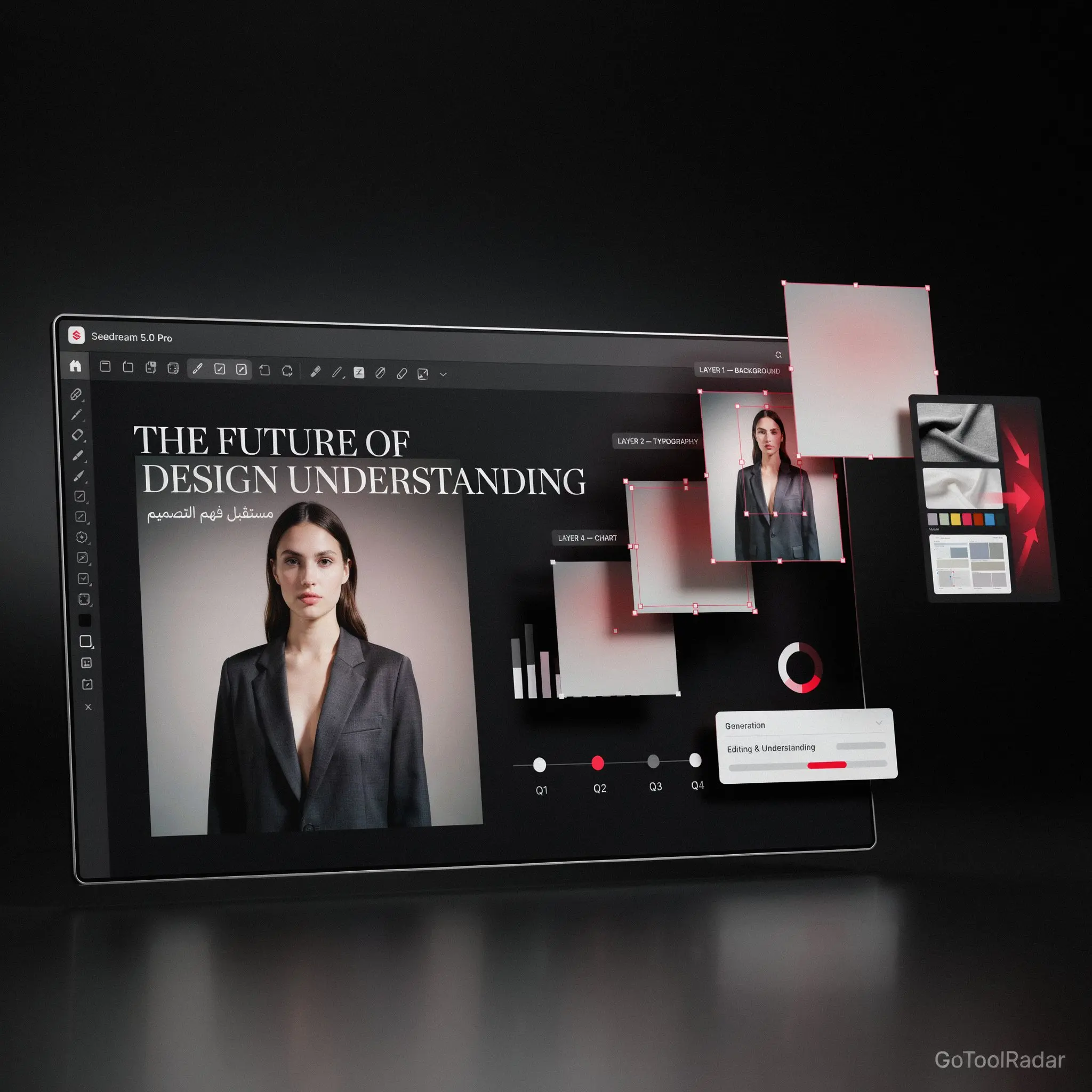
The clearest evidence is what the model can do to an existing image rather than what it can generate from scratch: point selection, lasso selection, sketch-based editing, material and color replacement, and — the most distinctive feature — layer decomposition, which can take a single flat image and separate it into independently editable elements (background, subject, text, individual objects) for recomposition. ByteDance calls this interactive precision editing, and it's a genuinely different pitch than most competing image models make.

What Seedream 5.0 Pro Actually Does
Layer decomposition
Breaks a single image into independently editable elements — background, subject, text, decorations, individual objects — for targeted editing and recomposition, going well beyond standard inpainting.
Infographic generation
Built to handle information-dense images — charts, diagrams, timelines, tables, presentation pages — combining multiple data-visualization types (a timeline plus bar, pie, and line charts) alongside photographs in a single composition.
Multilingual text rendering
Supports 14 languages per Dreamina's current documentation, including Arabic — with ByteDance specifically claiming support for right-to-left text direction within the design itself, not just Arabic-language prompts.
Multi-image fusion
Accepts up to 10 input images through the official API, combining and referencing multiple source images in a single generation or edit rather than working from one input at a time.
ByteDance is candid about current limitations rather than claiming a finished product: the company itself acknowledges that precise text rendering and pixel-level editing still need improvement — worth taking at face value rather than assuming the layout and structural understanding extends to flawless execution on every detail.
Pricing
Seedream 5.0 Pro is available two ways: through the BytePlus ModelArk API, or through Dreamina, ByteDance's consumer creative platform. API pricing is structured by output size rather than a flat per-image rate — roughly $0.045 per image at or below 2.61 megapixels, rising to about $0.09 per image above that threshold, plus a small additional charge (around $0.003) per extra reference image used. That works out to roughly $45-$90 per 1,000 images depending on resolution, though exact rates can vary by deployment region — this isn't a single universal price posted everywhere.
Through Dreamina, Seedream 5.0 Pro is currently available in Europe, Asia, the Middle East, South America, and the United States for paid subscribers, with free daily credits available for lighter use — not a fully free, unlimited tier, but a genuine way to try the model before committing to API pricing.
The Benchmark Reality Check
This is worth stating plainly rather than letting marketing set the frame: on Artificial Analysis's Image Arena, Seedream 5.0 Pro currently sits around Elo 1077, ranking roughly 17th of 26 models tracked — solidly mid-pack for general text-to-image generation, not a leaderboard leader. Anyone claiming it's currently the best overall AI image model isn't supported by that data.
The picture changes meaningfully once editing enters the comparison. In an August 2026 Arena snapshot tracked by independent sources, Seedream 5.0 Pro ranked 8th in text-to-image but 5th in single-image editing and 2nd in multi-image editing — a pattern that lines up exactly with where ByteDance has actually focused development. Separately, a July 9, 2026 test by Contra Labs comparing Seedream against ChatGPT Images 2.0, Nano Banana Pro, and Flux 2 across 10 creative briefs found Seedream winning the photorealism category (35.7%) and landing in the top two on 57% of head-to-head matchups — strong, but not a dominant overall winner. A separate, more workflow-focused pilot test by IMG.LY had Seedream topping 29 of 37 prompts with a 3.88/5 overall score, though IMG.LY itself flags the dataset as a pilot rather than a finalized blind expert-panel benchmark.
Pro vs Flash vs Lite
As of a September 22, 2026 documentation update, Seedream now ships as a three-tier lineup rather than a single model. Seedream 5.0 Flash, the newest addition, targets faster and cheaper generation while retaining core Pro capabilities including precision editing, layer decomposition, and multilingual generation — a meaningful option for use cases where the full Pro model's cost or speed doesn't fit. Seedream 5.0 Lite, by contrast, supports higher output resolutions (up to 3K/4K) that Pro currently doesn't offer, trading some of Pro's editing depth for resolution headroom. Evaluating "Seedream 5" as a single product misses that the right pick now depends on whether editing sophistication, speed, or resolution matters most for a given project.
Pros & Cons
Seedream 5.0 Pro vs GPT Image vs Nano Banana Pro vs Flux 2
| Model | Strongest at | Access | Best for |
|---|---|---|---|
| Seedream 5.0 Pro | Multi-image editing, photorealism | API / Dreamina | Layer-based editing, infographics, multilingual design |
| ChatGPT Images 2.0 | Infographic tests (per Contra Labs) | ChatGPT / API | Data-visualization-heavy generation |
| Nano Banana Pro | General-purpose generation | API | Broad text-to-image use cases |
| Flux 2 | General-purpose generation | API / self-hostable variants exist | Developers wanting more open deployment options |
None of these four dominates every category the Contra Labs test measured, which is the honest takeaway rather than a weakness to hide: Seedream's photorealism win and strong top-two rate sit alongside ChatGPT Images 2.0 pulling ahead specifically on infographics within that same test. The practical choice depends on which specific task matters most for a given project rather than picking whichever model tops one aggregate leaderboard.
Who It's For
Choose Seedream 5.0 Pro if: your work involves editing existing images with precision — layer-based recomposition, multi-image fusion, material or color swaps — or you need infographic-style images combining data visualization with photography, especially with multilingual or Arabic text requirements.
Look elsewhere if: you mainly need straightforward, best-in-class text-to-image generation from scratch, where several other models currently rank higher on general benchmarks, or you specifically need a self-hostable, downloadable model rather than an API/hosted service.
Expert Editorial Opinion
The most useful thing about Seedream 5.0 Pro's story is how well the benchmark data actually matches the company's own positioning, rather than contradicting it. ByteDance isn't claiming to have built the best general-purpose image generator — it's building toward a design-editing tool, and the independent numbers back that up specifically: mid-pack on raw text-to-image, genuinely strong on multi-image editing. That's a rare case where a company's marketing framing and the third-party evidence actually line up instead of the evidence quietly undercutting an overreaching claim.
The infographic and multilingual capabilities deserve attention specifically because they're underserved elsewhere in this category. Most image models are optimized for a single striking image from a short prompt; comparatively few are built to handle dense, structured information — charts alongside photography alongside readable text in more than one language and writing direction. Whether that capability is fully realized in practice is a separate question from whether it's a genuinely useful thing to be building toward, and ByteDance's own admission that text rendering and pixel-level editing still need work is a reasonable, honest caveat rather than a disqualifying one.
The three-tier Pro/Flash/Lite lineup, introduced within months of the original launch, suggests ByteDance is iterating quickly on a genuine product roadmap rather than treating Seedream 5 as a single finished release — worth watching over the next few months rather than evaluating as a static, unchanging product today.
Final Verdict
Seedream 5.0 Pro earns its score for a genuinely differentiated, benchmark-verified editing capability — layer decomposition, multi-image fusion, and infographic generation are real strengths, not marketing repackaging of standard generation. The score reflects real, disclosed limitations rather than hype: mid-pack general text-to-image quality, ByteDance's own acknowledgment of text-rendering and pixel-editing gaps, and no self-hosting path. For editing-heavy, multilingual, or infographic-style work, it's a genuinely distinctive tool; for straightforward best-in-class image generation from a prompt, other models currently rank higher.
| Dimension | Weight | Score | Why |
|---|---|---|---|
| Technical quality | 30% | 7.0/10 | Mid-pack overall (17th/26 on Artificial Analysis) but verified strong in multi-image editing (#2) and single-image editing (#5) — real strength concentrated in a specific area |
| Price-to-value | 25% | 7.0/10 | Reasonable per-image API pricing and a genuine Dreamina free-credit path, though regional pricing variance adds real complexity to comparison-shopping |
| Maturity & documentation | 20% | 7.0/10 | Launched July 2026 with a September Flash addition — rapid iteration, but still a young product with a correspondingly thinner long-term track record |
| Ceiling & flexibility | 15% | 6.5/10 | Three-tier lineup (Pro/Flash/Lite) offers real choice, but no self-hosting option limits ceiling versus genuinely open alternatives |
| Honesty of positioning | 10% | 7.5/10 | ByteDance's own documentation openly acknowledges text-rendering and pixel-editing limitations rather than overselling a finished product |
Weighted total: (7.0×0.30) + (7.0×0.25) + (7.0×0.20) + (6.5×0.15) + (7.5×0.10) = 7.00/10 — Score band: 7.0–7.9, "Competent but compromised: a genuine specialist in editing, not a general leaderboard-topper."
❓ Frequently Asked Questions
🔗 Related ToolRadar Reviews
Official documentation and current pricing: BytePlus ModelArk and Dreamina. Given how recently the Flash tier launched and how quickly this lineup is evolving, verify current pricing and regional availability directly before building a workflow around it.
Comments
Post a Comment