


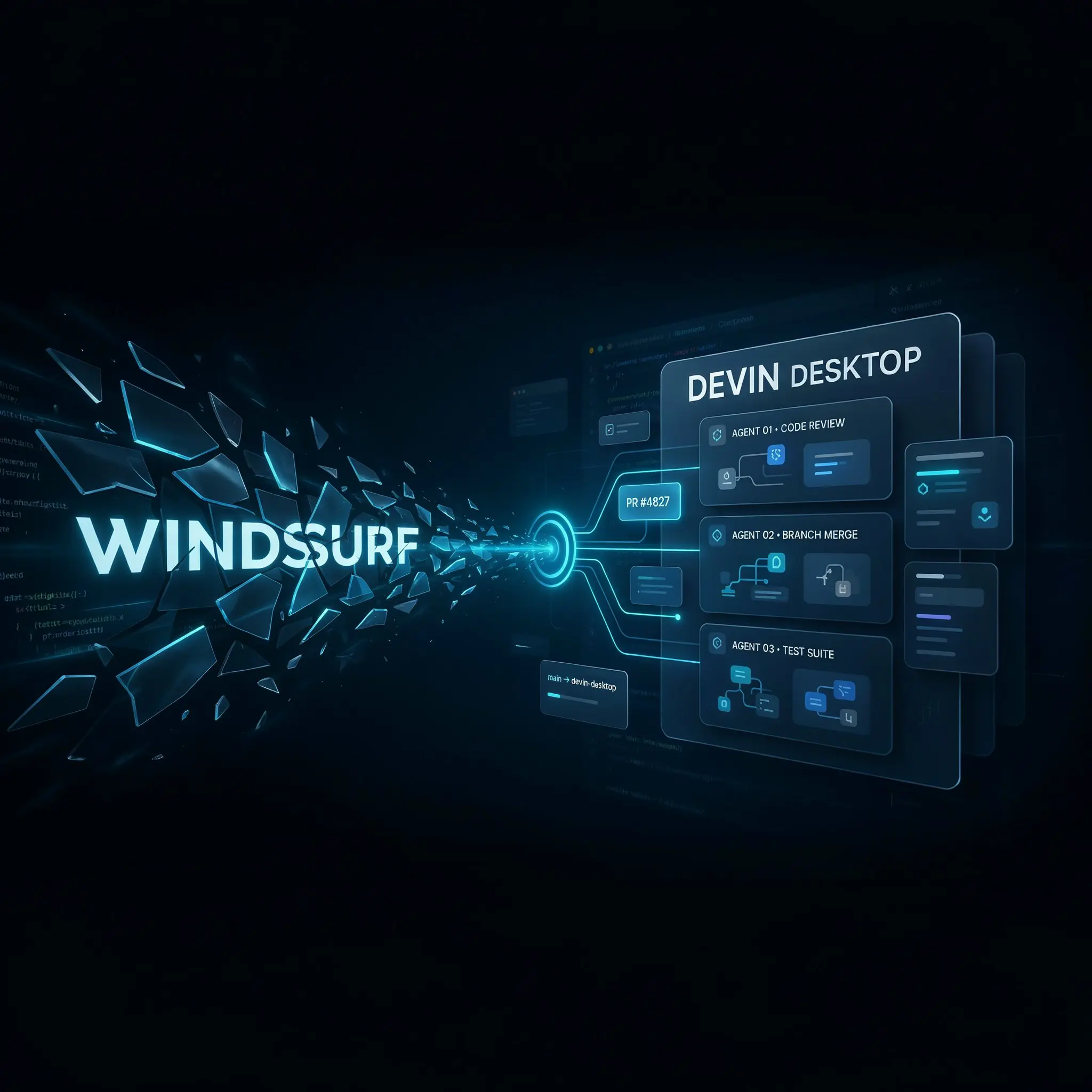
What Happened to Windsurf? The AI Coding IDE Is Now Devin Desktop
A year ago, OpenAI reportedly offered $3 billion for it. Then Google paid $2.4 billion just for the founders. Then Cognition bought what was left. Now the name is gone entirely — but the product isn't.
📋 Table of Contents
If you open what used to be Windsurf and see "Devin Desktop" instead, you didn't install the wrong thing. On June 2, 2026, Cognition — the company behind the autonomous coding agent Devin — renamed the Windsurf editor Devin Desktop, folding one of the most fought-over assets in AI coding into its own product family. That single sentence undersells just how strange the twelve months before it were.
In the space of about a year, Windsurf went from a reported $3 billion acquisition target for OpenAI, to a $2.4 billion talent-and-licensing deal with Google that didn't buy the company at all, to an outright acquisition by Cognition, to a full rebrand that erased its own name from its flagship product. This review covers that whole arc, what actually changed under the hood versus what's just a new name, current pricing for new and existing users, and how Devin Desktop compares to Cursor and Claude Code today. It's built from Cognition's official announcements and documentation and independently verified reporting — not a claim of hands-on testing of the product itself unless stated otherwise.
The Wildest Year in AI Coding: A Timeline
April 2025 — OpenAI Moves to Acquire Windsurf
Bloomberg and CNBC reported OpenAI was in talks to acquire Windsurf (then still closely tied to its earlier name, Codeium) for roughly $3 billion, entering an exclusivity period to finalize the deal.
July 11, 2025 — The OpenAI Deal Collapses
The exclusivity period lapsed and the acquisition fell apart, with multiple outlets reporting the collapse centered on concerns over Microsoft's rights to access Windsurf's technology through its relationship with OpenAI.
Same Day — Google's $2.4 Billion "Reverse Acquihire"
Within hours, Google DeepMind announced it was hiring Windsurf CEO Varun Mohan, co-founder Douglas Chen, and a group of researchers, while separately paying about $2.4 billion for a non-exclusive license to some of Windsurf's technology. Google explicitly did not take a stake in or control of Windsurf — the company kept operating independently, now without its founders.
July 14, 2025 — Cognition Acquires What Remained
Three days later, Cognition — maker of the autonomous coding agent Devin — announced it was acquiring Windsurf's IDE, IP, trademark, product, business, and remaining team. Cognition stated Windsurf had reached $82 million in ARR with more than 350 enterprise customers at the time; the acquisition price itself was undisclosed, though later reporting estimated it at roughly $250 million.
Early-Mid 2026 — Windsurf 2.0
Cognition began integrating Devin's cloud agent capabilities directly into Windsurf, introducing an Agent Command Center that let developers plan locally, delegate work to Devin's cloud agent, and review the resulting pull requests without leaving the IDE.
June 2, 2026 — Windsurf Becomes Devin Desktop
Cognition shipped the rename as a standard over-the-air update to all existing installs — no reinstall, no migration wizard. The Agent Command Center became the default view, and the product was folded fully into the Devin brand alongside Devin Cloud, Devin CLI, and Devin Review.
July 1, 2026 — Cascade Reaches End of Life
Windsurf's signature built-in agent, Cascade, was retired and replaced by Devin Local, rewritten from scratch in Rust, which Cognition says is roughly 30% more token-efficient and supports spawning subagents for parallel work.
What Actually Changed (and What Didn't)
The most common confusion around this story is treating "renamed" as a synonym for "replaced" or "shut down." Neither is accurate. According to Cognition's own FAQ, the editor, extensions, keybindings, LSPs, in-progress work, and existing plans and pricing for current users all carried over automatically. If you were already using Windsurf 2.0, Cognition says, you were already using what became Devin Desktop in every meaningful sense — June 2 just made the branding and the Agent Command Center's default status official.
What did change is real, though, and it's more than cosmetic. The default view is now a Kanban-style Agent Command Center for managing multiple local and cloud agents, rather than opening straight into the editor canvas. Cascade — the agent Windsurf was arguably best known for — is gone, replaced by the Rust-rewritten Devin Local. And the product's entire framing shifted from "AI-native code editor" to "command center for managing agents," which is a genuine philosophical shift in how the tool wants you to work, not just new paint on the same workflow.
Devin Desktop Isn't Just Windsurf With a New Logo
Agent Command Center
A Kanban-style view of every local and cloud agent working on your codebase — sessions, pull requests, and files organized as tasks you manage rather than a single chat thread you scroll through.
Spaces
A way to share project context — files, sessions, PRs — across multiple agents working on the same codebase, so a cloud agent and a local agent aren't operating with disconnected understanding of the project.
Agent Client Protocol (ACP)
An open-source protocol Cognition shipped alongside the rename that lets outside agents — Codex, Claude Agent, OpenCode, and others — run inside Devin Desktop as first-class citizens, not locked to Cognition's own Devin. This is arguably the most consequential technical change: the product's name suggests a Devin-only tool, but the architecture is explicitly multi-agent.
Devin Local
The Rust-rewritten successor to Cascade, Cognition's default local agent, with a claimed ~30% improvement in token efficiency and support for spawning subagents to handle parallel work within a single task.
Pricing — And Why Old Users Aren't Affected
| Plan | Price | Notes |
|---|---|---|
| Free | $0 | Light daily/weekly quota, limited model availability, unlimited inline edits and Tab completions |
| Pro | $20/month | Higher quotas, full frontier model access, Devin Cloud access; overage billed at API pricing |
| Max | $200/month | Highest individual-tier quotas |
| Teams | $80/month + $40/full seat | Team management and collaboration features |
| Enterprise | Custom | SOC 2 Type 2, ISO/IEC 27001:2022, SSO, dedicated support |
The most important line in Cognition's own FAQ for anyone who was already paying for Windsurf: current plans and pricing stay exactly the same for existing users, including legacy Windsurf Enterprise plans — the rename did not trigger an automatic price change. Some reporting has noted that original Windsurf subscribers were specifically grandfathered at older rates (around $15/month Pro, $30 per developer seat) that are lower than the current new-user pricing shown above.
For anyone signing up fresh, the pricing table above is Devin's standard structure, and it comes with a real nuance worth understanding: usage allowances renew on daily and weekly cycles, and going over quota doesn't hit a hard wall — it bills at API pricing instead. That means the monthly subscription price is a starting point for cost, not necessarily a spending ceiling, particularly on heavier agentic workloads that lean on Devin Cloud.
Devin Desktop vs. Cursor vs. Claude Code
| Tool | Core Model | Multi-Agent Support |
|---|---|---|
| Devin Desktop | Local IDE + cloud agent command center | Open via ACP — Devin, Codex, Claude Agent, OpenCode |
| Cursor | AI-native IDE, primarily single-agent workflow | Limited, largely tied to its own agent |
| Claude Code | Terminal/CLI-based coding agent | Single-agent, Anthropic-model-centric |
The real differentiator here isn't editor polish — it's philosophy. Cursor and Claude Code are both built around a strong single-agent experience: you work closely with one AI collaborator inside the editor or terminal. Devin Desktop's bet, backed by the open ACP protocol, is that developers will increasingly manage several agents at once — a local agent for immediate work, a cloud agent for longer autonomous tasks, possibly a third-party agent for a specific job — and that the IDE's job is to be the control panel for all of them rather than a home for just one.
Strengths and Real Limitations
Who Devin Desktop Is Actually For
Devin Desktop fits developers and teams who are already comfortable delegating work to AI agents and want a single place to plan, delegate, monitor, and review that work — rather than a tool for writing every line yourself with autocomplete assistance. Teams already using Devin Cloud specifically benefit most, since the local and cloud experience is now designed to be one continuous workflow rather than two separate products. Former Windsurf users, including Enterprise customers, can also simply keep working — Cognition's own transition data backs up the claim that nothing forces a workflow change immediately.
It's a weaker starting point for developers who specifically want a single, tightly integrated AI pair-programmer experience without managing multiple agents — Cursor or Claude Code may feel more direct for that — and for anyone who's specifically attached to Cascade's exact behavior, since that agent is gone regardless of preference. Teams evaluating this fresh, with no prior Windsurf history, should also budget for the quota-based pricing model rather than assuming the listed monthly price is a hard cap.
Expert Editorial Opinion
Strip away the brand names and this is one of the more legible stories in recent AI infrastructure history: three different companies looked at the same asset — a well-built, VS Code-based IDE with real enterprise traction — and made three different bets on what it was worth to them. OpenAI wanted to own the editor outright. Google wanted the people and a technology license, explicitly not the company. Cognition wanted the product itself, to complete a specific strategic idea it already had half-built.
That strategic idea is the part worth taking seriously rather than dismissing as branding theater. Devin, Cognition's cloud agent, could already work autonomously — plan, code, test, open a PR — but it had no natural home for the human half of the workflow: reviewing, steering, correcting. Windsurf was exactly that home, already built, already proven with real customers. Buying it wasn't Cognition collecting a trophy asset; it was Cognition acquiring the missing half of a product it had already designed around.
The decision to kill the Windsurf name entirely, rather than keep it as a sub-brand under Cognition, is the more debatable call, and I think it's a genuine tradeoff rather than an obviously correct move. Windsurf had real brand equity — a loyal user base, name recognition from the OpenAI/Google saga itself — and folding it fully into "Devin" sacrifices some of that recognition for a cleaner, more unified product story. The mixed Reddit reaction after the rename is a predictable, honest cost of that decision, not evidence that Cognition mishandled the technical transition, which by every account was executed cleanly.
The ACP protocol is the detail I'd flag as most likely to matter a year from now. A company that had just spent hundreds of millions of dollars acquiring an IDE could easily have locked it to its own agent exclusively — that's the obvious, short-term-revenue-maximizing move. Instead, Cognition shipped an open standard that lets Codex, Claude Agent, and OpenCode run natively inside Devin Desktop. That's a bet that owning the control surface for agent management is more valuable long-term than owning every agent running inside it, and it's a more interesting, more defensible strategic position than a walled garden would have been.
Should a developer care about any of this? If you're already in the Devin or former-Windsurf ecosystem, the practical answer is simple: nothing forces your hand, the transition was genuinely low-friction, and the new Agent Command Center is worth exploring even if you keep working mostly the way you always did. If you're choosing a coding tool fresh in late 2026, the more useful question isn't "Windsurf or Devin Desktop" — that choice no longer exists — it's whether you want a single-agent pair-programming tool like Cursor or Claude Code, or a multi-agent command center built around exactly the kind of delegation workflow Devin Desktop is betting the entire industry is moving toward.
Final Verdict
Score band: 8.0-8.9 — Strong: a well-executed transition built on proven technology, with a genuinely open multi-agent architecture, held back slightly by lingering brand confusion and a usage-based pricing model that requires attention.
| Dimension | Weight | Score /10 | Why |
|---|---|---|---|
| Technical quality | 30% | 8.5/10 | Built on a proven IDE with real enterprise traction pre-acquisition, plus a genuinely open multi-agent architecture via ACP |
| Price-to-value | 25% | 7.5/10 | Existing users kept their pricing unchanged; new users get a competitive but quota-plus-overage model that requires monitoring usage |
| Maturity & documentation | 20% | 7.5/10 | Unusually clear, detailed official FAQ covering the transition, offset by real lingering brand confusion (Windsurf naming persists in some plugins and docs) |
| Ceiling & flexibility | 15% | 9.0/10 | Open support for third-party agents (Codex, Claude Agent, OpenCode) via ACP is a genuinely high ceiling few competitors match |
| Honesty of positioning | 10% | 8.0/10 | Cognition was direct about what changed and what didn't, and transparent about Cascade's retirement timeline rather than a quiet, undocumented cutover |
Weighted calculation: (8.5×0.30) + (7.5×0.25) + (7.5×0.20) + (9.0×0.15) + (8.0×0.10) = 8.10.

Comments
Post a Comment