


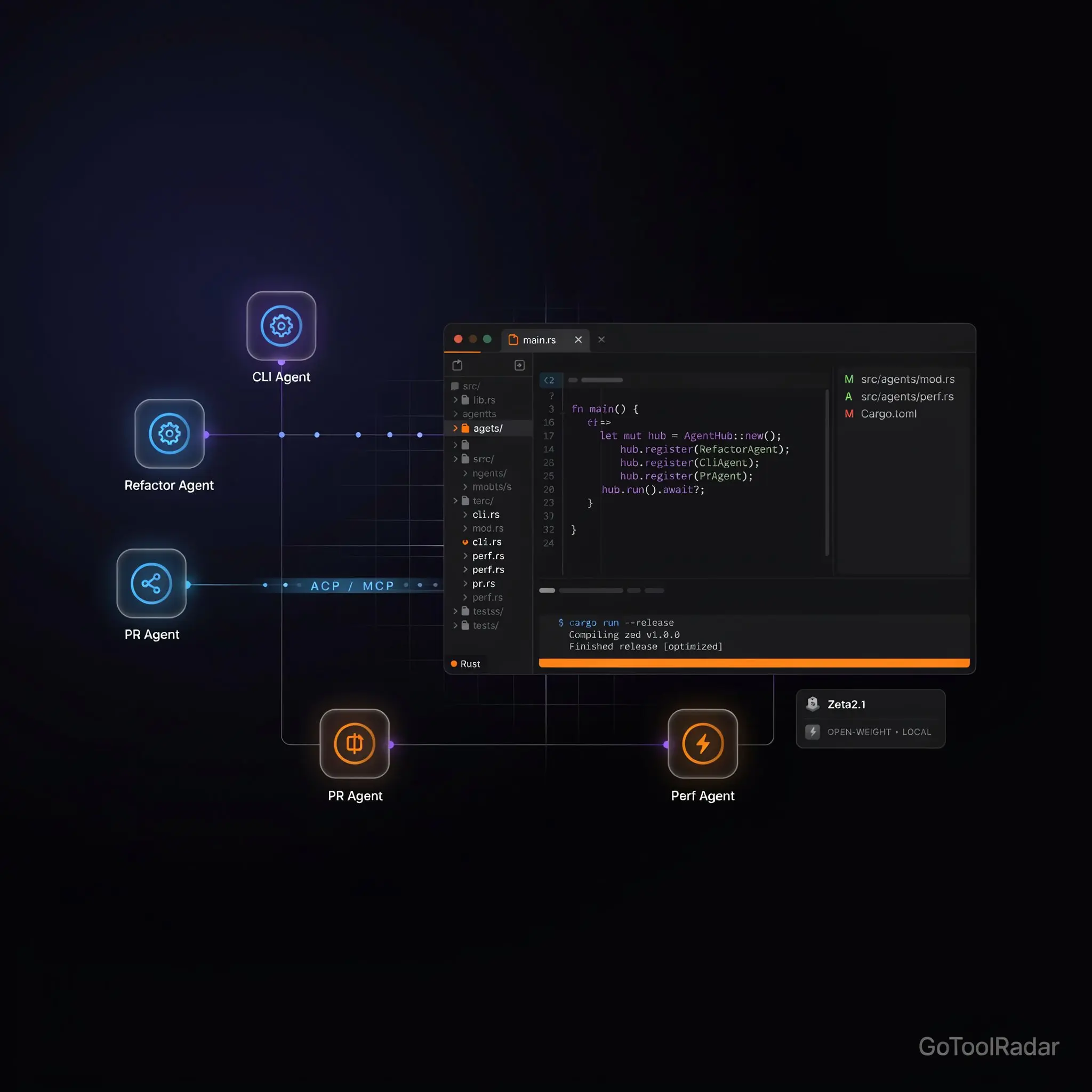
Zed Editor Review 2026: The Open-Source Code Editor Goes All-In on AI Agents
Zed spent years trying to build a faster code editor. In 2026 it finally reached 1.0 — just as it started turning into something bigger: a collaborative home for humans and AI coding agents built on Rust instead of Electron.
- Zed 1.0: What the Milestone Actually Means
- Why Zed Is Built the Way It Is
- AI Agents, Three Different Ways
- Zeta2.1: Zed's Own Open-Weight Model
- Pricing — And Why "Free AI" Needs a Caveat
- Delta: Betting Beyond the Editor
- Zed vs. VS Code vs. Cursor
- Strengths and Real Limitations
- Who Zed Is Actually For
- Expert Editorial Opinion
- Final Verdict
- FAQ
Zed Editor review 2026: for most of its life, Zed was the editor developers were curious about rather than the one they actually switched to — a genuinely fast, Rust-built alternative to Electron-based tools like VS Code, with a devoted following and a GitHub star count that kept climbing past 90,000. On April 29, 2026, that changed. Zed shipped 1.0, and the release note made the real story clear: this isn't just a performance milestone, it's the point where AI agents stopped being a bolt-on feature and became part of the editor's foundation.
This review covers what Zed 1.0 actually includes, its three different ways of working with AI agents, its own open-weight edit-prediction model, current pricing, and where it genuinely still trails VS Code and Cursor. It's built from Zed's official documentation, blog posts, and pricing pages, and independently verified third-party coverage — not a claim of hands-on testing of the editor itself unless stated otherwise.

Zed 1.0: What the Milestone Actually Means
Zed's history goes back further than most people realize. Founder Nathan Sobo spent nine years at GitHub working on Atom and Electron — the very framework Zed was built to move past — before starting Zed Industries. The editor was first previewed in March 2023, went open source in January 2024 under GPL-3.0, and spent the next two years adding GitHub Copilot support, native Git integration, and a growing agent ecosystem before finally reaching 1.0.
Sobo's own framing of the milestone is unusually candid: "1.0 doesn't mean 'done.' It also doesn't mean 'perfect.' It means we've reached a tipping point where most developers can quickly feel at home in Zed." That's a meaningfully different claim than most 1.0 announcements make, and it's borne out by what actually shipped: real-time collaborative editing, AI integration built into the architecture rather than layered on top, GPU-accelerated rendering, Git integration, and a working debugger — available on macOS, Linux, and Windows from day one. As of this review, GitHub shows the repository at roughly 90,000+ stars and 10,000+ forks, though that number changes weekly and shouldn't be treated as a fixed figure.
Why Zed Is Built the Way It Is
The performance story is a real architectural decision, not marketing language layered onto an ordinary editor. Zed's blog describes the choice bluntly: "we built it like a video game, organizing the entire application around feeding data to shaders running on the GPU" — instead of building on Electron, the Chromium-based framework that also underlies VS Code and most of its forks. To do that, Zed built its own UI framework from scratch, called GPUI, open source alongside the rest of the codebase.
Worth being precise about what this claim does and doesn't establish: Zed's architecture is genuinely, verifiably different from Electron-based competitors, and that difference is designed specifically to avoid the performance ceiling web-based UI frameworks impose. That's not the same as an independently benchmarked "fastest editor" claim across every workflow — no controlled, third-party benchmark comparing Zed against every competitor in every scenario currently exists, so the architectural difference should be understood as the real, verifiable fact, while broad speed superiority claims deserve the same skepticism any self-reported performance figure does.
AI Agents, Three Different Ways
Zed Agent
Built directly into the editor, using your choice of LLM provider plus built-in tools, skills, and instructions, with MCP support for connecting external data and tools.
External Agents via ACP
The Agent Client Protocol lets Zed run outside agents — Claude Agent, Codex, OpenCode, GitHub Copilot, Cursor, and others — as first-class citizens inside the editor rather than through workarounds.
Parallel Agents
Run multiple agent threads simultaneously instead of one agent handling one task at a time — a direct response to the shift toward agentic, multi-task development workflows.
Terminal Threads
Organize CLI and TUI-based coding agents directly within Zed's interface, rather than switching to a separate terminal window to manage them.
The strategic bet behind ACP is worth naming explicitly: instead of trying to build the best single in-house agent the way most AI-editor competitors do, Zed is betting that developers will want to choose their agent independently of their editor, and that owning the interoperability layer is more durable than owning any one agent. Zed launched an ACP Registry in January 2026 to formalize that ecosystem further. Permissions matter here too — Zed's MCP and agent tooling support allow/deny/confirm controls before an agent can execute file changes or run commands, which matters given how much access these agents can have.
Zeta2.1: Zed's Own Open-Weight Model
Rather than relying entirely on third-party models for its core edit-prediction feature, Zed built and released its own: Zeta2.1, shipped in May 2026. The company's own reported figures show real efficiency gains over the previous Zeta2 — roughly 90 output tokens versus 270, a p50 response time of 136ms versus 189ms, and improvements in both acceptance rate and reduced explicit rejection. These are Zed's own measurements, not an independent benchmark, and should be read with that context.
What makes Zeta2.1 genuinely notable regardless of the specific numbers is that it's open-weight and can run locally — Zed has published bindings on PyPI specifically to make self-hosting more accessible. For a company whose business model depends partly on hosted AI subscriptions, open-sourcing the model behind one of its core AI features is a real, verifiable commitment, not just a privacy talking point.
Pricing — And Why "Free AI" Needs a Caveat
| Plan | Price | What it includes |
|---|---|---|
| Personal | $0 forever | 2,000 accepted Edit Predictions, unlimited use with your own API keys, external agents (Claude Agent, Codex CLI, etc.) |
| Pro | $10/month | Unlimited Edit Predictions, $5 monthly hosted-model token credit, usage-based billing beyond that |
| Business | $30/seat/month | Org-wide AI policies, data governance, spend visibility, role-based controls |
The editor itself is genuinely free, with no account or authentication required to use it. Where "free" needs qualification is Zed's own hosted AI models — those are gated behind the $10/month Pro plan, and even then it's a $5 token credit plus usage-based billing beyond it, not unlimited hosted generation. What keeps this honest is that Zed doesn't force you into that model at all: bring your own API keys for Anthropic, OpenAI, Google, Amazon Bedrock, GitHub Copilot, DeepSeek, Ollama, LM Studio, OpenRouter, and others, and you can use AI features without paying Zed anything beyond what your provider charges. A 14-day Pro trial (no credit card required) reverts to Free automatically rather than auto-converting to a paid subscription when it ends.
Delta: Betting Beyond the Editor
The most recent and most ambitious signal of where Zed is heading: Delta, a multiplayer environment for working alongside AI agents, announced in August 2026 and moved to public beta on September 16, 2026. Zed has described the direction as potentially replacing parts of the traditional GitHub workflow, including pull requests — a meaningfully bigger ambition than "make code editing faster."
Read alongside 1.0, ACP, Parallel Agents, and remote development, Delta fits a clear pattern: Zed isn't trying to be a better VS Code anymore. It's positioning itself as a collaborative environment where humans and AI agents work together as first-class participants, with the traditional editor as the entry point rather than the whole product.
Zed vs. VS Code vs. Cursor
| Tool | Architecture | Ecosystem Size | AI Model |
|---|---|---|---|
| Zed | Rust + custom GPU UI (GPUI) | Smaller, growing (~extensions in the hundreds) | Open (ACP/MCP, BYOK, open-weight Zeta2.1) |
| VS Code | Electron | Massive, industry-standard | Copilot-centric, extension-dependent |
| Cursor | Electron (VS Code fork) | Inherits VS Code's ecosystem | AI-first, deep codebase indexing |
The honest tradeoff: Zed wins decisively on raw architecture and is the most open about which AI agent you use, but VS Code's ecosystem remains far larger, and Cursor currently offers deeper codebase-wide semantic indexing and multi-file agentic editing than Zed does natively. Choosing Zed today means trading some extension breadth and Cursor's more mature agentic-editing depth for a faster, more architecturally modern base and genuine agent-vendor flexibility.
Strengths and Real Limitations
Who Zed Is Actually For
Zed fits developers who specifically want a fast, architecturally modern editor and are willing to trade some of VS Code's extension breadth for it, teams that want real-time collaborative editing as a core workflow rather than an add-on, and anyone who wants genuine flexibility in which AI agent they use rather than being locked into one vendor's stack. Its open-weight Zeta2.1 model and BYOK-friendly pricing also make it a natural fit for developers who specifically care about not depending entirely on a single AI provider.
It's a weaker fit right now for teams deeply dependent on a specific VS Code extension without a Zed equivalent, for enterprises that need SSO/SAML/SCIM/SOC 2 compliance today rather than on a near-term roadmap, and for developers who specifically want the most mature deep-codebase AI editing available — Cursor's semantic indexing is currently more developed in that specific area.
Expert Editorial Opinion
The most credible thing about Zed 1.0 is what it doesn't claim. Most products treat a 1.0 release as a marketing moment to declare victory; Sobo's own announcement explicitly says the opposite — not done, not perfect, just a tipping point. That kind of restraint is worth noting specifically because it lines up with what actually shipped: a real, if not exhaustive, feature set (debugger, SSH remoting, native Git, agent support) rather than a rushed checklist assembled to hit a version number.
The ACP bet is the part of this story I think is most strategically interesting and most likely to matter beyond Zed specifically. Building the best single AI agent is an expensive, crowded race that Anthropic, OpenAI, and several well-funded startups are already running hard. Building the best place to run any of those agents, with genuine vendor neutrality, is a different and arguably more durable position — it doesn't require Zed to out-innovate Claude Agent or Codex, just to be the best environment for using either one. Zed didn't just build this for itself either; opening an ACP Registry in January 2026 signals an attempt to make this a genuine industry standard, not a Zed-only feature.
Open-sourcing Zeta2.1 deserves more credit than it's gotten in most coverage I've seen. A company whose Pro tier revenue depends partly on hosted-model usage choosing to publish an open-weight, self-hostable version of its own edit-prediction model is a real tension resolved in the user's favor, not a marketing gesture — it directly reduces the incentive to lock users into Zed's paid hosting for that specific feature.
The gap I'd weigh most heavily before recommending Zed for a larger team is the Business tier's compliance maturity. SSO, SAML, SCIM, and SOC 2 being described as in-progress at launch isn't disqualifying, but it's a real, current limitation for any organization with hard compliance requirements — worth confirming directly with Zed's current status rather than assuming it's resolved by the time you're evaluating it, since this is exactly the kind of gap that closes over months rather than staying static.
Is it worth switching to? For a solo developer or small team that values the architectural difference and wants real agent-vendor flexibility, yes, especially now that Windows support and a working debugger remove two of the biggest historical reasons to wait. For a large enterprise team with strict compliance needs or deep reliance on a specific VS Code extension, it's worth a serious trial rather than a full commitment until Business's compliance story catches up to its technical one.
Final Verdict
Score band: 8.0-8.9 — Strong: a genuinely differentiated, architecturally modern editor with real AI-agent flexibility, held back mainly by a smaller ecosystem and an enterprise compliance story still catching up to the product itself.
| Dimension | Weight | Score /10 | Why |
|---|---|---|---|
| Technical quality | 30% | 8.5/10 | A genuinely different, GPU-native architecture, a working debugger and Git integration, and an open-weight edit-prediction model with real reported efficiency gains |
| Price-to-value | 25% | 8.5/10 | A genuinely free editor with no account required, plus BYOK support that avoids forcing users into Zed's own hosted AI billing |
| Maturity & documentation | 20% | 7.0/10 | A real 1.0 milestone with clear documentation, offset by a smaller extension ecosystem and Business-tier compliance features still in progress |
| Ceiling & flexibility | 15% | 9.0/10 | Open agent interoperability via ACP and MCP, BYOK across nearly every major provider, and an expanding scope (Delta) push this well past a typical editor's ceiling |
| Honesty of positioning | 10% | 8.0/10 | Unusually candid public messaging about what 1.0 does and doesn't mean, and transparent framing of performance claims as architectural rather than a blanket "fastest editor" assertion |
Weighted calculation: (8.5×0.30) + (8.5×0.25) + (7.0×0.20) + (9.0×0.15) + (8.0×0.10) = 8.225, shown as 8.2.
Comments
Post a Comment