


FLUX.2 Review 2026: The Open-Weight Image Model Developers Can Actually Build On
FLUX.2 review 2026: Black Forest Labs' image model family — FLUX.2 [dev], the local-deployable [klein] 4B/9B, and the production [pro]/[max]/[flex] APIs — multi-reference editing, licensing (it's not what "open source" implies), pricing, and where it actually ranks on independent benchmarks.
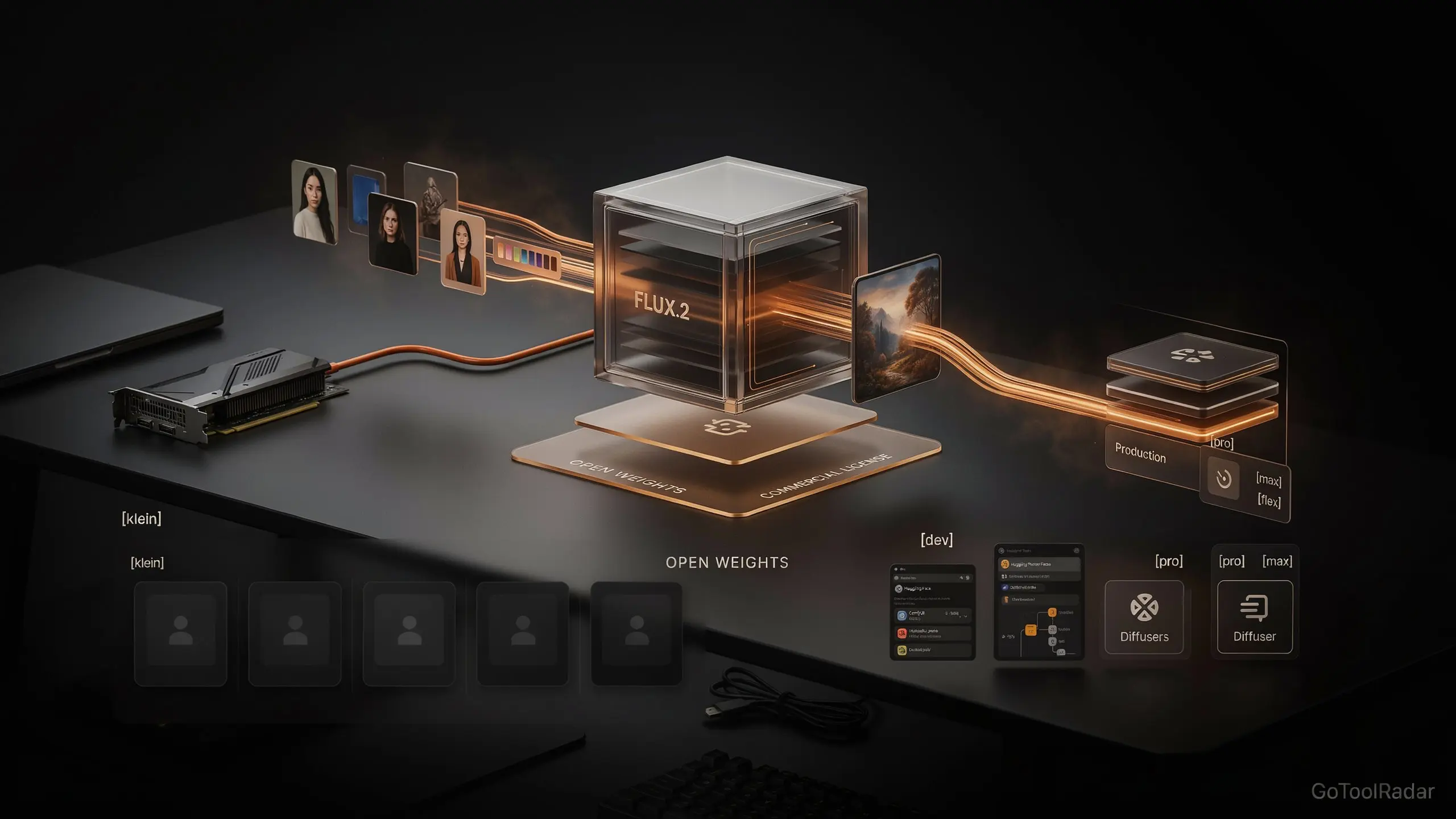
FLUX.2 review 2026: Black Forest Labs isn't trying to build another AI image website — it's building an image model stack developers can actually deploy, fine-tune, and run locally. The base FLUX.2 generation was announced November 25, 2025, with the local-deployable [klein] family following on January 15, 2026 — a distinction worth getting right, since a lot of coverage conflates the two as a single January launch.
The core shift from FLUX.1 is architectural: instead of just "prompt in, image out," FLUX.2 takes instructions plus up to 10 reference images — characters, objects, style, brand colors — and builds or edits a coherent scene around them, without needing separate fine-tuning for each reference type. That's a genuinely different capability than most consumer image generators offer, and it's specifically aimed at developers and production pipelines rather than casual one-off image generation.

The FLUX.2 Family, Explained
FLUX.2 [dev] — the open-weight flagship
A 32B-parameter rectified-flow transformer handling generation, editing, and multi-reference combination without extra fine-tuning for character/object/style consistency. Weights are downloadable, but commercial use requires a separate license (more below).
FLUX.2 [klein] — local deployment, Jan 2026
A 4B and 9B model family under Apache 2.0, built specifically for consumer GPUs (Black Forest Labs cites RTX 3090/4070-class hardware, ~13GB VRAM for the 4B model) — the version that actually makes local/edge deployment realistic.
FLUX.2 [pro] / [max] / [flex] — production APIs
API-first, pay-as-you-go tiers for teams that don't want to self-host: [pro] balances quality/speed, [max] targets highest fidelity and grounded generation, [flex] bills by megapixel for precision-heavy work like typography.
Multi-reference generation
Up to 10 reference images in select FLUX.2 models, combining character, object, and style consistency in a single generation or edit pass.
Ecosystem tooling
Supported through Hugging Face Diffusers and ComfyUI, with an active GitHub repository still seeing issues and pull requests as of September 2026.
API Pricing
FLUX.2 [flex] bills differently — $0.05 per megapixel rather than a flat per-image rate, with reference images factored into the cost on some models. This pay-as-you-go structure, with no mandatory subscription, makes FLUX.2 a genuinely attractive backend for a SaaS product or website compared to committing to a fixed monthly plan. But API pricing isn't the whole cost story: running FLUX.2 [dev] locally trades the per-image fee for GPU, electricity, VRAM, and engineering time — "the weights are free" doesn't mean the total cost of local deployment is zero.
Licensing & Hardware — Read This First
This is the section most "open-weight" coverage gets wrong, so it's worth being precise. FLUX.2 [dev] is open-weight, not open source in the fully-permissive sense: the weights are downloadable and the inference code is public, but dev is released under the FLUX Non-Commercial License — commercial use of that specific model requires a separate commercial license from Black Forest Labs. FLUX.2 [klein], by contrast, ships under Apache 2.0, a genuinely permissive license. Running [dev] at full 32B scale also realistically needs H100-class hardware without quantization, though FP8/NVFP4 quantized paths and remote text-encoder setups bring that down to roughly 18–32GB VRAM depending on configuration — still well beyond casual consumer hardware, unlike Klein.
Pros & Cons
✓ Strengths
- ✅ Multi-reference generation (up to 10 images) with character/object/style consistency, without per-reference fine-tuning
- ✅ Klein's Apache 2.0, consumer-GPU-friendly models make local deployment genuinely realistic, not theoretical
- ✅ Pay-as-you-go API pricing avoids locking a product into a fixed monthly subscription
- ✅ A real, active ecosystem — ~398K monthly downloads, dozens of community adapters and finetunes, active GitHub development
✗ Weaknesses
- ❌ FLUX.2 [dev] is not free for commercial use despite being open-weight — a real licensing trap for anyone assuming "open-weight" means "free to monetize"
- ❌ Not the top-ranked open-weight model on independent benchmarks — Artificial Analysis currently places [dev] at #4 for text-to-image and #6 for editing among open-weight models
- ❌ Eight+ model/license variants (dev, pro, max, flex, klein 4B/9B, distilled/base) create genuine decision friction for newcomers
- ❌ Full 32B [dev] deployment needs serious hardware even with quantization — not a casual local-run model like Klein
Which FLUX.2 Model Do You Actually Need?
| Use case | Best FLUX.2 model | Why |
|---|---|---|
| Production API backend, no self-hosting | [pro] or [max] | API-first, pay-per-image, no infrastructure to manage |
| Local/edge deployment, consumer GPU | [klein] 4B | Apache 2.0, ~13GB VRAM, runs on RTX 3090/4070-class hardware |
| Research, fine-tuning, non-commercial projects | [dev] | Full 32B capability, open weights, but non-commercial license |
| Typography/precision-heavy commercial work | [flex] | Per-megapixel billing suited to controlled, detail-heavy generation |
Who Should Use It
Ideal user: a developer or team building an image-generation feature into a product — someone who needs multi-reference consistency, wants pay-as-you-go pricing or local/edge deployment, and is comfortable navigating a multi-tier license structure to pick the right model for their use case.
Look elsewhere if: you want a single, simple, consumer-facing image generator with no licensing homework (a hosted tool like Midjourney or Adobe Firefly fits that need more directly), or you specifically need the single highest-ranked open-weight model on every benchmark — FLUX.2 [dev] is strong but not currently #1.
Expert Editorial Opinion
The most honest way to frame FLUX.2 isn't "the best open image model" — Artificial Analysis' current leaderboards don't support that claim, with [dev] sitting at #4 for text-to-image and #6 for editing among open-weight models. The more accurate and, frankly, more interesting framing is that FLUX.2 isn't optimized to win a leaderboard; it's optimized to be a stack developers can actually build production systems on — multi-reference consistency, a genuine local-deployment path via Klein, and an ecosystem (Diffusers, ComfyUI, active finetunes) that a pure benchmark score doesn't capture.
The licensing structure deserves the most direct correction of any part of this review. "Open-weight" and "free for commercial use" get conflated constantly in coverage of models like this, and FLUX.2 [dev] is the clearest possible case of why that conflation matters: the weights are open, the code is open, but commercial deployment of dev specifically requires a paid license from Black Forest Labs. Anyone building a commercial product should treat Klein's Apache 2.0 license and dev's non-commercial license as two fundamentally different starting points, not interchangeable "open" options.
Black Forest Labs' own performance and safety claims — the 2.7x speed and 55% VRAM reduction figures for quantized Klein, the "10x fewer vulnerabilities" red-teaming result — are worth citing as the company's own reported numbers, not independently verified facts. That doesn't make them false; it means they haven't been confirmed by a neutral third party the way the Artificial Analysis leaderboard position has.
Final Verdict
FLUX.2 earns a Strong rating for genuine technical differentiation — multi-reference consistency, a real local-deployment path via Klein, and an active developer ecosystem — priced attractively through pay-as-you-go APIs. The named caveats: it isn't the top-ranked open-weight model on independent benchmarks, and the licensing structure (particularly [dev]'s non-commercial terms) requires real attention before any commercial deployment. For developers building production image features rather than casual users wanting a single simple tool, this is a recommended model family with those caveats clearly understood.
| Dimension | Weight | Score /10 | Why | |---|---|---|---| | Technical quality | 30% | 8.0/10 | Genuinely strong multi-reference and editing capability, though independently ranked #4 (text-to-image) and #6 (editing) among open-weight models, not #1 | | Price-to-value | 25% | 8.0/10 | Attractive pay-as-you-go API pricing and a genuinely free-to-run local option (Klein), though dev's local deployment carries real hardware/engineering costs | | Maturity & documentation | 20% | 8.5/10 | A real, active ecosystem (398K monthly downloads, 80 adapters, 39 finetunes) with ongoing GitHub development | | Ceiling & flexibility | 15% | 9.0/10 | Local deployment, fine-tuning, quantization paths, and a multi-tier model family give it an unusually high ceiling for developers | | Honesty of positioning | 10% | 7.0/10 | The license structure genuinely confuses "open-weight" with "free for commercial use" in a lot of outside coverage — worth flagging clearly even though Black Forest Labs' own documentation is reasonably precise | Weighted total: (8.0×0.30) + (8.0×0.25) + (8.5×0.20) + (9.0×0.15) + (7.0×0.10) = **8.15/10**, rounded to **8.2/10** — Score band: 8.0–8.9, "Strong — recommended with named caveats: check the specific license per model variant before any commercial use, and don't assume open-weight means #1 on every benchmark."❓ Frequently Asked Questions
🔗 Related ToolRadar Reviews
Official source: Black Forest Labs. Given the multiple model variants and license terms, verify the specific license and hardware requirements for the FLUX.2 variant you plan to use before any commercial deployment.
Comments
Post a Comment