


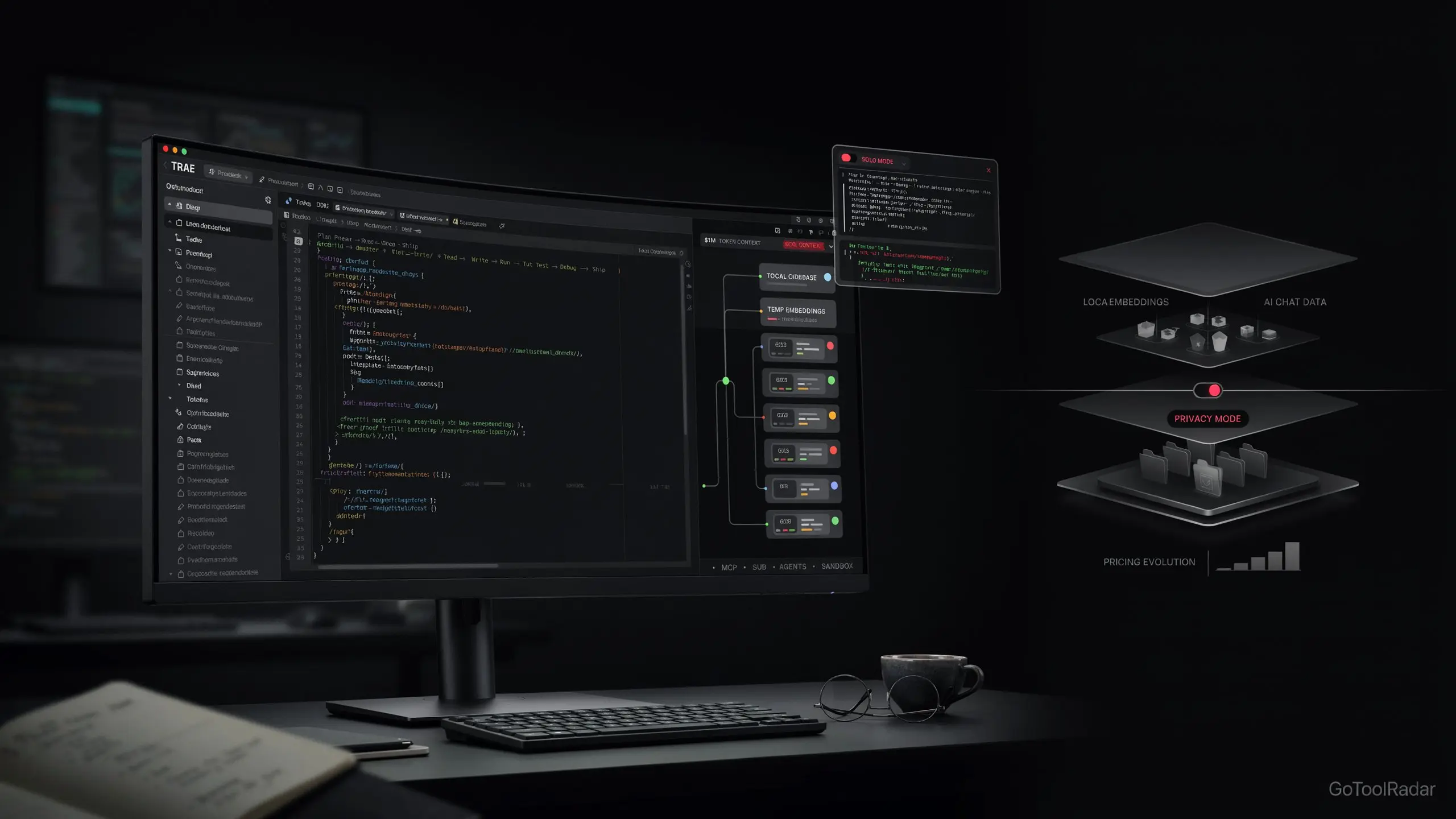
TRAE Review 2026: ByteDance's AI IDE Is Powerful — But Is Your Code Really Private?
TRAE review 2026: ByteDance's AI IDE with an autonomous SOLO Mode, current $0-$200 pricing (up sharply from February's $3-$100 tiers), and a consumer data policy where "local-first" doesn't mean your code never leaves your machine.
TRAE review 2026: the easy pitch for TRAE has always been "ByteDance's free AI IDE," and that framing earned the product real attention when it launched. By October 2026, that pitch is only half true. TRAE still has a free tier, and it's still capable — SOLO Mode, its autonomous agent, can plan a task, read the project, write and run code, test, debug, and iterate through to a shippable result with minimal hand-holding. What's changed is the price of getting past the free tier's real limits, and the amount of reading required to understand exactly what TRAE does with your code along the way.
Start with the number that should reframe how this product gets covered: TRAE's pricing jumped from an introductory $3/$10/$30/$100 structure announced in February 2026 to a current $0/$20/$60/$200 structure on its official pricing page. That's not a minor adjustment. It's a repositioning from "unusually cheap AI IDE" to something priced closer to its established competitors — while the free tier itself narrowed to auto-mode-only access with capped autocomplete.
The deeper story, and the one this review spends the most time on, is privacy. TRAE describes itself as local-first. It also says, in its own documentation, that codebase files can be temporarily uploaded to its servers to build embeddings, and that AI chat interactions — including code snippets — can be used for analytics, product improvement, and model training unless a specific Privacy Mode setting is turned on. Both of those are TRAE's own stated terms, not speculation, and neither is obvious from the "local-first" headline alone.

IDE Mode vs. SOLO Mode
IDE Mode
A conventional AI-assisted coding environment: code generation, debugging, codebase understanding, browser preview, MCP connections, custom agents, rules, skills, and sub-agents, all with a human steering each step.
SOLO Mode — the autonomous agent
TRAE's framing is explicit: an agent meant to drive the full development cycle — understand the task, plan, read the project, write code, run tools, test and debug, and iterate to a shippable result — with far less step-by-step human approval than IDE Mode.
Max Mode's 1M-token context
Announced in February 2026, Max Mode can access up to 1M-token context windows depending on the model, with as many as 200 tool calls in a single session — genuinely useful for large, unfamiliar codebases.
Sandbox Mode (Jan 2026)
Isolates agent-run shell commands (bash, PowerShell, git-bash, zsh, fish) within defined boundaries via shell interception — a real safeguard against an autonomous agent running something destructive. It launched in beta on macOS and remote Linux, with Windows support still catching up at announcement.
TraeWork
A separate general-purpose AI work assistant alongside TraeCode, with cloud-task concurrency limits that scale by plan: 2 on Free, 10 on Pro, 15 on Pro+, 20 on Ultra.
Privacy — What "Local-First" Actually Means
TRAE describes its philosophy as local-first with minimal data collection, and it's true that your codebase lives on your machine as the default state. What that description leaves out is the indexing step: to build the embeddings that power codebase search and context, TRAE's own documentation says files can be temporarily uploaded to its servers for processing. After that processing, TRAE states that plaintext code is deleted — embeddings and associated metadata remain. "Local-first" and "your code never leaves your machine" are not the same claim, and TRAE's own terms make that distinction explicit if you read past the headline.
AI chat data follows a different, separate policy. Unless Privacy Mode is turned on, TRAE's documentation states that chat interactions — including related code snippets — along with telemetry, can be used for analytics, product improvement, and model training. Enabling Privacy Mode is described as stopping chat data from being used for those purposes. Importantly, Privacy Mode does not retroactively change the separate codebase-indexing process — uploading files temporarily for embeddings is a distinct mechanism, and turning on Privacy Mode doesn't disable it.
| Data type | What TRAE says happens |
|---|---|
| Local codebase | Stays on your device as the default state |
| Codebase indexing | Files may be temporarily uploaded to build embeddings |
| Plaintext after embedding | TRAE states it is deleted post-processing |
| AI chat content | May be used for analytics/product improvement/model training unless Privacy Mode is on |
| Privacy Mode | Stops chat data use for those purposes — doesn't affect indexing uploads |
| Enterprise tier | Advertises zero retention and no model training, separate from consumer terms |
That last row matters enormously, and it's worth stating plainly: consumer TRAE and Enterprise TRAE operate under genuinely different promises. TRAE Enterprise advertises zero retention, no model training, encryption in transit, code never stored on servers, RBAC, SOC 2 Type 2 certification, and upcoming VPC deployment. None of that is the same offer a free or Pro-tier individual developer gets. Saying "TRAE doesn't train on your code" without that qualifier would be inaccurate for most individual users; saying it specifically about Enterprise, with Privacy Mode enabled on the consumer side, is accurate to what TRAE itself claims.
Pricing — What Changed Since February
| Plan | Current Price | February 2026 Price | Includes |
|---|---|---|---|
| Free | $0 | — | Auto mode only, limited usage, ~5,000 autocomplete/month |
| Pro | $20/mo | $10/mo | $20 usage credit, all models, unlimited autocomplete |
| Pro+ | $60/mo | $30/mo | $60 usage credit, 3x Pro's allowance |
| Ultra | $200/mo | $100/mo | $200 usage credit, early access to new models |
This table is the single most important fact in this review, and it deserves to be seen directly rather than summarized away. Every paid tier roughly doubled between TRAE's February 2026 launch pricing and its current page. A tool that earned its early reputation partly on being unusually cheap is, as of October 2026, priced in the same range as Cursor and Claude Code's Pro tiers rather than meaningfully undercutting them. The free tier is real, but describing it as "unlimited free AI coding" would be inaccurate — it's auto-mode-only, with a capped autocomplete allowance around 5,000 completions per month.
Pros & Cons
✓ Strengths
- ✅ SOLO Mode offers genuine end-to-end autonomous development, not just chat-assisted editing
- ✅ Max Mode's up to 1M-token context window is genuinely useful for large, unfamiliar codebases
- ✅ Sandbox Mode (Jan 2026) provides real isolation for agent-run shell commands, a meaningful safety feature for autonomous execution
- ✅ Enterprise tier offers genuinely strong, clearly-stated privacy terms (zero retention, no model training, SOC 2 Type 2) for organizations that need them
✗ Weaknesses
- ❌ Paid tier pricing roughly doubled since February 2026 — the "cheap AI IDE" reputation no longer matches current pricing
- ❌ The free tier is real but narrow: auto-mode-only with a capped autocomplete allowance, not the generous access TRAE was once known for
- ❌ "Local-first" is a genuinely misleading headline on its own — codebase files can be temporarily uploaded for indexing, and chat data defaults to being usable for model training unless Privacy Mode is manually enabled
- ❌ Strong benchmark claims (the 75.20% SWE-Bench Verified result) belong to a separate research project, not a verified measure of the commercial product's everyday performance
TRAE vs. Cursor vs. Claude Code
| Tool | Entry price | Core strength | Best fit |
|---|---|---|---|
| TRAE | Free (limited) / $20+ | Autonomous SOLO Mode, 1M context | Developers comfortable reading privacy terms closely and wanting a full autonomous agent |
| Cursor | $20/mo Pro | Polished AI-native IDE | Developers wanting a mature, tightly integrated editor experience |
| Claude Code | $20/mo Pro | Terminal-first agent, Anthropic models | Developers preferring a CLI-centric workflow with Anthropic's reasoning models |
Who Should Use It
Ideal user: a developer who wants a genuinely autonomous coding agent, values the large context window for bigger codebases, and is willing to actually read TRAE's data policy and enable Privacy Mode deliberately rather than assuming "local-first" covers everything.
Look elsewhere if: you were specifically drawn to TRAE's old reputation as an unusually cheap option (current pricing is now comparable to Cursor or Claude Code), you need absolute data-handling clarity without reading a privacy policy closely, or your work involves code you can't risk having temporarily processed on external servers for indexing, even briefly.
Expert Editorial Opinion
The capability story here is genuinely strong, and it would be a mistake to let the privacy and pricing critiques below overshadow that. SOLO Mode's framing as a full-cycle autonomous agent, backed by Sandbox Mode's real execution isolation and Max Mode's million-token context, represents a serious, well-architected product — not a thin wrapper around a chat model. ByteDance has real engineering resources, and it shows in the breadth of what TraeCode actually does.
The pricing change deserves more attention than most coverage of TRAE is likely to give it. Roughly doubling every paid tier within a matter of months is the kind of change that quietly invalidates a lot of "TRAE is the cheap option" content still circulating from earlier in the year. Anyone recommending TRAE specifically for its affordability needs to check the current page before repeating that reputation — it isn't accurate anymore in the way it once was.
The privacy section of this review is the part that required the most care to get exactly right, because the gap between "local-first" as a marketing phrase and "local-first" as TRAE's own documented practice is real and specific, not a vague concern. Temporary codebase uploads for embeddings and default-on chat-data usage for model training are both things TRAE states itself, in its own terms — this isn't an accusation, it's a direct reading of the company's own policy. The honest framing is neither "TRAE spies on you" nor "TRAE is fully private." It's that TRAE gives users real controls (Privacy Mode) that meaningfully change what happens to chat data, while leaving the codebase-indexing mechanism separate and running regardless.
The Enterprise-versus-consumer split is worth naming directly because it's easy to blur accidentally. TRAE Enterprise's stated terms — zero retention, no model training, SOC 2 Type 2 — are genuinely strong, comparable to what serious enterprise AI vendors offer elsewhere. Those terms simply don't apply to someone on the Free or Pro consumer tier without Enterprise's contract in place, and conflating the two in casual coverage would overstate consumer-tier privacy considerably.
Put together, TRAE in October 2026 is a capable, well-engineered autonomous coding IDE that no longer competes primarily on price, and that asks a genuinely informed user to actively configure privacy settings rather than assume good defaults cover everything. That's not disqualifying. It is a meaningfully different value proposition than the one that made TRAE's early reputation, and this review's job is to make that shift visible rather than let an outdated "ByteDance's free AI IDE" framing carry forward unchallenged.
Final Verdict
TRAE earns real credit for a genuinely capable autonomous agent (SOLO Mode), a usefully large context window, and real execution safeguards via Sandbox Mode. The score reflects two substantive caveats alongside that strength: paid pricing has roughly doubled since February 2026, undercutting TRAE's earlier value reputation, and the gap between "local-first" marketing language and the documented reality of temporary codebase uploads and default chat-data usage requires active user configuration to close. For developers willing to read the privacy terms carefully and evaluate current pricing on its own merits rather than its old reputation, TRAE remains a serious option — not an automatic pick based on outdated assumptions about cost or privacy.
| Dimension | Weight | Score /10 | Why |
|---|---|---|---|
| Technical quality | 30% | 8.5 | A genuinely capable autonomous agent (SOLO Mode) with a large context window and real sandboxed execution safety |
| Price-to-value | 25% | 6.0 | Paid tiers roughly doubled since February 2026, and the free tier is now notably narrower than TRAE's earlier reputation suggested |
| Maturity & documentation | 20% | 7.0 | Real security infrastructure (SOC 2, Sandbox Mode) offset by consumer privacy documentation that requires careful reading to fully understand |
| Ceiling & flexibility | 15% | 8.5 | MCP, custom agents, sub-agents, skills, rules, and cross-platform support (Mac/Windows/Linux) give it a genuinely high ceiling |
| Honesty of positioning | 10% | 6.0 | "Local-first" framing understates real data flows, and a strong benchmark result belongs to a separate research project, not the commercial product |
Weighted total: (8.5×0.30) + (6.0×0.25) + (7.0×0.20) + (8.5×0.15) + (6.0×0.10) = 7.325/10, rounded to 7.3/10 — Score band: 7.0–7.9, "Competent but compromised — a genuinely capable autonomous agent that no longer competes primarily on price, with privacy terms that reward a careful reader and punish an assuming one."
❓ Frequently Asked Questions
🔗 Related ToolRadar Reviews
Official source: TRAE. Given both the pricing changes and the privacy nuances covered here, verify current plan costs and read the data-policy page directly — including enabling Privacy Mode deliberately — before using TRAE for sensitive or proprietary code.
Comments
Post a Comment