


Wan 2.2 Review 2026: Alibaba's Free, Open-Source Alternative to Sora and Runway
No subscription, no credits, no watermark — Wan 2.2 is a real, downloadable video model with 17,000+ GitHub stars. Here's what it actually takes to run it, and where it falls short of the paid tools.
📋 Table of Contents
Most "free" AI video tools are free the way a demo is free — a handful of watermarked credits, then a paywall. Wan 2.2 is different: it's a full video generation model that Alibaba's Tongyi Lab released under the Apache 2.0 license, with the actual weights sitting on Hugging Face and GitHub for anyone to download, run, and even sell work made with — no royalties, no subscription, no account required.
That doesn't make it a drop-in replacement for Runway or Kling. Running it means owning the hardware or renting it, wiring up ComfyUI, and accepting rougher edges than a polished SaaS product. This review covers what Wan 2.2 actually does well, what it costs in practice, and who should bother with the setup.
What Is Wan 2.2?
Wan 2.2 is a video generation model built by Alibaba's Tongyi Lab, released in July 2025 and still one of the most actively used open-weight video models in 2026. It uses a Mixture-of-Experts (MoE) architecture — 27 billion parameters total, but only 14 billion active during any single generation — which is what lets a model this capable run on a single consumer GPU like an RTX 4090 instead of a data-center cluster.
The lineup includes a 14B text-to-video and image-to-video pair for higher-end output, plus a lighter 5B hybrid model (TI2V-5B) tuned specifically to be fast on consumer hardware — it's currently one of the quickest options available for 720p/24fps generation on a single GPU. There's also an Animate-14B variant for character animation and replacement, and an audio-driven S2V-14B model, both released as open weights through late 2025.
Core Features
Text & Image-to-Video
Generate from a text prompt or animate a still image, with native bilingual (English/Chinese) prompting.
Consumer-Hardware Ready
The TI2V-5B model runs 720p/24fps generation on a single RTX 4090 — no enterprise GPU cluster required.
Cinematic Aesthetic Control
Trained on curated data with explicit labels for lighting, composition, and color tone, giving more predictable stylistic control than earlier open models.
LoRA Support
Train and apply LoRA adapters to lock a specific character or style across a whole series of generations — a real advantage for episodic or branded content.
Animate-14B
A dedicated character animation and replacement model, released as open weights, with holistic movement and expression transfer.
Audio-Driven Generation (S2V-14B)
A separate open-weight model for audio-driven, cinematic video generation — sound-to-motion rather than text-to-motion.
Cost & Hardware: What "Free" Actually Requires
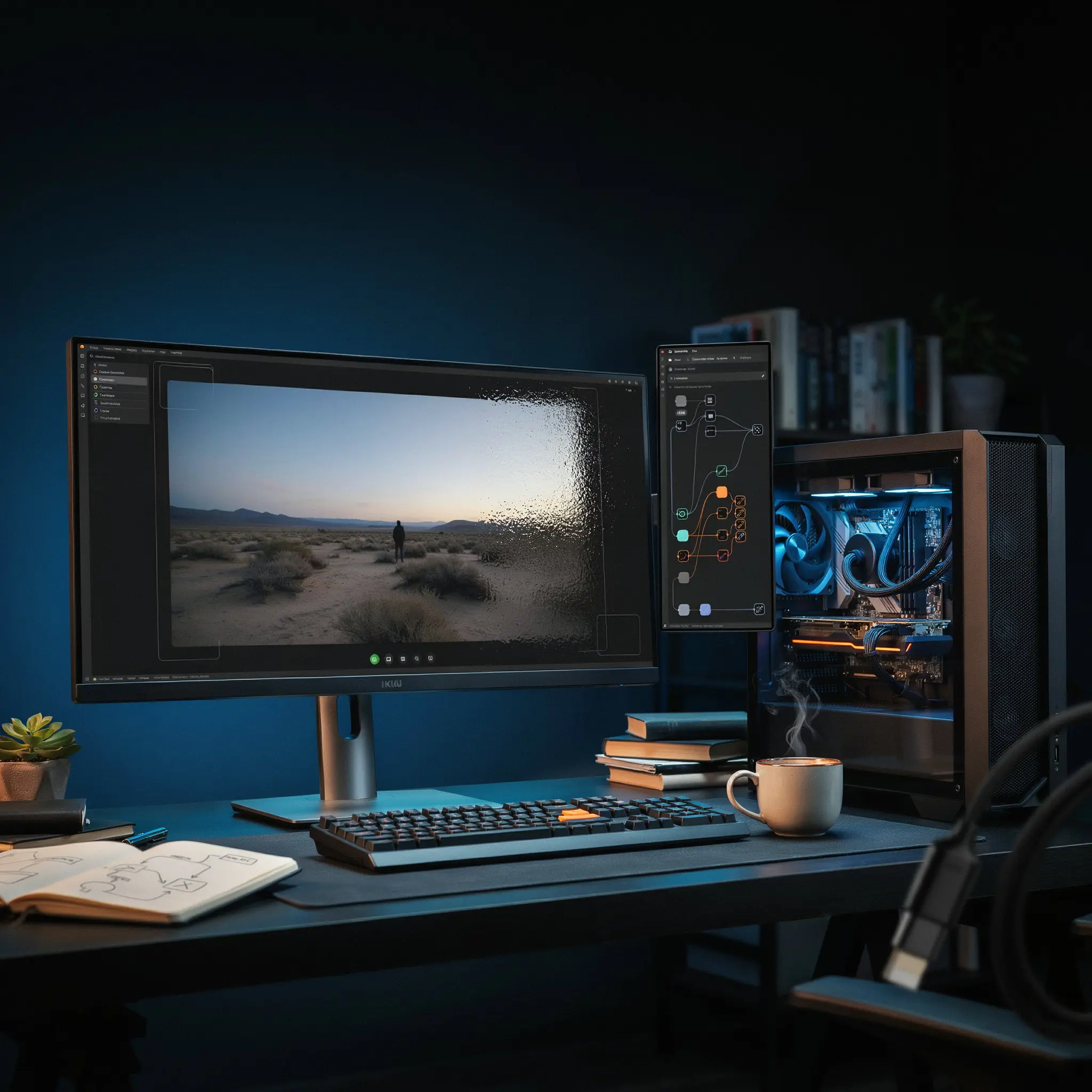
There's no subscription because there's no product to subscribe to — you're running a model, not renting an app. That shifts the cost from a monthly fee to a hardware decision. The 5B model is realistic on a single RTX 4090 (24GB VRAM) or similar consumer card. The full 14B models want more headroom — 24GB+ VRAM is the practical minimum most guides recommend for smooth generation, and cloud GPU rental (an A100 or H100 by the hour) is the common workaround if you don't own the hardware.
Setup runs through ComfyUI, which has native Wan 2.2 support with official workflow templates, or through Diffusers if you're comfortable scripting your own pipeline. If neither local GPU access nor ComfyUI sounds appealing, several inference platforms (Hugging Face Spaces, third-party GPU-rental services) let you run Wan 2.2 generations without installing anything, usually billed per second of output rather than a flat subscription.
Try Wan 2.2 online → or get the weights directly from the official GitHub repository.
Wan 2.2 vs Sora vs Runway vs Kling
| Feature | Wan 2.2 | Runway Gen-4 | Kling AI | OpenAI Sora |
|---|---|---|---|---|
| License / Access | Apache 2.0, self-hosted | Closed, subscription | Closed, subscription | Discontinued |
| Cost | Free (hardware only) | From $15/mo | From $5/mo | — |
| Max resolution | 720p (5B) / higher (14B) | Up to 4K upscale | 1080p | — |
| Runs offline / self-hosted | ✅ Yes | ❌ | ❌ | ❌ |
| Ease of use | Requires setup (ComfyUI) | Polished web app | Polished web app | — |
That last column isn't a formatting error: OpenAI discontinued Sora's consumer app in April 2026 and is shutting down the API entirely by late September 2026, after the product burned through far more in daily compute costs than it earned in revenue. It's a useful reminder of what "free" really means with a hosted product — the company can take it away. Wan 2.2's weights, once downloaded, work whether or not Alibaba keeps supporting them.
Pros & Cons
Learning Curve
This is the steepest learning curve of any tool in this category, and it's worth being upfront about it. There's no signup-and-generate flow. You're installing ComfyUI, downloading multi-gigabyte model files, and — if you want character consistency — training your own LoRA from 20 to 50 reference images. None of it is exotic to anyone who's touched Stable Diffusion before, but if your only AI experience is typing prompts into a web app, budget a real afternoon before your first usable clip.
Who Should Use It?
✅ Choose Wan 2.2 if...
You already have (or can rent) a decent GPU, you're comfortable with ComfyUI or similar node-based tools, and you want full control with zero recurring cost.
❌ Look elsewhere if...
You want a polished, no-setup web app, need a full production pipeline with storyboarding and editing built in, or don't have access to a capable GPU.
Alternative path: If the appeal is specifically "open and self-hostable," Hunyuan Video from Tencent is the other major open-weight option worth comparing before committing to a workflow. If the appeal is specifically "free," Kling's daily-refresh free tier or Seedance's daily credits get you generating without any local setup at all — at the cost of not owning the model.
Expert Editorial Opinion
The honest way to frame Wan 2.2 is as a developer tool wearing a video-generator's clothes. The output quality, when the setup is right, competes credibly with paid options from a year or two back — genuinely useful for people building pipelines, training custom LoRAs, or running high-volume generation where per-clip subscription costs would add up fast. That's a different audience than someone who wants to type a caption and post to TikTok in the next five minutes.
The Mixture-of-Experts architecture is the technical decision that makes the rest of the story work. By only activating 14B of the model's 27B parameters per step, Alibaba made it possible to run a serious video model on hardware people actually own, rather than requiring a rented server for every generation. That's the same trade-off that made Stable Diffusion useful to millions of people who never touched Midjourney's API — and it's likely why Wan 2.2 picked up 17,000+ GitHub stars within months.
What keeps this from being a universal recommendation is simply the gap between "open weights exist" and "this is usable by anyone." Wan 2.2 assumes you're willing to install software, manage GPU memory, and troubleshoot a pipeline instead of a support ticket. For that audience, it's arguably the best free option in the category. For everyone else, a $5–15/month subscription to a polished tool will save more time than it costs.
One more point worth flagging given the current market: OpenAI just wound down Sora entirely within about eighteen months of its debut. Whatever you think of Wan 2.2's rougher edges, the model itself doesn't disappear if Alibaba changes strategy — the weights are already on your drive. That durability is a real, if unglamorous, argument for open weights that closed products can't match.
My take: don't go into Wan 2.2 expecting a Runway replacement. Go in expecting a genuinely capable, genuinely free video model that rewards technical patience — and treat the setup time as the actual price of admission.
Final Verdict
Wan 2.2 delivers on a promise most "free" AI tools don't: it's actually free, actually open, and actually yours once you've downloaded it. The Mixture-of-Experts design makes serious video generation possible on consumer hardware, and the community around it — 17,000+ GitHub stars, active LoRA sharing, native ComfyUI support — is real and growing.
The trade-off is setup friction that closed, subscription tools have engineered away entirely. If you're comfortable with GPUs and node-based workflows, Wan 2.2 is one of the strongest free options available in 2026. If you want to skip straight to generating, a paid tool will get you there faster — just budget for the fact that, unlike Wan 2.2, a hosted product can be discontinued without much warning.
❓ Frequently Asked Questions
🔗 Related ToolRadar Reviews
Would you trade a polished app for full ownership of the model — or is setup friction a dealbreaker no matter how good the price is? Try Wan 2.2 for yourself here.

Comments
Post a Comment