



Is Hunyuan Video the Best Open-Source AI Video Generator You Can Actually Use in 2026?
Tencent's 13-billion-parameter open-source video model promises Hollywood-grade motion without the Hollywood budget. But does it actually run on your machine?
- What Is Hunyuan Video and Why Does It Matter?
- Key Features That Set It Apart
- Pricing: Free, Hosted, or Self-Hosted?
- Pros & Cons: The Full Picture
- Real User Pulse: What Reddit & Trustpilot Say
- How It Compares to Kling AI & Runway Gen-4
- Who Should Use Hunyuan Video?
- Expert Editorial Opinion
- Final Verdict
- Related ToolRadar Reviews
- Frequently Asked Questions
Imagine typing "a samurai walking through a bamboo forest at golden hour, cinematic tracking shot" and watching a 10-second clip materialize in front of you — smooth motion, coherent lighting, no flickering artifacts. That is the promise of Hunyuan Video, Tencent's open-source AI video generator that has quietly become one of the most powerful tools in the open-source video ecosystem since its launch in December 2024. With 13 billion parameters and a architecture built on Diffusion Transformers (DiT) with 3D causal VAE, it is not just another text-to-video toy — it is a production-grade engine that rivals closed-source heavyweights like Runway Gen-3 and Luma 1.6 in professional human evaluations.
But here is the catch that nobody talks about enough: "open-source" does not mean "accessible." The original model demands 60GB of VRAM at full resolution — hardware that costs more than a used car. The newer v1.5 trimmed that down to 14GB with offloading, but you are still looking at a steep technical climb. So the real question is not whether Hunyuan Video is good — it absolutely is — but whether it is good *for you*. This review breaks down everything you need to know: what it does, what it costs, where it struggles, and whether you should invest your time (and GPU budget) into making it work.
What Is Hunyuan Video and Why Does It Matter?
Hunyuan Video is Tencent's flagship open-source video generation model, built on a 13-billion-parameter Diffusion Transformer architecture with a 3D causal VAE that compresses video data at 16x spatial and 4x temporal ratios. Launched on December 1, 2024, it was the largest open-source video model available at the time — and it remains one of the most capable today. The model supports both text-to-video and image-to-video generation, with particular strength in understanding Chinese-language prompts and generating content optimized for Chinese social media platforms. In November 2025, Tencent released HunyuanVideo 1.5, a lighter 8.3B-parameter variant with SSTA (Selective Sliding Tile Attention) that trades some resolution for dramatically improved accessibility and inference speed. The model is fully open-source, commercially licensed, and backed by one of the most serious AI research teams on the planet.
Key Features That Set It Apart
Cinematic Motion & Physics
Hunyuan Video generates smooth, temporally coherent motion with physics-based accuracy. The DiT architecture with full attention mechanism captures complex interactions between visual and semantic information, producing tracking shots, dollies, and pans that feel genuinely cinematic rather than AI-smoothed. Users on Civitai consistently report fewer flickering artifacts between frames compared to competing open models, even on complex action sequences.
True Bilingual Understanding
The model uses a Multimodal Large Language Model (MLLM) as its text encoder rather than the standard CLIP/T5 combination. This gives it superior understanding of both Chinese and English prompts, with better image-text alignment and complex reasoning capabilities. The Prompt Rewrite feature (Normal and Master modes) automatically enhances user prompts for richer scene descriptions and better camera movement guidance.
1080p Super-Resolution Pipeline
HunyuanVideo 1.5 introduces a dedicated video super-resolution enhancement system that upscales low-resolution outputs to 1080p without the grid artifacts common in traditional interpolation methods. The system operates in latent space through a trained upsampling module, enhancing sharpness while correcting distortions — a critical feature for content destined for professional platforms.
Developer-Friendly & Self-Hostable
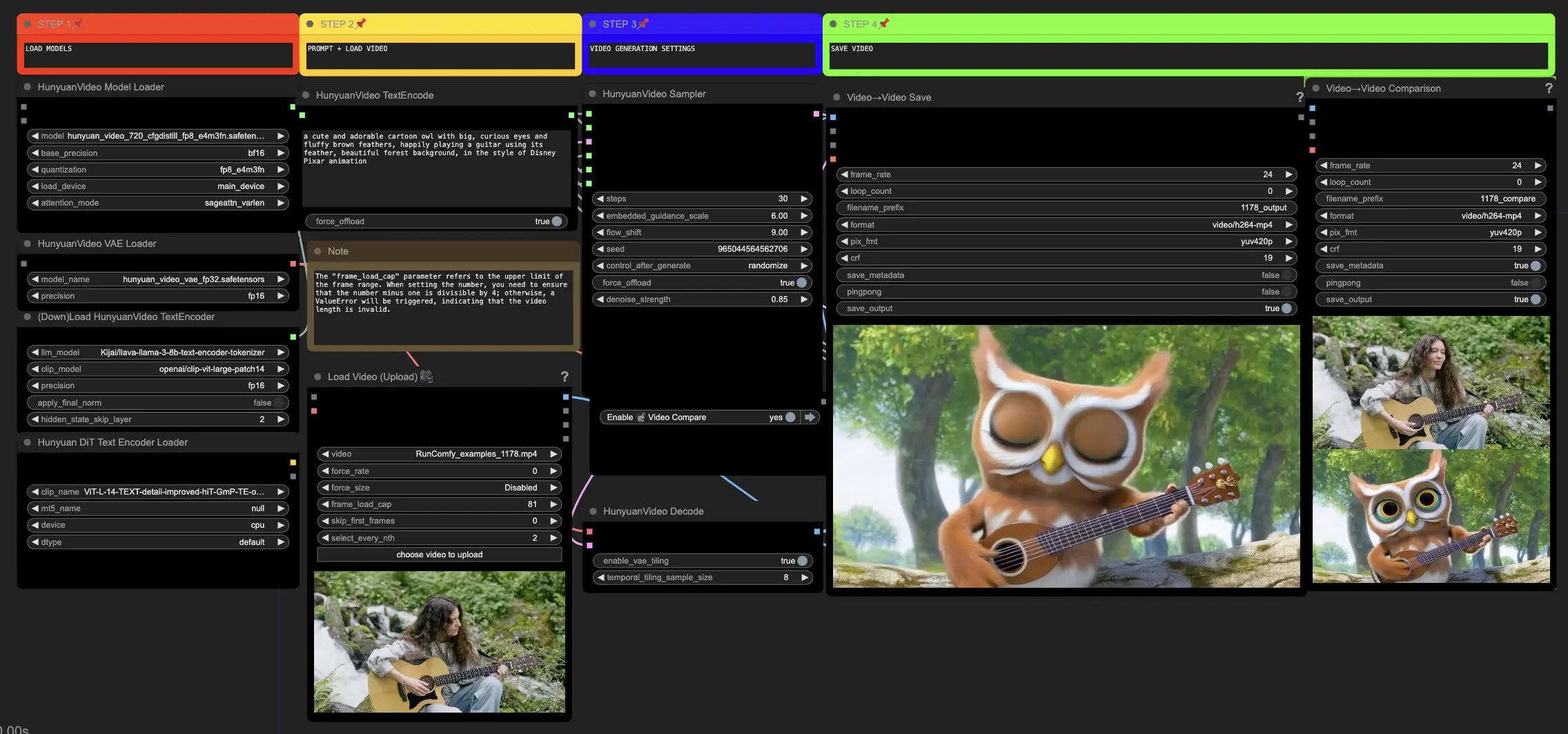
Being fully open-source means Hunyuan Video integrates into custom pipelines via ComfyUI, Diffusers, and direct API calls. The community has built FP8 quantization guides, AMD compatibility patches, blockswap memory optimization workflows, and temporal tiling for 8GB VRAM setups. For developers building video generation applications, this level of customization is impossible with closed-source alternatives.
Pricing: Free, Hosted, or Self-Hosted?
| Plan | Cost | Details |
|---|---|---|
| Open Source (Self-Hosted) | Free | Download weights from GitHub. Requires GPU with 14GB+ VRAM (v1.5) or 60GB+ (original). Hardware costs apply. |
| fal.ai Hosted (v1.5) | $0.075/sec | ~13 generations per $1.00. 480p output, ~3 min generation time. Best for rapid prototyping without hardware investment. |
| fal.ai Hosted (Original) | $0.40/video | Higher resolution options. ~4 minutes per generation. Pro mode costs 2x for 55 inference steps. |
Pros & Cons: The Full Picture
✓ What Works
- ✅ Open-source and commercially licensed — full control over your data and pipeline
- ✅ Best-in-class motion coherence among open-source models; professional evaluations rank it above Runway Gen-3
- ✅ Strong bilingual prompt understanding (Chinese + English) with automatic prompt enhancement
- ✅ 1080p super-resolution pipeline produces professional-grade output without interpolation artifacts
✗ What Frustrates
- ❌ Original 13B model requires 60GB VRAM — far beyond consumer GPU reach without aggressive workarounds
- ❌ Generation speed is slow: ~3-4 minutes per clip on hosted platforms, making real-time iteration impossible
- ❌ No native built-in editor or post-generation workflow — users must export and refine externally
💡 Real User Pulse: What Reddit & Trustpilot Say
How It Compares to Kling AI & Runway Gen-4
| Feature | Hunyuan Video 1.5 | Kling AI v3 | Runway Gen-4 |
|---|---|---|---|
| Architecture | 8.3B DiT + 3D VAE + SSTA | Proprietary (closed) | Proprietary (closed) |
| Max Resolution | 1080p (via SR) | 1080p native | 1080p native |
| Open Source | Yes (Apache 2.0) | No | No |
Who Should Use Hunyuan Video?
Ideal Users: Technical creators and developers who want full control over their video generation pipeline. If you are comfortable with ComfyUI, GPU optimization, and command-line deployment, Hunyuan Video offers unmatched flexibility at zero marginal cost. Chinese-speaking content creators targeting Douyin, Bilibili, or Xiaohongshu will find the native bilingual understanding a game-changer — no more awkward translations or lost nuance in prompts. Enterprise teams building video generation products will appreciate the commercial license and API integration options.
Look Elsewhere If: You need instant results without technical setup. If your workflow depends on real-time iteration — tweaking a prompt and seeing results in 30 seconds — Hunyuan Video's 3-4 minute generation time will frustrate you. Creators who want an all-in-one platform with built-in editing, music sync, and template libraries should stick with Runway or Kling. And if you are running on a MacBook or entry-level GPU without access to cloud credits, the hardware requirements will block you entirely.
Expert Editorial Opinion
Hunyuan Video represents one of the most significant achievements in open-source AI video generation, but it also exposes a fundamental tension in the democratization of creative tools. On one hand, Tencent has released a model that objectively outperforms closed-source competitors in professional evaluations — a 13-billion-parameter engine with cinematic motion quality, bilingual understanding, and full commercial licensing. On the other hand, "open" does not mean "accessible." The original model's 60GB VRAM requirement places it in the territory of enterprise data centers, not home studios.
The v1.5 release addresses this partially by dropping to 8.3B parameters and introducing SSTA attention, cutting minimum requirements to 14GB with offloading. But this is still a 24GB GPU territory for comfortable operation — an RTX 4090 at minimum, or cloud instances at $2-4 per hour. The community has responded with remarkable ingenuity: ComfyUI workflows, FP8 quantization, blockswap tricks, and even 8GB VRAM temporal tiling. Yet each optimization trades speed for accessibility, and the question remains whether a tool that requires this level of technical sophistication is truly democratizing creativity.
From a pricing perspective, the hosted options via fal.ai at $0.075 per second are genuinely competitive — roughly 13 generations per dollar at 480p. This positions Hunyuan Video as one of the most cost-effective text-to-video options for standard-definition workflows, undercutting both Kling AI and Runway Gen-4 by significant margins. But the lack of a free tier on hosted platforms means creators must commit financially before evaluating quality, a barrier that closed-source competitors with trial credits do not impose.
Final Verdict
Hunyuan Video earns its place as the flagship open-source AI video generator of 2026. With 13 billion parameters, cinematic motion quality that outperforms Runway Gen-3 in professional evaluations, and genuine bilingual understanding of Chinese and English prompts, it is a technical achievement that few competitors can match. The open-source licensing and self-hosting capability give developers and enterprise teams unprecedented control over their video pipelines. However, the hardware requirements — 60GB VRAM for the original model, 14GB+ for v1.5 — place it firmly in the hands of technical users with serious GPU budgets. The hosted options via fal.ai at $0.075 per second offer a practical entry point, but the 3-4 minute generation time and lack of a free tier create friction for casual creators. For those who can clear the technical bar, Hunyuan Video delivers production-grade results at a fraction of commercial costs. For everyone else, it remains a fascinating tool to read about — and a reminder that "open source" and "accessible" are not the same thing.
🔗 Related ToolRadar Reviews
More tools from AI Video
❓ Frequently Asked Questions
Is Your GPU Ready for the Open-Source Video Revolution?
Hunyuan Video proves that open-source AI can compete with the biggest names in video generation — but only if you have the hardware and technical skills to unlock it. Are you willing to invest in the setup, or would you rather pay a premium for instant results?
Explore Hunyuan Video →
Comments
Post a Comment