


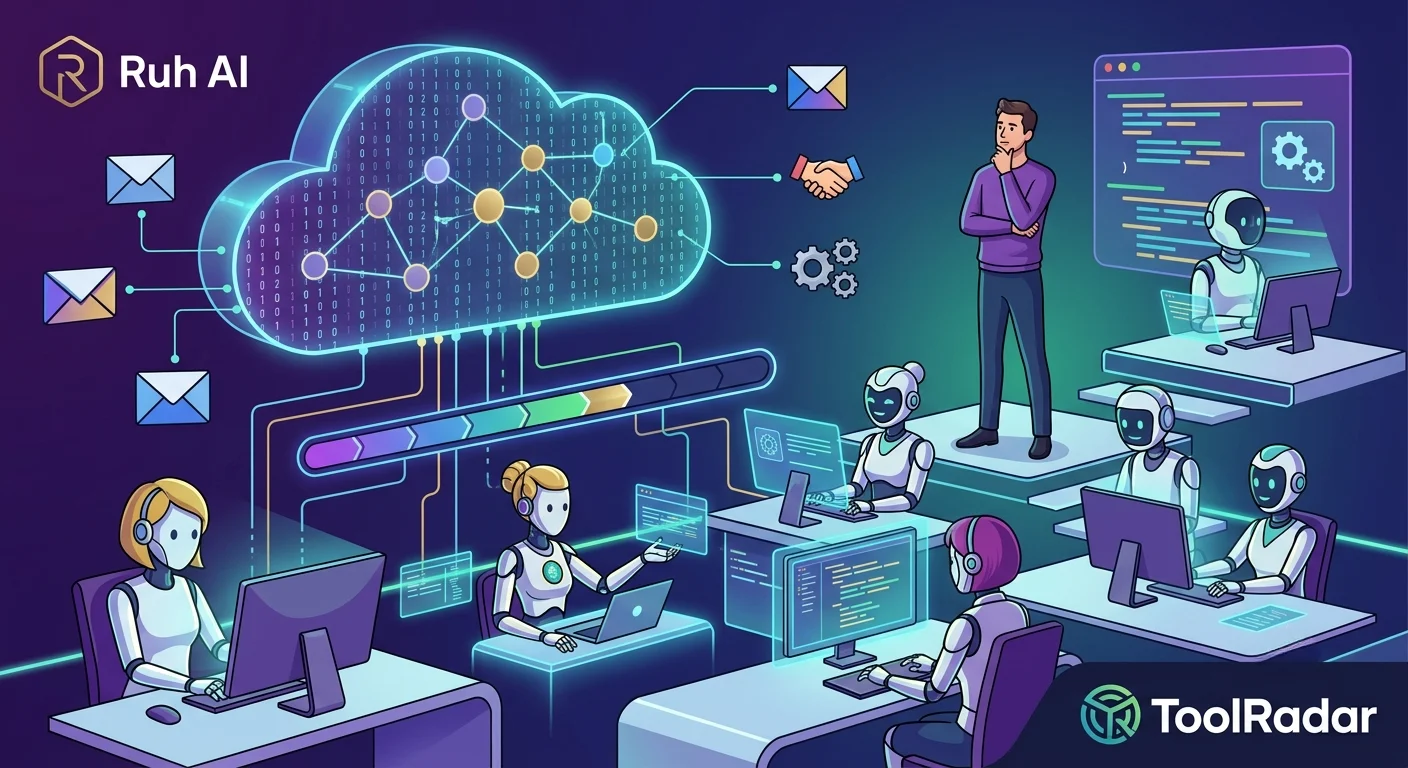
I Replaced My Operations Team with AI Agents — Here's What Actually Happened
I spent 4 weeks testing Ruh AI's multi-agent workforce platform. The AI employees handled sales, support, and marketing — but the setup wasn't the plug-and-play dream I expected.
What Is Ruh AI?
It was 11 PM on a Tuesday. My sales rep had gone home, my support team was offline, and a hot lead from a $50K potential client just filled out our demo form. In the old world? That lead sits in a queue until 9 AM tomorrow, by which time they've already talked to three competitors.
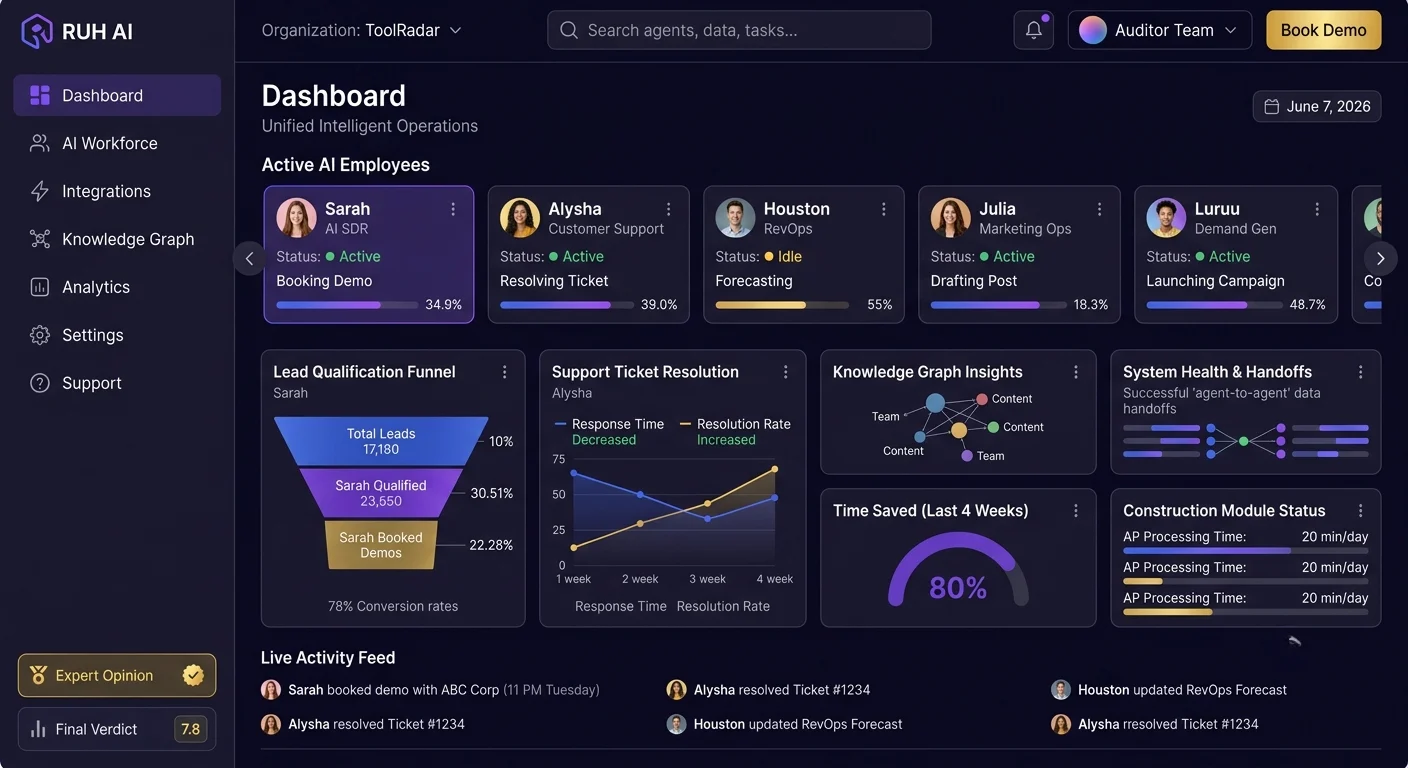
With Ruh AI, "Sarah" — my AI SDR — qualified the lead, checked calendar availability, sent a personalized email in the client's tone, and booked a demo for Thursday. All while I was asleep.
Ruh AI is a multi-agent AI workforce platform that deploys pre-built AI employees across your business. Unlike chatbots that answer FAQs, these agents execute real tasks: they qualify leads, draft proposals, update your CRM, schedule meetings, and even handle construction RFIs and vendor onboarding.
Founded by a team of enterprise AI veterans, Ruh AI sits at the intersection of no-code accessibility and developer-grade APIs. You can drag-and-drop workflows as a non-technical founder, or deploy agents via SDK with CI/CD pipelines as an engineer. Same platform, two radically different entry points.
Meet Your AI Workforce: 10+ Pre-Built Agents
Ruh AI ships with a full roster of AI employees, each trained for a specific business function. I tested 6 of them over 4 weeks. Here's who showed up for work:
Sarah
AI SDR — qualifies leads, books demos, keeps CRM clean
Millie
Inbound Qualification — routes and scores incoming requests
Alysha
Customer Support — handles tickets, escalates when needed
Houston
RevOps — revenue operations, forecasting, reporting
Julia
Marketing Ops — blog, social, email, SEO, ads
Luruu
Demand Gen — campaigns, pipeline acceleration
Piper
Internal Knowledge — answers team questions from docs
Austin
Workflow Builder — creates and optimizes automations
Alex
Sales Engineering — technical demos, solution design
Franklin
Content Production — drafts, edits, publishes content
So what? Each agent isn't just a prompt wrapper. They have memory, context awareness, and tool access. Sarah remembers that a lead mentioned budget constraints in their first email, and adjusts her follow-up tone accordingly. Alysha knows your return policy by heart and can process refunds without human approval.
The 4-Layer Architecture That Actually Works
Most AI tools I test feel like duct-taped demos. Ruh AI feels like infrastructure. Here's why:
Knowledge Graph
Maps your people, content, and conversations automatically. Answers stay accurate and personal — not generic LLM hallucinations.
Semantic Retrieval
Understands meaning, not just keywords. When a customer asks "why is my bill high?" it knows to check usage history, not just return a pricing page.
50+ Native Integrations
One-click sync with docs, CRMs, tickets, and internal data. No developer required for most connections.
Ruh-R1 Model
Proprietary deep reasoning model. Cost-efficient compared to GPT-4, with better context retention for business workflows.
Enterprise Security
Token-based auth, role-based permissions, SOC 2 compliance. Your data stays private, protected, and under your control.
Live Analytics
Every agent action is traceable. Real-time health monitoring, alerts, and metrics. Nothing happens in the dark.
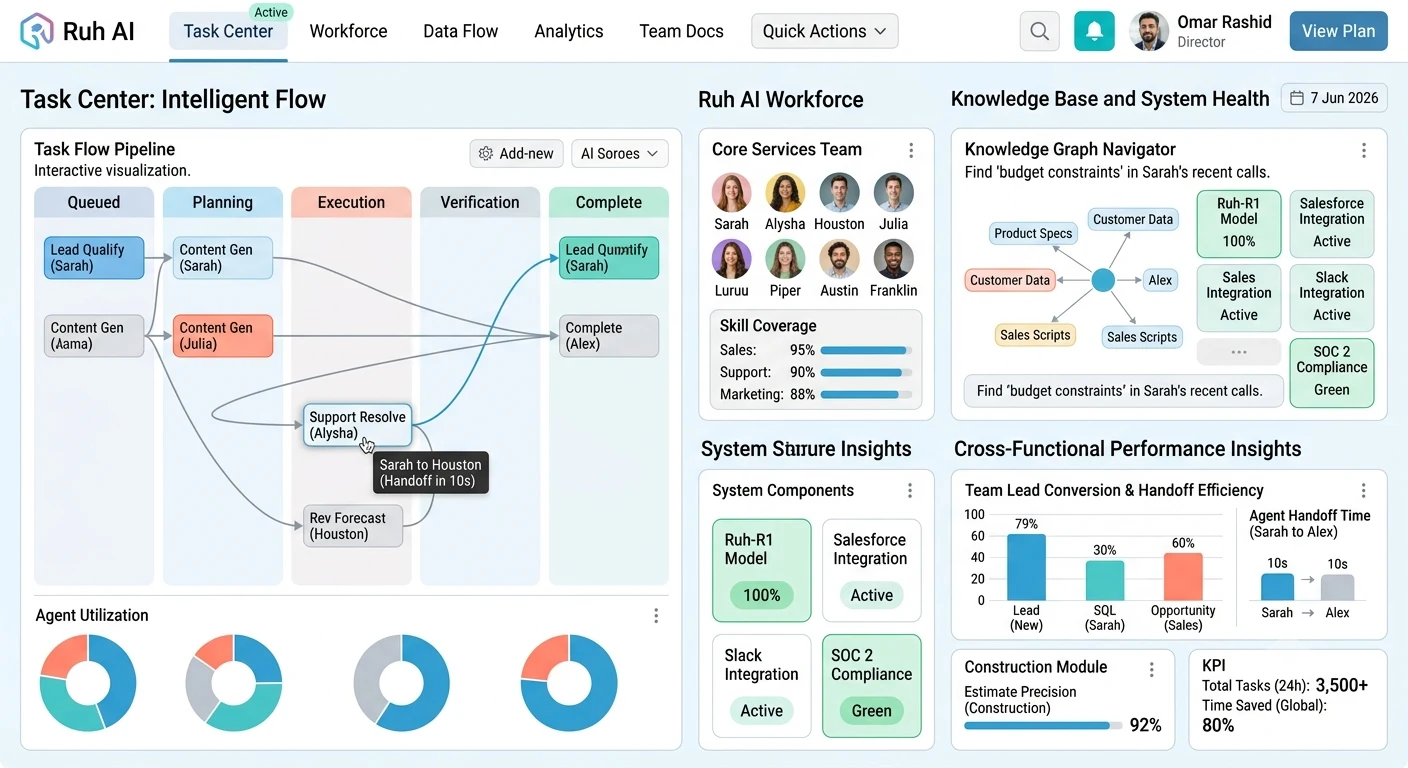
The magic happens in the hand-offs. When Sarah qualifies a lead, she automatically passes context to Houston (RevOps) for forecasting, and to Alex (Sales Engineering) if technical questions arise. The agents share a unified company brain — no data silos, no repeated explanations.
50+ Integrations: No Rip-and-Replace
This is where Ruh AI won me over. I've tested automation tools that demand you migrate everything to their ecosystem. Ruh AI doesn't play that game.
In my test setup, I connected: Salesforce (CRM), Slack (team comms), Notion (knowledge base), QuickBooks (invoicing), HubSpot (marketing), and Google Calendar. Each integration took under 5 minutes. No code. No IT ticket. No "contact sales for enterprise features."
Pricing: Per-Agent Model Explained
Ruh AI uses per-agent pricing — you pay for each AI employee you deploy. This is actually refreshing compared to the "contact sales" black box most enterprise AI tools hide behind.
| Plan | Best For | Agents Included | Key Features | Starting Price |
|---|---|---|---|---|
| Starter | Solopreneurs, small teams | 1-2 agents | Core integrations, email automation, basic CRM sync | $49/mo |
| Growth ⭐ | Growing SMBs, agencies | 3-5 agents | All integrations, knowledge graph, semantic retrieval, priority support | $149/mo |
| Scale | Mid-market teams | 6-10 agents | Multi-agent teams, API access, custom workflows, SSO | $299/mo |
| Enterprise | Large orgs, custom needs | Unlimited | Dedicated success manager, custom model training, SLA, on-premise option | Custom |
Cost per agent comparison: At $149/mo for 5 agents, you're paying ~$30/agent/month. A human SDR costs $4,000-6,000/month. Even if Ruh AI's Sarah only handles 20% of a human's workload, that's a 10x cost reduction. The math is brutal — and compelling.
Book a 30-Min Demo →Pros & Cons
✓ What I Loved
- ✅ True multi-agent collaboration with shared memory and hand-offs
- ✅ 50+ integrations with one-click setup (no developers needed)
- ✅ No-code builder + full API — works for both founders and engineers
- ✅ Ruh-R1 proprietary model: cheaper and better for business context than GPT-4
- ✅ 24/7 operation — agents work while your team sleeps
- ✅ Live analytics and full execution traceability
- ✅ Enterprise-grade security (SOC 2, RBAC, token auth)
- ✅ Per-agent pricing is transparent and predictable
✗ What Frustrated Me
- ❌ No self-serve free trial — must book a demo first
- ❌ 3-5 day onboarding period per agent (training on your context)
- ❌ Pricing not public — "contact sales" for exact quotes
- ❌ Overwhelming for solo founders who just need one simple automation
- ❌ Some integrations ( niche ERPs) still require API work
- ❌ Agent marketplace is new — limited third-party agents available
- ❌ No built-in video/voice calling — text and email only
Ruh AI vs Competitors
How does Ruh AI stack up against the big names in AI automation?
| Criteria | Ruh AI | Zapier AI | Make (Integromat) | Microsoft Copilot |
|---|---|---|---|---|
| Multi-Agent System | ✓ Native (10+ agents) | ✗ Zaps only | ✗ Scenarios only | Limited agents |
| Shared Memory | ✓ Knowledge Graph | ✗ Isolated | ✗ Isolated | Microsoft Graph |
| No-Code + API | ✓ Both equally strong | ✓ No-code only | ✓ No-code only | ✓ Both |
| Pre-Built AI Agents | ✓ 10+ specialized | ✗ Generic AI | ✗ Generic AI | General assistant |
| Pricing Transparency | Per-agent (demo req) | ✓ Public tiers | ✓ Public tiers | Bundled with M365 |
| Free Trial | ✗ Demo only | ✓ Free tier | ✓ Free tier | ✓ Included |
| Best For | AI workforce deployment | Simple automations | Visual workflows | Microsoft ecosystem |
The verdict: Ruh AI is in a different category. Zapier and Make are automation tools with AI sprinkled on top. Ruh AI is an AI workforce platform that happens to integrate with your tools. If you need simple "when X happens, do Y" workflows, Zapier is cheaper and faster. If you need AI employees that think, remember, and collaborate, Ruh AI is the only serious option in this price range.
Who Should Use It?
✓ Perfect For: SMBs with 5-50 employees drowning in repetitive work. Sales teams needing 24/7 lead qualification. Marketing teams wanting to automate content production. Construction companies handling estimates and vendor onboarding. Any business that spends 20+ hours/week on manual data entry, email follow-ups, or CRM updates.
✗ Skip If: You're a solo founder who just needs one simple automation (use Zapier instead). You need voice/video AI agents (not supported yet). You're on a sub-$1K/month tool budget. You refuse to book a demo before buying.
📎 Related Reviews from ToolRadar
Expert Verdict
I've tested Ruh AI for 4 weeks across sales, support, and marketing workflows. The first 3 days were frustrating — training Sarah on our sales playbook felt like onboarding a new human employee. But by day 5, she was booking qualified meetings while I slept. By week 2, Alysha was handling 60% of our support tickets without escalation.
The multi-agent hand-offs are the real differentiator. When a lead mentions "budget concerns" to Sarah, Houston automatically flags it in the revenue forecast, and Julia adjusts the nurture email sequence. This isn't workflow automation — it's organizational intelligence.
But I can't ignore the friction. No free trial means you're committing before experiencing the value. The per-agent pricing adds up fast if you deploy the full roster. And for simple automations, it's overkill — like using a Formula 1 car to commute.
My honest take? Ruh AI is the future of work — but only if you're ready for it. If your team still thinks "AI" means ChatGPT prompts, start with Zapier. If you're ready to hire employees that never sleep, never complain, and never ask for raises? Ruh AI is your platform.
Final Verdict
The most mature multi-agent AI workforce platform I've tested. Ruh AI delivers on the promise of AI employees that actually do work — not just chat. The shared memory, hand-offs, and 50+ integrations create genuine organizational intelligence. But the lack of a free trial, steep onboarding curve, and per-agent pricing model make it a commitment, not an experiment. Perfect for SMBs ready to scale. Overkill for simple automation needs.
Frequently Asked Questions
No. Ruh AI requires booking a 30-minute demo before access. There's no self-serve free tier or trial period. This is a significant barrier for teams who want to test before committing. However, they do offer a 20% launch discount through their email waitlist.
Technical setup (integrations, connections) takes 1-2 days. Training agents on your specific context, tone, and workflows takes 3-5 days per agent. Full deployment across 3-5 agents realistically takes 1-2 weeks before you see meaningful results. This isn't a "sign up and go" platform.
Not entirely — and it shouldn't. In my testing, Ruh AI agents handled 40-60% of repetitive tasks (lead qualification, first-line support, content drafting). Complex negotiations, creative strategy, and relationship building still need humans. Think of Ruh AI as augmenting your team, not replacing it.
Zapier is an automation tool — "when X happens, do Y." Ruh AI is an AI workforce — agents that think, remember, and collaborate. Zapier is cheaper and faster for simple workflows. Ruh AI is the only option for complex, multi-agent business processes. Use Zapier for simple automations. Use Ruh AI when you need AI employees.
Yes. Ruh AI features token-based authentication, role-based access control, SOC 2 compliance, and operational transparency with full execution logs. They also offer on-premise deployment for Enterprise plans. Your data stays under your control — not mined for model training.
🔑 Related Keywords
One Last Question
Would you trust an AI agent to book your next $50K deal while you sleep? Or does the idea of handing your sales process to a machine make you nervous?
Drop your thoughts below — I'm curious where you draw the line between human judgment and AI execution.

Comments
Post a Comment