


TruLens Review 2026: The Free Open-Source Tool Stanford Researchers Built to Stop AI Agents From Hallucinating
Born from Stanford research and popularized by Andrew Ng's DeepLearning.AI course, TruLens pioneered the RAG Triad. Now under Snowflake stewardship, is it still the go-to framework for LLM evaluation?
- What Is TruLens and Why Did It Go Viral?
- Core Features: From RAG Triad to Agentic Evals
- Pricing: The Zero-Dollar Advantage
- Pros and Cons: Where TruLens Shines and Stumbles
- Community Feedback: What Real Users Say
- TruLens vs DeepEval vs RAGAS: The 2026 Benchmark
- Who Should Use TruLens (and Who Should Look Elsewhere)
- Expert Editorial Opinion
- Final Verdict
- Related ToolRadar Reviews
- Frequently Asked Questions
In late 2023, a quiet open-source library from a team of Stanford professors suddenly became the most talked-about evaluation tool in the LLM ecosystem. Andrew Ng featured it in his DeepLearning.AI course. Thousands of developers installed it within weeks. The tool was TruLens, and it arrived at exactly the right moment — just as the industry realized that Retrieval-Augmented Generation systems were hallucinating not because the models were broken, but because nobody was systematically measuring whether retrieved context actually supported the answers being generated.
Fast forward to July 2026, and TruLens has evolved far beyond its original RAG Triad. Under Snowflake's stewardship following TruEra's acquisition, the framework now emits OpenTelemetry traces, evaluates AI agent goal-plan-action alignment through "Agent's GPA," and instruments Model Context Protocol (MCP) tool calls directly. But the landscape has also become crowded. DeepEval offers red-teaming and synthetic data generation that TruLens lacks. RAGAS ships more comprehensive out-of-the-box RAG metrics. And commercial platforms like LangSmith and Braintrust provide managed dashboards that open-source tools cannot match. This review examines whether TruLens's flexibility and zero-cost model still justify its place in your evaluation stack, or whether the field has moved on.
What Is TruLens and Why Did It Go Viral?
TruLens is an open-source Python library for evaluating and tracing AI agents, RAG pipelines, and LLM applications. Originally created by TruEra — a company founded by Stanford professors — it gained explosive popularity in late 2023 and early 2024 through Andrew Ng's DeepLearning.AI course, which introduced thousands of developers to the concept of feedback-driven LLM evaluation. After TruEra was acquired by Snowflake, the project transitioned to community-driven development with Snowflake actively overseeing and supporting its roadmap.
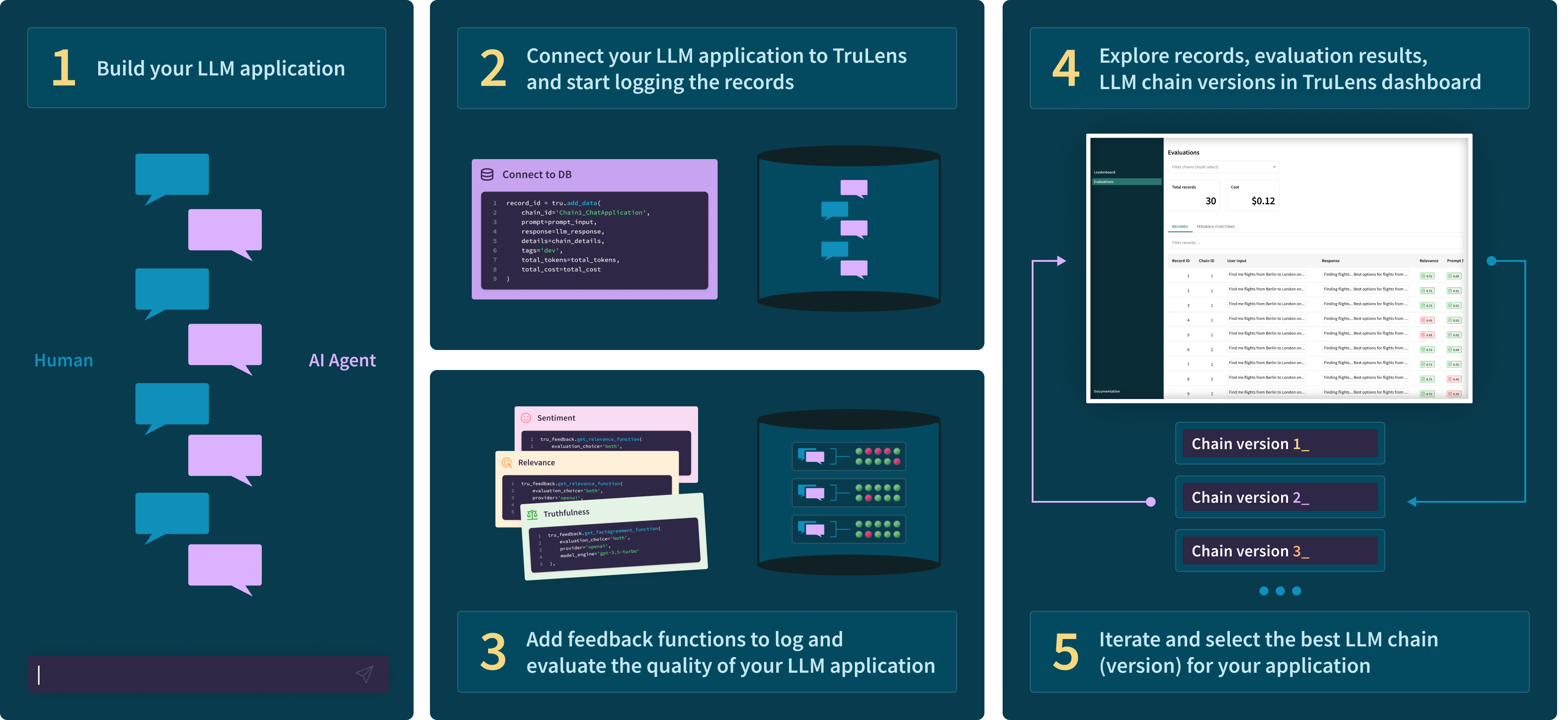
The core insight behind TruLens is deceptively simple: instead of treating LLM evaluation as a post-hoc manual review process, you instrument your application so that every function call, LLM generation, retrieval, and tool invocation is captured as a structured trace. These traces are then scored by "feedback functions" — programmatic checks that use either rule-based logic or an LLM-as-judge to rate outputs along quality dimensions. The result is a systematic, repeatable evaluation pipeline that runs alongside your application rather than after it. In 2026, TruLens has expanded this model to support both inline evaluation (as the app runs) and batch evaluation via a Run API against pre-collected datasets, making it suitable for everything from rapid prototyping to production regression testing.
Core Features: From RAG Triad to Agentic Evals
The RAG Triad
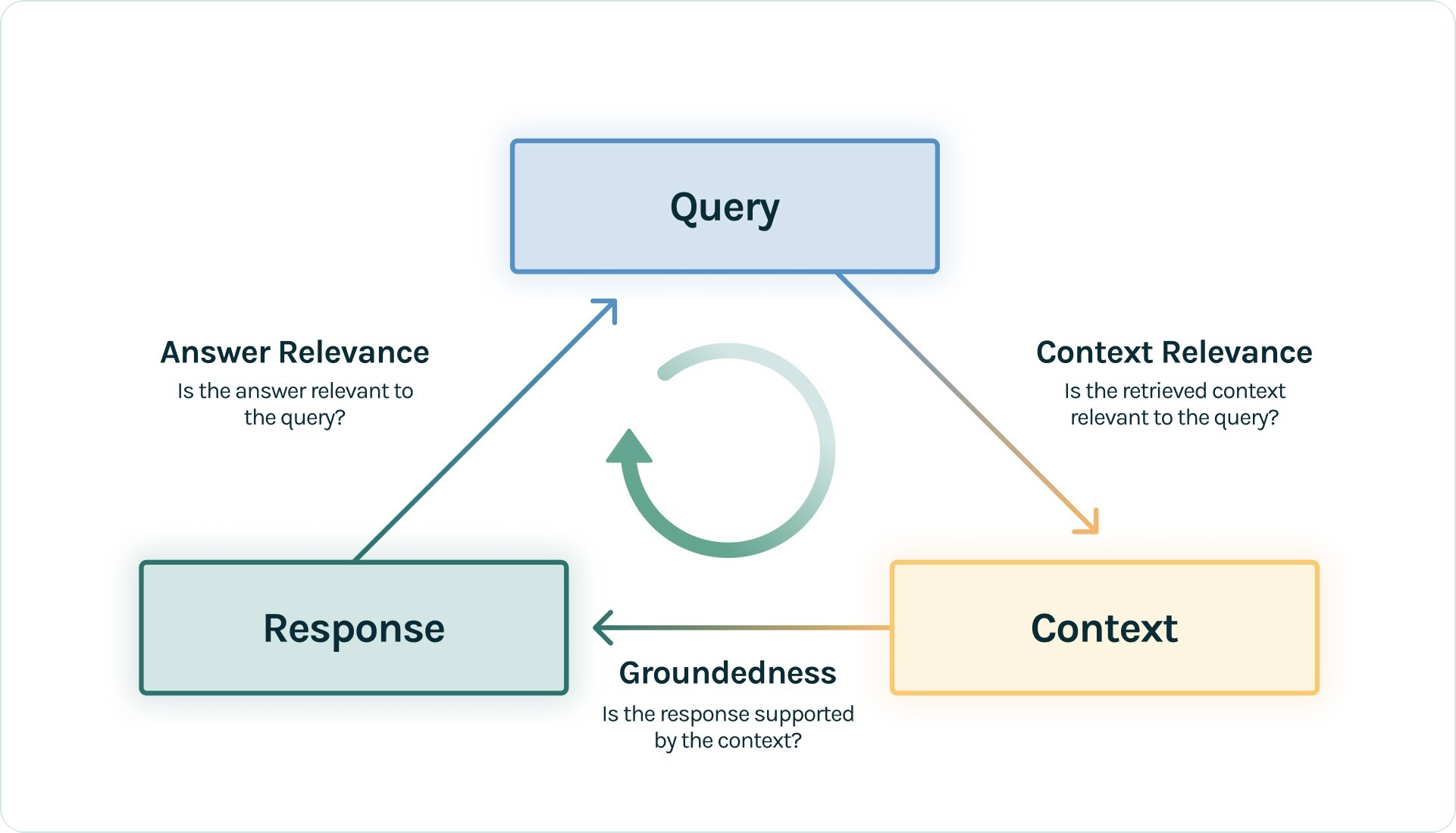
TruLens pioneered the three-metric evaluation that became industry standard: Context Relevance (are retrieved chunks relevant?), Groundedness (is the answer supported by context?), and Answer Relevance (does it address the question?). Together, they provide confidence your RAG is hallucination-free up to the limit of its knowledge base.
OpenTelemetry-Native Tracing
Every function call, LLM generation, retrieval, and tool invocation is captured as a structured OTEL span. Export traces to Jaeger, Grafana Tempo, Datadog, or any OTLP-compatible backend. TruLens fits into your existing observability stack instead of forcing a new one.
Agent's GPA & 7 Agentic Evaluators
New in 2026: evaluate agent goal-plan-action alignment with "Agent's GPA," benchmarked to cover 95% of internal agent errors. Seven purpose-built evaluators measure LogicalConsistency, ExecutionEfficiency, PlanAdherence, PlanQuality, ToolSelection, ToolCalling, and ToolQuality.
MCP Tool Call Instrumentation
TruLens can instrument Model Context Protocol (MCP) tool calls directly, capturing tool name, arguments, output, and latency. This is critical for evaluating modern agentic systems where tool use quality is as important as final output quality.
Evaluation Dashboard & Leaderboard
Visualize context relevance, answer relevance, and groundedness scores per record. Compare app versions on a leaderboard to identify trace-level regressions and make informed trade-offs between accuracy, reliability, cost, and latency.
Custom Feedback Functions
Define any metric in Python. The same framework that scores faithfulness for a RAG app can score code quality for a code-gen app or accuracy for a math tutor. Use any LLM provider as a judge: OpenAI, Anthropic, HuggingFace, local models, or even custom rule-based logic.
Pricing: The Zero-Dollar Advantage
| Component | Cost | Notes |
|---|---|---|
| TruLens Core Library | $0 | Apache 2.0 open source, pip install trulens-core |
| Dashboard / UI | $0 | Self-hosted, runs locally or on your own server |
| LLM Judge API Calls | Variable | You pay your LLM provider (OpenAI, Anthropic, etc.) for judge tokens |
| Enterprise Support | Documentation Only | Community Discord/GitHub; no paid support tier as of July 2026 |
TruLens's biggest competitive advantage is also its simplest: it is completely free. There are no seat limits, no usage caps, no feature gates, and no subscription tiers. You install the library, instrument your application, and start evaluating. The only costs you incur are the API calls to your chosen LLM provider acting as a judge for feedback functions — and even those can be minimized by using local models or caching repeated evaluations.
This pricing model makes TruLens uniquely accessible to solo developers, academic researchers, and early-stage startups that cannot justify $39 per seat per month for LangSmith or $249 per month for Braintrust. For a bootstrapped AI startup running RAG evaluation on a few hundred queries per day, TruLens can reduce evaluation infrastructure costs from hundreds of dollars monthly to essentially zero. The tradeoff is that you are responsible for hosting the dashboard, managing the database backend (SQLite for local, PostgreSQL for production), and building your own CI integration — there is no managed service to handle these concerns for you.
Get Started With TruLens →Pros and Cons: Where TruLens Shines and Stumbles
✓ What Works
- ✅ 100% free and open source — no usage limits, no vendor lock-in, no subscription anxiety
- ✅ Pioneered the RAG Triad, which became the industry-standard vocabulary for RAG evaluation
- ✅ Maximum flexibility via custom feedback functions — define any metric in Python
- ✅ OpenTelemetry-native tracing integrates seamlessly with existing observability stacks
✗ What Hurts
- ❌ No synthetic data generation — you must bring or manually curate your own evaluation datasets
- ❌ No red-teaming, safety testing, or adversarial evaluation capabilities
- ❌ Traction "slowly died" after the Snowflake acquisition; community momentum shifted to DeepEval
- ❌ Setup complexity and significant custom configuration required for powerful feedback functions
💡 Community Feedback: What Real Users Say
TruLens vs DeepEval vs RAGAS: The 2026 Benchmark
| Capability | TruLens | DeepEval | RAGAS |
|---|---|---|---|
| Open Source License | Apache 2.0 | Apache 2.0 | Apache 2.0 |
| RAG Metrics (Out-of-Box) | RAG Triad (3 metrics) | Comprehensive (10+ metrics) | Canonical (5 core metrics) |
| Custom Metric Flexibility | Maximum (feedback functions) | High (G-Eval, custom) | Moderate |
| Synthetic Data Generation | Not available | Built-in generator | Built-in generator |
| Red Teaming / Safety | Not available | Full suite (DeepTeam) | Limited |
| Agentic Evaluation | 7 evaluators + Agent's GPA | 6 agent metrics | Limited |
| CI/CD Integration | Manual pytest setup | Native pytest integration | Strong CI support |
| Observability Tracing | OpenTelemetry native | Limited | Via export |
The 2026 benchmark paints a nuanced picture. TruLens wins decisively on custom metric flexibility and OpenTelemetry-native observability — no competitor matches its ability to define arbitrary feedback functions in Python and export traces to any OTLP-compatible backend. However, DeepEval has pulled ahead on breadth: it offers synthetic data generation, comprehensive red-teaming through DeepTeam, and native pytest integration that makes CI/CD gating effortless. RAGAS remains the gold standard for out-of-the-box RAG metrics, with five canonical metrics that require zero configuration to start measuring faithfulness and relevance.
For teams building RAG applications who want immediate, comprehensive metrics without writing custom code, RAGAS is the faster starting point. For teams who need safety testing, adversarial evaluation, and automated dataset generation as part of a mature LLMOps pipeline, DeepEval is the more complete solution. TruLens occupies a specific niche: teams that value maximum flexibility, already have observability infrastructure they want to integrate with, and prefer defining their own quality dimensions rather than accepting a vendor's metric taxonomy. In practice, many mature teams run a hybrid stack: TruLens for trace-level debugging and custom metrics, RAGAS for canonical RAG evaluation, and DeepEval for CI regression gates and red-teaming.
Who Should Use TruLens (and Who Should Look Elsewhere)
TruLens is built for: Python developers who want full control over their evaluation logic, teams already invested in OpenTelemetry observability stacks, academic researchers and grad students who need a free, extensible evaluation framework, and startups that cannot afford commercial per-seat pricing but need production-grade RAG evaluation. It is especially compelling for teams building domain-specific AI applications where generic metrics fail — medical diagnosis assistants, legal research tools, or scientific literature review systems where "correctness" requires custom, expert-defined criteria that no off-the-shelf metric can capture.
Look elsewhere if: You need plug-and-play evaluation with minimal setup (RAGAS is faster), you require safety testing, red-teaming, or adversarial evaluation (DeepEval has these natively), you want synthetic data generation to expand test coverage automatically, you need a managed dashboard with team collaboration features (LangSmith or Braintrust), or you are not comfortable writing Python feedback functions and prefer YAML-configured test suites (Promptfoo is a better fit). TruLens rewards technical investment; it does not handhold beginners.
Expert Editorial Opinion
TruLens occupies a fascinating position in the 2026 LLM evaluation landscape. It was the first framework to systematize RAG evaluation through the Triad, and that intellectual contribution has permanently shaped how the industry thinks about retrieval quality. The OpenTelemetry pivot was a strategically brilliant move — instead of competing with observability platforms, TruLens became interoperable with them, exporting traces to Jaeger, Datadog, and Grafana Tempo. This decision preserved TruLens's relevance even as commercial platforms like LangSmith and Braintrust captured the managed-dashboard market.
The pricing gap is not really a gap at all — it is TruLens's entire value proposition. At $0, it undercuts every commercial alternative by definition. But the hidden cost is engineering time. Setting up custom feedback functions, configuring PostgreSQL backends for production, and building CI integration from scratch requires significantly more effort than clicking through a LangSmith onboarding flow. For a solo developer or a cash-constrained startup, that time investment is rational. For a mid-size product team with deadlines, the $39 per seat for LangSmith or $19.99 per user for DeepEval often pays for itself in saved engineering hours.
The Snowflake acquisition remains the elephant in the room. While the project has stayed open source and community-driven, the "slowly died" observation from competitor analysis is not entirely unfair. GitHub activity, new release velocity, and community Discord engagement have all softened compared to the peak Andrew Ng hype cycle. DeepEval, by contrast, has accelerated — adding synthetic data generation, red-teaming, and a commercial cloud tier that funds continued open-source development. TruLens needs a compelling 2026 roadmap to reclaim momentum, particularly around the gaps that competitors have exploited: safety testing, automated dataset generation, and easier out-of-the-box metrics.
Is TruLens worth using without a free tier? The question is almost irrelevant — there is no paid tier to worry about. The real question is whether TruLens's zero-dollar model justifies the engineering investment it demands. For teams with strong Python skills, existing observability infrastructure, and a need for custom metrics, the answer is a clear yes. For teams wanting a turnkey evaluation suite with minimal configuration, the answer is increasingly no — not because TruLens is bad, but because DeepEval and RAGAS have become so good at their specific niches that TruLens's generalist flexibility feels like overkill.
Looking ahead, TruLens's survival depends on whether Snowflake commits resources to close the feature gaps. If the framework adds synthetic data generation, pre-built safety evaluators, and tighter CI/CD integrations while maintaining its open-source ethos, it could reassert itself as the Swiss Army knife of LLM evaluation. If development continues at its current pace, it risks becoming a respected historical reference rather than a living, competitive tool. The foundation is solid. The next 12 months will determine whether the building continues.
Final Verdict
TruLens earns a 7.8 out of 10 for its pioneering RAG Triad methodology, unmatched custom metric flexibility, and genuinely free open-source model. The OpenTelemetry-native architecture makes it the most observability-friendly evaluation framework available, and its seven agentic evaluators plus MCP instrumentation keep it relevant for modern agentic AI workflows. The deduction reflects real gaps: no synthetic data generation, no red-teaming or safety testing, and softened community momentum since the Snowflake acquisition. For teams that value flexibility over convenience and have the Python skills to exploit it, TruLens remains a powerful, zero-cost evaluation layer. For teams wanting comprehensive out-of-the-box metrics, automated safety testing, or managed dashboards, DeepEval, RAGAS, or commercial platforms are the better fit. Updated July 2026.
🔗 Related ToolRadar Reviews
More tools from LLM Evaluation & AI Infrastructure
- I Replaced My Operations Team With AI — Here\'s What Survived
- Build a Complete App From a Single Prompt: The New Standard?
- Why Developers Are Switching From VS Code in 2026
- Gumloop: Build AI Workflows Without Writing Code
- Can an AI Agent Really Replace Your DevOps Engineer?
- Zapier AI Review 2026: Automation Tool or Overpriced Connector?
- Devin Costs Hundreds. OpenHands Costs Nothing. We Tested Both.
- Is Aider the Best Free AI Coding Assistant in 2026?
❓ Frequently Asked Questions
If your AI agent hallucinated tomorrow, would you even know?
Most teams ship LLM apps with zero systematic evaluation. The ones that don't are already pulling ahead. Which side are you building on?

Comments
Post a Comment