


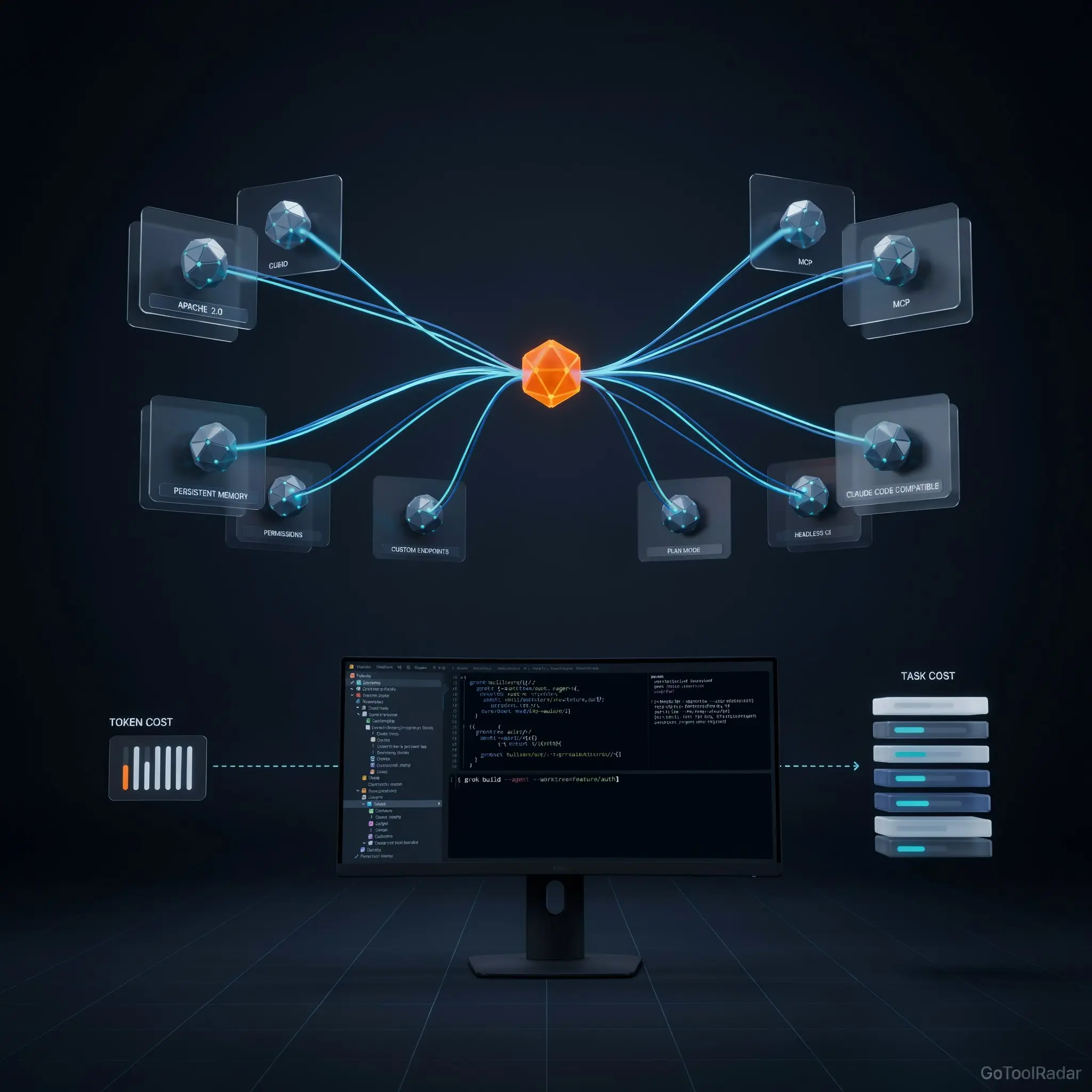
Is xAI's Grok Build Actually the Cheapest AI Coding Agent Right Now?
Grok Build review 2026: xAI's open-source terminal coding agent — Grok 4.7, parallel subagents, Git worktrees, persistent memory, and why cheap tokens don't always mean a cheap task.
📋 Table of Contents
Grok Build review 2026: xAI shipped Grok Build as an early-beta terminal coding agent on May 14, 2026, and it has changed shape almost every month since — open-sourcing the harness in July, opening app-building to every Grok plan in August, then adding persistent memory and swapping in Grok 4.7 by late September. The token price looks cheap on the API page. Whether a real coding task is cheap is a different question, and that gap is the actual story here.
xAI didn't just clone the terminal-agent format Claude Code and Codex popularized. It open-sourced the agent harness itself under Apache 2.0, built parallel subagents that work in isolated Git worktrees, and made the whole thing compatible with Claude Code's own plugins, skills, and MCP servers — so a project already set up for one agent doesn't need to be rebuilt for another. That's a genuinely different bet than "same CLI, different model."

What Grok Build Does
Parallel subagents in isolated worktrees
The main agent can split a task across several subagents, each working in its own Git worktree so they never overwrite each other's changes — useful for investigating a bug across auth, database, and frontend code at once, then comparing the results.
Open-source harness (Apache 2.0)
The CLI, terminal UI, plugin system, and agent loop itself were open-sourced on July 15, 2026, and the repository has since passed 27,000+ GitHub stars and 5,000+ forks. The underlying Grok models stay closed — it's the harness that's public.
Bring-your-own-model support
Because the harness is open, it can be compiled and pointed at a custom inference endpoint through config.toml — meaning Grok Build isn't structurally locked to Grok models, even though Grok 4.7 is the default.
Claude Code compatibility
Grok Build reads existing Claude Code plugins, skills, MCP configs, hooks, CLAUDE.md, and .claude/rules/ directly, alongside its own AGENTS.md support — cutting the switching cost for teams with an existing agent setup.
Plan Mode and permissions
Non-trivial tasks start with a reviewable step-by-step plan before any file changes happen, and a permission system (allow/deny rules per tool, with deny overriding allow) blocks destructive commands like rm -rf or git push unless explicitly authorized.
Persistent memory
Added September 16, 2026: the agent stores coding conventions, architectural decisions, and project facts as Markdown files, viewable via /memory and organized via /dream — scoped per-project or globally, and deliberately excluding secrets or task state.
Figures from Artificial Analysis' independent benchmark of Grok Build running Grok 4.7 in xhigh reasoning mode — not xAI's own marketing numbers.
Pricing & Access
As of August 2026, the CLI itself is free to try, and Build-style app generation is available across every Grok plan including free. But usage isn't unlimited on any paid tier: xAI runs Grok Build on a shared weekly compute pool alongside Chat, Imagine, and Voice — once that allowance is used, you wait for reset, buy extra usage credits, or upgrade. A long agentic coding task can burn through far more of that pool than a single chat message, so "$30/month" doesn't translate cleanly into "unlimited coding agent." The one genuinely uncapped option is compiling the open-source harness yourself and pointing it at your own inference endpoint — *at that point you pay only your own model provider, not xAI.
Learning Curve
Comfortable in a terminal already? The core loop — type a task, review the plan, approve diffs — is quick to pick up. What takes longer is everything around it: configuring MCP servers, writing permission rules that actually match your risk tolerance, understanding when subagents help versus when they just burn tokens, and deciding what belongs in persistent memory versus what should stay in your repo's own docs. None of it is exotic if you've used Claude Code or Codex before, but it's not a five-minute onboarding either.
Pros & Cons
✓ Strengths
- ✅ Open-source Apache 2.0 harness — inspectable, forkable, and not locked to Grok models
- ✅ Parallel subagents in isolated Git worktrees genuinely useful for large investigations and refactors
- ✅ Reads existing Claude Code plugins, skills, MCP configs, and CLAUDE.md — low switching cost
- ✅ Headless mode and Agent Client Protocol support make it usable inside CI/CD and other apps
✗ Weaknesses
- ❌ Real task cost can run high — one independent benchmark measured roughly $8.82 and 14.3M tokens for a single task
- ❌ Weekly shared usage pool makes the effective cost harder to predict than a flat subscription
- ❌ Still behind Codex on Artificial Analysis' overall Coding Agent Index (56 vs. 62) and notably weaker on Terminal-Bench
- ❌ Started as an early beta in May 2026 — younger ecosystem and less accumulated community troubleshooting than Claude Code or Codex
Grok Build vs. the Field
| Agent | Harness | Coding Agent Index (AA) | Notable edge |
|---|---|---|---|
| Grok Build | Open source (Apache 2.0) | 56 | Parallel worktrees, model-agnostic |
| GPT (Codex) | Closed | 62 | Strongest overall + Terminal-Bench |
| Claude Code | Closed | — | Largest ecosystem, CLAUDE.md standard |
| Cursor | Closed (IDE) | — | Full IDE, not terminal-first |
On task-specific benchmarks the picture is more mixed than the headline index suggests: Grok Build edges out Codex on DeepSWE (73% vs. 68%) and SWE-Atlas-QnA (63% vs. 62%), but falls well behind on Terminal-Bench (33% vs. 56%). Read that as "different strengths," not "clearly better" or "clearly worse" — the honest summary is that Codex currently leads on the aggregate index while Grok Build wins specific categories.
Who It's For
Ideal user: a developer or team already paying for SuperGrok or X Premium+, comfortable in a terminal, who wants an open-source agent harness they can inspect, extend, or eventually point at a different model — and whose work (large refactors, multi-part investigations) actually benefits from parallel subagents.
Look elsewhere if: you want the single highest-scoring agent on independent benchmarks today (that's currently Codex), or you want dead-simple flat-rate pricing without thinking about a weekly shared compute pool.
Expert Editorial Opinion
Grok Build's four-month arc is unusually fast even by 2026 standards: terminal CLI in May, open-source harness in July, broad app-building rollout in August, persistent memory and Grok 4.7 by late September. That pace is a genuine asset — most of the capability gaps a reviewer would have flagged in June are already closed. It's also a caveat: pricing, limits, and documentation are changing quickly enough that specifics here should be re-verified before any team commits budget around them.
The parallel-worktree architecture is the most technically interesting part of the product, and it's worth being precise about what it does and doesn't prove. Running eight subagents instead of one isn't automatically eight times better — it's a capability that suits certain tasks (repo-wide investigation, comparing implementation approaches) and adds real cost and complexity to others. Cursor Origin and Claude Code both bolt agents onto existing hosting or editor layers; Grok Build's bet is that isolating agents at the Git level, in an open harness, is the more durable architecture. That's a reasonable thesis, not a settled outcome.
The pricing story deserves the most scrutiny, because "cheap per token" is doing a lot of unearned work in how this tool gets described online. Grok 4.7's API rate — $2 input / $6 output per million tokens — is genuinely competitive. But Artificial Analysis' benchmark measured an average of roughly 14.3 million tokens and $8.82 for a single completed task under high-reasoning settings, because agentic coding tasks consume tokens very differently from chat. A team evaluating Grok Build purely on the headline API price will be surprised by what a real workload actually costs against the weekly usage pool.
None of that erases what xAI got right here: open-sourcing the harness under Apache 2.0, building genuine Claude Code compatibility instead of a walled garden, and shipping a credible model-agnostic architecture. It's a serious entrant, not a marketing exercise — just not, as of this review, the automatic "cheapest option" its per-token pricing implies at first glance.
Final Verdict
Grok Build's open-source harness, parallel worktrees, and Claude Code compatibility make it one of the more technically ambitious coding agents released in 2026 — but the score reflects the whole picture, not just the architecture. Real per-task cost can run well above what the headline token price suggests, the weekly usage pool complicates simple pricing comparisons, and Codex currently leads on the main independent aggregate benchmark. This lands as a strong, specific-use-case tool rather than an automatic default for every developer.
| Dimension | Weight | Score /10 | Why | |---|---|---|---| | Technical quality | 30% | 8.0/10 | Parallel subagents and worktrees work as documented; Coding Agent Index rose from 47 to 56 with Grok 4.7, though still behind Codex overall | | Price-to-value | 25% | 6.5/10 | Cheap per-token API rate, but real task cost (~$8.82, 14.3M tokens per AA benchmark) and a shared weekly pool complicate the value case | | Maturity & documentation | 20% | 6.5/10 | Rapid, credible progress since May 2026, but still a young ecosystem with fast-changing docs, pricing, and limits by xAI's own admission | | Ceiling & flexibility | 15% | 9.5/10 | Apache 2.0 open source, custom model backends via config.toml, MCP, ACP, headless mode, and Claude Code compatibility give it an unusually high ceiling | | Honesty of positioning | 10% | 7.5/10 | xAI labeled it early beta from the start and documents permissions/privacy openly, though "cheap" framing in outside coverage undersells real task cost | Weighted total: (8.0×0.30) + (6.5×0.25) + (6.5×0.20) + (9.5×0.15) + (7.5×0.10) = **7.5/10** — Score band: 7.0–7.9, "Competent but compromised — a strong fit for a specific kind of user, not an automatic pick for the majority of developers."❓ Frequently Asked Questions
🔗 Related ToolRadar Reviews
Official source: xAI's Grok Build announcement. Given the pace of change on this product, verify current pricing, usage limits, and model defaults directly before relying on figures here for a purchase decision.
Comments
Post a Comment