


The AI Tool That Finds Your SaaS Renewals Before They Cost You
Venduris Review 2026: most SaaS management tools tell a company what it owns. Venduris is built around one narrower question — what's about to renew, when, and what should happen before that renewal locks in.
Most software a finance or IT team buys to deal with SaaS sprawl answers one question: what do we own? Venduris was built around a narrower, sharper one — what's about to renew, when does the notice window close, and what should we do before we lose the ability to negotiate. The company is explicit that this isn't the same job as a contract repository or a full contract lifecycle management suite; it's a layer focused specifically on the renewal moment itself.
The founder story tracks directly with that focus. Venduris describes itself as founder-led by Boris, who spent roughly 20 years split between enterprise software sales and procurement — a background that means Venduris was built by someone who's sat on both sides of the exact negotiation the product is trying to prepare its users for.
How Venduris Actually Works
Contract Intelligence
Contracts get uploaded and AI parsing extracts renewal dates, notice periods, pricing mechanics, obligations, ownership, and spend — turning a static PDF into searchable, trackable data instead of a file nobody reopens until it's too late.
Renewal Control
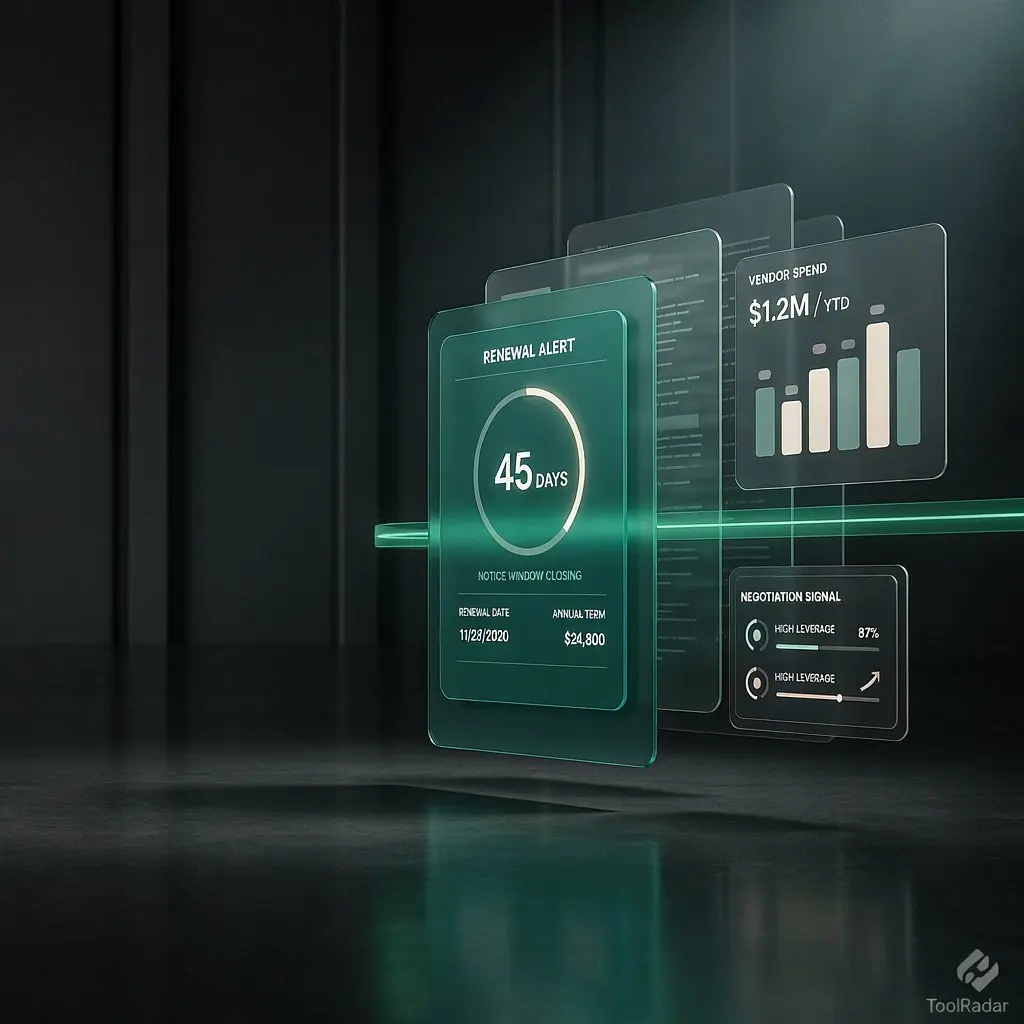
Every contract's renewal cycle gets tracked against its actual notice deadline, with alerts at 90, 60, and 30 days out. The goal isn't blocking renewals — it's making sure a renewal never happens automatically before a team has actually decided whether it should.
Negotiation Intelligence
This is where the product goes further than a calendar reminder. Venduris pulls historical pricing, usage data, license utilization, and market context into a renewal brief — so a team walks into a vendor call already knowing what they're paying, what they're actually using, and where the negotiating leverage sits. The AI assists with parsing and drafting; the actual negotiation stays in the team's hands.
Portfolio Intelligence
A CFO-facing view across the entire SaaS portfolio: total spend, renewal exposure by quarter, risk signals, named renewal owners, and overlap between duplicate tools — the kind of picture that's usually scattered across Finance, IT, and Procurement rather than sitting in one place.
One detail worth calling out on its own: Venduris organizes its risk detection around what it calls a Renewal Signals Library — named patterns like Auto-Renew Exposure, Usage Drift, Renewal Uplift Exposure, Pricing Memory Reset, License Baseline Ratchet, Notice Window Compression, Stakeholder Fragmentation, and Commitment Carryforward Constraints. It's a more structured way of framing "things that quietly cost you money at renewal" than most competitors bother to name explicitly, and it gives a concrete sense of what the product is actually watching for, rather than a vague promise to "use AI on your contracts."
Pricing
| Portfolio size | Starting price | Billing |
|---|---|---|
| Under 25 vendors | From $79/month | Monthly, no minimum term |
| 25–75 vendors | From $149/month | Monthly, no minimum term |
| 75–200 vendors | From $249/month | Monthly, no minimum term |
| 200+ vendors | Custom | Negotiated directly |
It's worth being precise about the structure here, since some third-party comparison pages describe Venduris as having three named tiers like "Essentials," "Growth," and "Scale." That's not how Venduris's own current pricing page frames it — it's presented as one plan scoped to the size of a company's vendor portfolio, not a traditional good-better-best tier ladder. The company states pricing includes no implementation fees, full data export, and a locked-in rate for as long as a customer stays.
Venduris also runs a separate advisory services line alongside the software, aimed at companies that want outsourced renewal expertise rather than just a dashboard: a Renewal Readiness Audit starting at $1,500 for a 10-40 vendor scope, a Pre-Renewal Strategy Brief starting at $900 per vendor, Negotiation Support starting at $2,500, an M&A Contract Exposure Review starting at $5,000, and an ongoing Renewal Desk service — essentially an outsourced renewal function — starting at $1,900/month.
There's no traditional free plan and no self-serve free trial. Instead, Venduris starts prospective customers with a 30-minute renewal review and guided onboarding, since the company positions the product as something set up around a customer's actual contracts rather than a generic sandbox account. Worth knowing going in if a $79 starting price creates an expectation of a self-serve free trial — that's not the model here.
Pros & Cons
✓ Strengths
- ✅ Genuinely narrow, well-defined focus on the renewal moment rather than trying to be a full contract or spend-management suite
- ✅ Published, transparent pricing tied directly to portfolio size, with no implementation fees
- ✅ Renewal Signals Library gives concrete, named risk patterns rather than a vague "AI reads your contracts" pitch
- ✅ Security posture includes encryption in transit and at rest, role-based access, audit trails, tenant isolation, GDPR compliance, and EU hosting, with contract data stated as not shared with third parties or used to train other models
✗ Weaknesses
- ❌ No free plan and no self-serve trial — onboarding starts with a guided sales conversation
- ❌ "SOC 2-ready architecture" is not the same claim as SOC 2 certification, and the company doesn't currently state it holds one
- ❌ A relatively small, newer company compared to established SaaS management names like Zylo or Vertice
- ❌ The AI drafts negotiation materials and briefs, but doesn't negotiate with a vendor on a team's behalf — the human workload of the actual negotiation call remains
When's the next contract in your company that renews automatically if nobody stops it?
If that's not an immediate answer, that's the exact gap Venduris is built to close.
✅ Choose Venduris if...
You're managing somewhere in the 25-200 SaaS and AI vendor range, don't have a large dedicated procurement team, and keep discovering renewals happened automatically before anyone reviewed the terms.
❌ Look elsewhere if...
You want a free tier to test before talking to sales, need a full contract lifecycle management suite rather than a renewal-focused layer, or your vendor count is small enough that a shared spreadsheet with calendar reminders still covers the job.
Who It's For
The clearest audience, by Venduris's own positioning, splits three ways inside a company. Finance wants the portfolio-level view — total spend, what's renewing this quarter, where the risk sits. IT knows the tools and the actual usage but often doesn't have visibility into notice periods or renewal clauses buried in a contract. Operations and procurement need the renewal calendar and negotiation prep, especially in companies that don't have a large dedicated procurement function to begin with — which the company states is exactly its sweet spot: organizations managing 25 to 200 SaaS vendors without the internal headcount to track every renewal manually.
Expert Editorial Opinion
It would be an overstatement to call renewal intelligence a category Venduris invented — SaaS management, procurement, and contract lifecycle tools all touch pieces of this problem already, and Venduris itself lists names like Vertice, Zylo, Tropic, Coupa, Zip, Zluri, and Torii as part of the broader competitive landscape it operates within. What's more defensible is that Venduris picked a specific, narrow slice of that landscape — the window between "a contract exists" and "a decision gets made about renewing it" — and built the product almost entirely around that moment, rather than trying to be an all-in-one system of record for every SaaS tool a company owns.
That focus shows up concretely in the pricing model, too. A single plan scoped to vendor count, with no implementation fee and a rate that's locked in for the life of the account, is a simpler pitch than the three-tier ladders most B2B SaaS products default to — and it's worth noting explicitly since some secondary sources describe Venduris's pricing incorrectly as a traditional tiered structure.
The honest caveat sits in two places. First, the "10-25% savings potential" figure is the company's own claim about what its platform can surface, not an independently verified outcome — a real, reasonable claim given the product's design, but worth treating as a company statement rather than a guaranteed result. Second, "SOC 2-ready architecture" is meaningfully different from holding an actual SOC 2 certification, and a buyer with strict vendor-security requirements should ask directly where Venduris currently stands on that distinction before assuming the two are equivalent.
Final Verdict
Venduris earns its score through genuine focus rather than breadth — a narrowly scoped product built specifically around the renewal moment, with transparent pricing and a named framework (the Renewal Signals Library) that makes its value proposition concrete rather than vague. The deductions are structural rather than about execution: no free trial for a company evaluating on a budget, unverified security certification status, and a company size and track record still smaller than established SaaS management players. For a mid-size company managing 25-200 vendors without a large procurement team, it's a genuinely well-targeted tool; for anyone wanting a full contract management system or a free tier to test drive first, it isn't built for that.
❓ Frequently Asked Questions
🔗 Related ToolRadar Reviews
Official platform and current pricing: venduris.com and venduris.com/pricing. Since Venduris is a newer, smaller platform actively updating its pricing and services pages, confirm current rates and certification status directly before committing.

Comments
Post a Comment