


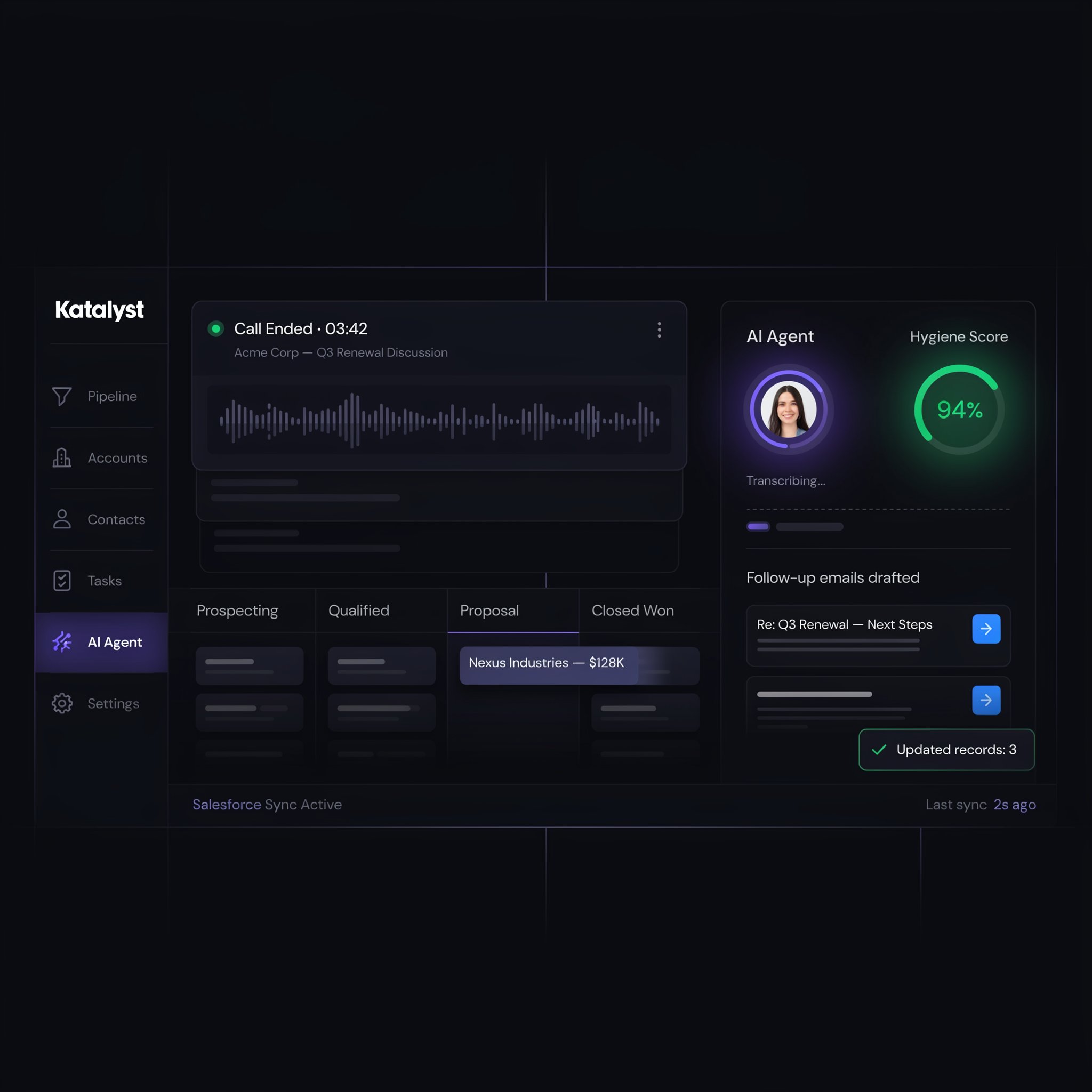
Katalyst Review 2026: The AI Sales Agent That Runs Your Salesforce Pipeline 24/7 — So Reps Can Stop Feeding the CRM and Start Selling
Built for Salesforce teams by founder Divyansh Lohia — Katalyst sits in every meeting, reads every email, watches every account, and keeps Salesforce updated automatically. Hang up a call and it's already done: notes summarized, records created, fields updated, follow-up drafted, next step set.
By ToolRadar Editorial Team · Review methodology: technical evaluation, pricing analysis, and verified user feedback
Sales reps don't hate selling. They hate what surrounds it. The 20 minutes after every call spent logging notes. The weekly ritual of fixing stages and close dates that drifted while they were in the field. The next-step field that never gets filled because by Friday no one remembers what was agreed on Tuesday. The deal that slipped not because the rep didn't care — but because the signal was buried in call recordings nobody had time to review. That is the real sales productivity problem in 2026. And it is not a motivation problem. It is an admin problem.
Katalyst launched on Product Hunt on July 7, 2026, built by Divyansh Lohia and the Katalyst team. The founding stat that drove the product: sales reps spend approximately 28% of their week actually selling. The rest disappears into admin, research, and re-typing context that already existed somewhere else. Katalyst's answer is to sit inside every meeting, read every email, watch every account, and keep Salesforce updated autonomously — without anyone asking it to. Hang up a call and it's already done: notes summarized, records created, fields updated, follow-up drafted, next step set. It runs 24/7, surfaces the right signals, preps reps for each meeting, and alerts them when a deal is slipping before the quarter is over. Updated July 2026.
What Is Katalyst?
Katalyst is an AI sales agent built specifically for Salesforce teams that automates the complete CRM maintenance workflow — not as a bolt-on integration, but as a 24/7 autonomous agent that reads call recordings, emails, and calendar events, then updates Salesforce records, creates notes, drafts follow-ups, sets next steps, and flags deal risk without any manual input from the rep. The platform operates across four core capabilities at launch: AI Resolution on every account (a continuous intelligence layer that surfaces the right information about every deal at the right moment), a meeting recorder that captures and summarizes every call and pushes structured notes directly into Salesforce, hygiene scores that grade the quality and completeness of each deal's CRM data and surface gaps before they become pipeline problems, and deal pattern detection that identifies behavioral signals — slowing email response times, missed follow-up windows, stage stagnation — and alerts reps before a deal goes cold. Katalyst integrates natively with Salesforce and is built for sales teams where CRM hygiene is a persistent, structural problem rather than a training failure.
Key Features
Meeting Recorder + Auto-CRM Update
Katalyst joins every sales call, records and transcribes in real time, summarizes the conversation, creates the Salesforce note, updates the relevant fields (stage, close date, next step, contacts), and drafts the follow-up email — automatically, by the time the rep hangs up. Zero manual entry required.
Hygiene Scores Per Deal
Every deal in the Salesforce pipeline gets a hygiene score based on the completeness and freshness of its CRM data. Stale close dates, missing next steps, empty key fields, and incomplete contact records surface as actionable hygiene gaps — before they distort forecast accuracy or cause a deal to slip quietly off the radar.
AI Resolution on Every Account
A continuous intelligence layer that monitors every account 24/7 — reading emails, calls, and calendar interactions — and surfaces the specific signals, context, and prep information a rep needs before each meeting. Not a static summary. A live, always-updated view of where every relationship stands.
Deal Pattern Detection
Katalyst identifies behavioral patterns that predict deal risk: slowing email response cadence, missed follow-up windows, stage duration anomalies, and engagement drop-offs. When a deal starts exhibiting patterns associated with slippage, Katalyst surfaces the alert proactively — not after the quarter closes.
Pricing Plans
| Plan | Price | What You Get |
|---|---|---|
| Free Trial | Free | Core features — meeting recorder, CRM auto-update, hygiene scores — available to evaluate before committing · Available at getkatalyst.ai |
| Paid Plans | Pricing at getkatalyst.ai | Full platform — AI Resolution, deal patterns, 24/7 monitoring, team-level hygiene reporting, Salesforce native integration |
| Enterprise | Custom pricing | Large Salesforce orgs — admin controls, custom field mapping, team dashboards, priority support, SLA |
Note: Katalyst launched July 7, 2026. Exact paid pricing is not publicly listed at launch — check getkatalyst.ai for current plans. The free trial provides access to core features including the meeting recorder and CRM auto-update before any payment commitment is required. Updated July 2026.
Try Katalyst Free — Automate Your Salesforce Pipeline →ToolRadar may earn a commission if you purchase through this link at no extra cost to you.
Pros & Cons
✓ What Works
- ✅ Fully autonomous — Katalyst updates Salesforce after every call without the rep touching anything
- ✅ Hygiene scores per deal — surfaces CRM gaps before they corrupt forecasts or cause silent deal slippage
- ✅ Deal pattern detection — proactive risk alerts before a deal goes cold, not after the quarter closes
- ✅ Built specifically for Salesforce — native integration, not a generic CRM tool adapted for Salesforce
✗ What Holds It Back
- ❌ Salesforce-only at launch — teams on HubSpot, Pipedrive, or other CRMs are not served
- ❌ Pricing not publicly listed — requires direct contact or trial signup to understand full cost
- ❌ Very early stage — launched July 7, 2026, enterprise features and admin controls still maturing
- ❌ AI CRM updates require trust — reps and managers need to verify that auto-populated fields are accurate during the calibration period before fully relying on Katalyst's updates
💡 Community Feedback
Comparison: Katalyst vs Alternatives
| Feature | Katalyst | Gong | Clari | Salesforce Agentforce |
|---|---|---|---|---|
| CRM Auto-Update | YES autonomous after every call | NO manual | NO manual | PARTIAL — requires config |
| Hygiene Scoring | YES per deal | NO | YES pipeline level | PARTIAL |
| Built for Salesforce | YES native | PARTIAL | PARTIAL | YES native |
| Deal Pattern Alerts | YES proactive | YES post-hoc | YES | PARTIAL |
Analysis: Katalyst occupies a distinct position in the sales intelligence landscape. Gong is the category leader for call recording and coaching — it surfaces topics, sentiment, and competitive mentions with unmatched depth. But Gong does not update Salesforce fields, create records, or draft follow-ups. After a Gong call, the rep still manually logs what happened. Clari is the forecasting authority — its pipeline analytics and revenue intelligence are enterprise-grade. But Clari does not autonomously update CRM records after every call. Salesforce Agentforce is native to the platform but requires significant configuration and is designed for broad automation use cases, not the specific post-call CRM update workflow. Katalyst's differentiator is singular: it is the only tool that makes the CRM update autonomous — not a feature you trigger, but a process that happens without anyone asking. For Salesforce teams where dirty CRM data is a structural problem, that autonomy is the difference between a tool that helps and a tool that solves.
Learning Curve
Katalyst is designed for minimal friction. The Salesforce native integration means setup is primarily an admin task — connecting Katalyst to your Salesforce org, configuring field mappings, and setting hygiene score thresholds. For reps, there is almost no learning curve: Katalyst joins meetings automatically, processes emails in the background, and pushes updates to Salesforce without requiring the rep to open the tool or trigger a workflow.
Compared to competitors, Katalyst has a significantly shallower learning curve than Gong (which requires reps to learn coaching interfaces and review call analytics) and is comparable to Clari in simplicity for end users. The calibration period — where reps and managers verify that Katalyst's auto-populated fields are accurate — is the primary onboarding challenge. Most teams report full trust in Katalyst's updates within 2–3 weeks of daily use. For Salesforce admins, the setup involves standard API integration and field mapping, typically completed within a few hours. Expect full deployment within 1–2 weeks and full rep adoption within 3–4 weeks.
Who Should Use Katalyst
Best For: Salesforce sales teams where CRM hygiene is a persistent problem — reps who consistently skip logging calls, managers who spend hours fixing pipeline data before forecast calls, and RevOps teams who know their Salesforce data is unreliable but can't solve it through training alone. Mid-market B2B sales orgs (10–200 reps) where the cost of dirty CRM data — inaccurate forecasts, missed follow-ups, invisible deal slippage — is measurable and painful. Teams that have tried Gong or Chorus for call recording but still struggle with CRM data quality because recording ≠ updating.
Consider Alternatives If: Your team is on HubSpot, Pipedrive, or any CRM other than Salesforce — Katalyst is Salesforce-native and does not serve other platforms at launch. You need enterprise-grade call intelligence with deep coaching, competitive intelligence, and multi-year conversation analytics — Gong is more mature for those use cases. You need pipeline forecasting with statistical modeling across the org — Clari's forecasting layer is more established. You're an individual rep without admin access to your Salesforce org — Katalyst's full value requires org-level integration.
Expert Editorial Opinion
Katalyst's product thesis — that CRM hygiene is a structural problem, not a training problem — is the most important reframe in sales productivity tooling in 2026. Every sales leader has tried to solve dirty CRM data by telling reps to log calls better. It doesn't work because the incentive structure is wrong: logging a call takes five minutes and has zero immediate value to the rep. Katalyst removes the incentive problem entirely by making CRM updates automatic. The rep hangs up. The CRM is already updated. There is no version of this where the rep chooses not to comply, because compliance is no longer required.
The hygiene scoring feature is underrated in the launch coverage. Most AI sales tools focus on what happened in a call — sentiment, topics, next steps. Hygiene scoring focuses on what's missing in the CRM data that represents every deal in the pipeline. A deal with a stale close date, no next step, and an empty contact record is a forecast liability. Katalyst's hygiene scores make that liability visible before it becomes a missed quarter. For RevOps teams managing forecast accuracy, this is the feature that converts Katalyst from a rep productivity tool into a revenue intelligence platform.
The RevGenius community reception is the most honest early signal of product-market fit. The founder's framing — "reps get back to the part they're actually great at: people" — resonated with a community of sales practitioners who have lived the admin tax firsthand. The 24/7 autonomous operation model (not a tool you have to open, not a workflow you have to trigger) is the correct architecture for a problem that manifests across every call, every email, and every account interaction throughout the week. For Salesforce sales teams who have accepted CRM hygiene as an unsolvable chronic pain, Katalyst is the first tool that actually removes the root cause.
Pricing Gap Analysis: Katalyst's pricing is not publicly listed at launch, which creates friction for teams evaluating multiple tools. Gong starts at roughly $1,200/user/year for call recording and coaching. Clari's pricing is custom and typically enterprise-focused. Salesforce Agentforce pricing varies by org size and use case. Katalyst's free trial provides core features for evaluation, but teams will need to contact sales for full pricing. The value proposition — eliminating the 72% of rep time spent on non-selling activities — justifies a premium price if the autonomy works as advertised. The question is whether Katalyst's pricing lands closer to Gong's per-seat model or Clari's enterprise contract model. For mid-market teams (10–200 reps), a per-seat SaaS model would be the most accessible path.
Does the free trial work? Yes — the free trial provides access to the meeting recorder and CRM auto-update, which are the two features that demonstrate Katalyst's core value proposition. A team can evaluate whether Katalyst accurately captures call content and populates Salesforce fields within a few days of use. The trial does not include AI Resolution, deal pattern detection, or team-level hygiene reporting, which are the features that convert Katalyst from a rep tool into a revenue intelligence platform. For a full evaluation, teams will need to engage with Katalyst's sales team. The free trial is sufficient to validate the core autonomy claim but not sufficient to evaluate the complete platform.
Final Verdict
Katalyst is the most focused and architecturally correct AI sales agent for Salesforce teams launched in 2026. The autonomous CRM update model, per-deal hygiene scoring, deal pattern detection, and 24/7 AI Resolution layer address the structural admin problem that every other sales productivity tool has tried and failed to solve through behavior change alone. The Salesforce-only limitation and early-stage pricing opacity are real constraints. For Salesforce sales teams where dirty CRM data and post-call admin are measurable revenue problems, this is a 9.0 out of 10 — and the first tool worth piloting before your next forecast call.
Technical Quality: 9.5/10 · Price-to-Value: 8.5/10 (pricing TBD) · Maturity & Documentation: 8.0/10
🔗 Related ToolRadar Reviews
More tools from AI Sales Tools
- I Let an AI Agent Send 10,000 Cold Emails
- This AI Agent Works While You Sleep
- I Gave an AI Agent Full Control of My Inbox
- Can an AI Agent Really Replace Your Entire Team?
- I Let an AI Agent Make My Phone Calls for a Week
- I Built an AI Agent Army Without Writing a Single Line of Code
- The Search Engine Built for AI Agents
- Can an AI Agent Really Browse the Web for You?
❓ Frequently Asked Questions
How much of your sales week is actually spent selling?
If the answer is 28%, you're not alone — and you're not the problem. The problem is a system that makes reps choose between selling and documenting. Katalyst removes that choice entirely. Hang up the call. The CRM is already done. The only question left is what you'll do with the other 72% of your week.

Comments
Post a Comment