


GitHub Copilot Review 2026: From AI Autocomplete to a Full Coding Agent
GitHub Copilot review 2026: Agent Mode, cloud agents, agentic code review, MCP, sandboxes, GPT-6 and Claude Opus/Sonnet 5.5 model access, usage-based AI-credit pricing, and a privacy policy that genuinely differs by plan.
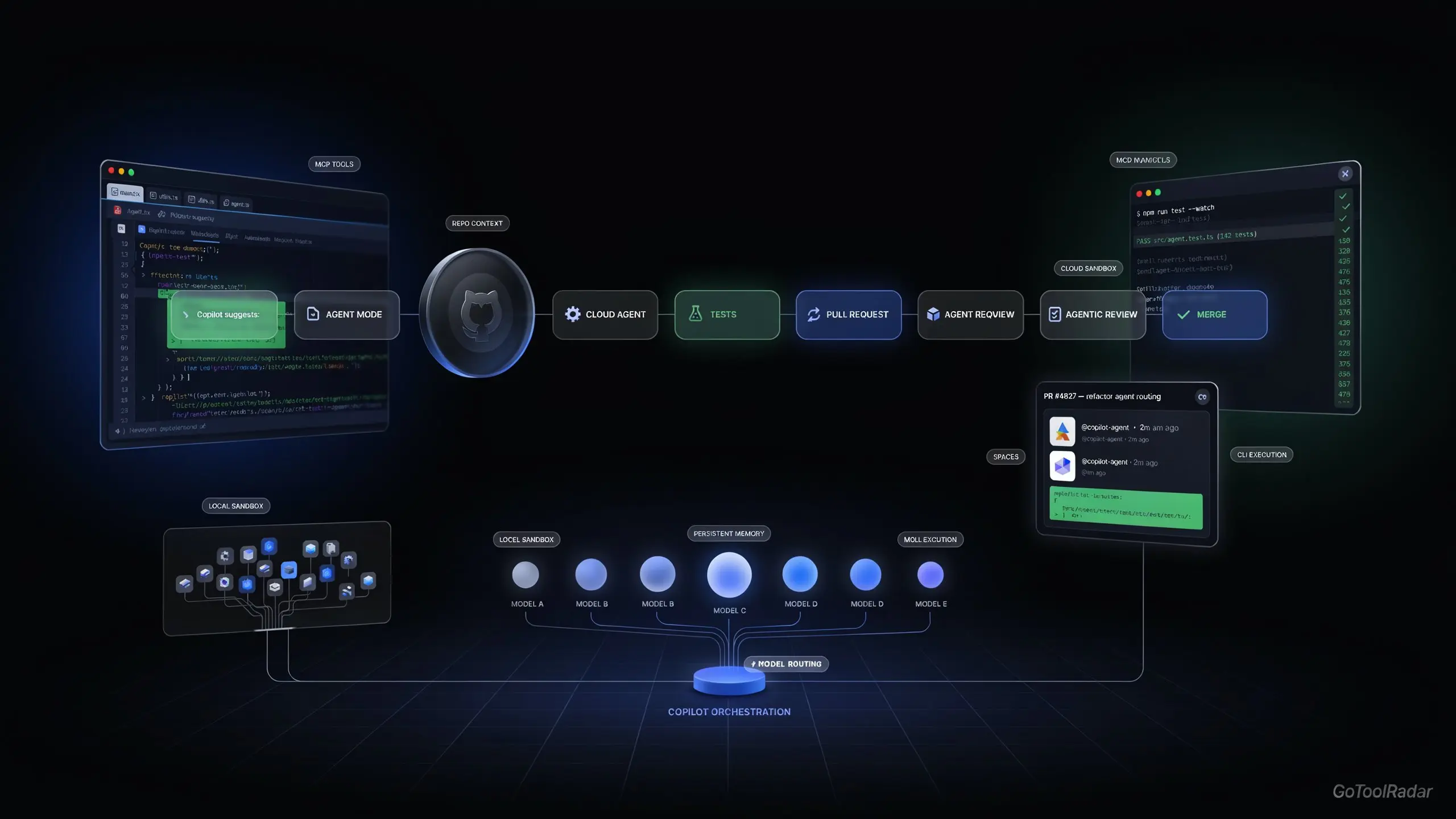
GitHub Copilot review 2026: Copilot used to help you write code. In 2026, GitHub is turning it into an agent layer for the entire software lifecycle — Agent Mode plans and executes multi-step changes inside your IDE, a Cloud Agent can research, implement, test, and open a PR with minimal supervision, and agentic Code Review analyzes pull requests using full project context. GitHub describes Copilot as "the world's most widely adopted AI developer tool" — a real, self-reported claim worth treating as GitHub's own framing rather than an independent industry ranking.
The bigger story is how far Copilot has moved from a single-model autocomplete tool toward a model-agnostic orchestration layer: GPT-6 Sol and Luna, and as of September 2026, both Claude Opus 5.5 and Claude Sonnet 5.5, are available inside Copilot across VS Code, the CLI, cloud agent, and more. This review covers that shift honestly, alongside a genuinely consequential pricing change (usage-based AI credits since June 2026) and a privacy policy that differs meaningfully by plan.

From Autocomplete to Agent Layer
Agent Mode (IDE)
Give it a multi-step task instead of a single completion — it identifies files to change, proposes edits, runs terminal commands with approval, iterates on errors, and runs tests until the task is done.
Cloud Agent (renamed from "coding agent," April 2026)
Researches the repository, builds an implementation plan, works on a branch, runs tools and tests, and opens a PR after you approve the diff — including deep-research capability for broad codebase investigation.
Agentic Code Review
Analyzes PRs using full project context, repository instructions, and MCP, with two tiers — Lite for common issues, Balanced for security-sensitive or complex changes using a higher-reasoning model.
Local & Cloud Sandboxes
Local sandbox limits Copilot's filesystem/network access on your machine; Cloud sandbox is an ephemeral, GitHub-hosted Linux environment inheriting your organization's cloud-agent policies — real execution isolation, not just a chatbot with opinions.
Multi-model access
A model picker spanning GPT-6 Sol/Luna and Claude Opus 5.5/Sonnet 5.5 (as of Sept 2026), with availability varying by plan tier — Copilot is increasingly an orchestration layer rather than a single proprietary model.
Spaces & Memory
Spaces bundle repo, docs, and instructions into a shared source of truth; Memory (public preview on Pro/Pro+/Max) retains useful learned context about a repository across sessions, including during code review.
Pricing — AI Credits, Explained
| Plan | Price | AI Credits/mo |
|---|---|---|
| Free | $0 | 2,000 completions, limited AI usage |
| Pro | $10/mo | 1,500 |
| Pro+ | $39/mo | 7,000 |
| Max | $100/mo | 20,000 |
| Business | $19/user/mo | 1,900/user |
| Enterprise | $39/user/mo | 3,900/user |
As of June 1, 2026, Copilot runs on usage-based billing through GitHub AI Credits, where 1 credit equals $0.01. Code completions and next-edit suggestions on paid plans don't consume credits at all and remain unlimited — but chat, agents, the CLI, and Spaces do. That distinction is the single most important thing to understand before budgeting: a $10/month Pro subscription does not mean unlimited agent usage, even though it does mean unlimited basic autocomplete.
What Actually Costs Credits
GitHub's own estimates put a single Code Review at roughly $0.05–$1 in credits on the Lite tier and $0.25–$5 on Balanced — before counting any separate GitHub Actions minutes a workflow might consume. Heavy agent tasks (deep research, long cloud-agent sessions) can consume credits well beyond what a casual user expects from a subscription price alone. Understanding which surface (completions vs. chat vs. agent vs. code review) you're using, and at which model tier, is genuinely part of managing a Copilot budget — not just picking a plan and forgetting about it.
Pros & Cons
✓ Strengths
- ✅ Unmatched platform coverage — VS Code, Visual Studio, JetBrains, Xcode, Eclipse, Neovim, CLI, GitHub.com, mobile, and a dedicated desktop app
- ✅ Genuinely deep GitHub-native context — repository, issues, PRs, Actions, and code review all accessible to the same agent layer
- ✅ Real execution isolation via local and cloud sandboxes, not just permission prompts
- ✅ Multi-model access (GPT-6, Claude Opus/Sonnet 5.5) makes it less of a single-vendor bet than most competitors
✗ Weaknesses
- ❌ Usage-based AI credits make real monthly cost genuinely hard to predict for heavy agent or code-review use
- ❌ Best models are gated by plan tier — not every model is available at every price point
- ❌ Data-training policy differs meaningfully between Free/Pro/Pro+ (opt-out, on by default) and Business/Enterprise (excluded) — easy to miss if you're on an individual plan
- ❌ MCP support currently covers tools but not MCP resources/prompts, and OAuth-based remote MCP servers aren't yet supported
Copilot vs. Cursor vs. Claude Code vs. Codex
| Tool | Core strength | Best fit |
|---|---|---|
| GitHub Copilot | GitHub-native context + platform breadth | Teams already living inside GitHub's ecosystem |
| Cursor | AI-native IDE experience | Developers wanting an editor built around AI from the ground up |
| Claude Code | Terminal-first autonomous agent | Developers preferring a CLI-centric workflow |
| Codex | Cloud-first agent development | Teams wanting OpenAI's agent ecosystem specifically |
The honest framing for 2026: Copilot's real edge isn't "the best model" — it offers several frontier models, but so do competitors. Its edge is that GitHub itself is the context layer: code, issues, PRs, Actions, and governance all live in one place a Copilot agent can reach natively, which a separate tool bolted onto GitHub has to approximate through integrations instead.
Who Should Use It
Ideal user: a developer or team already working inside GitHub, who wants agentic coding (Agent Mode, cloud agents, agentic code review) without leaving that ecosystem, and values having multiple frontier models available rather than being locked to one vendor.
Look elsewhere if: your team isn't GitHub-centric, you want the simplest possible flat-rate pricing without tracking credit consumption across completions/chat/agents/review, or you need full remote MCP server support with OAuth today.
Expert Editorial Opinion
The useful way to read Copilot's 2026 evolution isn't "GitHub added AI features" — it's that GitHub is trying to make the platform itself the place agentic software development happens, rather than positioning Copilot as a feature bolted onto an editor. Sandboxing, Cloud Agent, agentic code review, Spaces, and Memory are all pieces of the same thesis: GitHub already has the context (repos, issues, PRs, Actions) that every other coding agent has to reconstruct through integrations, and it's betting that owning that context natively is a durable advantage.
The multi-model shift deserves direct attention: Copilot offering GPT-6 and Claude Opus/Sonnet 5.5 side by side means GitHub is explicitly not betting its agent platform on a single model's quality — it's betting on being the best place to access and orchestrate whichever model fits a given task. That's a meaningfully different value proposition than "our model is the best," and it's a more honest one given how quickly model leaderboards shift.
The credit-billing complexity and tiered privacy policy are the two things most likely to surprise a new or individual user. Neither is dishonest — GitHub documents both clearly — but "$10/month for Copilot" undersells how differently that $10 behaves depending on whether you're doing autocomplete (unlimited) or heavy agent work (credit-metered), and the training-data default genuinely changes between an individual Pro account and a Business/Enterprise seat in ways worth knowing before you start using it for sensitive work.
Final Verdict
GitHub Copilot earns a Strong rating on the strength of unmatched platform coverage, genuinely deep GitHub-native context, real execution sandboxing, and access to multiple frontier models rather than a single proprietary one. The named caveats: usage-based AI credits make real monthly cost harder to predict than the subscription price alone suggests, and the privacy/training-data policy differs meaningfully between individual and organizational plans. For teams already living in GitHub, this is a recommended agent platform with those caveats understood upfront.
| Dimension | Weight | Score /10 | Why | |---|---|---|---| | Technical quality | 30% | 8.5/10 | Agent Mode, Cloud Agent, agentic code review, and sandboxing form a genuinely comprehensive agent platform, not just a model wrapper | | Price-to-value | 25% | 7.0/10 | Unlimited completions are a real value, but credit-metered agent/review/chat usage makes true monthly cost hard to predict | | Maturity & documentation | 20% | 8.5/10 | Extensive, clearly documented enterprise governance, though the pricing and privacy models both changed significantly within 2026 | | Ceiling & flexibility | 15% | 9.0/10 | Broadest IDE/platform coverage in its category, plus multi-model access and MCP support (with some current limitations) | | Honesty of positioning | 10% | 7.5/10 | GitHub is reasonably clear that its "most widely adopted" claim is self-reported, and documents its tiered privacy policy explicitly rather than burying it | Weighted total: (8.5×0.30) + (7.0×0.25) + (8.5×0.20) + (9.0×0.15) + (7.5×0.10) = **8.1/10** — Score band: 8.0–8.9, "Strong — recommended with named caveats: track credit consumption across completions/chat/agents/review, and check your plan's data-training default."❓ Frequently Asked Questions
🔗 Related ToolRadar Reviews
Official source: GitHub Copilot. Given the pace of model, pricing, and policy changes this year, verify current credit costs, model availability, and your plan's data-training setting directly before relying on figures here.
Comments
Post a Comment