


Murf AI Review 2026: Is It Worth Paying for Professional AI Voiceovers?
Murf is really two products under one brand: a voiceover studio and a real-time voice API. Here is what each costs, where each is strong, and where the marketing gets ahead of the evidence.
📋 Table of Contents
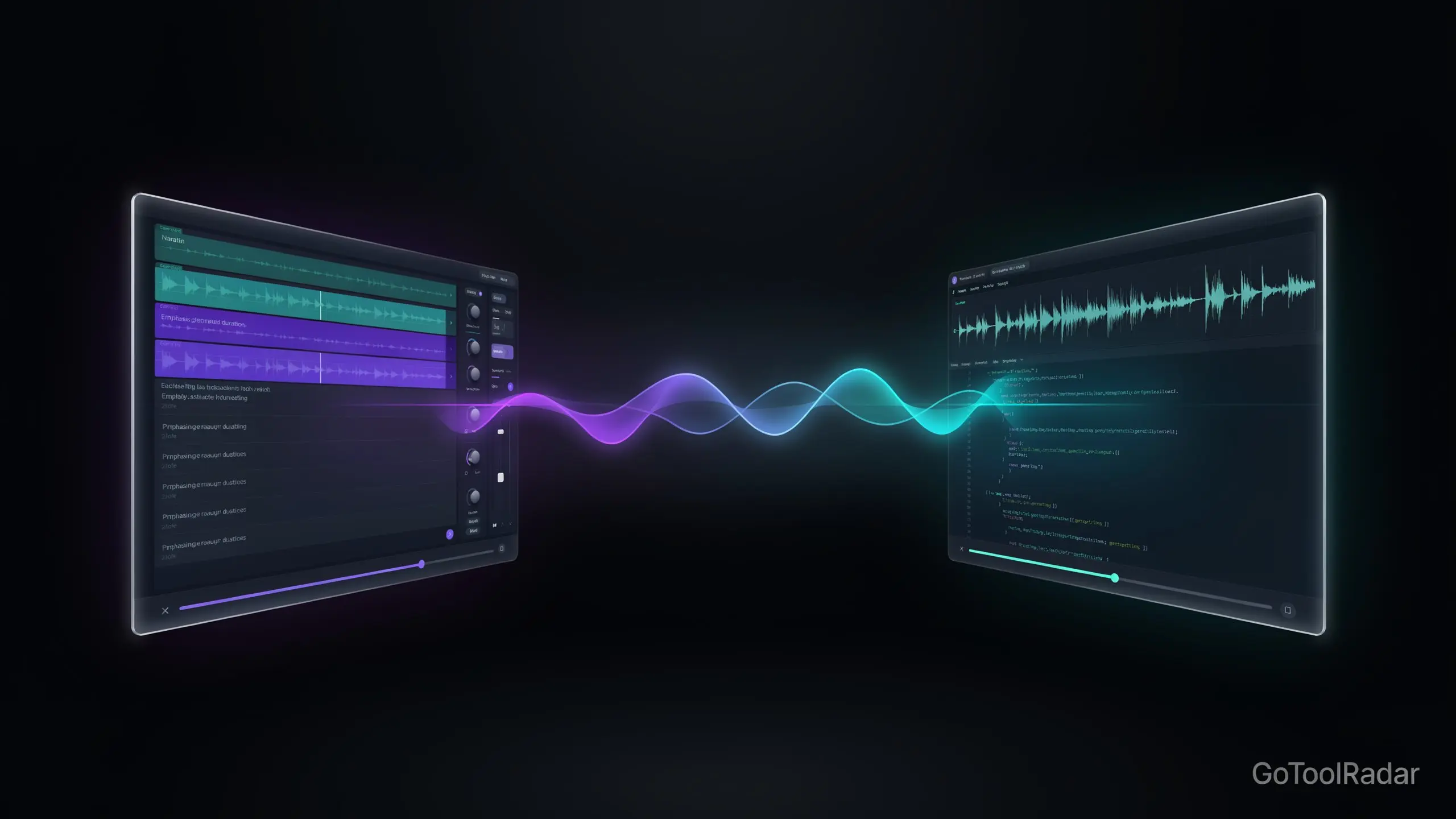
This Murf AI review starts from one observation: Murf is two products sharing a logo, and most of the confusion around its pricing comes from treating them as one. Murf Studio is a browser-based voiceover editor for narration, e-learning, explainers and slide decks. The Murf API is a separate developer service built on two speech models: Gen2 for controllable, studio-style output, and Falcon 2 for low-latency voice agents, which Murf made publicly available on August 20, 2026.
We score it 7.69 out of 10. It is dependable for scripted narration, held back by generation caps, voice cloning that sits behind a sales conversation, and benchmarks that Murf mostly runs on itself. Everything below comes from official pages and third-party coverage, and vendor claims are labeled as claims.

What Murf Actually Offers
Voice previews and the current voice list live on the official Murf site. Here is the substance behind them.
Studio: the voiceover editor
This is where most readers will live. You paste a script, choose from 200+ voices across 35+ languages (Murf's help center cites 40+, so the count depends on which page you read), and adjust pitch, speed, emphasis and pauses at the word level. You can sync narration to images, video and music, then export to MP3, WAV, FLAC, SRT, VTT and more. Murf lists integrations with Canva, Google Slides, PowerPoint, Articulate 360 and Adobe Captivate, which explains why it keeps appearing in e-learning workflows.
Gen2 and MultiNative voices
Gen2 is the customization-first model. Murf's help center describes MultiNative voices that let a single voice speak several languages with native-style accuracy, handy when one narrator must carry a course across markets.
Falcon 2 for voice agents
Falcon 2 is the streaming model behind Murf's push into conversational AI. Murf and launch coverage cite sub-100 ms time-to-first-audio, 150+ voices in 35+ languages, up to 10,000 concurrent calls, regional data residency and on-premise deployment. Treat all of that as vendor-reported. Murf says Falcon 2 scores above some OpenAI entries on the independent Artificial Analysis leaderboard, but we found no neutral head-to-head using identical prompts across vendors.
Dubbing, voice changer, translation
Murf Dub handles AI dubbing, and the API exposes a voice changer and translation endpoints. Murf's own pages cite different language counts for dubbing (20+ in one place, 40+ in another), so confirm your target language first.
Arabic voices
The public voice browser lists Arabic voices such as Samirah, Nadira and Khalid, and Murf's Arabic page claims Modern Standard Arabic plus regional accents. Quality varies by voice, model and text, and Falcon's language list does not necessarily mirror Studio's. Audition your real script on the exact voice and model before paying.
Security and voice cloning
Murf states SOC 2, ISO 27001, GDPR and HIPAA compliance. Cloning exists, but it is not a self-serve button: Murf's help center says the process is separate and not DIY, and pricing trackers list custom voice clones as an Enterprise add-on.
Murf AI Pricing 2026: Studio vs API
Murf's pricing page renders dynamically, so the figures below combine Murf's published tiers as reported by several pricing trackers in September and October 2026. Confirm live numbers on murf.ai/pricing before you buy.
| Plan | Price | What it covers |
|---|---|---|
| Studio Free | $0 | 10 minutes of voice generation, no card needed; no downloads and no commercial rights |
| Studio Creator | $29/mo monthly, or $19/mo billed annually ($228/yr) | About 24 hours of generation per year, one seat, commercial rights |
| Studio Business | $99/mo monthly, or $66/mo billed annually ($792/yr) | About 96 hours per year on the annual plan, priority support, Voice Changer |
| Studio Enterprise | Custom | Compliance features, SSO; custom voice clones and full broadcast rights are listed as add-ons |
| API: Falcon 2 | $0.01 per 1,000 characters | Murf's marketing quotes the same rate as about $0.01 per minute |
| API: Gen2 | $0.03 per 1,000 characters | Controllable, studio-style speech |
| API: extras | Voice changer $0.10/min; translation $0.02 per 1,000 characters | Dubbing is reported at 2 credits per minute per language at $0.25 per credit |
| API trial | About $10 free credit monthly | Reported by trackers; no Studio plan required |
Do the arithmetic and the Studio plans look like this: Creator at $228 a year for 24 hours is $9.50 per hour of generation, and Business at $792 for 96 hours is $8.25. An hour of generation is not an hour of published audio, because retakes and pronunciation fixes burn the same allowance.
How Hard Is Murf to Learn?
Studio is the easy half. If you can edit a slide deck you can edit a Murf project, and word-level controls are discoverable without a tutorial.
The API is a different story. Falcon 2 and Gen2 expose different capabilities and, as noted above, different voice and language lists, so a developer needs to check which model supports the voice they want before wiring up a streaming pipeline. Budget an afternoon of testing, not five minutes.
Murf vs ElevenLabs vs Cartesia
| Murf | ElevenLabs | Cartesia | |
|---|---|---|---|
| Best fit | Scripted narration, e-learning, slides | Expressive voices, cloning, long-form | Real-time voice agents |
| Entry paid price | Creator $19/mo annual ($29 monthly) | Starter $6/mo; Creator $22/mo ($11 first month) | Pro $5/mo |
| Free tier | 10 minutes, no downloads | 10,000 credits, no commercial license | 20,000 credits |
| Voice cloning | Sales-led / Enterprise | Instant clone from Starter; professional from Creator | Instant cloning listed on Pro |
| Billing unit | Hours (Studio), characters (API) | Credits | Credits |
| Latency claim | Under 100 ms (Falcon 2, Murf) | Flash/Turbo low-latency models | Under 90 ms (Cartesia) |
Official pricing pages: Murf, ElevenLabs, Cartesia. ElevenLabs figures reflect its early-October 2026 page as read by independent trackers, and its Creator first-month price was a promotion.
The headline takeaway is that subscription prices do not compare directly. Murf counts hours of generation, the other two count credits. On our reading, ElevenLabs is the stronger pick when emotional range and self-serve cloning matter, and our ElevenLabs v3 review covers that side. For latency-first agents, see our look at Cartesia, whose own latency claim sits right beside Murf's, and no neutral test settles it. One more note: PlayHT, which older comparisons still list, was acquired by Meta's team in July 2025 and shut down on December 31, 2025, so it is not a live option. Our earlier PlayHT coverage is kept for context only.
Pros and Cons
✅ Choose Murf AI if...
You produce scripted narration such as explainers, training modules and slide decks, and want fine control over pacing and pronunciation without building anything. Also if you want a cheap streaming TTS API and are willing to validate Falcon 2 yourself.
❌ Look elsewhere if...
You need self-serve voice cloning or highly emotional character performance, where reviewers commonly place ElevenLabs ahead. If you want text-to-video and voice in one tool, try Fliki.
Expert Editorial Opinion
Murf is an established tool, founded in 2020, that has recently stretched into a second market. That shapes how to judge it: the Studio is the mature product, and Falcon 2 is the ambitious new bet.
The sharpest observation is the pricing gap. Assuming roughly 1,000 characters per minute of speech, which is how trackers translate Murf's per-character rates, Gen2 on the API works out near $1.80 per generated hour and Falcon 2 near $0.60. Studio Creator, as computed above, is $9.50. That is about five times the Gen2 rate for broadly similar voices. What you are buying with the Studio premium is the editor, the project management, the integrations and not having to write code. For a non-developer that can be a fair trade. For anyone who can call an API, it is a premium worth questioning.
Then there is the free-tier question. Murf's free plan gives you ten minutes and no downloads, so it cannot show you what your finished audio will sound like in your actual workflow. The honest first test therefore costs money. Our advice: preview the voices for free, confirm your language and voice exist on the model you need, and start on monthly billing at $29 before committing $228 up front. The annual saving is real, but it only pays off if the tool survives your first real project.
Falcon 2 deserves caution rather than excitement. The price is genuinely low and the launch coverage is loud, yet latency, naturalness and the leaderboard standing are Murf's own numbers, and Cartesia publishes a competing latency figure of its own. If you are building agents, our piece on the hidden costs of voice agents is a useful reminder that TTS is only one line of the bill.
Finally, vendor continuity. PlayHT's shutdown left users with no data export, and it is the best argument for keeping your scripts and exports outside any single voice vendor. We found no newer Murf funding disclosure than its 2022 Series A, so assess that risk yourself.
Final Verdict
At 7.69, Murf lands in the 7.0 to 7.9 band: competent but compromised, right for a specific user rather than for everyone. If you make scripted voiceovers and want a polished editor, it earns its place. If you need cloning, maximum expressiveness, or a verified real-time edge, the evidence is thinner and the alternatives deserve a look. Try the free plan first, and test your own script.
| Dimension | Weight | Score /10 | Why |
|---|---|---|---|
| Technical quality | 30% | 7.8 | Strong control and varied voices; accuracy claims are internal |
| Price-to-value | 25% | 7.5 | Cheap API, pricey Studio hours, cloning gated |
| Maturity & documentation | 20% | 8.5 | Founded 2020, help center, API docs, compliance claims |
| Ceiling & flexibility | 15% | 7.5 | Wide export formats and on-prem option; cloning is sales-led |
| Honesty of positioning | 10% | 6.5 | Self-run benchmarks; inconsistent counts across pages |
Weighted total: (7.8 × 0.30) + (7.5 × 0.25) + (8.5 × 0.20) + (7.5 × 0.15) + (6.5 × 0.10) = 2.34 + 1.875 + 1.70 + 1.125 + 0.65 = 7.69.
Comments
Post a Comment