



Vapi AI Review 2026: The Hidden Cost Trap Behind the $0.05 Voice Agent
Vapi AI advertises $0.05 per minute. The real bill? Closer to $0.22. Here's what happens when you peel back the layers of the most flexible — and most complicated — voice agent platform on the market.
Vapi AI's homepage promises voice agents at $0.05 per minute. For a developer scanning pricing pages, that number is magnetic — cheaper than Retell AI ($0.07/min), cheaper than Bland AI ($0.09/min), and half the cost of ElevenLabs Conversational AI ($0.12/min). But that $0.05 is not the full story. It is the opening chapter of a much longer, more expensive book.
After analyzing real deployment data from Techsy, CloudTalk, and Tested Media — plus verified user feedback from Dialora, Ringg, and ServiceAgent — the reality is clear: Vapi is the most flexible voice agent platform on the market, but flexibility comes with a billing complexity that can multiply your costs by 4x and your vendor management by 5x. For teams with dedicated engineering resources and unique model requirements, that tradeoff is worth it. For everyone else, it is a trap.
What Is Vapi AI?
Vapi AI is a developer-first voice agent platform that acts as middleware between your phone system and AI models. It handles the full pipeline: speech-to-text (STT) → LLM processing → text-to-speech (TTS) → caller response. But unlike managed platforms like Retell AI, Vapi does not bundle these services. You bring your own providers for each layer.
This "bring your own stack" (BYOK) architecture means Vapi supports any LLM (GPT-4, Claude, Gemini, open-source), any voice provider (ElevenLabs, Azure, Play.ht, Cartesia), and any STT engine (Deepgram, Whisper, AssemblyAI). The platform handles the orchestration: turn-taking, barge-in detection, endpointing, and tool calling. You handle the vendor relationships, the billing reconciliation, and the 3 a.m. Twilio registration questions.
Founded with a focus on technical teams, Vapi has built a reputation for speed and flexibility. Sub-500ms latency is achievable with tuned configurations. The REST API and SDKs offer full programmatic control. And the platform scales to 1M+ concurrent calls with 99.999% uptime SLA on enterprise plans. But the operational tax is real — and often underestimated.
Key Features
Sub-500ms Latency
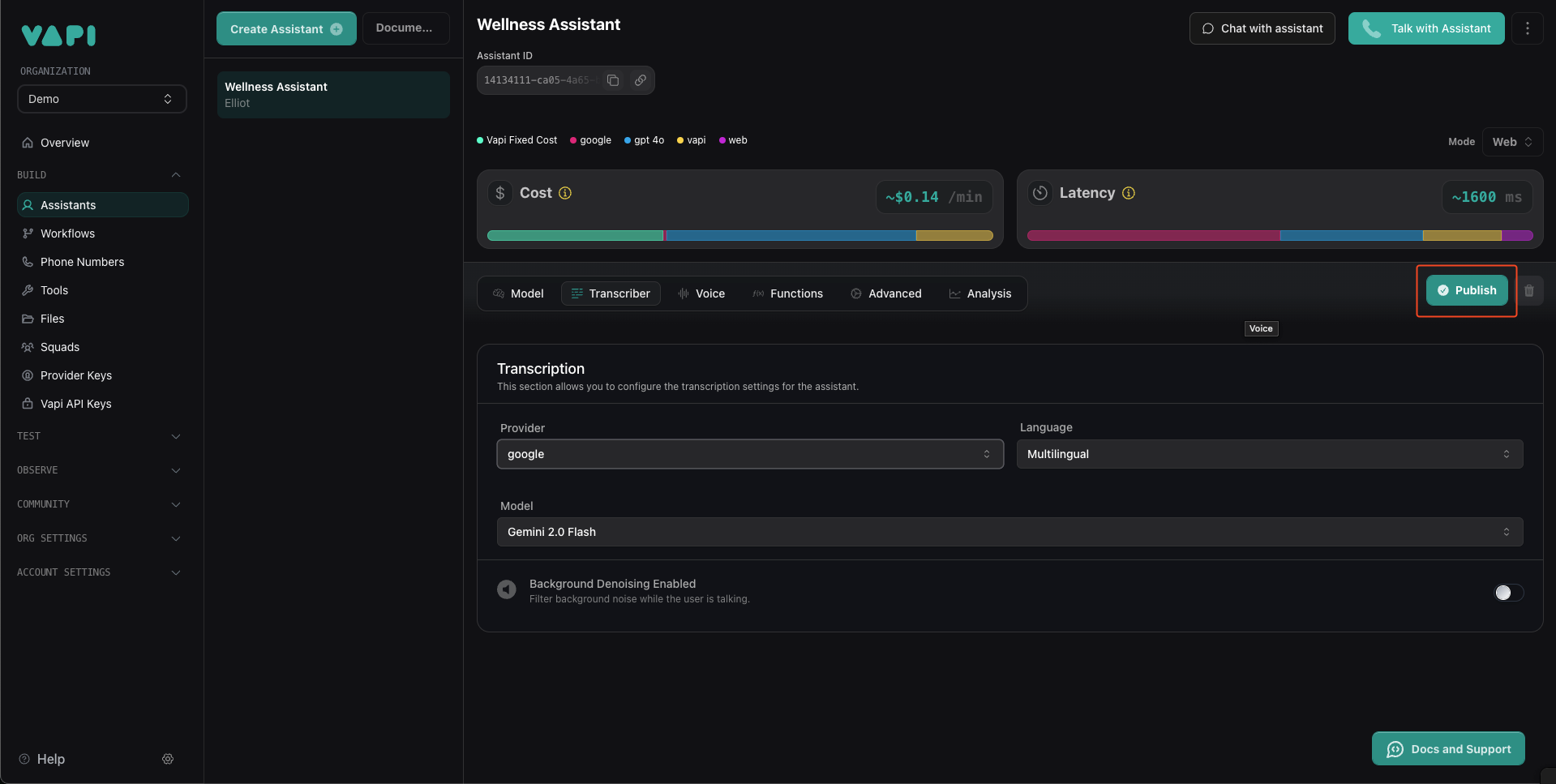
When tuned with Deepgram Nova-3, GPT-4o-mini, and ElevenLabs Flash, Vapi hits ~500-700ms median latency. Time-to-first-audio measures ~350ms. However, P95 latency under load can spike to 1.2-1.9 seconds — the range where customers actually hang up. LLM choice dominates the latency budget; switching to Claude Opus adds ~200ms regardless of platform.
Bring Your Own Stack
Vapi supports any LLM provider (OpenAI, Anthropic, Groq, Together, self-hosted), any TTS provider (ElevenLabs, Azure, PlayHT, Cartesia), and any STT engine (Deepgram, Whisper, AssemblyAI). This is genuine flexibility that no managed platform offers. If you need a specific model for compliance, cost, or performance reasons, Vapi is the only realistic choice.
Inbound & Outbound Calling
Handle both inbound customer service and outbound sales campaigns through the same API. Integrates with Twilio for telephony, supports WebRTC streaming with Google Meet-quality audio, and offers 100+ languages through your chosen TTS provider. The 10 concurrent call limit on pay-as-you-go plans scales to unlimited on enterprise.
Squads: Multi-Agent Handoff
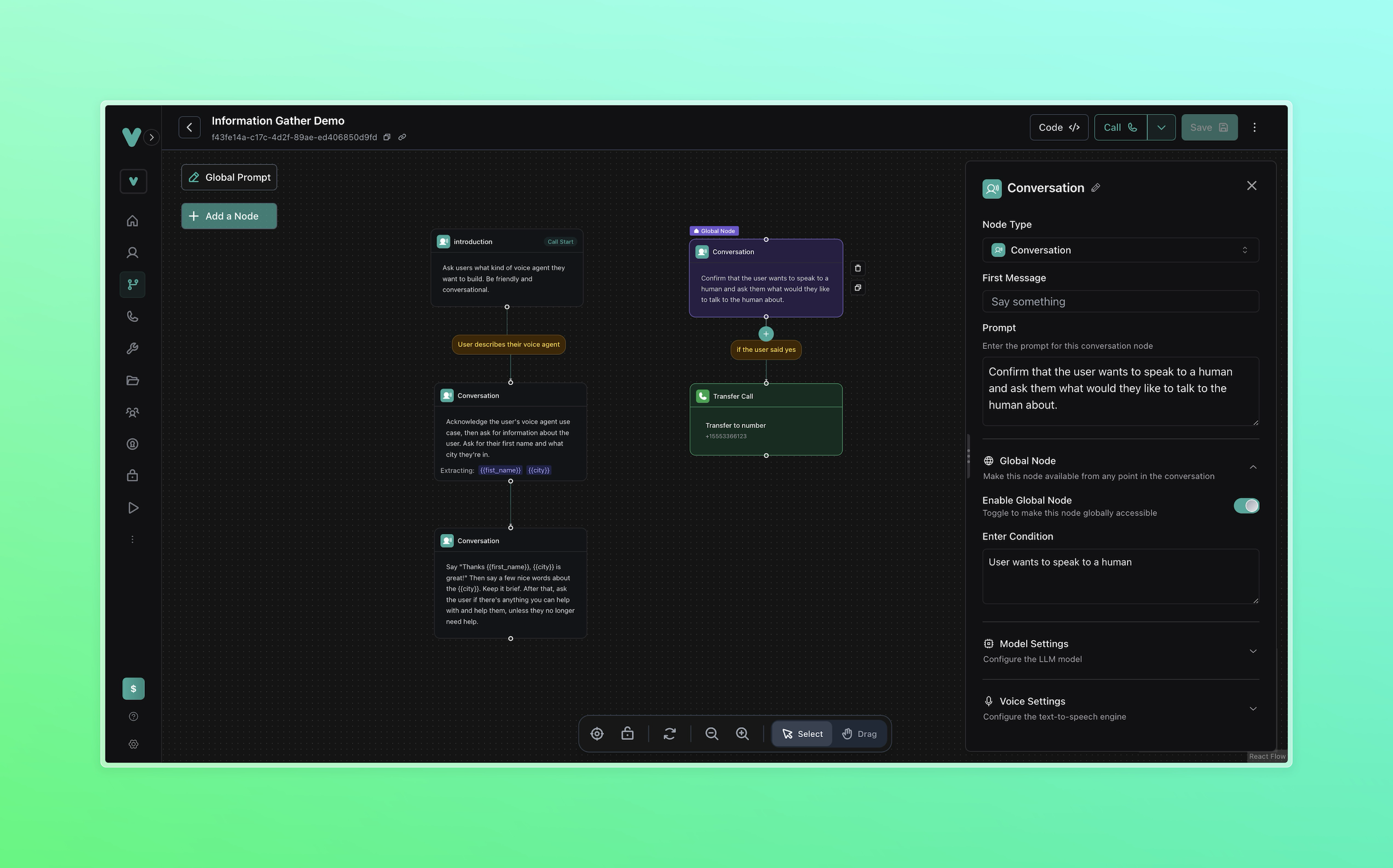
Vapi's "Squads" feature enables multi-agent constellations with handoff and shared context — ideal for sales-to-support transfers or complex workflows requiring multiple specialized agents. This is a genuine differentiator; Retell's Conversation Flow and Bland's Pathways do not offer equivalent multi-agent orchestration natively.
REST API + SDKs
Comprehensive API documentation, real-time analytics, custom voice cloning, and extensive webhook options. The JSON configuration is verbose but flexible — you will keep an assistant.config.ts checked in. For teams that want full programmatic control over every parameter, this is the gold standard.
Enterprise Compliance
Enterprise plans offer HIPAA compliance infrastructure, SOC 2 Type II certification, Business Associate Agreements (BAAs), and 24/7 technical support. However, HIPAA requires separate agreements with each third-party provider (STT, LLM, TTS, telephony) — adding procurement friction that managed platforms handle internally.
Pricing: The Hidden Math
| Plan | Base Rate | Real Total Cost |
|---|---|---|
| Pay-as-you-go | $0.05/min | $0.18-0.22/min (with all providers) |
| Enterprise | Custom | $40,000-70,000/year typical |
| Free Trial | $10 credit | ~150-200 minutes (limited testing) |
The itemized stack at 40,000 minutes/month (10K calls × 4 min avg):
| Component | Cost/min | Monthly Cost |
|---|---|---|
| Vapi Platform | $0.05 | $2,000 |
| STT (Deepgram Nova-3) | ~$0.0043 | ~$172 |
| LLM (GPT-4o-mini realtime) | ~$0.06 | ~$2,400 |
| TTS (ElevenLabs Flash) | ~$0.08 | ~$3,200 |
| Telephony (Twilio) | ~$0.013 | ~$520 |
| Total | ~$0.20/min | ~$8,292 |
💡 Compare to managed platforms: At the same 40K minutes, Retell AI invoices ~$2,800/month all-in. Bland AI on Scale runs $3,600-4,400/month. Vapi's flexibility costs 2-3x more at this volume — though the break-even point flips around 200K+ minutes/month with enterprise vendor discounts.
Explore Vapi AI →Pros & Cons
✓ What Developers Love
- ✅ Any LLM, any TTS, any STT — true BYOK flexibility
- ✅ Sub-500ms latency achievable with tuned configs
- ✅ Multi-agent "Squads" with handoff and shared context
- ✅ Comprehensive API and SDK documentation
- ✅ 100+ languages through provider choice
- ✅ Scales to 1M+ concurrent calls
- ✅ Fastest time to demo (~15-30 minutes)
✗ What Developers Hate
- ❌ Real costs 4x higher than advertised base rate
- ❌ 4-6 separate vendor invoices to manage monthly
- ❌ 10 concurrent call limit on pay-as-you-go
- ❌ Steep operational tax: 40-80 hrs/month engineering
- ❌ December 2025 pricing restructure without warning
- ❌ Platform updates can break existing setups
- ❌ HIPAA only on Enterprise with $1K/month add-on
💡 Real User Pulse: What Developers Actually Say
Vapi vs Retell vs Bland vs Synthflow
| Feature | Vapi AI | Retell AI | Bland AI | Synthflow |
|---|---|---|---|---|
| Starting Price | $0.05/min + usage | $0.07/min + usage | $0.09/min all-in | From $29/mo |
| Real Cost @ 40K min | ~$7,200-8,800 | ~$2,800 | ~$3,600-4,400 | ~$429 |
| Median Latency | ~500-700ms | ~600-620ms | ~700-900ms | ~800-1000ms |
| LLM Control | Any (BYO) | Curated list | Bundled only | Multiple |
| Setup Time | 20-60 hrs | 8-20 hrs | 4-12 hrs | 1-4 hrs |
| Best For | Flexibility, custom stacks | Inbound, quality, speed | Outbound at scale | No-code, fast ship |
| HIPAA BAA | Enterprise only | Standard | Standard | Yes (+30%) |
| Native Integrations | 0 (webhooks only) | 0 (webhooks only) | 4 (CRM) | 50+ |
When to choose each:
Pick Vapi if you have at least one senior engineer who actively wants to own five vendor relationships plus a Twilio account. If you need a specific LLM (Claude, open-source, self-hosted) that no managed platform supports, Vapi is the only answer. The flexibility is genuine; so is the operational tax. Teams that hire Vapi without a dedicated owner ship late and over budget every single time.
Pick Retell AI if you need a managed phone agent shipped in weeks, not months. At $0.07/min all-in with standard HIPAA BAAs, it is the best balance of quality, speed, and price for inbound use cases under 50K minutes/month. You trade LLM flexibility for operational sanity.
Pick Bland AI if you are running outbound campaigns at 1,000+ concurrent calls. The Pathways architecture, deterministic flows, and all-in pricing make it 30-50% cheaper than Vapi at high outbound volume. Inbound feels like an afterthought, so skip it if your mix is balanced.
Pick Synthflow if you have no developer and need a working voice agent in under 30 minutes. The visual builder, 50+ native integrations, and no-code approach make it the fastest path from idea to live call — though latency and voice quality sit below the code-first platforms.
Who Should Use Vapi AI?
✅ Ideal For: Engineering teams with dedicated AI infrastructure owners who need model flexibility that managed platforms cannot offer. If your compliance requirements demand a self-hosted LLM, or your use case requires a TTS provider that Retell does not support, Vapi is the only realistic choice. Teams running 200K+ minutes/month can also achieve better unit economics through enterprise vendor discounts — though the break-even point is high. Multi-agent workflows (sales-to-support handoff) benefit from Vapi's "Squads" feature, which has no direct equivalent on competing platforms.
❌ Look Elsewhere If: You do not have at least one senior engineer who wants to manage five vendor relationships, four separate invoices, and Twilio compliance. If you are a solo HVAC contractor doing 80 calls a month, Synthflow will get you live in 4 hours for $99/month. If you are a dental practice needing HIPAA-compliant inbound, Retell offers standard BAAs without the $1K/month enterprise add-on. If you are running outbound at scale, Bland's all-in pricing and campaign management will save you thousands monthly. Vapi's flexibility is wasted on teams that do not need it — and punishing on teams that underestimate it.
Expert Editorial Opinion
The Pricing Illusion. Vapi's $0.05/minute headline is technically accurate — it is what Vapi charges for platform orchestration. But it is also deliberately misleading. No production deployment runs on Vapi's platform fee alone. You need STT, LLM, TTS, and telephony. At 40K minutes/month, the real cost is $0.20/minute — 4x the advertised rate. The first month we modeled a 40K-minute deployment, the expected $2,000 invoice became $8,292 across five vendor dashboards. That is not a hidden fee; it is a hidden architecture. Vapi's pricing page should show a calculator, not a rate card.
Is the Flexibility Worth the Tax? For 80% of use cases, no. Retell AI ships the same inbound agent in 2-6 weeks with one invoice and ~$2,800/month at 40K minutes. Vapi takes 4-10 weeks, five invoices, and ~$8,300/month. The $5,500/month premium buys you the ability to swap LLMs and TTS providers without changing platforms. If that ability is worth $66,000/year to your business, Vapi is correctly priced. If not, you are paying a luxury tax for a feature you will never use.
The December 2025 Warning Shot. Vapi's pricing restructure arrived without advance notice to existing customers, leaving teams mid-project with blown budgets. This is not a one-time mistake — it is a pattern. When a platform's core value proposition is "we give you control," but its pricing behavior is "we change the rules without warning," the contradiction undermines trust. For a tool that asks you to build your entire voice infrastructure on top of it, trust is not optional.
Where Vapi Actually Wins. At 500K+ minutes/month with enterprise vendor discounts, Vapi's unit economics flip. A team running self-hosted LLMs and negotiated TTS rates can hit $0.11-0.13/min all-in — undercutting Retell and Bland at scale. The multi-agent "Squads" feature is genuinely unique for complex handoff workflows. And for teams that need a specific model for regulatory reasons (healthcare self-hosting, financial services audit trails), Vapi's BYOK architecture is the only compliant path. The problem: most teams buying Vapi are not at 500K minutes/month, and most do not need Squads.
The Verdict on Build vs. Buy. Vapi is a build platform disguised as a buy platform. It sells itself as "voice agents in minutes," but the real product is "voice agent infrastructure you own." That is a valid product — but it is not the product most buyers think they are getting. If you want to buy a working voice agent, go to Retell or Synthflow. If you want to build a custom voice stack and are willing to pay 4x the headline price for the privilege, Vapi is your platform. Just make sure you have the engineering team, the vendor management capacity, and the budget reconciliation process to handle what comes next.
Final Verdict
Vapi AI is the most technically capable voice agent platform on the market — and the most financially dangerous for teams that do not read the fine print. The $0.05/minute base rate is real, but the $0.20/minute production cost is equally real. The BYOK flexibility is unmatched, but the operational overhead of managing 4-6 vendor relationships is also unmatched.
For engineering teams with dedicated infrastructure owners, unique model requirements, and 200K+ minutes/month volumes, Vapi delivers genuine value that justifies its complexity. For everyone else — startups, small businesses, non-technical teams, and anyone who values predictable billing — the platform is a trap dressed as a bargain.
Recommended for: Senior engineering teams with custom model needs and high call volumes. Not recommended for: Solo operators, small businesses, teams without dedicated DevOps, or anyone who needs predictable monthly costs.
🔗 Related ToolRadar Reviews
More tools from AI Voice Agents
- PlayHT New Voices Review: Can AI Really Replace Human Voice?
- Cartesia Review: Is It the Fastest AI Voice Engine?
- VoiceAI Review: Best Real-Time Voice Changer?
- ElevenLabs V3 Review: AI Voice That Sounds Human
- Can an AI Agent Really Browse the Web for You?
- This AI Agent Works While You Sleep
- Can an AI Agent Really Replace Your Team?
- Zapier AI Review 2026: Automation Tool
❓ Frequently Asked Questions
Would you pay 4x the advertised price for the freedom to choose your own AI models?
For most teams, the answer is no — and that is why Retell AI and Synthflow exist. But if your use case demands a specific LLM, a custom TTS voice, or a self-hosted stack, Vapi is the only platform that says yes. The question is not whether Vapi is good. The question is whether you are the 20% of teams who actually need what it sells.
Test Vapi AI Free →
Comments
Post a Comment