


Semantic Scholar Review 2026: The Free AI Research Tool With 200M+ Papers
Semantic Scholar review 2026: AI-generated TLDR summaries, influential-citation detection, and cross-discipline search across 200M+ indexed papers — what's genuinely free versus what "indexed" doesn't guarantee, and how it actually compares to Google Scholar.
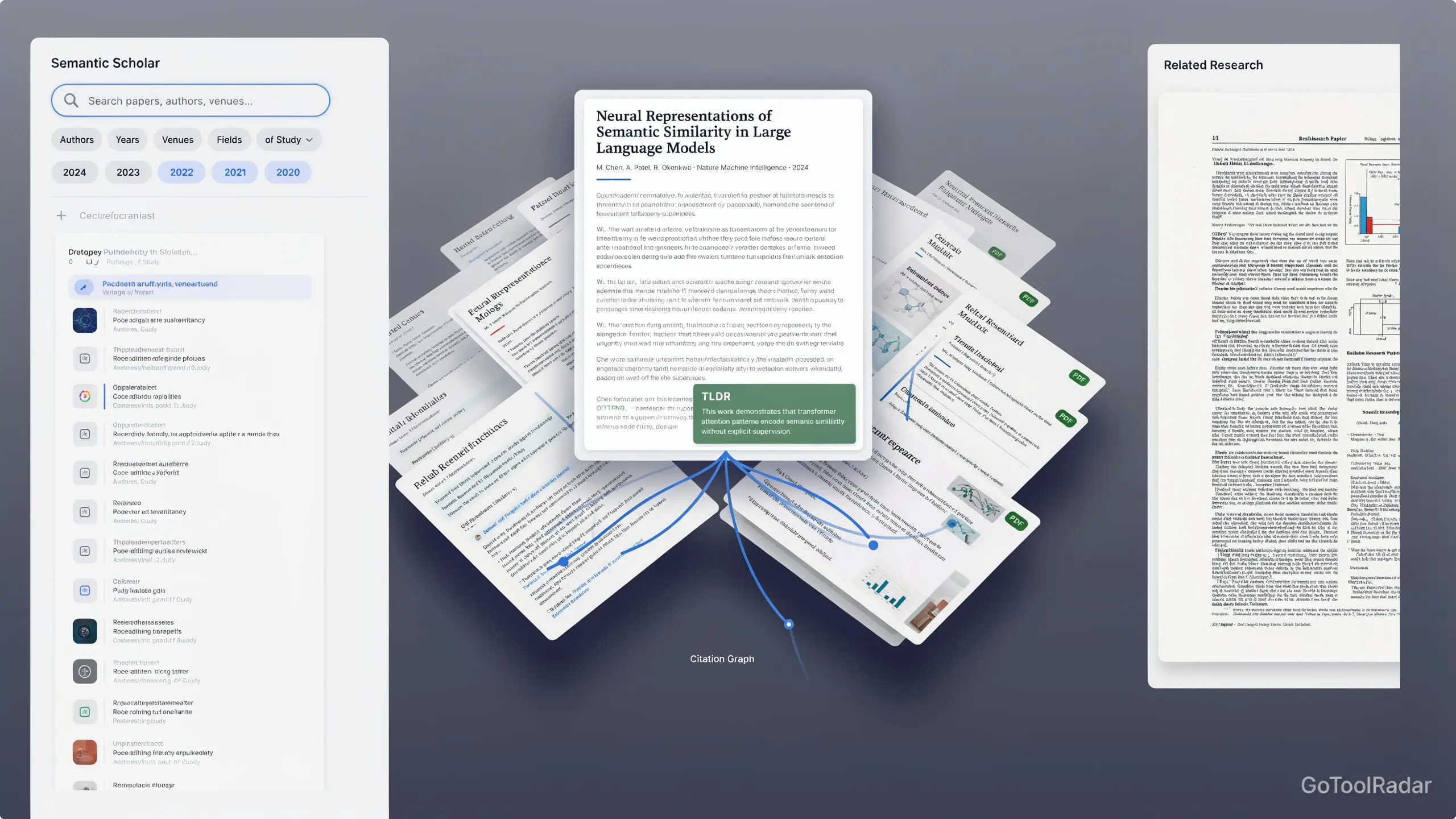
Semantic Scholar review 2026: built by the nonprofit Allen Institute for AI, Semantic Scholar indexes more than 200 million academic papers and layers AI tools on top of that index to help researchers and students find and triage papers faster — one-sentence TLDR summaries, machine-learning-estimated influential-citation detection, and cross-discipline search with filters for author, year, publication type, and venue. For anyone doing literature review work who's tired of relying on secondhand summaries instead of primary sources, that's a genuinely useful combination.
The honest framing this review leans on is narrower than "AI beats Google Scholar": Semantic Scholar's real strength is the combination of a wide academic index with AI summarization and citation tools for a subset of that index — not universal coverage, and not a replacement for reading the primary source before citing an important result. Both of those caveats come directly from how the product itself describes its own limitations, not speculation.

TLDR, Citations & Discovery
TLDR — one-sentence summaries
Condenses a paper's core idea and findings to help readers quickly decide whether it's worth reading in full. Available for roughly 60 million papers per the product page — a large number, but limited mainly to fields like computer science, medicine, and biology, not universal coverage.
Highly Influential Citations
A machine-learning algorithm attempts to identify which cited works meaningfully influenced the citing paper, rather than listing every citation as equally weighted — a useful signal, not a final verdict on a study's quality, and one that can miss citations where full-text access is limited.
Advanced cross-discipline search
Search across multiple fields and filter by author, year, publication type, journal, or conference, then follow related papers — useful for students, researchers, and writers who want primary sources rather than secondhand internet summaries.
Saved papers & alerts
A free account lets you save papers and set up alerts for new research matching your interests, without needing a paid subscription.
Developer API
Available with usage terms and rate limits, useful for building research tools or pipelines on top of Semantic Scholar's index rather than only using the web interface.
Is It Actually Free?
| Feature | Access |
|---|---|
| Paper search | Free |
| TLDR summaries | Free, where available (not every paper) |
| Saved papers & alerts | Free account |
| Full-text PDF | Not guaranteed for every paper — depends on open-access or institutional availability |
| Developer API | Available, subject to usage terms and rate limits |
Core academic search is genuinely free, and that's worth stating plainly rather than burying under caveats. But "free" needs one honest qualifier: Semantic Scholar aggregates data from publishers, repositories, and other sources, and a paper appearing in search results doesn't guarantee you can download the complete text without a subscription or institutional access elsewhere. That's not a paywall trick on Semantic Scholar's part — it's an inherent limit of being an index and discovery layer rather than the publisher of the underlying research — but it's a distinction worth understanding before assuming every indexed result is fully accessible.
What TLDR and Citation Scores Don't Tell You
A TLDR summary is a starting point, not a substitute for the paper itself. It may not capture every methodological limitation or caveat that matters for how a result should actually be used — anyone planning to cite a significant finding should read the original paper, not just its one-sentence summary, before relying on it.
Coverage isn't even across the index. TLDR summaries concentrate in fields like computer science, medicine, and biology; a researcher in a less-covered discipline will find the feature available for a smaller share of relevant papers, not the near-universal coverage the "60 million papers" figure might imply out of context.
Citation counts and influence labels are useful signals, not quality judgments. A highly cited paper, or one flagged as an influential citation elsewhere, isn't automatically correct or methodologically sound — citation volume reflects attention and relevance within a field, not a guarantee of validity, and the influence-detection algorithm itself can miss citations where full-text access is limited.
Pros & Cons
✓ Strengths
- ✅ Genuinely free core search across a large, cross-discipline academic index — no paywall on the discovery layer itself
- ✅ TLDR summaries offer a real time-saving triage tool for the fields where they're available
- ✅ Backed by the Allen Institute for AI, a reputable nonprofit research organization, not an unproven startup
- ✅ A developer API extends usefulness beyond the web interface for building custom research tools
✗ Limitations
- ❌ TLDR coverage concentrates in specific fields (CS, medicine, biology) rather than applying universally across disciplines
- ❌ Being indexed doesn't guarantee free full-text PDF access — many papers still require a subscription or institutional access elsewhere
- ❌ Influential-citation detection is a useful signal, not a definitive quality judgment, and can miss citations where full text isn't accessible
- ❌ Not a substitute for reading primary sources before citing an important result in serious academic work
Semantic Scholar vs. Google Scholar
| Aspect | Semantic Scholar | Google Scholar |
|---|---|---|
| Price | Free | Free |
| Core strength | AI-assisted discovery, TLDR summaries | Broad academic literature search |
| Citation tools | Influential-citation indicators | Citation counts and related works |
| Full-text access | Depends on open-access/institutional availability | Depends on availability online or via library |
Neither tool is categorically better — they overlap substantially and differ mainly in emphasis. Semantic Scholar's AI-assisted summaries and citation-influence indicators are useful specifically when you're triaging a large set of papers quickly; Google Scholar's broader raw search reach is useful when you want the widest possible net cast across the literature, with fewer AI-curated signals layered on top.
Who Should Use It
Ideal user: students, researchers, and writers who want primary academic sources rather than secondhand internet summaries, and who'll use TLDR and citation-influence signals as a triage tool to decide what to read in full — not as a replacement for reading it.
Look elsewhere if: your field falls outside TLDR's concentrated coverage areas, you need guaranteed full-text access without separate institutional or open-access availability, or you're looking for a tool that does more than discovery and summarization (note-taking and synthesis tools like NotebookLM serve a different stage of the research workflow).
Expert Editorial Opinion
The right way to position Semantic Scholar isn't "beats Google Scholar" — it's a genuinely useful, free complement that does a specific job well: helping a researcher triage a large set of papers faster than reading every abstract manually would. That's a real, measurable time-saving for anyone doing serious literature review work, and it doesn't require inflating the claim beyond what the tool actually does.
What makes this a credible recommendation rather than just an obvious one is how honestly the product itself describes its own limits. TLDR summaries aren't claimed to cover every field equally, citation-influence detection is framed as an algorithmic estimate rather than a quality judgment, and the gap between "indexed" and "freely downloadable" is an inherent structural reality of being a discovery layer over publisher content, not a hidden gotcha. A tool built on an academic index that's upfront about those limits is more trustworthy than one that oversells what AI summarization can reliably do with scientific literature.
The practical advice worth repeating directly: use TLDR and citation signals to decide what to read, never as a substitute for actually reading it before you cite something important. That's not a knock on Semantic Scholar specifically — it's the correct way to use any AI summarization tool applied to research literature, where getting a methodological nuance wrong has real downstream consequences for whatever you're writing.
Final Verdict
Semantic Scholar earns a Strong rating for genuinely free, wide-reaching academic search layered with useful AI triage tools — TLDR summaries and influential-citation detection — backed by a reputable nonprofit research organization. The named caveats: TLDR coverage isn't universal across disciplines, being indexed doesn't guarantee full-text access, and citation-influence signals are estimates, not quality judgments. For researchers and students doing real literature review work, this is a recommended tool with those caveats clearly understood.
| Dimension | Weight | Score /10 | Why |
|---|---|---|---|
| Technical quality | 30% | 8.0 | Genuinely useful AI-assisted discovery and summarization, with honestly stated limits on coverage and citation-influence accuracy |
| Price-to-value | 25% | 8.5 | Core search, summaries, and saved-paper tools are genuinely free, with the main limit being full-text access tied to the underlying publisher, not Semantic Scholar itself |
| Maturity & documentation | 20% | 8.5 | Backed by the Allen Institute for AI, a reputable and established nonprofit research organization |
| Ceiling & flexibility | 15% | 7.0 | A developer API extends usefulness beyond the web interface, though the tool's scope stays fixed to discovery and summarization rather than broader research workflows |
| Honesty of positioning | 10% | 8.5 | The product's own documentation is notably upfront about TLDR's uneven coverage and the limits of citation-influence detection, rather than overselling either |
Weighted total: (8.0×0.30) + (8.5×0.25) + (8.5×0.20) + (7.0×0.15) + (8.5×0.10) = 8.125/10, rounded to 8.1/10 — Score band: 8.0–8.9, "Strong — recommended with named caveats: use TLDR and citation signals for triage, not as a substitute for reading the primary source."
❓ Frequently Asked Questions
🔗 Related ToolRadar Reviews
Official source: Semantic Scholar. Given that TLDR coverage and full-text availability vary by paper and field, verify both directly for your specific research area before relying on either as universal.
Comments
Post a Comment