


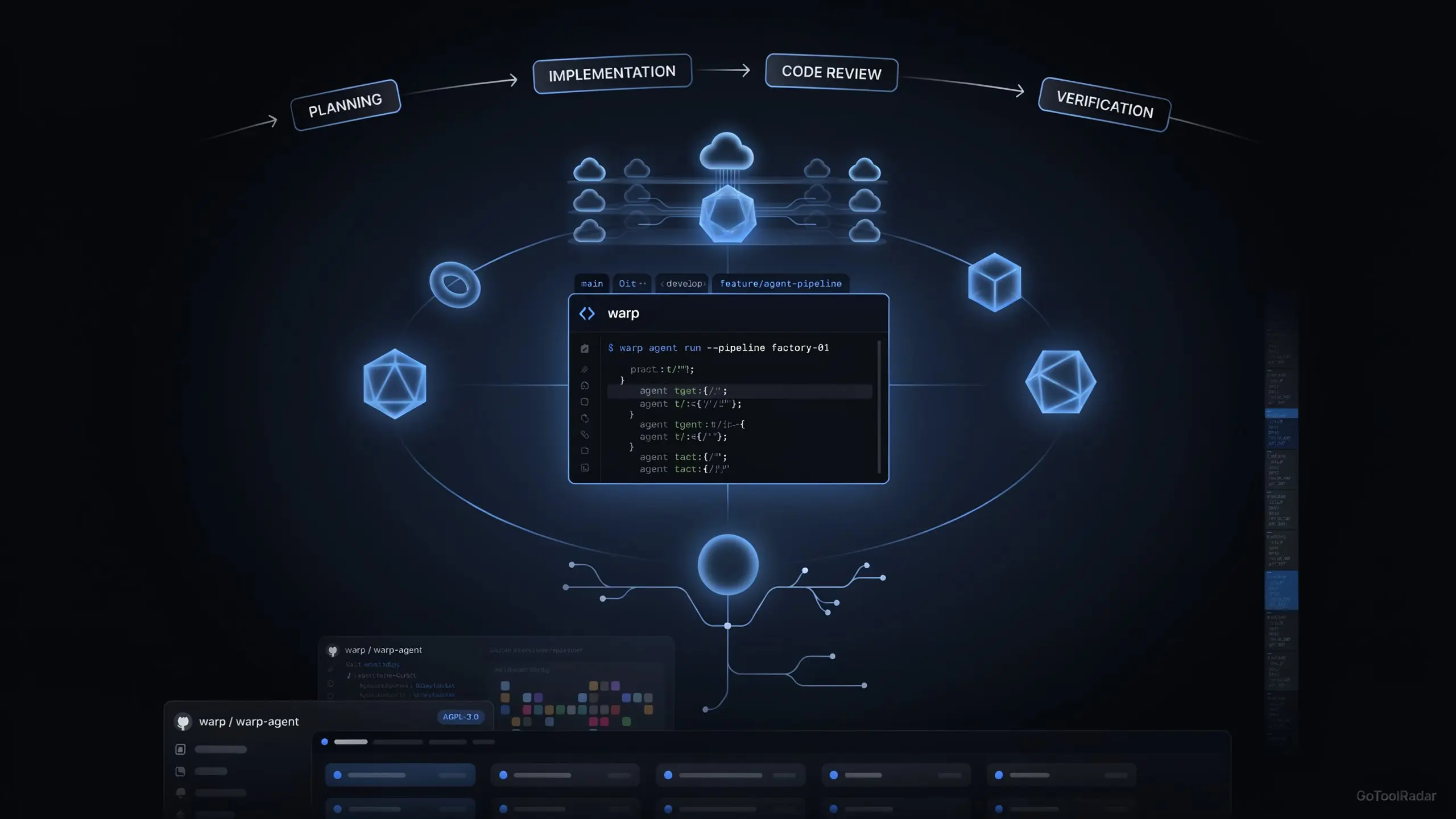
Warp Review 2026: This Isn't Just a Terminal Anymore
Warp review 2026: the AI terminal that became an open-source agentic development environment — Warp Agent, Claude Code/Codex/Gemini support, Oz cloud orchestration, Factories, credit-based pricing, and benchmark claims worth reading with a critical eye.
📋 Table of Contents
Warp review 2026: Warp started as a modern, Rust-built, GPU-rendered terminal — a genuinely nice upgrade over the decades-old terminal emulators most developers were stuck with. That's not what it is anymore. In April 2026, Warp open-sourced its client under the AGPL, brought on OpenAI as a founding sponsor, and started using its own agents to help build itself. Today it describes itself as an Agentic Development Environment: one place for a terminal, multiple AI coding agents, code review, and cloud-based agent orchestration.
The most important thing to understand about Warp in late 2026 is that it doesn't force you into one agent. You can run Warp's own agent, or Claude Code, Codex, Gemini CLI, OpenCode, and others — all inside the same environment, with vertical tabs, notifications, and session management layered on top. That's a deliberate choice. Rather than competing head-on with every coding agent on the market, Warp is betting it can become the shared workspace all of them run inside.
Three other things changed this year worth knowing before anything else: Warp's free tier no longer includes bundled AI usage for its own agent, the company now publishes benchmark claims (#1 Terminal-Bench, #5 SWE-Bench Verified) that are self-reported and worth treating as such, and its Zero Data Retention guarantee has a real asterisk — it only applies when you're using Warp-provided inference, not your own API keys. This review covers all three plainly.

From Terminal to ADE
A modern terminal, still at the core
Rust-built and GPU-rendered, with a block-based interface, command search, and the quality-of-life features that made Warp's reputation before any of the agent layer existed.
Multi-agent, not single-agent
Run Warp Agent, Claude Code, Codex, Gemini CLI, or OpenCode inside the same environment, with vertical tabs and notifications managing them — Warp positions itself as the shared workspace, not a replacement for any one of them.
Warp Agent CLI (Aug 2026)
A standalone version of Warp's own agent that runs outside Warp entirely — in Ghostty, iTerm2, VS Code's integrated terminal, or Windows Terminal — with model routing and multi-agent orchestration built in.
Oz — cloud agent orchestration
Launched February 2026: run several agents in parallel in the cloud, with tracking, an audit trail, and CLI/API control, rather than being limited to whatever a single laptop can run at once.
Factories (Early Access)
An extension of Oz toward a full pipeline — triage, specification, implementation, review, and verification handled by cloud agents in sequence, aimed at something closer to an automated software production line than a single coding assist.
Broad, growing model support
OpenAI, Anthropic, Google, xAI, and z.ai models, plus open-weight models like Kimi, MiniMax, and Qwen with automatic routing — genuinely model-agnostic rather than tied to one lab's roadmap.
Pricing — Credits, Not Unlimited AI
| Plan | Price | What you get |
|---|---|---|
| Free | $0 | Terminal fully usable; Warp Agent requires BYOK or purchased credits — no bundled AI usage |
| Build | $20/mo | 1,500 credits (~$20 of agent usage), full Warp Agent, frontier/open models, expanded cloud agents |
| Max | $200/mo | 18,000 credits (~$240 of usage) — roughly 12x Build's allowance |
| Business | $50/user/mo | 1,500 credits/user, SAML SSO, usage metrics, admin controls |
Here's the detail that trips people up: Warp's Free plan sounds like it includes AI, and the terminal itself is genuinely free and fully usable — but Warp Agent usage on Free requires bringing your own API key (OpenAI, Anthropic, Google), connecting a SuperGrok/X Premium account, or buying credits outright. There's no meaningful bundled AI allowance on Free the way some competing tools offer. Build's $20/month buys roughly $20 worth of agent usage at Warp's own accounting; Max's $200/month scales that up by roughly 12x rather than a flat 10x, which is a modest volume discount worth knowing if you're deciding between tiers based on heavy usage.
The Credit Unpredictability Problem
Warp is explicit, in its own documentation, that credit cost isn't fixed. A larger task, a bigger codebase, a pricier model, or cloud (versus local) execution can all push consumption higher — and real user reports back that up. One account on Reddit described burning roughly 50 credits on a relatively small test covering seven problems; another complained of agents consuming credits quickly during ordinary coding tasks. These are individual anecdotes, not a controlled benchmark, but the pattern is consistent enough to be worth a direct warning rather than a footnote: don't plan a Warp budget around the sticker price alone. Plan around how large and how frequent your actual agent tasks will be.
Pros & Cons
✓ Strengths
- ✅ Genuinely agent-neutral — runs Claude Code, Codex, Gemini CLI, and OpenCode alongside its own agent, rather than forcing a single choice
- ✅ Warp Agent CLI works standalone outside Warp itself, in Ghostty, iTerm2, VS Code, and Windows Terminal — a real hedge against vendor lock-in for the agent layer specifically
- ✅ Oz and Factories push well past a single-session coding assistant toward real parallel and pipelined agent work, with audit trails for enterprise accountability
- ✅ Open-sourced client (AGPL-3.0 core, some MIT UI crates) with OpenAI as a founding sponsor — a credible signal of long-term commitment, not just a marketing gesture
✗ Weaknesses
- ❌ The free tier's lack of bundled AI usage is a real downgrade from what a casual developer might expect from "free AI terminal"
- ❌ Credit consumption is explicitly variable and, per real user reports, can burn through an allowance faster than expected on ordinary tasks
- ❌ Headline benchmark claims (#1 Terminal-Bench, #5 SWE-Bench Verified) are self-reported by Warp without full published methodology, model version, or harness details
- ❌ Zero Data Retention only applies to Warp-provided inference — bringing your own API key routes requests under that provider's own terms instead, not Warp's ZDR guarantee
Warp vs. Superset vs. a Single Agent's Own Tooling
| Tool | Starting point | Best fit |
|---|---|---|
| Warp | Terminal that grew into an agent environment | Developers who want a daily-driver terminal with agents layered in, not a separate orchestration app |
| Superset | Purpose-built orchestration workspace | Teams specifically focused on running many agents in parallel with isolated worktrees |
| A single agent's native tooling (Cursor, Copilot) | One vendor's full-stack agent product | Developers who've already committed to one agent and don't need multi-agent flexibility |
Warp and Superset solve an overlapping problem from different starting points, and it's worth being precise about that rather than declaring a winner. Superset was built from day one as an orchestration layer sitting on top of Git worktrees; Warp was a terminal first, and grew an agent orchestration story (Oz, Factories) on top of a product people already had open all day. Neither approach is objectively correct — a developer who lives in a terminal anyway may prefer Warp's gravity; a team specifically optimizing for running many isolated agents at once may prefer Superset's narrower focus.
Who Should Use It
Ideal user: a developer who already lives in a terminal daily and wants agent capability layered into that existing habit — someone who values model flexibility (Claude, GPT, Gemini, open-weight models) and might eventually want cloud-based parallel agent work via Oz, without adopting a separate dedicated orchestration app.
Look elsewhere if: you want guaranteed, predictable AI costs without monitoring credit consumption, you need the single highest-ranked coding agent by an independently verified benchmark rather than a flexible multi-agent environment, or data retention is a hard requirement and you plan to use your own API keys rather than Warp-provided inference.
Expert Editorial Opinion
Warp's trajectory this year is genuinely one of the more interesting product stories in developer tooling. A terminal company open-sourcing its core client, bringing on OpenAI as a founding sponsor, and then using its own agents to help build the product — that's not a small pivot. It's a company betting that owning the place developers already spend their day is worth more, long-term, than owning any single AI model or agent.
That bet has a real logic to it. Developers don't open a new app to use a terminal; they already have one open. If Warp can make that existing habit the natural home for agent work too, it sidesteps the adoption friction that a standalone orchestration tool like Superset has to overcome from scratch. Whether that's enough of an advantage to matter in the long run is a separate question — but it's not a weak thesis.
The credit economics deserve more scrutiny than Warp's own marketing gives them. Saying "Build is $20/month" implies a predictable cost in a way the actual system doesn't deliver — credit consumption depends on task size, codebase size, model choice, and local versus cloud execution, and real user reports of fast credit burn aren't outliers so much as a predictable consequence of how the system is designed. Anyone evaluating Warp for regular use should budget for variability, not a flat monthly number.
The benchmark claims are the part of this review that required the most restraint to get right. "#1 Terminal-Bench, #5 SWE-Bench Verified" sounds authoritative on a product page. It is also Warp's own reported result, without a fully disclosed methodology, model version, or harness configuration attached to the current claim — which doesn't make it false, but does make it something to cite as "Warp reports," not as independently verified fact. That distinction matters more here than in most reviews, because terminal and coding-agent benchmarks are genuinely sensitive to exactly those undisclosed variables.
None of this is a case against Warp. It's a case for reading the fine print on a product that's grown this fast, this publicly, in a single year. The open-source move, the OpenAI sponsorship, and the Oz/Factories roadmap are real, substantive developments — not marketing dressing on an unchanged terminal app. Warp earned its place in this review's coverage. It just doesn't need inflated claims to make that case, and this review isn't going to repeat them uncritically on its behalf.
Final Verdict
Warp earns a Strong rating for a genuinely ambitious and well-executed transition from terminal to agentic development environment — multi-agent support, a standalone Agent CLI, cloud orchestration via Oz, and real open-source credibility backed by OpenAI's sponsorship. The named caveats: credit consumption is explicitly variable and reportedly aggressive in practice, headline benchmark claims are self-reported without full methodology disclosure, and the Zero Data Retention guarantee doesn't automatically extend to bring-your-own-key usage. For developers who already live in a terminal and want agent capability layered naturally on top of that habit, this is a recommended environment with those caveats clearly understood.
| Dimension | Weight | Score /10 | Why | |---|---|---|---| | Technical quality | 30% | 8.5/10 | A genuinely comprehensive progression from terminal to multi-agent CLI to cloud orchestration (Oz) to pipelined Factories | | Price-to-value | 25% | 7.0/10 | Reasonable entry pricing offset by a free tier with no bundled AI usage and credit consumption that's explicitly variable and reportedly fast-burning | | Maturity & documentation | 20% | 8.5/10 | Strong company fundamentals (800K+ developers, 65K+ GitHub stars, $50M Series B) and a credible, publicly documented open-source transition | | Ceiling & flexibility | 15% | 9.0/10 | Genuinely model-agnostic across major labs and open-weight models, with an agent CLI that works outside Warp entirely | | Honesty of positioning | 10% | 7.0/10 | Benchmark claims are self-reported without full disclosed methodology, and the ZDR/BYOK distinction requires careful reading to catch | Weighted total: (8.5×0.30) + (7.0×0.25) + (8.5×0.20) + (9.0×0.15) + (7.0×0.10) = **8.05/10**, rounded to **8.1/10** — Score band: 8.0–8.9, "Strong — recommended with named caveats: budget for variable credit consumption, and read benchmark and privacy claims with their qualifiers intact."❓ Frequently Asked Questions
🔗 Related ToolRadar Reviews
Official sources: Warp · Pricing · GitHub. Given how quickly Warp's agent economics and benchmark claims have shifted this year, verify current credit costs and methodology directly before budgeting heavy usage.
Comments
Post a Comment