


Willow Review 2026: The AI Voice Tool That Understands What You Mean
Willow review 2026: AI dictation plus Scribe, which turns a spoken instruction into a rewritten message rather than a transcript — Frontier Pro's edit-rate-focused architecture, a genuinely strong free tier, privacy terms, and the real risk that comes with an AI trying to guess your intent.
📋 Table of Contents
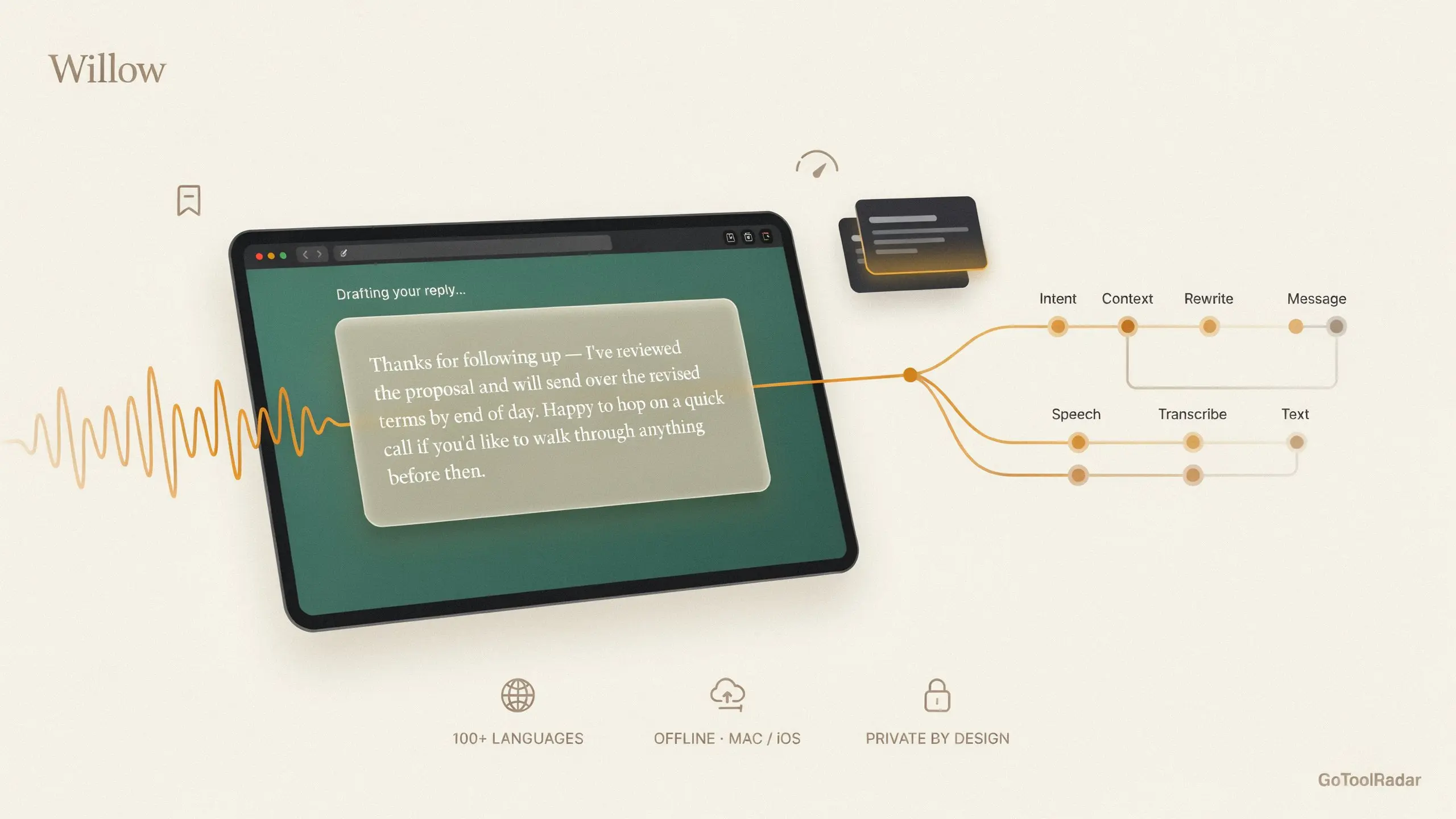
Willow review 2026: most dictation tools answer one question — what did you say? Willow, especially since launching a feature called Scribe, is trying to answer a different and much harder one: what did you mean? Say "tell him 7 works, and let him know I'm excited" while looking at a half-written text message, and Scribe reads the screen's context and writes the message you actually meant to send, not a transcript of your spoken instruction.
That distinction — dictation versus intent — is the entire story of this review. It's also, as a documented real-world case later in this piece shows, Willow's biggest risk as much as its biggest strength. The more an AI tries to understand what you meant rather than simply what you said, the more room there is for it to guess wrong about which one you wanted in the first place.
Willow started as a Y Combinator Spring 2025 company under founders Allan Guo and Lawrence Liu, has raised roughly $4.5M in seed funding, and now says it serves 100,000+ professionals — a company-reported figure, worth treating as exactly that. On July 7, 2026, it made its core dictation model free, permanently. That move, and what it does and doesn't actually include, is where this review starts.

Dictation vs. Scribe — the Real Difference
Core dictation (Frontier Pro / Mini)
Speech goes through ASR, then a separately-trained edit model (built with RL techniques) fixes punctuation, capitalization, sentence boundaries, names, and technical vocabulary — before personalization is layered on top.
Scribe — intent-based rewriting
Select existing text and give a spoken instruction — "make this more formal," "turn this into a Slack message," "translate to Spanish" — and Scribe reads on-screen context and rewrites the text in place, without copying into ChatGPT and back.
Edit-rate focus, not just accuracy
Willow explicitly optimizes for how often you have to manually fix the output before using it, not just raw transcription accuracy — arguably a more useful metric for a daily writing tool.
Personalization & vocabulary
Learns names, glossary terms, app-specific conventions, and previously accepted edits over time, aiming to reduce repetitive corrections the longer you use it.
100+ languages
Willow's current product page states 100+ supported languages — up from a 50-language figure on older help pages, so use the current number rather than older cached references.
Offline mode (Mac/iOS)
Dictation works offline on Mac and iOS specifically — not a claim that the entire product runs locally, since cloud processing is still part of the standard experience.
Pricing — What "Free Forever" Actually Means
| Plan | Price | Includes |
|---|---|---|
| Basic | $0 | Frontier Mini, unlimited dictation, 20 Scribe uses/week |
| Pro | $15/mo ($12/mo annual) | Frontier Pro unlimited, priority transcription, smart memory, unlimited Scribe |
| Business | $35/mo | Admin controls, privacy/compliance features |
| Enterprise | Custom | SSO/SAML, API, advanced governance |
"Making dictation free, forever" is a genuinely accurate description of what happened on July 7, 2026 — Frontier Mini, the base dictation model, really is unlimited on the free Basic plan, with no catch on that specific feature. What the free-forever framing doesn't make obvious is that Scribe, the more distinctive intent-based rewriting feature, is capped at 20 uses per week on Basic. Unlimited Scribe, the stronger Frontier Pro model, and priority transcription all sit behind the $15/month Pro tier. Free is real. Free-and-unlimited-for-everything is not quite the same claim, and it's worth knowing which one you're actually getting before picking a plan based on the headline.
Pros & Cons
✓ Strengths
- ✅ A genuinely strong, non-expiring free tier — unlimited core dictation, not just a time-limited trial
- ✅ Scribe's in-place, context-aware rewriting is a real workflow improvement over the copy-paste-into-ChatGPT loop most people currently use
- ✅ Edit-rate as the optimization target is a more honest, user-centered metric than raw transcription accuracy alone
- ✅ Serious enterprise posture for a young company — SOC 2 Type II, HIPAA, enforced zero data retention on business plans
✗ Weaknesses
- ❌ No Android app yet — a real gap against Wispr Flow, which already supports it
- ❌ Headline performance numbers (98%+ accuracy, ~200ms latency, "3x fewer errors") are company-reported, including on Willow's own comparison page against Wispr Flow, not independently benchmarked
- ❌ Context-aware editing carries a documented real risk: one long-time user reported Willow misinterpreting a literal word like "delete" as an editing command rather than dictated text, after a 78-day, 340,000+-word streak — a genuine failure mode of the Scribe philosophy, not a one-off bug
- ❌ Still an early-stage, seed-funded company — ecosystem maturity and long-term stability are less proven than larger, better-capitalized competitors
Willow vs. Wispr Flow vs. Superwhisper
Best for anyone who wants spoken instructions turned into finished, context-aware writing — not just a transcript — with the strongest free tier in the category.
Best for fast, general-purpose dictation plus a built-in meeting notetaker, with Android support Willow currently lacks.
Best for users who prioritize local/privacy-oriented processing and flexible configuration over Scribe-style intent editing.
Who Should Use It
Ideal user: a Mac, Windows, or iPhone user who writes a lot of messages, emails, or notes and wants spoken instructions turned into finished text in place — especially someone drafting from context (a half-written reply, an open document) rather than dictating from a blank page every time.
Look elsewhere if: you're on Android (not yet supported), you specifically want a meeting notetaker as a core feature (that's closer to Wispr Flow's positioning), or you'd rather dictate literal text without an AI layer trying to interpret your intent — a risk the documented "delete" misinterpretation case illustrates concretely.
Expert Editorial Opinion
The useful way to think about Willow isn't "a better Wispr Flow." It's a different bet about what voice input is for. Most dictation tools treat the keyboard replacement as the whole job: say words, get text, done. Willow's Scribe feature treats that as only half the job — the harder, more valuable half is turning a spoken instruction into finished, context-appropriate writing, the way a good assistant would interpret "tell him 7 works" rather than transcribing it literally into a message that reads like a transcript of a transcript.
That's a genuinely different product thesis, and it's well-supported by the architecture underneath it. Separating ASR from a purpose-trained edit model, and optimizing specifically for edit rate rather than raw transcription accuracy, reflects real thought about what actually frustrates a daily dictation user — it's rarely the occasional misheard word, it's the repeated manual cleanup afterward.
But there's a real tension built into this approach, and it deserves more weight than a single bullet point in a pros/cons list. The more an AI tries to infer intent rather than transcribe literally, the more opportunities it creates to guess wrong about which mode you're in. The documented case of a long-time user — 78 days, over 340,000 words — eventually leaving specifically because Willow interpreted a literal word as an editing command isn't a minor anecdote. It's close to a worked example of exactly the failure mode this review predicted before finding that evidence: context-aware systems trade transcription literalism for interpretive risk, and that tradeoff doesn't disappear just because it usually works.
None of that makes Scribe a bad idea. It makes it a feature that needs continued refinement, and a feature users should understand the shape of before relying on it for anything where literal accuracy matters more than inferred intent — dictating a legal clause, say, versus drafting a casual text reply.
The free tier is the other half of why this review lands where it does. Making real, unlimited core dictation free — not a seven-day trial, not a capped word count, an actual non-expiring free plan — is a genuinely strong move in a category where most competitors gate basic usability behind a paywall. It's good for users. It's also, bluntly, good marketing timed well, and both things can be true at once.
Weigh the company-reported numbers accordingly. 98%+ accuracy and "3x fewer errors than built-in dictation" sound precise. They come from Willow's own testing, including on its own comparison page against a named competitor — informative as a directional signal, not as independently verified fact. The honest framing: Willow is a genuinely interesting, well-architected product from a young, still-proving-itself company, with one standout feature that is simultaneously its best argument and its clearest risk.
Final Verdict
Willow earns credit for a genuinely strong free tier and a well-architected, intent-aware writing feature in Scribe that goes meaningfully beyond standard dictation. The score reflects real caveats alongside that strength: a documented real-world case of Scribe misinterpreting literal speech as an editing command, company-reported performance numbers without independent verification, no Android support yet, and the ecosystem maturity of a young, seed-stage company. For the specific use case of voice-native writing on Mac, Windows, or iPhone, this is a competent, promising tool — not yet a guaranteed long-term bet.
| Dimension | Weight | Score /10 | Why |
|---|---|---|---|
| Technical quality | 30% | 8.0 | Genuinely innovative edit-rate-focused architecture, offset by a documented real-world failure mode in Scribe's intent interpretation |
| Price-to-value | 25% | 8.5 | A real, non-expiring free tier with unlimited core dictation is a standout advantage in this category |
| Maturity & documentation | 20% | 6.5 | A young, seed-stage company (~$4.5M raised) with most headline stats being company-reported rather than independently verified |
| Ceiling & flexibility | 15% | 7.0 | Real enterprise features (SOC 2, HIPAA, SSO) offset by the missing Android app and cross-platform gaps |
| Honesty of positioning | 10% | 7.0 | Privacy terms are reasonably clearly documented, though headline accuracy/latency claims are self-reported, including on its own competitor-comparison page |
Weighted total: (8.0×0.30) + (8.5×0.25) + (6.5×0.20) + (7.0×0.15) + (7.0×0.10) = 7.575/10, rounded to 7.6/10 — Score band: 7.0–7.9, "Competent but compromised — a genuinely strong free tier and a distinctive feature, with real caveats around interpretive accuracy and company maturity."
❓ Frequently Asked Questions
🔗 Related ToolRadar Reviews
Official source: Willow. Given that most performance figures here are company-reported, and that Scribe's intent-interpretation behavior has a documented real-world failure case, test both the free dictation and Scribe specifically on your own workflow before relying on them for anything where literal accuracy matters.
Comments
Post a Comment