



Genei.io Review 2026: The AI Research Assistant That Summarizes Papers — But Is It Worth the Price?
Upload your PDFs, ask questions across your entire library, and extract citations automatically. But with billing complaints piling up and no free tier, does Genei still justify its cost in 2026?
- What Is Genei.io and Why Does It Matter?
- Key Features: How Genei Handles Research Workflows
- Pricing: No Free Tier, Steep Monthly Cost
- Pros & Cons: The Honest Breakdown
- Real User Pulse: What Capterra & Trustpilot Say
- Genei.io vs Competitors: The Comparison
- Who Should Use Genei.io (And Who Shouldn't)
- Expert Editorial Opinion
- Final Verdict
- Related ToolRadar Reviews
- Frequently Asked Questions
The AI research tool landscape in 2026 is crowded in a way that would have been unimaginable three years ago. Perplexity does deep web research. NotebookLM synthesizes your own documents. Elicit parses scientific papers. ChatGPT reads any PDF you throw at it. In this environment, it is worth asking an honest question: what does Genei still do that general-purpose AI tools do not? The answer is more specific than it first appears.
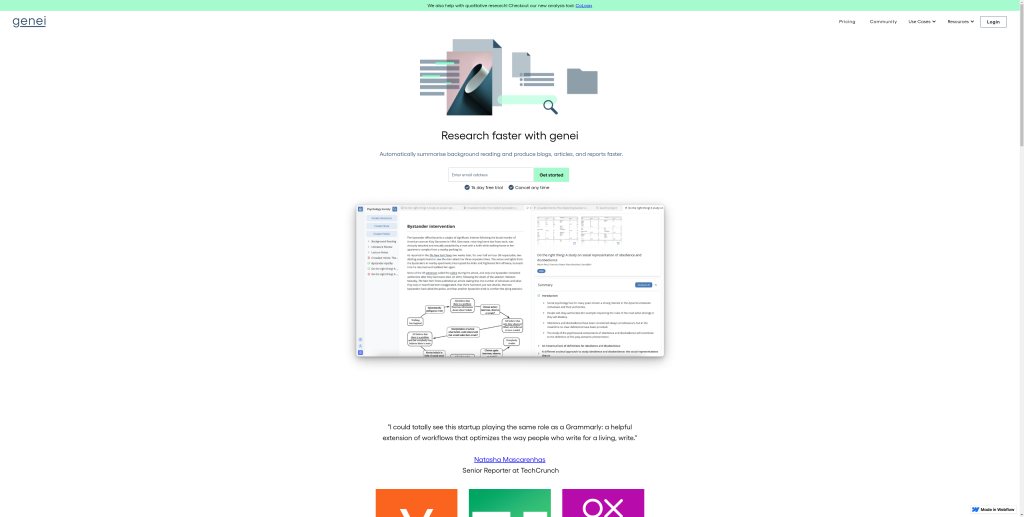
Genei.io is an AI-powered research assistant built by an independent UK-based team and backed by Y-Combinator. Founded as a purpose-built platform rather than a general AI tool retrofitted for research, it centers on three core capabilities: keyword extraction and definition, semantic and query-based search within and across documents, and summarization of entire documents and sections. Users can organize papers into project folders, annotate articles with comments and highlights, tag words and phrases with custom definitions, and make linked notes across sources. Updated June 2026, this review examines whether Genei's structured research environment justifies its subscription cost — or whether the billing complaints and competitive pressure from free alternatives have made it a harder sell than it once was.
What Is Genei.io and Why Does It Matter?
Genei occupies a specific niche in the research tool ecosystem: it is not a general-purpose chatbot that happens to read PDFs, but a structured environment designed for the full research workflow. The platform allows users to upload documents — PDFs, web pages, and other formats — into project folders, then applies NLP models including GPT and BERT to extract insights, summarize content, and enable semantic search across the entire library.
What distinguishes Genei from simply uploading PDFs to ChatGPT is persistence and cross-referencing. When you upload ten papers into a Genei project, you can ask questions that span all ten documents simultaneously. The platform surfaces specific answers from within your uploaded research library rather than generating responses from training data. Citation extraction identifies references within documents automatically, and the reference generator compiles bibliographies directly inside the platform. Linked notes allow annotations to connect across sources, creating a web of insights rather than isolated highlights.
The Chrome extension extends this workflow into browsing — summarizing webpages on the fly or saving them for later reading without switching to the main app. Cloud integrations with Google Drive, Box, Dropbox, OneDrive, and Evernote, plus availability as a Microsoft SharePoint add-on, mean Genei can sit on top of existing document management infrastructure rather than requiring a complete migration. For researchers who have built their reading and synthesis process inside this structured environment, the organizational value is significant. The question is whether that value exceeds the cost and risk in a market where free alternatives are rapidly improving.
Key Features: How Genei Handles Research Workflows
Multi-Document Summarization
The Pro plan enables cross-document analysis, letting users synthesize insights from multiple papers or articles simultaneously rather than processing them one at a time. This is particularly valuable for literature reviews where themes must be extracted across a body of work, not just isolated documents.
Semantic and Query-Based Search
Search within and across documents using natural language questions rather than keyword matching. The system surfaces specific answers from within your uploaded research library, understanding context and meaning rather than simply finding word occurrences. This moves beyond Ctrl+F to genuine comprehension-level retrieval.
Citation and Reference Management
Built-in citation extraction identifies references within documents automatically, with a reference generator and citation management system for compiling bibliographies directly inside the platform. This eliminates the manual copy-paste workflow that consumes hours of research time.
Cloud Integrations
Connects with Google Drive, Box, Dropbox, OneDrive, and Evernote, and is available as a Microsoft SharePoint add-on for organizations with existing document management infrastructure. This means Genei enhances rather than replaces your current document storage setup.
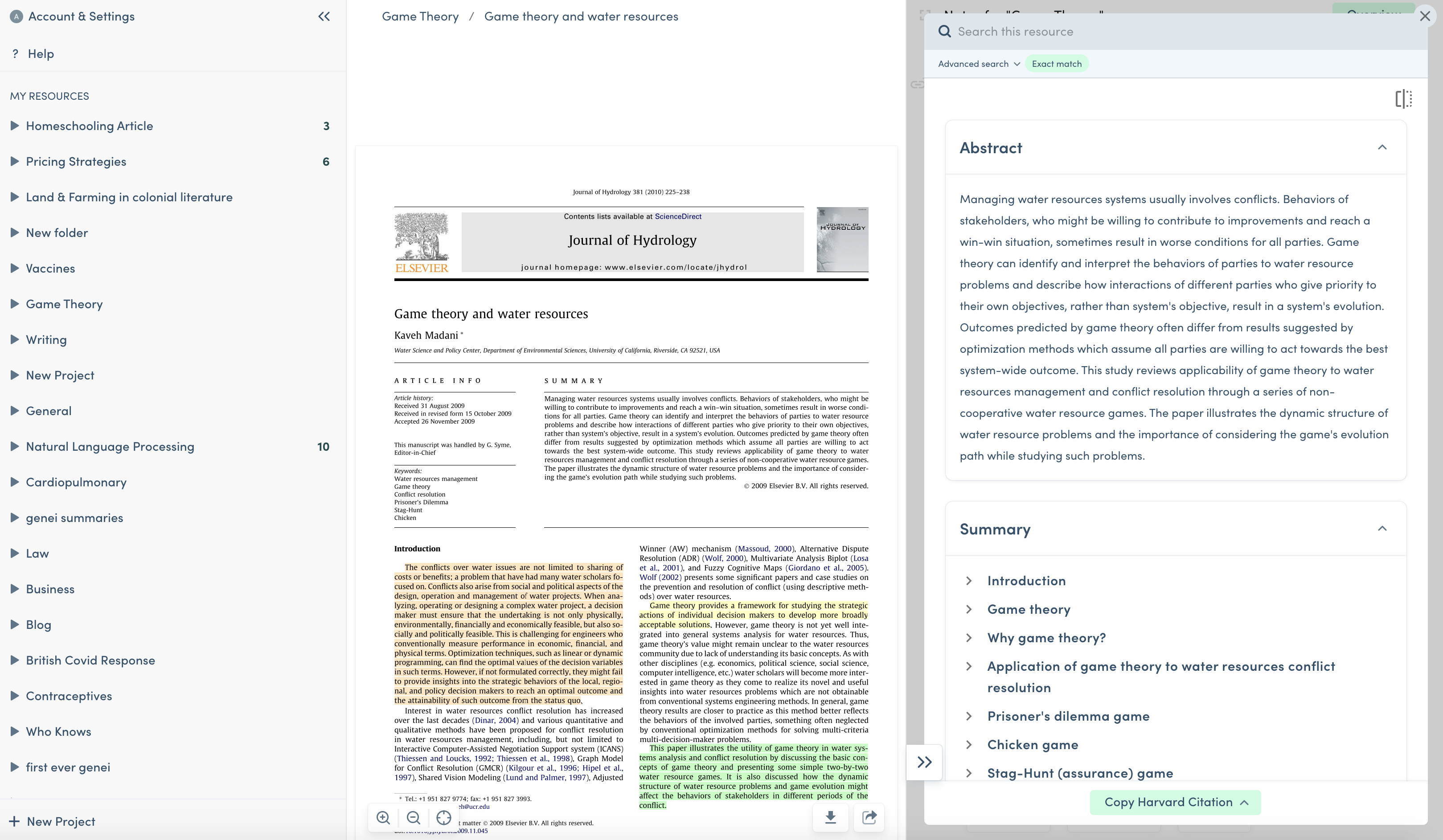
Graph, Figure, and Table Extraction
Extracts visual data elements from academic PDFs rather than treating documents as pure text. This matters significantly for scientific and technical research where the insight is often in the figures, charts, and tables rather than the prose surrounding them.
Linked Notes and Annotations
Annotate articles with comments and highlights, tag words and phrases with custom definitions, and make linked notes across sources. This creates a persistent knowledge web that grows with your research rather than isolated annotations that lose context over time.
Pricing: No Free Tier, Steep Monthly Cost
| Plan | Price | What's Included |
|---|---|---|
| Basic | £9.99/mo £7.99/mo annually |
AI-generated keywords, AI-powered summaries, cloud-based notes and annotations, note linking, graph/figure/table extraction, reference generation and management, export functionality |
| Pro | £29.99/mo £24.99/mo annually |
Everything in Basic plus GPT-powered summaries, AI-powered expand/paraphrase/rephrase, multi-document analysis, GPT access for search and question mode, priority server access |
| Academic Pro | ~£18/mo 40% discount |
Full Pro features at 40% discount for verified students and academics. Requires academic verification. 14-day free trial available on all plans. |
The pricing structure is straightforward but uncompromising. There is no free tier — every plan requires payment after the 14-day trial ends. At £9.99 for Basic and £29.99 for Pro, Genei sits in the upper-middle range of AI research tools. The 40% academic discount is genuinely significant, bringing the Pro plan to roughly £18 per month for students and researchers — a price point that makes sense for heavy academic use but still represents a meaningful monthly commitment.
The critical pricing question is not whether Genei is expensive, but whether it is expensive relative to what free alternatives now offer. ChatGPT Plus at $20 per month reads PDFs, answers questions about them, and generates summaries. Perplexity Pro at $20 per month does deep web research with citations. NotebookLM is free and synthesizes uploaded documents into podcasts and briefings. Against this backdrop, Genei's value proposition depends entirely on whether its structured environment — project folders, cross-document search, linked notes, and citation management — justifies the cost over these cheaper or free alternatives. For researchers who need that structure, the answer may be yes. For those who just need summaries, the answer is increasingly no.
Try Genei.io Free Trial →Pros & Cons: The Honest Breakdown
✓ What Genei.io Gets Right
- ✅ Structured persistent research environment — project folders, linked notes, and cross-document search create a workflow that general AI tools cannot replicate
- ✅ Semantic search across document libraries — natural language questions retrieve specific answers from your uploaded research, not generic training data
- ✅ Automatic citation extraction and bibliography generation — eliminates manual reference management, a genuine time-saver for academic writing
- ✅ Graph and figure extraction from PDFs — handles visual data elements that text-only summarizers miss entirely
- ✅ Strong cloud integrations — works with Google Drive, Dropbox, OneDrive, Evernote, and SharePoint without forcing migration
- ✅ Significant academic discount — 40% off makes the Pro plan accessible to students and researchers on tight budgets
✗ Where Genei.io Falls Short
- ❌ No free tier — every plan requires payment after the 14-day trial, unlike competitors with generous free tiers
- ❌ Document length limitations — struggles with documents over 100 pages, limiting usefulness for book-length research materials
- ❌ PDF parsing failures — scanned documents and non-standard formatting are not reliably readable
- ❌ No multi-paper export to single document — compiling summaries from multiple papers requires manual combination
- ❌ Documented billing and refund issues — multiple verified complaints about charges after cancellation and unresponsive support on Trustpilot
- ❌ Desktop-first, mobile-secondary — the mobile experience is limited, restricting use cases for researchers on the go
- ❌ Occasional UI clunkiness — reviewers describe the interface as sometimes feeling busy and unintuitive
💡 Real User Pulse: What Capterra & Trustpilot Say
Genei.io vs Competitors: The Comparison
| Feature | Genei.io | NotebookLM | ChatGPT Plus |
|---|---|---|---|
| Free Tier | None — 14-day trial only | Generous free tier | Free tier limited |
| Cross-Document Search | Semantic, across library | Conversational | Per-upload only |
| Citation Management | Built-in extraction + generation | None | Manual |
| Pricing Entry | £9.99/mo | Free | $20/mo |
| Project Organization | Folders + linked notes | Per-notebook | Chat threads |
| Billing Trust | Documented issues | Google-backed | OpenAI-backed |
The comparison reveals Genei's position clearly. Against NotebookLM, it wins on structured organization, citation management, and cross-document semantic search but loses decisively on price — NotebookLM is free and backed by Google's infrastructure. Against ChatGPT Plus, Genei wins on persistent research environment and citation workflow but loses on flexibility and the breadth of tasks ChatGPT handles beyond research. The ideal stack for many researchers may include both: NotebookLM for free document synthesis and audio briefings, Genei for structured literature review workflows with citation management. For researchers who can only afford one tool, the choice depends on whether organization or raw capability matters more.
Who Should Use Genei.io (And Who Shouldn't)
Ideal for: Academic researchers and PhD students conducting systematic literature reviews who need cross-document synthesis, citation extraction, and persistent project organization. Content writers and bloggers who process large volumes of source material and need structured note-taking with linked annotations across sources. Students on tight budgets who can verify academic status for the 40% discount — at roughly £18 per month for Pro, the value proposition becomes defensible for heavy research use. Teams already using Google Drive, Dropbox, or SharePoint who want an AI layer on top of existing document infrastructure without migrating libraries. Researchers who regularly work with PDFs containing figures, charts, and tables that text-only summarizers miss.
Look elsewhere if: You need a free tool — Genei has no free tier, and NotebookLM or ChatGPT's free tier may suffice for lighter use. You primarily read book-length materials over 100 pages — Genei struggles with very long documents. You need reliable customer support and transparent billing — the documented Trustpilot complaints about post-cancellation charges and unresponsive support are a genuine concern. You want a mobile-first research experience — Genei is desktop-centric with limited mobile functionality. You just need quick summaries of individual documents — ChatGPT Plus or free alternatives handle this adequately at lower cost. You are uncomfortable subscribing to a service with documented billing issues — using virtual cards for trials and carefully tracking cancellation dates is advisable.
Expert Editorial Opinion
 Independent Analysis
Genei.io occupies a genuinely important position in the research tool ecosystem because it addresses a problem that most general-purpose AI tools ignore: the workflow. ChatGPT can read a PDF. NotebookLM can synthesize ten documents into a podcast. But neither creates a persistent, organized research environment where documents live in project folders, annotations link across sources, citations generate automatically, and semantic search retrieves answers from your specific library rather than the internet at large. This is not a feature gap. It is a category difference. And workflows are sticky in a way that individual features are not, because migrating away means rebuilding the organizational structure that the tool created.
The billing and trust issues, however, are not minor footnotes. A 2.3 out of 5 Trustpilot rating with multiple verified complaints about post-cancellation charges is a signal that potential users should take seriously. While the company responds publicly and offers refunds when contacted, the pattern of issues across independent sources suggests systemic friction in the billing and cancellation process rather than isolated incidents. For a tool that asks users to trust it with their research libraries and credit card details, this is a material liability. The recommendation to use virtual cards for trial subscriptions and to carefully document cancellation confirmations is not paranoia — it is prudent risk management based on documented user experiences.
The pricing gap analysis is the central tension. At £9.99 for Basic and £29.99 for Pro, Genei is not cheap — especially with no free tier and strong free alternatives like NotebookLM. The academic discount at 40% off brings the Pro plan to roughly £18 per month, which is defensible for researchers who genuinely use the cross-document and citation features daily. But for casual users who just need occasional PDF summaries, the cost is hard to justify against ChatGPT Plus at a similar price point with far broader capabilities. The question for Genei is whether its structured workflow advantage is large enough and durable enough to maintain pricing power as free alternatives improve. For now, the answer is conditional: yes for heavy researchers who need organization, increasingly uncertain for everyone else.
Final Verdict
Genei.io earns a 6.8 out of 10 for delivering a genuinely differentiated structured research environment with strong cross-document search, citation management, and figure extraction capabilities. The workflow it creates — persistent projects, linked notes, semantic search across libraries — is something general-purpose AI tools have not replicated. The deduction is significant and multifaceted: the absence of a free tier, documented billing and refund issues on Trustpilot, struggles with long documents, no multi-paper export, and increasingly capable free alternatives that erode its value proposition. For academic researchers with verified status who can access the 40% discount and who genuinely need structured literature review workflows, Genei is a defensible investment. For casual researchers, content creators with lighter needs, or anyone uncomfortable with documented billing risks, the free alternatives have narrowed the gap enough to make Genei a harder recommendation than it was two years ago. Updated June 2026.
🔗 Related ToolRadar Reviews
More tools from AI Research Tools
- Can Humata.ai Actually Read a 500-Page PDF? We Tested It
- Is Reflect the Smartest Note-Taking App in 2026?
- Readwise Review 2026: Can This App Actually Improve Your Reading?
- Fabric App Review 2026: AI Second Brain or Overhyped Folder?
- I Replaced My Entire Note-Taking Stack With AI — Here's What Survived
- Google's NotebookLM Started It — These 3 Tools Took It Further
- Genspark Review 2026: AI Research Agent or Overhyped Search?
- Perplexity AI 2026 Review: The World's Most Accurate AI Search?
❓ Frequently Asked Questions
How many hours did your last literature review cost you?
Genei.io turns paper stacks into searchable, linked knowledge libraries. The 14-day trial is free — but the real question is whether its structured workflow is worth the monthly cost when free alternatives are catching up fast.
Try Genei.io Free Trial →
Comments
Post a Comment