


Deepgram Review 2026: The Voice AI Infrastructure Behind the Agent Boom
Deepgram review 2026: Nova-3 speech recognition, Flux real-time turn-taking, Aura-2 text-to-speech, and a Voice Agent API that 1,300+ organizations are reportedly building on — with pricing, independent benchmarks, and privacy defaults worth knowing before you build on it.
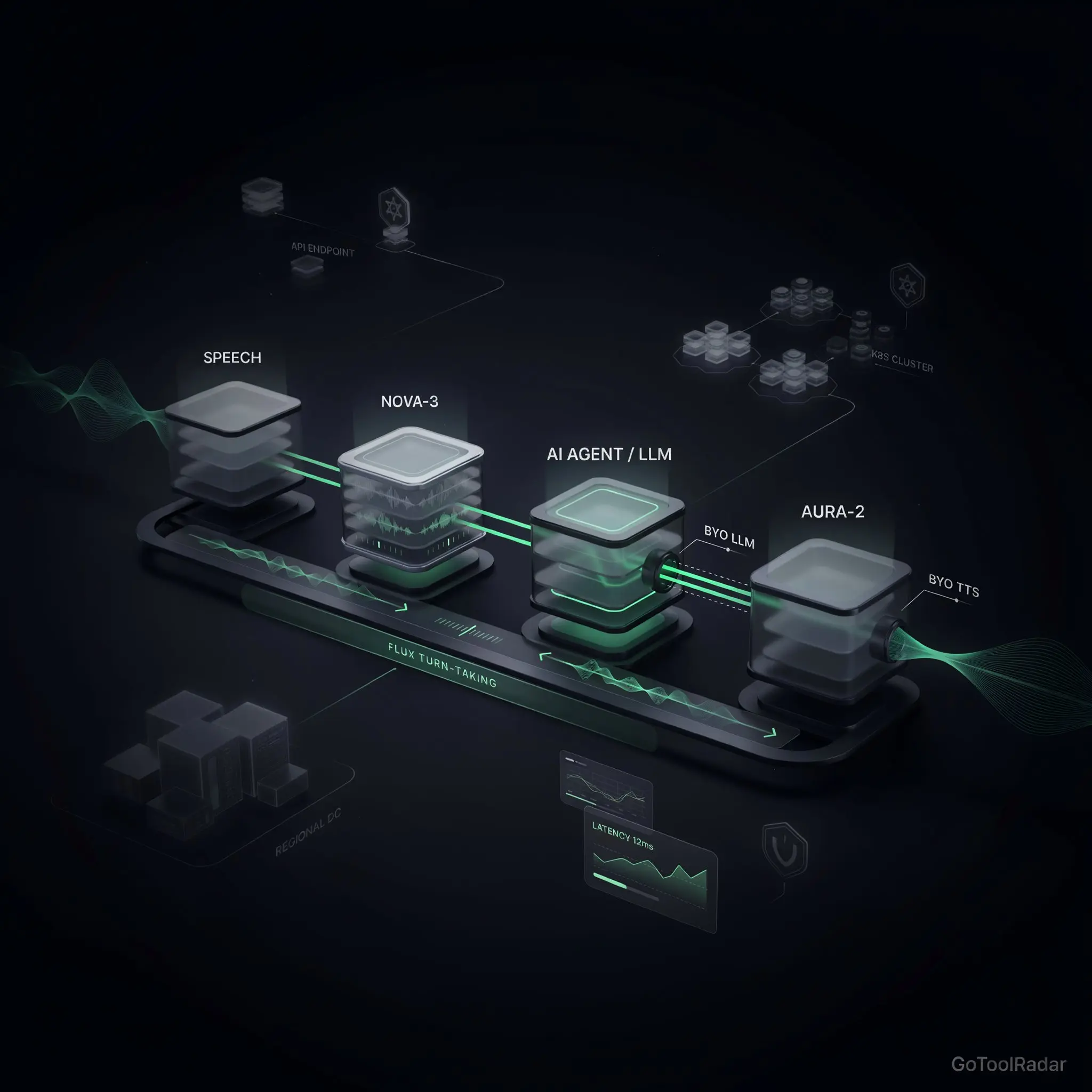
Deepgram review 2026: most AI voice products want you to talk to them. Deepgram wants to power the companies building the ones you talk to. What started as a developer-focused speech-to-text API has grown into a full voice AI stack — Nova-3 for transcription, Flux for real-time conversational turn-taking, Aura-2 for speech generation, and a Voice Agent API that bundles speech recognition, LLM orchestration, and voice output into one production pipeline.
The business case behind that shift is real: Deepgram raised a $130 million Series C in January 2026 at a $1.3 billion valuation, with investors including Twilio, SAP, ServiceNow Ventures, and Citi Ventures, and says more than 1,300 organizations now build on its stack. This review treats Deepgram as what it's actually positioning itself to be in 2026 — infrastructure, not a transcription app — and checks that positioning against independent benchmarks rather than the company's own numbers alone.

What Deepgram Actually Is
Nova-3 — speech-to-text
Deepgram's core transcription model, continuously updated through 2026 with new languages nearly every month — from Bengali and Tamil in January to Kazakh and Hebrew improvements in September.
Flux — conversational speech recognition
Launched October 2025, Flux is built specifically for turn-taking in live conversations: end-of-turn detection, interruption handling, and keyterm prompting, with three configurable modes (automatic, semi-manual, fully manual) added in August 2026.
Aura-2 & Flux TTS — text-to-speech
Aura-2 targets enterprise/conversational voice rather than entertainment-grade narration; Flux TTS is the newer, latency-optimized option for real-time voice experiences.
Voice Agent API
Combines STT, LLM orchestration, and TTS into one real-time pipeline — usable with Deepgram's own models end-to-end, or with your own LLM and/or TTS bolted in (BYO).
Self-hosting & enterprise deployment
Runs on cloud infrastructure, bare metal, Kubernetes, or AWS SageMaker, including FIPS 140-3-compliant self-hosted images (GA since July 2026) and HIPAA/GDPR-oriented regional deployments.
Flux Multilingual
GA since April 2026, covering 10 languages with automatic language detection, mid-conversation code-switching, and the same turn-detection and interruption handling as English Flux.
Pricing Breakdown
*Promotional rates; regular Nova-3 Monolingual is $0.0077/min and Flux English is $0.0077/min. The Voice Agent API has meaningful tier variation worth understanding before estimating a bill: Standard runs $0.075/min ($4.50/hour) using Deepgram's full stack, Custom BYO-LLM drops to $0.065/min, and Custom BYO-LLM+TTS drops further to $0.050/min — with the caveat that bringing your own LLM or TTS adds their separate cost on top. Deepgram's own comparison puts its Standard tier at roughly 24% below ElevenLabs Conversational AI ($5.79/hour) and 75% below OpenAI Realtime ($18.03/hour) — figures worth noting, but they come from Deepgram's own published benchmark, not an independent source. At 10,000 minutes/month, Standard works out to about $750; the BYO-LLM+TTS tier drops that to roughly $500 before external model costs.
mip_opt_out=true. Regional endpoints (EU, India, Australia) help keep processing in-region, but strict in-region guarantees also depend on this opt-out being configured — the two settings aren't automatically the same thing.Pros & Cons
✓ Strengths
- ✅ Genuinely differentiated turn-taking architecture (Flux) built for live conversation, not adapted from batch transcription
- ✅ Voice Agent API supports BYO LLM/TTS — not a black-box platform lock-in
- ✅ Serious enterprise depth: self-hosting, FIPS 140-3, HIPAA/GDPR-oriented regional deployment, Kubernetes/SageMaker support
- ✅ Financially stable position (company reports cash-flow positive status plus fresh Series C capital) reduces platform-risk concerns
✗ Weaknesses
- ❌ Nova-3 isn't the most accurate STT model on every independent benchmark — AssemblyAI's own published multilingual comparison shows Nova-3 behind several rivals on global WER
- ❌ Key performance claims (VAQI voice-agent quality score, cost comparisons) come from Deepgram's own published benchmarks, not neutral third parties
- ❌ A sprawling product line (Nova-3, Flux, Aura-2, Flux TTS, Voice Agent API, Audio Intelligence, Saga) adds real evaluation complexity
- ❌ Not the strongest fit for pure creative/voiceover use — Aura-2 ranks mid-pack on Coval's independent TTS latency and WER measurements
Deepgram vs. the Field
| Provider | Core strength | Best fit |
|---|---|---|
| Deepgram | Real-time infrastructure + self-hosting | Production voice agents at scale |
| ElevenLabs | Voice quality & cloning | Creator/content-focused voice work |
| OpenAI Realtime | Model ecosystem integration | Teams already deep in the OpenAI stack |
| AssemblyAI | Raw transcription accuracy (per independent benchmark) | Accuracy-first transcription workloads |
Who Should Use It
✅ Choose Deepgram if...
you're building a production voice agent — a call center bot, healthcare intake assistant, or restaurant-ordering system — and need real-time turn-taking, self-hosting or regional deployment, and the flexibility to swap in your own LLM or TTS.
❌ Look elsewhere if...
you want expressive, creator-grade voice cloning and narration quality above all else — that's closer to ElevenLabs' core strength than Deepgram's infrastructure-first positioning.
Expert Editorial Opinion
The most useful way to understand Deepgram in 2026 is to stop thinking of it as a transcription API and start thinking of it the way its own funding round frames it: infrastructure for an entire category of software — voice agents — that didn't really exist as a mainstream product line three years ago. Flux's turn-taking modes are the clearest evidence of that shift; solving "when did the user finish speaking" inside the speech model itself, rather than bolting VAD and silence timers on top, is a real architectural choice, not a marketing label.
That said, the company's own benchmark numbers deserve more skepticism than most coverage gives them. The VAQI voice-agent quality score, the Nova-3 WER improvement claims, and the cost comparison against ElevenLabs and OpenAI Realtime are all Deepgram-run and Deepgram-published. Independent measurement paints a more mixed picture: Coval's ongoing benchmark places Nova-3 sixth of 27 measured STT models, and AssemblyAI's own multilingual comparison — admittedly also a competitor's page, so read in both directions — shows Nova-3 trailing several rivals on raw global WER. None of that erases Deepgram's real strengths in latency and turn-taking; it just means "most accurate" isn't currently a claim the independent evidence fully backs.
The BYO-LLM/TTS flexibility inside the Voice Agent API is arguably the most underrated part of the product. A lot of voice-agent platforms want the whole stack; Deepgram is comfortable being just the speech and orchestration layer if that's what a team needs, which is a meaningfully different sales pitch than most "all-in-one" competitors make.
Worth flagging plainly for anyone evaluating this for production: the Model Improvement Program defaults to on, and understanding Deepgram's true cost for a given workload requires reading past the headline $4.50/hour figure into which tier, which region, and which BYO components actually apply. Neither is a dealbreaker, but both are the kind of detail that shows up in a bill or a compliance review after launch, not before.
Final Verdict
Deepgram earns a Strong rating on the strength of genuinely differentiated real-time voice infrastructure — Flux's conversational turn-taking, BYO-flexible Voice Agent API, and serious self-hosting/enterprise depth are hard to match. The named caveats: independent benchmarks don't universally support "most accurate STT," several of Deepgram's headline performance and cost claims are self-published, and the Model Improvement Program's default-on retention is worth configuring deliberately before production use. For teams building real-time voice agents at scale, this is a recommended platform with those caveats clearly understood going in.
| Dimension | Weight | Score /10 | Why | |---|---|---|---| | Technical quality | 30% | 7.5/10 | Strong real-time performance and genuinely innovative turn-taking (Flux); independent WER benchmarks show Nova-3 isn't the most accurate STT model available | | Price-to-value | 25% | 8.0/10 | Competitive Voice Agent pricing with BYO flexibility to cut costs further, though true cost requires reading past the headline rate | | Maturity & documentation | 20% | 8.5/10 | Financially stable, continuously updated (near-monthly language/model releases through 2026), well-documented enterprise deployment options | | Ceiling & flexibility | 15% | 9.5/10 | Self-hosting, BYO LLM/TTS, FIPS 140-3 images, regional endpoints, and Kubernetes/SageMaker support give it an unusually high ceiling | | Honesty of positioning | 10% | 7.0/10 | Key benchmark and cost-comparison claims (VAQI, WER improvements, vs. ElevenLabs/OpenAI pricing) are self-published rather than independently verified | Weighted total: (7.5×0.30) + (8.0×0.25) + (8.5×0.20) + (9.5×0.15) + (7.0×0.10) = **8.075/10**, rounded to **8.1/10** — Score band: 8.0–8.9, "Strong — recommended with named caveats: verify accuracy claims independently and configure data-retention settings deliberately before production use."❓ Frequently Asked Questions
🔗 Related ToolRadar Reviews
Official sources: Deepgram · Pricing. Given how frequently Deepgram updates language coverage and pricing tiers, verify current rates and model availability directly before budgeting a production deployment.
Comments
Post a Comment