


Mistral's Newest OCR Model Costs Twice as Much as Its Last One — Developers Are Split on Whether It's Worth It
Mistral OCR 4 Review 2026: officially $4 per 1,000 pages, adding paragraph-level bounding boxes and confidence scores that OCR 3 didn't have — but real developer feedback on Hacker News isn't unanimous about the price jump.
📋 Table of Contents
Mistral AI released OCR 4 on June 23, 2026, as the successor to OCR 3 — and unlike most model-generation upgrades, this one came with a genuinely straightforward pricing change worth knowing upfront: the standard rate roughly doubled, from OCR 3's $2 per 1,000 pages to $4 per 1,000 pages, confirmed directly on Mistral's own pricing page and model documentation. A follow-up release, OCR 4.1, shipped as a public preview on July 16, 2026, at the same price, adding one confirmed capability on top: block-level confidence scores alongside the page- and word-level scores OCR 4 already supported.
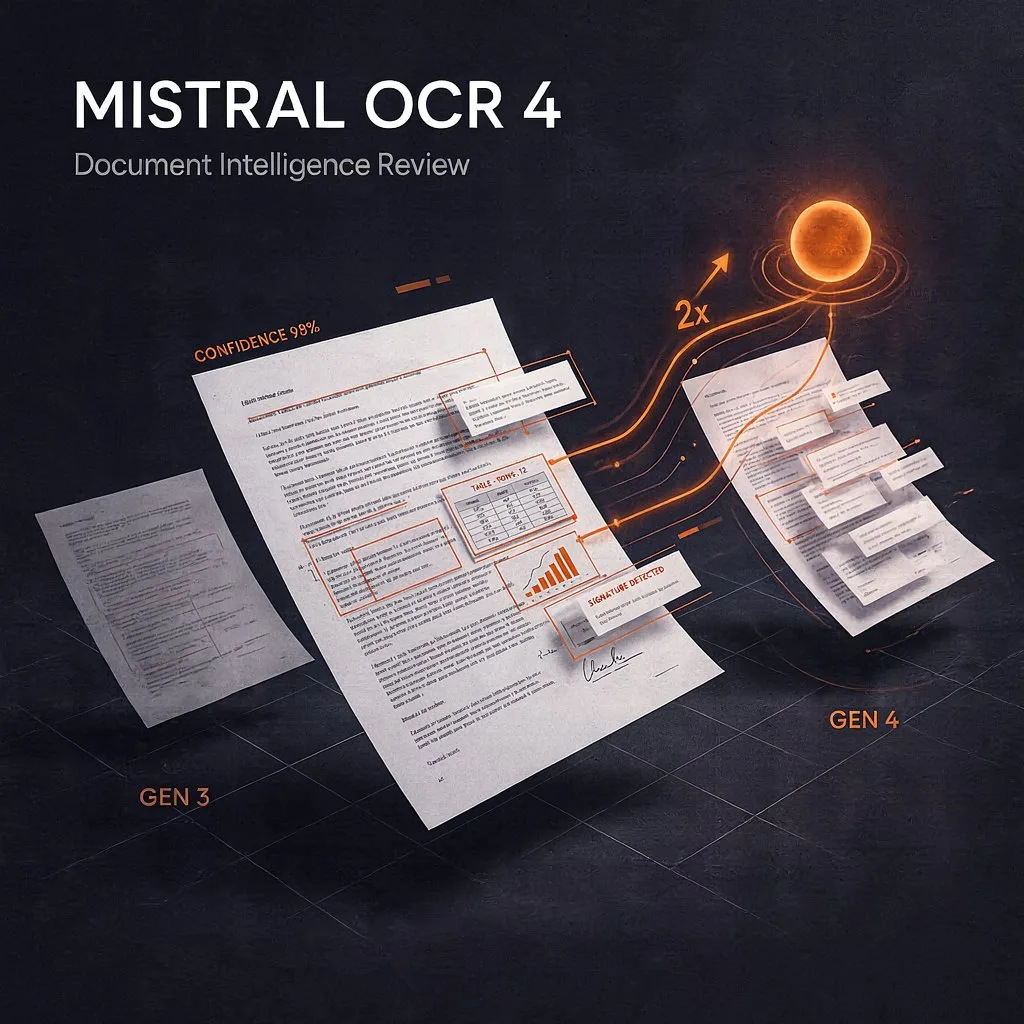
What justifies the increase, according to Mistral's own model documentation, is a real capability gap between the two generations. OCR 3's feature set covered text extraction, structured annotations, and batch processing — solid for high-volume plain-text extraction, but blind to where content actually sits on a page. OCR 4 adds paragraph-level bounding box extraction, letting a downstream system know not just what a document says, but exactly where each block of text or image sits, plus confidence scoring at multiple levels of granularity. That's a meaningfully different product for agentic and RAG pipelines that need spatial structure, not just transcribed text.
Features
Paragraph-level bounding boxes
New in OCR 4 and absent from OCR 3's official feature list — returns exact spatial coordinates for each block of extracted content, not just the transcribed text itself.
Multi-level confidence scores
Confidence scoring at page, word, and — as of the OCR 4.1 update — block granularity, letting a pipeline flag low-confidence regions for human review rather than trusting every extraction equally.
Block classification
Distinguishes content types within a document — separating body text, headers, tables, and figures — useful for downstream systems that need to treat different content types differently.
Multilingual document support
Built on Mistral's broader multilingual foundation, with reviewers reporting strong coverage across a wide range of scripts and languages, positioning it for global document processing rather than English-only pipelines.
Access runs through Mistral's developer platform, la Plateforme, via the /v1/ocr endpoint, with batch processing available through a separate /v1/batch endpoint for high-volume jobs. A Document AI studio mode is also available for non-developers who want to parse documents through a UI rather than writing API calls, and on-premises self-hosting is offered selectively for organizations handling highly sensitive or classified information.
Pricing
| Model | Standard OCR | Structured Annotations |
|---|---|---|
| OCR 4 / OCR 4.1 (current) | $4 / 1,000 pages | $5 / 1,000 pages |
| OCR 3 (previous generation) | $2 / 1,000 pages | $3 / 1,000 pages |
Both figures for OCR 4 and 4.1 are confirmed directly on Mistral's official pricing page and model documentation, and both versions carry the identical rate — the 4.1 update added a feature, not a price change. Batch inference is available through a separate API endpoint for high-volume processing; Mistral's own pricing page does not list a specific discounted batch rate for OCR 4 at the time of this review, so treat any third-party-quoted batch figure for OCR 4 specifically as unconfirmed until Mistral publishes one directly (OCR 3's batch rate, for comparison, was a confirmed 50% discount).
mistral-ocr-latest currently points to OCR 4.1, so any integration calling that alias is already running the newest version without a code change. Some third-party sources quote pricing in EUR (around €3.50/1,000 pages) rather than the $4 USD rate on Mistral's own page — the discrepancy reflects currency conversion and exchange-rate timing, not two different prices.Pros & Cons
Mistral OCR 4 vs AWS Textract vs Azure Document Intelligence
| Tool | Pricing model | Best for |
|---|---|---|
| Mistral OCR 4 | $4 / 1,000 pages, $5 annotated | Multilingual documents, mixed typed/handwritten scans, RAG pipelines needing spatial structure |
| AWS Textract | Usage-based, generally lower per-page for basic extraction | Teams already on AWS infrastructure wanting tight integration with existing cloud services |
| Azure Document Intelligence | Usage-based, tiered by feature set | Microsoft-stack teams needing prebuilt models for invoices, receipts, and forms |
| Self-hosted open-source OCR | Compute cost only, reported as low as $0.05-$0.10/1,000 pages on rented GPUs | High-volume teams with engineering resources to manage their own inference pipeline |
The comparison isn't a clean win for any single option. Developer commentary specifically flags Mistral OCR 4 as pricier than AWS Textract or Azure Document Intelligence for comparable basic extraction — by some estimates, more than double. Where Mistral's case gets stronger is on the specific tasks reviewers highlight it handling well: mixed handwritten-and-typewritten documents and degraded scans, areas where general-purpose cloud OCR services are reported to need more manual correction. Self-hosted alternatives sit at the far end of the cost spectrum, cheaper by a wide margin, but with accuracy and latency that aren't guaranteed to match a managed API without real engineering investment.
Who It's For
Choose Mistral OCR 4 if: your pipeline needs spatial document structure — bounding boxes, block classification, confidence scoring — for agentic workflows or RAG systems, or you're processing multilingual, degraded, or mixed handwritten/typed documents where general-purpose OCR services tend to need more correction.
Look elsewhere if: you only need basic plain-text extraction at the lowest possible per-page cost (AWS Textract or Azure Document Intelligence are reported cheaper for that use case), or you have the engineering capacity to run a self-hosted open-source OCR pipeline at a fraction of any managed API's price.
Expert Editorial Opinion
The most defensible thing about this release is that Mistral didn't disguise the price increase. Some vendors quietly restructure pricing around a version bump and let customers discover the new rate at billing time; here, the doubled rate is stated plainly on the same pricing page as the old one used to be, alongside a real, checkable feature difference — bounding box extraction wasn't in OCR 3's documented capabilities at all.
Whether that capability is worth paying for depends entirely on what a given pipeline actually needs. For a team just extracting plain text from PDFs, OCR 4's bounding boxes and confidence granularity are genuinely unused capability, and the Hacker News commentary bears that out — developers doing basic extraction are the ones pointing at AWS Textract's lower price. For teams building agentic document workflows or RAG systems that need to know not just what a document says but where each piece of content physically sits, that same feature set is closer to a requirement than a nice-to-have, and $4 per 1,000 pages is a genuinely small line item against the engineering cost of building bounding-box extraction in-house.
The unresolved question, at least from public information available at the time of this review, is batch pricing specifically for OCR 4. OCR 3 had a clearly documented 50% batch discount; OCR 4's documentation available as of this review doesn't state an equivalent figure. For high-volume users, that's worth confirming directly with Mistral before assuming the old discount pattern carries over automatically.
Final Verdict
Mistral OCR 4 delivers a real, confirmed capability upgrade over its predecessor — bounding boxes, block classification, and multi-level confidence scoring genuinely weren't there before — and the pricing is transparent rather than hidden behind a sales call. The score reflects a genuine fit question rather than a quality flaw: for teams that need the new spatial and confidence features, doubling the price is easy to justify; for teams doing basic text extraction, cheaper alternatives from AWS and Azure are a legitimate, well-documented objection worth taking seriously before committing.
❓ Frequently Asked Questions
🔗 Related ToolRadar Reviews
Official documentation and current pricing: docs.mistral.ai and mistral.ai/pricing/api. Given how recently OCR 4.1 shipped, verify current pricing and the active model alias directly before building a production pipeline around either.

Comments
Post a Comment