


Gemini 4 Argon vs Local AI: Is Google's New Model Worth Paying for Once the Intro Price Ends?
Google's newest reasoning model arrived at $2 and $10 per million tokens, then doubles on December 1. Here is what is confirmed, what is only claimed, and when running open models yourself still wins.
- What Gemini 4 Argon Is and Does
- Pricing: The Intro Rate Is Temporary
- Who Can Use It Today
- The Benchmarks: Wins and Losses
- Argon vs Running Models With Ollama
- Pros and Cons
- What Early Reactions Say
- Who Should Pay for It
- Expert Editorial Opinion
- Final Verdict
- Frequently Asked Questions
- Related Reviews
This Gemini 4 Argon review starts with a correction to the usual launch headline. Google's own announcement post is dated October 13, 2026 and says the model is globally available through the API from that day, but Argon was first announced on September 30 with access limited to Google's teams, the U.S. government's voluntary pre-release process, and vetted cybersecurity defenders in its Fairwind Program, according to The New Stack's coverage. So the people who tested it first were not the people who can buy it now.
For anyone deciding where to spend money, three things matter more than the superlatives. What does it cost once the introductory price expires on November 30? Which of Google's published benchmark results are wins and which are losses? And when is a closed model you rent a better choice than open models you run yourself, which is the trade-off behind tools like Ollama? We checked each figure against Google's own pages and scored the model with the ToolRadar weighted formula, with no claim of hands-on testing.

- Model ID, modalities, limits, and tool support come from Google's Gemini API model page; prices come from its pricing page, both read on October 15, 2026.
- Benchmark numbers, limitations, and safety notes come from the official DeepMind model card. Those are Google's own results, and the methodology page they link to was not part of what we read.
- Early reactions, access history, and disputes come from named third-party coverage and a Hacker News thread, linked where used. We did not run Argon ourselves, so we publish no speed, quality, or cost-per-task figures of our own.
What Gemini 4 Argon Is and Does
A reasoning model with adjustable effort
The API identifier is gemini-4-argon, listed as stable. You choose a thinking level of low, medium, or high, which trades answer quality against cost and time. Google positions it for complex, multi-step work in coding, finance, legal, cybersecurity, and science.
Many inputs, one kind of output
It accepts text, images, video, audio, and PDFs, and replies in text only. The documentation states that audio generation, image generation, and the Live API are not supported.
A one-million-token window, with a catch
The context window is 1,048,576 tokens, shared between input and output. By default a synchronous request can return up to 65,536 tokens; only the long-running mode with long decoding stretches output toward the full million. Third-party coverage calls the million-token output ceiling a figure "on paper", and it is unverified in practice.
Tools
Supported: code execution, file search, function calling, Google Search and Google Maps grounding, structured outputs, URL context, and agentic video understanding. Computer use is labeled "Supported (Preview)", so do not treat it as settled.
Three ways to buy it
Beyond standard calls, the Batch API, Flex inference, and Priority inference are all supported, each at its own price (see the table below).
Safety claims from Google
Google reports it evaluated Argon under its Frontier Safety Framework and cut attack success on a prompt-injection benchmark to 0.7%. The model card is franker about limits: it says the model may hallucinate, may be slow or time out, has a March 2026 knowledge cutoff, and that Google "cannot rule out" reaching some critical capability levels in biology and cybersecurity, with safeguards applied.
Pricing: The Intro Rate Is Temporary
The headline price is genuinely low for a frontier model, and it is also temporary. Prices below come from Google's pricing page, which states that Argon "is not available on the Free tier or on the Google AI Pro plan" for API use.
| Mode (per 1M tokens) | Through Nov 30, 2026 | From Dec 1, 2026 |
|---|---|---|
| Standard input | $2.00 | $4.00 |
| Standard output (includes thinking) | $10.00 | $20.00 |
| Cached input (implicit only) | $0.10 | $0.20 |
| Batch and Flex: input / output | $1.00 / $5.00 | $2.00 / $10.00 |
| Priority: input / output | $3.60 / $18.00 | $7.20 / $36.00 |
One detail worth catching: the cached-input rate also doubles, from $0.10 to $0.20, but both figures are 5% of the matching input price, so the roughly 95% caching discount survives in relative terms. Explicit caching is not supported at all. Treat the $2 and $10 as a promotional window, not as the price you will plan a product around.
Who Can Use It Today
Access depends on where you stand, and Google's pages describe it in layers.
- API developers: available through Google AI Studio and the Gemini API on the paid tier, per Google's launch post.
- Subscribers: Google AI Ultra subscribers can use it in Google Antigravity, and Ultra and Pro subscribers in the Gemini app and AI Mode in Search. Note the difference: the app access is a subscription feature, while the API docs exclude the Free tier and the Google AI Pro plan from API use.
- Enterprises: through Gemini for business and the API. Google's cloud announcement lists no regions and no data-retention or training terms, so a regulated team has questions to put to Google before sending sensitive data.
- Cyber defenders: vetted participants in the Fairwind Program get a version without cyber guardrails, on a rolling basis.
- Scientists: an application program offers six months of free access to Antigravity's top usage tier for up to 10,000 scientists, subject to eligibility and selection.
Neither Google's launch post nor its cloud post uses labels like "preview" or "generally available" for the model as a whole. The API page marks the model ID stable, and only computer use carries a preview label.
The Benchmarks: Wins and Losses
This is a sample from the official model card, with the best score in each row marked. It is Google's own table, as of October 2026.
| Benchmark | Gemini 4 Argon | GPT-6 Astra | Claude Opus 5.5 | Claude Fable 5.1 |
|---|---|---|---|---|
| Vals Index | 68.9% | 63.1% | 67.0% | 65.8% |
| AutomationBench | 51.3% | 41.4% | 42.5% | 31.4% |
| Harvey's Legal Agent Benchmark | 19.6% | 5.4% | 3.8% | 6.7% |
| DeepSWE v1.1 | 77.9% | 74.1% | 74.2% | 67.4% |
| FrontierSWE v2 | 55.0% | 65.5% | 62.3% | 56.3% |
| Terminal-bench 4.0 | 57.4% | 58.2% | 66.4% | 57.9% |
| Terminal-Bench Science 0.1 | 57.6% | 68.1% | 63.3% | 52.6% |
| GraphWalks, 256K to 1M (F1) | 84.2% | 71.8% | 66.8% | 65.0% |
| OSWorld-2.0, offline subset | 69.2% | 72.6% | — | — |
Across all 19 rows in the full card, Argon is best or tied on 14 and behind on five: FrontierSWE v2, Terminal-bench 4.0, PostTrainBench, Terminal-Bench Science, and OSWorld-2.0. The pattern is clear enough. Knowledge-work and long-context rows are where it pulls ahead, and the terminal and agentic-coding rows are where rivals lead. The New Stack's author rated its coding as "so-so" and knowledge work as excellent, while noting there was no independent hands-on testing behind that view, and pointed out that many leads are narrow and that some cyber comparisons mixed models with different agent harnesses.
So is it "the best model in the world"? No source we read supports that sentence as fact. Google says it ranks first on the Vals Index, which is one index among many, and the card's own table shows other models ahead on several tests. Read the numbers as a map of strengths, not a trophy, and remember none of them replace a trial on your own tasks.
Argon vs Running Models With Ollama
These two are not rivals of the same kind, and comparing them as if they were is the most common mistake. Argon is a closed model you rent over an API. Ollama is a runtime that runs open-weight models on your machine, and, for models too large to hold, on its own hosted infrastructure.
| Question | Gemini 4 Argon | Open models via Ollama |
|---|---|---|
| Where does it run? | Google's cloud, through an API | Your hardware, or Ollama's cloud for larger models |
| Per-token bill? | Yes: $2/$10 now, $4/$20 from Dec 1 | None for models on your own machine; hardware and power are your cost |
| Free tier? | No | The runtime is free; its cloud has a free plan with starter credits |
| Data leaves your machine? | Yes, every request | Not for local models |
| Context ceiling | 1M tokens (input plus output) | Set by the model and your memory; Ollama recommends at least 64k for agents |
Can Argon run on Ollama? We found no official statement that Argon's weights are available to download or run locally, and Ollama's own cloud-models page lists open models such as qwen3-coder, gpt-oss, and deepseek, with no mention of Gemini. So treat Argon as API-only. Google does ship an open family, Gemma, and Gemma 4 appears in Ollama's library, so a Google model on your own machine is possible. It is just a different and smaller product than Argon.
The choice then follows your constraints. If you need the strongest long-document reasoning and have no GPU, renting is rational. If privacy, a fixed monthly cost, or offline work matters most, open models you control are the better fit, as we explain in our guide to running AI agents 100% locally. Our review of Ollama covers the cost side of the local route in detail.
Pros and Cons
💡 What Early Reactions Say
Both comments date from announcement day, when access was still restricted, so they reflect the numbers and not real use. Together they capture the early mood: impressed by the table and the price, frustrated that few could try it. A harsher view comes from a report by Bloomberg, summarized by Android Headlines on October 1. It says some employees with model access found Argon strong on standardized tests but weaker on real-world coding and front-end design, and critics accused Google of tuning for the benchmarks. Google DeepMind's leadership rejected that, and the article reports no independent test settling it. We cannot resolve the dispute from documents, and you should not treat either side as proven.
Who Should Pay for It
✅ Choose Gemini 4 Argon if...
Your work is long documents, finance, legal analysis, or agent tasks that benefit from a huge context, and an API bill is acceptable. It also suits teams already inside Google's stack who can test it on real tasks before committing.
❌ Look elsewhere if...
You need data to stay on your own machine, you want a free tier, or your main use is terminal-style coding, where rivals lead in Google's own table. Our comparison of Claude Fable 5.1 and GPT-6 Astra and our guide to what AI subscriptions really cost are good next stops.
Expert Editorial Opinion
Argon is an unusually fresh product to judge, and that shapes everything we can responsibly say. It reached general API availability on October 13, two days before this review, so the independent record is thin: there is Google's launch post, Google's model card, a handful of press write-ups, and early forum reactions. What is missing is months of developers reporting what it does on messy real projects. The honest posture for a model this new is to ask whether it is worth following, not whether it is proven.
On that question, the evidence for strengths is real but self-reported. A model that tops 14 of 19 rows in its maker's table is clearly competitive, and the long-context lead is the part least likely to be an artifact of test design. The coding picture is murkier, with losses on the harder terminal and agentic tests and a public dispute about benchmark tuning. The sensible response is not to pick a side but to run your own five hardest tasks before moving any production traffic.
Now the pricing gap. The $2 and $10 rate is half the later $4 and $20, and Google's own pages say so. Anyone building a cost model on the introductory price is modeling a month that ends on November 30. For scale, an output of 1,048,576 tokens, the long-decode ceiling, costs about $10.49 now and about $20.97 after December 1, before counting input. Cheap per token can still be expensive per task when the model thinks at length.
Would it be worth paying for if there were no promotional rate and no free tier to ease you in? For long-document and knowledge-work jobs where a human would otherwise spend hours, plausibly yes. For casual chat, drafting, or code you could generate with a cheaper or local model, no, and the closed, cloud-only design makes that call easier for privacy-sensitive work.
The wider point is about how to read launches like this one. A table of wins and a list of caveats can both be true at once, and this model card has both, which is to its credit. We scored it as Strong with named caveats, and we will revisit the number when independent testing and a full pricing cycle give us something firmer than a launch week.
Final Verdict
Gemini 4 Argon sits at the bottom edge of the Strong band (8.0 to 8.9): recommended for long-context and knowledge-work tasks, with named caveats. The published results are impressive, the context window and pricing options are real, and the model card is candid. But the evidence is mostly Google's own, the coding story is contested, the price doubles on December 1, and the model is closed and cloud-only.
| Dimension | Weight | Score /10 | Why |
|---|---|---|---|
| Technical quality | 30% | 8.6 | Leads or ties on 14 of 19 published rows, but results are self-reported and coding is mixed. |
| Price-to-value | 25% | 7.9 | Low intro price and Batch/Flex options, offset by a doubling on Dec 1 and no free tier. |
| Maturity & documentation | 20% | 7.8 | Thorough docs and model card, but a days-old release with staged access and a preview tool. |
| Ceiling & flexibility | 15% | 7.6 | 1M context and many tools, but closed weights, API-only, and text-only output. |
| Honesty of positioning | 10% | 7.9 | Candid limits in the model card, against "frontier" framing and a benchmark-tuning dispute. |
Final score = (8.6 × 0.30) + (7.9 × 0.25) + (7.8 × 0.20) + (7.6 × 0.15) + (7.9 × 0.10) = 2.58 + 1.975 + 1.56 + 1.14 + 0.79 = 8.045, shown as 8.0 and not rounded up.
Would you rather rent the best model or own a good one?
Pick your three most expensive recurring tasks and run each once through Argon's API and once through an open model on your own hardware. Count minutes, dollars, and edits. The gap between the two columns, not the leaderboard, is what you are actually paying for.
❓ Frequently Asked Questions
🔗 Related ToolRadar Reviews
- Claude Fable 5.1 vs GPT-6 Astra: the frontier rivals Argon is measured against
- Ollama review: local AI is free, but your hardware is not
- How to run AI agents 100% locally
- What ChatGPT, Claude, Devin and more really cost
- Google Gemini in 2026: the assistant side of the family
Official sources: Google's announcement · Gemini API docs · DeepMind model card
Muse Wonder vs Gemini: Which AI Agent Is Actually Better in 2026?
Meta and Google launched their newest agent models a day apart. We lined up prices, plans, benchmarks, and safety records to see where each one really stands, and where nobody has proof yet.
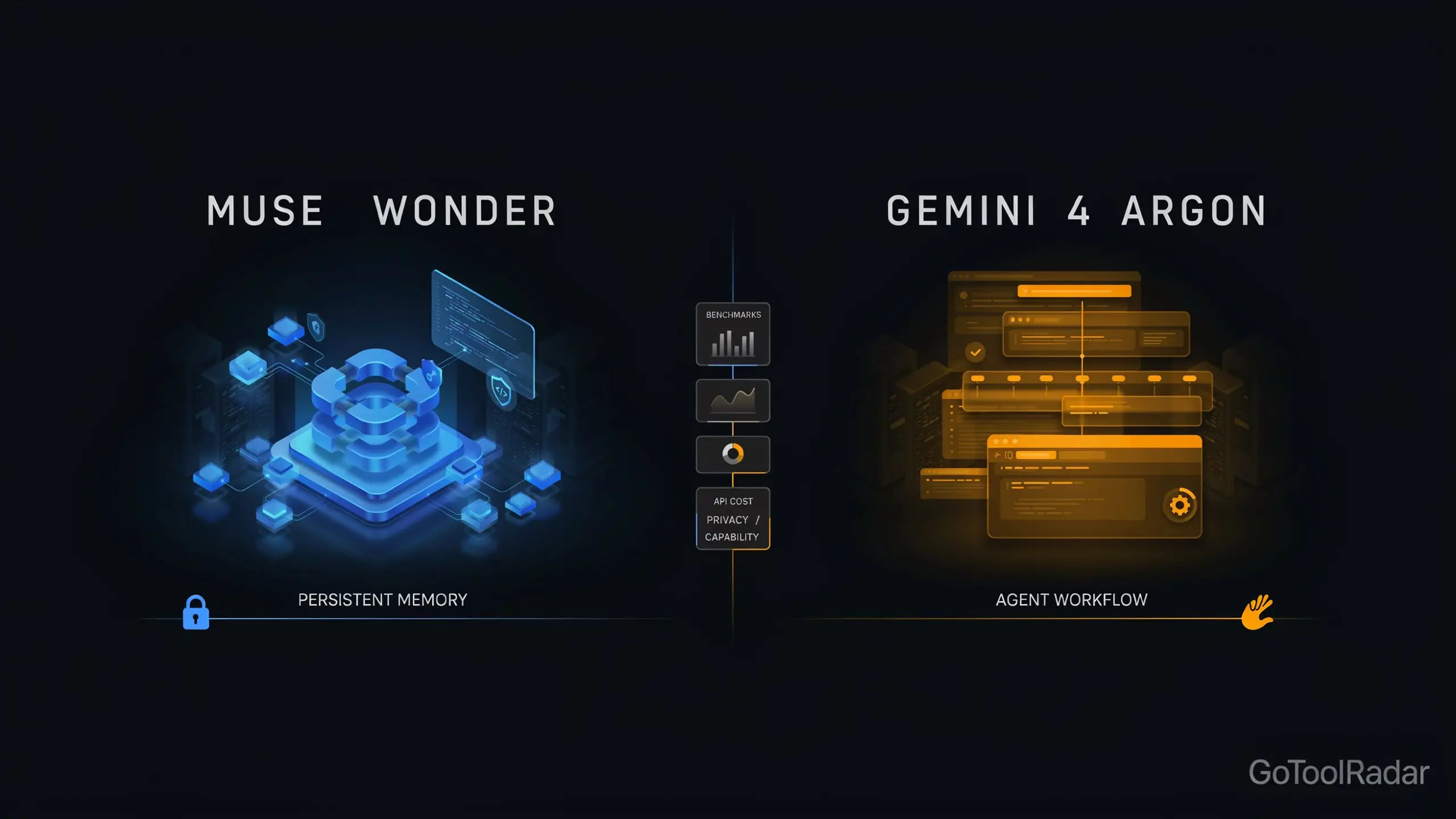
The Muse Wonder vs Gemini question arrived with unusually bad timing for anyone trying to answer it. Meta announced Muse Wonder on October 12, 2026, and Google's post making Gemini 4 Argon broadly available followed on October 13. Both are pitched at agents, meaning software that keeps working on a goal instead of answering one prompt, and both come with big benchmark claims. Neither company compared itself with the other.
So a "which is better" verdict has to be built from pieces, and some pieces are missing. This comparison covers what each model is, what you pay, what the surrounding agent products do, where the evidence is thin, and what the privacy and security records say. We read each company's own pages, then checked named third-party coverage, and scored both with the ToolRadar weighted formula. We did not run either model.
- Meta's side comes from its announcement, its research post and model card, and its developer docs for pricing, models, and Muse Code subscriptions, read on October 17, 2026.
- Google's side comes from its Gemini 4 Argon launch post, the Gemini API model page, and its AI plans page, plus the API prices we verified on October 15. Benchmark figures are each company's own unless we name another source.
- Reactions, incidents, and independent rankings come from named outlets and Hacker News threads, linked where used. We ran neither model, so we publish no speed, quality, or cost-per-task measurements of our own. Where we do arithmetic, we say so.
What Each One Is (the Names Are Confusing)
Most of the confusion comes from vocabulary, so it helps to pin down what is actually being compared. Neither Muse Wonder nor Gemini 4 Argon is an app. Each is a model, and the "agent" part lives in the products wrapped around it.
- Muse Wonder (
muse-wonder-1.0) is Meta's new model. It has a 1,048,576-token context window, accepts text, images, video, audio, and PDFs, and replies in text. Meta's developer docs list it on the Meta Model API with a Preview label, and it is also available in Muse Code, Meta's terminal coding agent. - Muse Wonder Full is the larger variant. It is sold only through the higher Muse Code plans, and Meta's model page lists it as not available on the API.
- Muse is Meta's personal agent app. Meta says Wonder "will soon" power experiences there, rolling out first to subscribers. That has not happened yet.
- Gemini 4 Argon (
gemini-4-argon) is Google DeepMind's model, with the same 1,048,576-token limit shared between input and output, and text-only output. It was first announced on September 30 with limited access, and Google's October 13 post made it available globally through the API. - Gemini the product is the app, Antigravity, and the other places Google puts the model, covered below.
That asymmetry matters. Argon already sits inside consumer and developer products people can open today. Muse Wonder is reachable by developers and Muse Code subscribers, while its flagship consumer role is still a promise. We covered Meta's earlier coding agent in our Muse Code review, which predates Wonder and its new plan structure.
What They Cost
The only prices that line up exactly are the two API rates, and they are closer than the headlines suggest. Meta's pricing page lists Muse Wonder at $4.00 per million input tokens, $0.20 for cached input, and $20.00 for output, with reasoning tokens billed as output. Google's Argon rate is half that until November 30, then identical.
| Route | Muse Wonder | Gemini 4 Argon |
|---|---|---|
| API, input / output per 1M tokens | $4.00 / $20.00 (cached input $0.20) | $2 / $10 through Nov 30, 2026; $4 / $20 from Dec 1 (cached $0.10, then $0.20) |
| Free route | None found in the pages we read | Free Gemini plan does not list Argon; Google says Argon is not on the API Free tier |
| Entry subscription | Muse Code Everyday, reported at $5 a month: Wonder, not Full | Google AI Pro, $19.99 a month: Argon in the Gemini app and AI Mode |
| Top subscription | Muse Code Power and Maximum, reported at $50 and $200 a month: include Wonder Full | Google AI Ultra, from $99.99 a month (a $199.99 tier is also listed) |
A few details change how those rows read. Meta's subscriptions page shows no prices, since they appear at checkout, so the $5, $15, $50, and $200 figures come from DataCamp and eesel quoting Meta's pages. The page does give the allowances: Everyday covers roughly 10 to 50 prompts every five hours, High is 5 times that, Power 20 times, and Maximum 80 times. Subscriptions also default to Contributor mode, where Meta may train on your content, and you can switch it off for future content.
On Google's side, the plans page lists Argon under Pro and Ultra, but the launch post names Ultra for Argon inside Antigravity, while the plans page lists entry-level Antigravity limits on Pro. Check what your plan includes before paying for the Argon part. One outlet also reported $20 and $100 Muse app subscriptions at launch, but we found no confirmation on Meta's own pages, so treat that as unconfirmed.
What the Agents Can Actually Do
This is where the two companies describe their products most differently. Meta leads with memory and persistence. Google leads with skills, scheduling, and developer tooling. Everything below is as the companies describe it, not as we tested it.
Muse Wonder: Active Memory
Carries what matters to you across conversations and brings back relevant details. It is the clearest memory claim either company makes, and it is exactly the feature that raises the privacy questions covered below.
Muse Wonder: Active Focus
Meant to keep working toward a goal when a task gets hard: trying other approaches, recovering from errors, asking for clarification, and checking in before anything important.
Muse Wonder: demos and Muse Code
Meta's research post shows the model working in a browser and across apps, for example building a running plan, ordering custom swag from Instagram photos, and making a wedding seating chart. These are demos. The post does not mention MCP. Muse Code is the part you can use today.
Gemini: skills and scheduled tasks
Google's example turns a project folder into a client proposal deck, emails it, and sets up an automated workflow with a scheduled task. Its launch post does not mention memory or personal context for Argon.
Gemini: Antigravity
Google's developer environment supports slash commands like /goal and multi-agent loops with custom skills. Google says its own teams raised agentic code submissions by more than 35%, a company-reported figure.
Gemini: the rest of the plan menu
Google's plans page lists Agent Mode (in the Ultra FAQ), Chrome auto browse and Jules on Pro and Ultra, and Tasks in Gemini on Ultra in select countries. In the API, Argon supports function calling, code execution, search grounding, and computer use, which is still labeled Preview.
Put simply, Gemini has more agent surfaces you can open right now, and Meta has a more explicit memory story that is not yet in its main consumer app. If the question is "which agent can I use this afternoon", Google has the edge on availability. If it is "which one will remember me", Meta has made the louder promise. For how Google's assistant has evolved, see our overview of Gemini in 2026.
The Benchmark Problem: Different Yardsticks
You will find confident rankings online, so here is the uncomfortable part. Meta's model card names GPT-6 Astra, Claude Fable 5.1, and Claude Opus 5.5 as its comparison models. Google's model card compares Argon against the same three. Neither card includes the other company's model, and most of the benchmark names do not match, or match only by name while using different versions or harnesses.
BenchLM, an aggregator, found three benchmarks that appear under the same name for both Argon and Muse Wonder Full as of October 15. The results split:
- Finance Agent v2: Argon 65.4%, Wonder Full 59.1%. Argon ahead.
- DeepSWE: Argon 77.9%, Wonder Full 79.0%. Wonder Full ahead.
- MazeBench (ASCII mode): Argon 12%, Wonder Full 1%. Argon ahead, on a puzzle benchmark that tells you little about office work.
On a broader index, Artificial Analysis rates Muse Wonder Full at about 56, ahead of Argon at 52.6 and standard Muse Wonder at 52.4, according to TrendingTopics and DataCamp. It is worth reading that carefully. The model at the top of that comparison is the one with no API access and a $50 minimum subscription. The model you can call by API is Muse Wonder standard, which lands about level with Argon.
The caveats are Meta's own. Its model card says competitor runs were "best-effort" and may not be optimally tuned for proprietary models, and it calls its SWE-Marathon comparison not a controlled one. DataCamp notes that Wonder Full fully completes only 39.4% of OSWorld V2.1 tasks, even though its partial-credit score is 78.4. On Google's side, there is a public dispute about whether Argon is tuned to benchmarks, which we covered in our Gemini 4 Argon review. Hacker News commenters raised the same suspicion about Meta's results, and nobody has settled it with independent hands-on testing.
Side by Side
| Question | Muse Wonder | Gemini 4 Argon |
|---|---|---|
| Released | October 12, 2026 | Announced Sept 30 with limited access; API open Oct 13 |
| Status label | Meta's models page says Preview | Model ID listed as stable; computer use is Preview |
| Context window | 1,048,576 tokens | 1,048,576 tokens, shared between input and output |
| Output | Text only | Text only |
| Strongest tier | Wonder Full: subscription only, no API | No separate tier; highest access on Ultra plans |
| Agent products today | Muse Code; Muse app support promised "soon" | Gemini app skills and tasks, Antigravity, Agent Mode, Chrome auto browse |
| Named memory feature | Active Memory | Not described in the launch post |
| Your data and training | Subscriptions default to Contributor mode; API is Standard only | Not spelled out in the pages we read |
| Weights | Not released; Meta has not said whether it will open them | Closed |
| Independent evidence | Thin; one index and aggregator rows | Thin; same sources |
Privacy, Security, and Safety Records
For agents, the model's IQ matters less than what it is allowed to touch. An agent that reads your inbox and acts on your behalf is only as safe as its permissions, its data handling, and its resistance to being tricked. Here is what is on the record.
On Meta's side, the record involves the Muse app, the agent that Wonder is due to power. In September, The Information reported, via a Reuters story carried by KSL, that an outside researcher had found a flaw in Muse that could let an attacker reach a user's dedicated cloud machine, which holds data such as emails and files. An internal incident report rated it SEV-2, the third-highest of five levels, and Meta said it was adding a clearer safety warning. One outlet reports Meta later patched it, but we could not confirm that from a second source.
On October 9, Atlanta News First reported that Muse offers to sync Gmail and Facebook on first launch, that its default setting shares user information for learning according to Meta's Help Center, and that deleting a conversation does not erase what Muse learned from it, though users can reset it or ask it to forget topics. The same story cites reports from Yahoo Finance and Inc.com that Muse shared a user's home address with a stranger and read private messages unprompted. We have not verified those incidents, and Meta says it is investigating.
Google's record is shorter, and mostly its own claims. The launch post says Argon cut attack success on the Gray Swan indirect prompt-injection benchmark to 0.7%, that shortcut attempts on coding benchmarks fell to 2%, and that an automated monitor reads the agent's reasoning and actions in real time. Those are company-reported results with no independent check we could find. Google's cloud announcement also lists no data-retention or training terms, so a regulated team has questions to ask before connecting sensitive data.
Neither side wins this section outright. Meta has a documented incident history and a consent default that favors learning, and Google has a clean-looking record that rests largely on its own statements.
💡 What Early Users Say
The first commenter says they paid for a month of Meta's coding product, so it is the only first-hand view of the three, and it is one person's experience. The second reflects a real change: DataCamp and eesel cite Muse Spark 1.3 at $1.25 input and $4.25 output, so Wonder's $4 and $20 is a large step up for Meta. The third comes from Argon's announcement day, before general access, so it speaks about the numbers and not real use.
DataCamp adds anecdotal developer reports that are worth treating as exactly that: one tester's 3D project reportedly cost about $4.11 in API-equivalent tokens and produced a weaker result than Claude Opus 5.5, and another early user said a few small requests used about half of an entry plan's five-hour limit. None of this is controlled testing.
Which One to Pick
Pick Gemini 4 Argon if: you want an agent you can use now, inside products you may already pay for, with a lower API price until November 30 and a clearer set of agent surfaces. It also suits long-document and knowledge-work jobs where Google's published numbers are strongest, and teams already in Google's stack. Test it on your own tasks before committing.
Pick Muse Wonder if: persistent memory is the feature you care about and you are willing to wait for the Muse app rollout, or you are a developer who wants a second frontier model on a separate API at a flat $4 and $20. It is also the one to watch if Wonder Full's standing on independent rankings holds up. Think twice if you handle sensitive data, or live somewhere Meta's regional policy may restrict access.
Expert Editorial Opinion
Two frontier launches in two days, with no shared yardstick, is the real story here. When both companies grade themselves against a third set of rivals, a head-to-head winner does not exist yet, and anyone declaring one is relying on the three overlapping rows and one index that we also read. Those rows split, and the index puts the strongest Meta model, the one you cannot call by API, a few points ahead of Argon, with the callable model roughly level. That is a fair fight, not a knockout, and it comes entirely from numbers the vendors or aggregators supplied.
What separates the two today is not intelligence but shipping status. Argon is in the Gemini app, in Antigravity, and in a stable API with documented tools. Muse Wonder is a Preview API, a coding CLI, and a promise about the Muse app. For an agent, which has to be wired into your accounts and your work to be useful, being available is a capability in its own right. This is the stage where a new tool's product layer matters more than its benchmark row.
Now the pricing gap. Until November 30, Argon costs half what Wonder does, and the two become identical afterward at $4 and $20 per million tokens. For a job that sends one million input tokens and returns 100,000 output tokens, that means $3 on Argon now and $6 later, against $6 on Wonder throughout. The more consequential gap is the one on the subscription side: the version of Wonder that tops independent rankings needs a $50 plan, which is not a number you can compare with a token price at all.
Would either be worth paying for with no free tier to ease you in? For developers whose work is long, tool-heavy, and costly in human hours, plausibly yes, but only after a trial on real tasks, since neither company has independent hands-on evidence behind its claims. For casual use, a free assistant still covers most needs, and the agent premium is hard to justify. For anything involving personal accounts, Meta's current incident record and its learning-by-default setting give us more pause than any benchmark gap does.
Our scoring reflects this. We ranked Gemini 4 Argon ahead mainly on maturity, availability, and pricing, not on proven capability, and we kept Muse Wonder in the competent band with a clear path upward. That path runs through three things we will be watching: Wonder reaching the Muse app, Meta's full safety report, and the first serious independent head-to-head tests of both models on agent work.
Final Verdict
Gemini 4 Argon (8.045, shown as 8.0) lands at the bottom edge of the Strong band: recommended with named caveats. Muse Wonder (7.45) sits in the Competent but compromised band: suitable for a specific user, not for the majority yet. Argon leads because it is available, documented, and cheaper in the near term. Muse Wonder is a credible challenger whose weakest points are maturity and its privacy record, both of which can change.
| Dimension | Weight | Muse Wonder | Gemini 4 Argon | Why |
|---|---|---|---|---|
| Technical quality | 30% | 8.2 | 8.6 | Both self-reported. Wonder Full leads one independent index but has no API; callable Wonder is about level with Argon, which wins or ties most rows on Google's card. |
| Price-to-value | 25% | 7.2 | 7.9 | Argon is half price until Nov 30, equal after. Wonder's best model needs $50 or more, with anecdotal reports of heavy token use. |
| Maturity & documentation | 20% | 6.9 | 7.8 | Wonder is Preview, with a model card lacking score tables, a pending safety report, and Muse app incidents. Argon has a stable ID and live products. |
| Ceiling & flexibility | 15% | 7.4 | 7.6 | Both closed and text-only with 1M windows. Wonder Full is off the API and Meta's regional policy limits access; Argon's computer use is still Preview. |
| Honesty of positioning | 10% | 7.0 | 7.9 | Meta's post gives no numbers and subscriptions default to training; both model cards admit limits, and Google's tuning dispute is unresolved. |
Muse Wonder = (8.2 × 0.30) + (7.2 × 0.25) + (6.9 × 0.20) + (7.4 × 0.15) + (7.0 × 0.10) = 2.46 + 1.80 + 1.38 + 1.11 + 0.70 = 7.45. Gemini 4 Argon = (8.6 × 0.30) + (7.9 × 0.25) + (7.8 × 0.20) + (7.6 × 0.15) + (7.9 × 0.10) = 2.58 + 1.975 + 1.56 + 1.14 + 0.79 = 8.045, shown as 8.0 and not rounded up. The Argon sub-scores match the ones we assigned in our standalone Argon review.
❓ Frequently Asked Questions
🔗 Related ToolRadar Reviews
- Gemini 4 Argon review: the $2 price tag and what happens after it
- Muse Code review: Meta's first coding agent
- Claude Fable 5.1 vs GPT-6 Astra: the frontier rivals both models cite
- Google Gemini in 2026: the assistant side of the family
- 5 AI agents that claim to work alone: how far it goes
- What ChatGPT, Claude, Devin and more really cost
Official sources: Meta's Muse Wonder announcement · Meta research post · Meta API pricing · Google's Gemini 4 Argon post · Gemini API docs · Google AI plans
Comments
Post a Comment