


Muse Code vs. Claude Code and Codex: Is Meta's New AI Agent Actually Cheaper?
Muse Code scores 7.0/10 in ToolRadar's launch-day review — Meta's first dedicated AI coding agent, released in beta today to compete directly with Claude Code and OpenAI Codex, evaluated against official company statements and day-one press coverage.
Comprehensive review based on official company documentation and day-one press coverage; this is not yet a hands-on, extended-use review.
Meta announced Muse Code today, its first dedicated AI coding agent, aimed squarely at the category Anthropic's Claude Code and OpenAI's Codex currently lead. CEO Mark Zuckerberg posted the announcement himself, and AI chief Alexandr Wang, who leads Meta Superintelligence Labs, framed the pitch to the Wall Street Journal around cost rather than raw capability: "an incredibly good option, especially from a cost perspective."
Muse Code is a terminal-only agent — no dedicated app, unlike some competitors in the space, similar in spirit to how ToolRadar found Claude Code operating primarily through the command line before voice-control layers got bolted on top. It installs with a single command on macOS or Linux, is powered by Meta's new Muse Spark 1.2 model co-trained specifically for the agent, and can fan a large task out into multiple sub-agents working in isolated worktrees simultaneously. Meta says internal testing had it build six features for a game at once with zero collisions — a specific, checkable claim rather than a vague one, though it comes from Meta's own testing rather than an independent benchmark. This review covers what's actually been announced, the real pricing tradeoff buried in the fine print, and why zero independent reviews exist yet for a product that's hours old.
What Is Muse Code?
Muse Code is Meta's first standalone AI coding agent, released today in public beta for macOS and Linux. It runs entirely from the terminal — install with one command, then hand it a coding task, and it plans changes, writes code, and validates the results across a repository. Meta says it's built specifically to handle "complete software engineering tasks across large repos," and it's powered by Muse Spark 1.2, a coding-focused model the company says was co-trained alongside the agent itself for tighter integration between model and harness. This is Meta's most direct challenge yet to Anthropic's Claude Code and OpenAI's Codex, arriving under AI chief Alexandr Wang, who also oversaw Meta's replacement of Llama with the Muse Spark model family earlier in 2026.
Key Features
Parallel Sub-Agents in Isolated Worktrees
When a task is large enough, Muse Code splits it into separate sub-agents that work simultaneously in isolated worktrees rather than one agent working through a task serially. Zuckerberg described this directly in his announcement: "Your working copy is never touched. In testing we had it build six features for a game simultaneously with no collisions." That's a specific, testable claim about parallel execution without merge conflicts, though it's Meta's own internal test rather than something reproduced by an outside reviewer. For a large repository where several independent changes are needed at once — say, six small feature branches for a shipping game — this parallel approach could meaningfully cut wall-clock time compared to an agent handling one change, then the next, in sequence.
Persistent Background Agents With Crash Recovery
Muse Code keeps a local event log recording every model call, tool use, approval, and edit, which lets a session resume after a crash instead of losing all progress. Built-in commands let a developer generate a plan up front, stress-test that plan before committing to it, or tell the agent to keep working toward a stated goal across a longer session. This kind of audit trail matters for trust in an agent making unattended changes across a codebase — you can trace exactly what happened and when, rather than treating the agent's output as a black box.
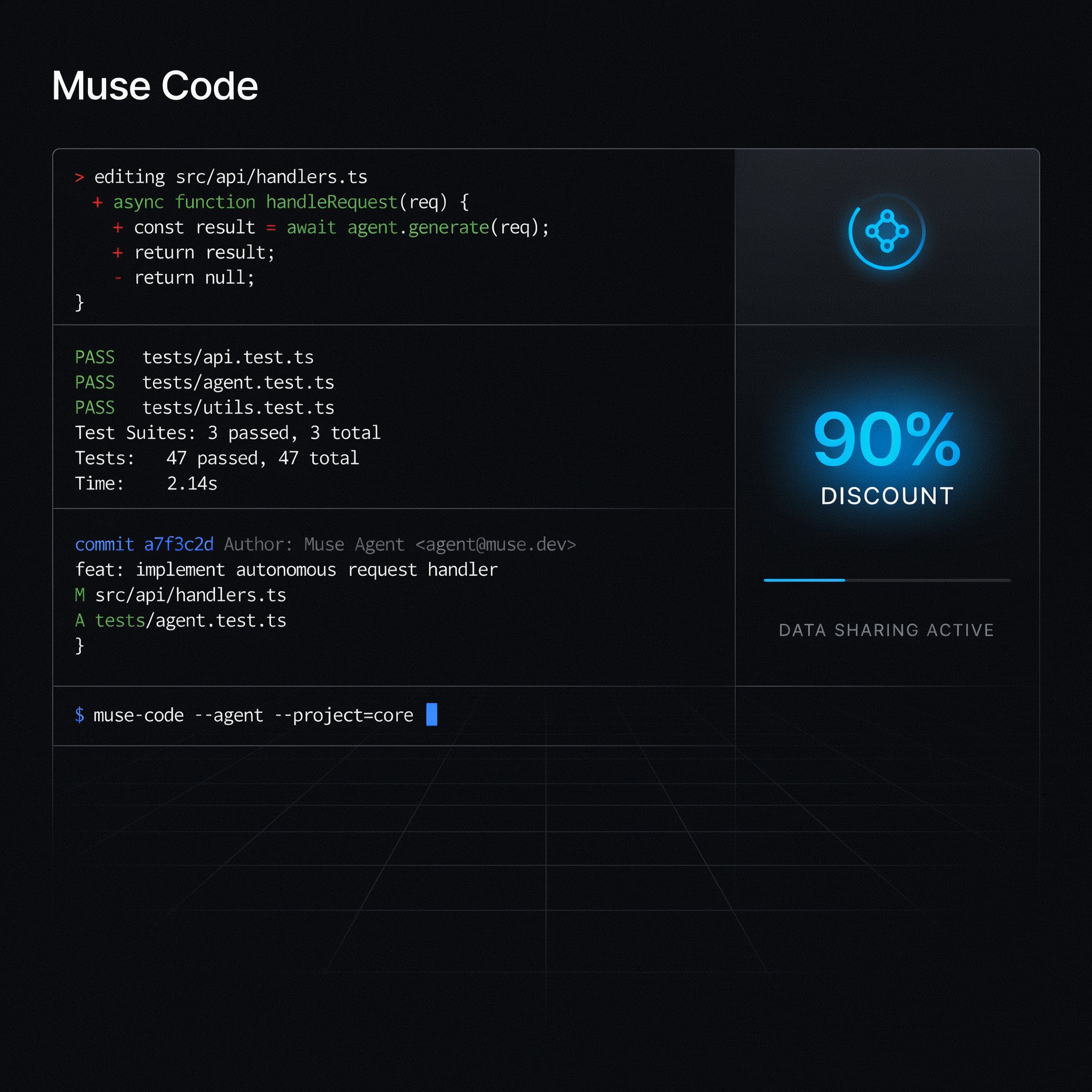
Pay-As-You-Go API, or a 90% Discount for Your Data
Standard access runs on the same pay-as-you-go API pricing as Muse Spark 1.1: $1.25 per million input tokens, $4.25 per million output tokens. Meta also offers a steeply discounted "contributor tier" that cuts costs by more than 90% in exchange for sharing usage data back to the company. That's a real, explicit tradeoff worth weighing carefully — Meta's track record on aggressive data collection across its consumer products is well documented, and a 90%-off coding agent that trains on your actual codebase and prompts is a meaningfully different privacy proposition than Claude Code or Codex's standard commercial terms.
Terminal-Only, No Dedicated App
Unlike Claude Code and Codex, Muse Code currently has no dedicated app interface — it's terminal-only, on macOS and Linux, with no Windows support mentioned at launch. For developers who already live in the terminal, that's a non-issue. For anyone who prefers a GUI, or who's on Windows, this is a genuine, immediate limitation rather than a minor rough edge, and it's worth checking whether Meta ships broader platform support before assuming this fits your existing setup.
Muse Code Pricing
| Access Type | Price | What's Included |
|---|---|---|
| Standard API | $1.25 / $4.25 per 1M tokens | Input / output pricing, same rate as Muse Spark 1.1 |
| Contributor Tier | 90%+ discount | Requires sharing usage data back to Meta |
| Installation | Free | Single-command install; you pay only for API usage |
ToolRadar has no affiliate or sponsorship relationship with Meta — the link above goes directly to Meta's official AI site.
Pros and Cons
✓ What Works
- ✅ Backed by one of the best-resourced AI labs in the world, with a model (Muse Spark 1.2) purpose co-trained alongside the agent
- ✅ Parallel sub-agent execution in isolated worktrees is a genuinely useful design for large, multi-part changes, if Meta's internal test holds up under outside use
- ✅ Local event log with full audit trail and crash recovery, rather than an unaccountable black box
- ✅ Standard API pricing is transparent and matches Meta's existing published rates, not a mystery credit system
✗ What to Watch For
- ❌ The steep contributor-tier discount requires sharing your usage data with a company known for aggressive consumer data collection — a real privacy tradeoff to weigh, not a minor footnote
- ❌ No dedicated app interface and no Windows support at launch, a real gap against Claude Code and Codex for anyone outside a terminal-first, macOS/Linux workflow
- ❌ Every capability claim so far, including the six-features-no-collisions test, comes from Meta itself — there are zero independent reviews or third-party benchmarks yet, since this launched hours ago
💡 What's Being Said About the Launch
Muse Code vs. Competitors
| Tool | Interface | Pricing Model | Track Record |
|---|---|---|---|
| Muse Code | Terminal only, macOS & Linux | $1.25/$4.25 per 1M tokens, or 90% off for data sharing | Launched today, zero reviews |
| Claude Code | Terminal + IDE integrations | Included in Claude subscriptions or API usage | Established, widely adopted |
| OpenAI Codex | CLI + app + IDE extension | Included in ChatGPT plans or API usage | Established, widely adopted |
Setup and Learning Curve
Installation is a single terminal command on macOS or Linux, consistent with how most coding agents in this category onboard developers. Since Muse Code launched only hours ago, there's no independently documented account yet of how the actual day-to-day experience compares to Claude Code or Codex once you're past installation — built-in commands to generate a plan, stress-test it, or work toward a goal are described by Meta, but how intuitive that workflow feels in practice is something only real, extended use will settle.
Who Should Use Muse Code?
Best For: Terminal-first developers on macOS or Linux working in large repositories with genuinely parallelizable tasks, who are already comfortable evaluating a day-one beta from a major vendor and want to test Meta's cost-per-token pricing against what they're currently paying Anthropic or OpenAI.
Look Elsewhere If: You're on Windows (not supported at launch), you want a GUI rather than a terminal-only workflow, you're not comfortable with Meta's data practices even at a steep discount, or you'd rather wait for independent reviews and real-world benchmarks before trusting a coding agent with production code.
Expert Editorial Opinion
Meta arrives late to this category but not unprepared. Co-training Muse Spark 1.2 specifically alongside the agent, rather than bolting an agent harness onto a general-purpose model after the fact, is a real technical decision that Anthropic and OpenAI both made early with their own coding-specific model work — Meta following that same playbook is a credible signal, not just marketing framing.
The parallel sub-agent design is the most interesting technical claim here, and it's specific enough to be falsifiable: six features built simultaneously in isolated worktrees with zero collisions. If that holds up under independent testing on messier, real-world codebases rather than Meta's own controlled demo, it would be a genuine capability edge for large-repo work. Right now it's an unverified company claim, which is a normal state for a same-day launch, not a red flag by itself.
The contributor-tier pricing is where this review gets most cautious. A 90%-plus discount in exchange for sharing your usage data is a steep enough incentive that plenty of developers and companies will take it without fully weighing what "usage data" includes for a coding agent — potentially prompts, code context, and patterns from real, possibly proprietary codebases. Given Meta's well-documented history with consumer data collection, this is a tradeoff worth reading the actual terms on rather than assuming it's equivalent to a typical enterprise discount.
On pure sticker price, standard API access at $1.25/$4.25 per million tokens is a published, comparable rate rather than a mystery credit system, which is a point in Muse Code's favor for transparency. Whether it's actually cheaper in practice than Claude Code or Codex for a real workload depends on token efficiency per completed task, which no independent source has measured yet — a lower per-token price doesn't automatically mean a lower total cost if the agent needs more tokens to reach the same result.
Is it worth trying today, hours after launch? For a terminal-first developer already paying for Claude Code or Codex API access, running a real task through Muse Code's standard tier costs little more than the API usage itself, and comparing the actual output quality and cost on your own codebase is more informative than anything in this review or Meta's own announcement. The contributor tier's discount is tempting but deserves a genuine read of the data-sharing terms before opting in, not a reflexive yes for the 90% savings.
Final Verdict
Muse Code is a credible, well-resourced entry into a category Meta was late to, backed by a purpose co-trained model and a technically specific parallel-execution claim that, if it holds up, would be a real differentiator for large-repo work. It launched hours before this review was written, which means every capability claim here comes from Meta itself, not independent testing, and that's the single biggest reason to treat this as a launch analysis rather than a verdict on real-world performance. The pricing story is genuinely two-sided: transparent, published per-token rates on one hand, and a steep discount tied to sharing your usage data with Meta on the other — read that tradeoff carefully rather than defaulting to the cheaper option. Worth testing against your current coding agent on a real task; too early to switch your whole workflow over on launch-day claims alone.
Technical Quality: 7.8/10 · Price-to-Value: 7.5/10 · Maturity & Documentation: 5.0/10
🔗 Related ToolRadar Reviews
More tools from AI Coding Agents
- Devin AI 2026: The End of Junior Developers?
- Forget GitHub Copilot, Cursor 3 Just Launched
- The Devin Killer: Why Open-Source AI Is Catching Up
- v0.dev vs Bolt.new vs Cursor: Which AI Coding Tool Wins?
- Devin Costs Hundreds, OpenHands Costs Less
- I Controlled Claude Code With My Voice
- Beyond the Hype: Google ADK 2026 AI Agent Framework
- Can an AI Agent Really Replace Your Job?
❓ Frequently Asked Questions
Already paying for Claude Code or Codex and curious if Meta's cheaper claim holds up?
Run one real task through Muse Code's standard tier and compare the actual token cost yourself — that will tell you more than any launch-day claim, including this review.

Comments
Post a Comment