


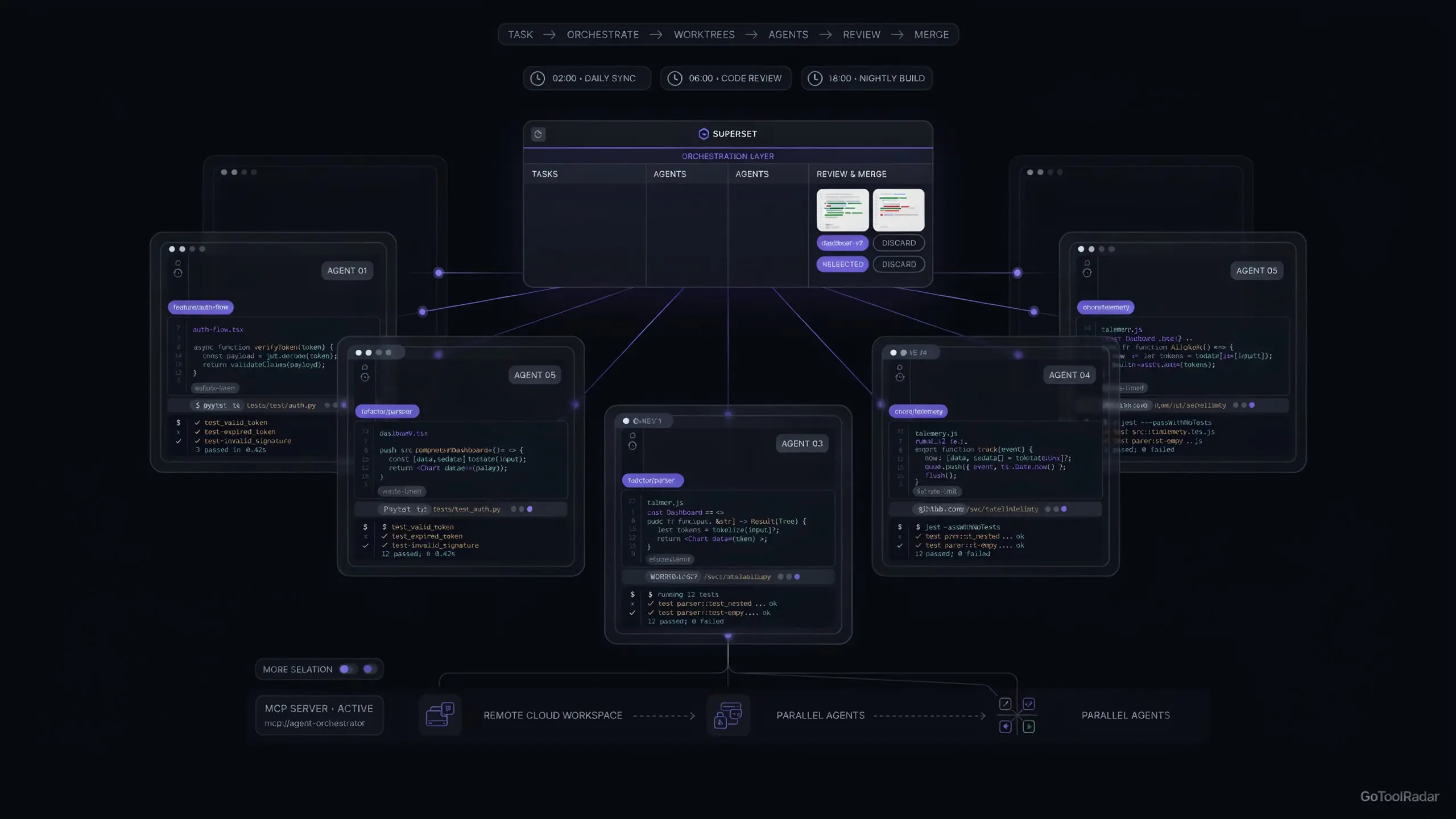
Superset Review 2026: The Orchestrator Turning AI Coding Agents Into a Parallel Team
Superset review 2026: run Claude Code, Codex, Gemini CLI, OpenCode, Cursor Agent, and more in parallel with isolated Git worktrees, remote workspaces, automations, and an MCP server — pricing, licensing, and the bottleneck the company itself admits isn't solved yet.
Superset review 2026: Claude Code can code. Codex can code. Gemini and Copilot and Cursor Agent can all code. Superset isn't trying to build another one — it's building the layer underneath them, giving every agent its own isolated Git worktree, branch, and terminal, then letting developers run several agents on the same codebase simultaneously, compare their output, and merge the useful pieces. The pitch is simple: stop waiting for one AI developer to finish, and start managing a team of them.
The harder question — one Superset's own team has raised publicly — is whether humans can actually keep up with reviewing what that team produces. This review covers both the genuinely clever infrastructure (worktree isolation, agent-neutral support for 15+ coding agents, MCP server, remote workspaces) and the real caveats: a cost structure that doesn't include the agents themselves, a young company still building a track record, and a license that isn't quite what "open-source" implies in casual coverage.

What Superset Actually Does
Isolated Git worktrees
Each agent gets its own worktree and branch rather than sharing one working directory — so running Claude Code and Codex on the same repo at once doesn't mean one overwrites the other's changes.
Agent-neutral support
Works with Claude Code, Codex, Gemini CLI, OpenCode, GitHub Copilot, Cursor Agent, Grok Build, Devin, and more — Superset manages the workspace, not a proprietary model.
Feature races & parallel workflows
Give the same task to multiple agents and compare solutions, or split a codebase into slices and assign different bugs or refactors to different agents simultaneously.
Remote workspaces (Superset 2.0)
A workspace can live on a separate Mac mini, a cloud VM, or a teammate's host — controlled from your local terminal, editor, and chat as if it were local.
Automations
Schedule a real agent session on a real workspace — "check dependencies nightly," "review test coverage every morning" — rather than a cron job that just fires a prompt.
MCP Server
External agents can use Superset's own MCP server to create workspaces, launch other agents inside them, run terminals, and review results — making Superset itself callable as a tool, not just a GUI.
Pricing — and the Cost It Doesn't Include
| Plan | Price | Includes |
|---|---|---|
| Free | $0 | 1 user, unlimited local workspaces, desktop app, GitHub integration, CLI |
| Pro | $20/user/mo ($15 annual) | Unlimited users, remote access, automations, Linear/Slack integration, mobile, collaboration |
| Enterprise | Custom | SAML SSO, SCIM, audit logs, IP restrictions, SOC 2 report, SLA, dedicated support |
This is refreshingly simple compared to the token-metered pricing common across AI coding tools — but it's simple because Superset's price covers orchestration only, not the agents it orchestrates. Superset is explicit that you need your own subscriptions or API keys for whatever coding agents you run inside it. Using Superset with Claude Code, Codex, and Gemini means paying Superset's $15–20/month plus each of those three agents' own subscription or API costs separately — the total cost of running several agents in parallel is Superset's price plus everything underneath it, not Superset's price alone.
Pros & Cons
✓ Strengths
- ✅ Genuine worktree isolation means multiple agents can work the same repo simultaneously without stepping on each other
- ✅ Agent-neutral by design — not locked into betting on one coding agent's quality over another
- ✅ Local-first privacy model: Superset doesn't proxy agent prompts/tokens, and repo content stays on your machine by default
- ✅ Real enterprise credibility signal — SOC 2 Type II completed August 2026, audited over a real operating period
✗ Weaknesses
- ❌ Superset's price doesn't include the agents it orchestrates — running several agents means paying for Superset plus each agent's own subscription
- ❌ No Windows support, and Linux is experimental (AppImage) — macOS is the only fully-supported platform
- ❌ A young company (hackathon project as of November 2025) still building a long-term track record despite fast early traction
- ❌ Real platform-vendor risk: Anthropic, OpenAI, GitHub, and Cursor are all adding their own parallel-agent features, which could commoditize the orchestration layer Superset is betting on
Superset vs. Building Agent Orchestration Yourself
Worktree management, remote workspaces, automations, and a review UI, ready to use — without building and maintaining that infrastructure yourself.
Free and fully under your control, but you're manually managing branches, terminals, and context-switching between agents with no unified review surface.
Cursor, Copilot, and others are adding their own parallel-agent tooling — simpler if you've already committed to one agent and don't need agent-neutral flexibility.
Who Should Use It
Ideal user: a developer or team already paying for multiple coding agents (Claude Code, Codex, Gemini, etc.) who wants to run them in parallel on isolated worktrees, compare outputs, and manage long-running automated sessions — on macOS, where support is mature.
Look elsewhere if: you use a single coding agent exclusively (its own native tooling may suffice), you need Windows support today, or you're not prepared for the review workload that comes with running several agents at once.
Expert Editorial Opinion
Superset's evolution — from a November 2025 hackathon project for managing Git worktrees to a funded, SOC 2-audited orchestration platform in under a year — is a genuinely fast trajectory, and the underlying thesis is sound: as coding agents multiply, the bottleneck shifts from "is the agent smart enough" to "how do I manage five, ten, or a hundred of them without losing track of what each one did." Worktree isolation is the right foundational answer to that problem, and agent-neutrality is a defensible bet given how unsettled the "best coding agent" question still is.
The most credible thing in this entire research is Superset's own admission that human review, not agent count, is the real scaling constraint — the company set a public goal of 100 parallel agents while simultaneously acknowledging that reviewing 100 agents' output is the harder problem than running them. That's a more honest framing than most "parallel AI agents" marketing offers, and it should anchor expectations: more agents running at once is not the same claim as proportionally faster shipped software.
The structural risk worth naming plainly is that Superset's core value proposition — managing multiple agents' isolated workspaces — is exactly the kind of feature a platform vendor with its own agent (Cursor, GitHub, Anthropic, OpenAI) could build natively, potentially commoditizing a third-party orchestration layer. Superset's bet is that agent-neutrality remains valuable even if individual vendors add their own parallel features, because no single vendor is incentivized to orchestrate its competitors' agents well. That's a reasonable bet, not a guaranteed one.
If you could run ten AI coding agents on your codebase right now, would you actually have time to review what any of them produced?
That's the real question Superset is built around — and it's a more honest starting point than "how many agents can you run."
Final Verdict
Superset earns credit for a genuinely well-architected approach to a real problem — isolated worktrees, agent-neutral support, remote workspaces, and an honest acknowledgment that human review is the actual bottleneck, not agent count. The score reflects real limitations alongside that strength: the price doesn't include the agents it orchestrates, platform support currently excludes Windows, and the company is still young relative to the platform-vendor competitors who could build similar orchestration natively. This is a strong, well-built tool for a specific kind of multi-agent workflow — not yet a guaranteed long-term bet.
| Dimension | Weight | Score /10 | Why | |---|---|---|---| | Technical quality | 30% | 8.5/10 | Genuinely well-designed worktree isolation, agent-neutral architecture, and MCP server, not just a dashboard wrapper | | Price-to-value | 25% | 7.0/10 | Simple, low pricing for the orchestration layer itself, but total cost depends heavily on the separately-paid agents running inside it | | Maturity & documentation | 20% | 7.0/10 | Fast, credible traction (14K+ stars, SOC 2 Type II) for a company that was a hackathon project less than a year ago | | Ceiling & flexibility | 15% | 9.0/10 | Agent-neutral support for 15+ coding agents, remote workspaces, CLI/SDK, and MCP give it genuine platform-level flexibility | | Honesty of positioning | 10% | 8.0/10 | The company publicly acknowledges human review as the real scaling bottleneck rather than overselling "100 agents = 100x productivity" | Weighted total: (8.5×0.30) + (7.0×0.25) + (7.0×0.20) + (9.0×0.15) + (8.0×0.10) = **7.85/10**, rounded to **7.9/10** — Score band: 7.0–7.9, "Competent but compromised — a strong fit for teams already running multiple paid coding agents, not yet a safe long-term bet given platform-vendor competition."❓ Frequently Asked Questions
🔗 Related ToolRadar Reviews
Official source: Superset. Given how young and fast-moving this product is, verify current platform support and supported-agent list directly before building a workflow around it.
For a beginner guide, start by explaining the core loop clearly: enter a world, break walls to earn currency, then spend it on hero upgrades before advancing. Suggest readers redeem active codes early for free boosts, but warn that codes expire, so verify them in-game. When covering heroes, group them by role rather than listing every unit, and note which are easiest to obtain first. For the latest update, describe new worlds or mechanics in plain terms and flag anything that changes early progression, so new players know what to prioritize.
ReplyDeleteRelated resource: https://animebreaker.org/