


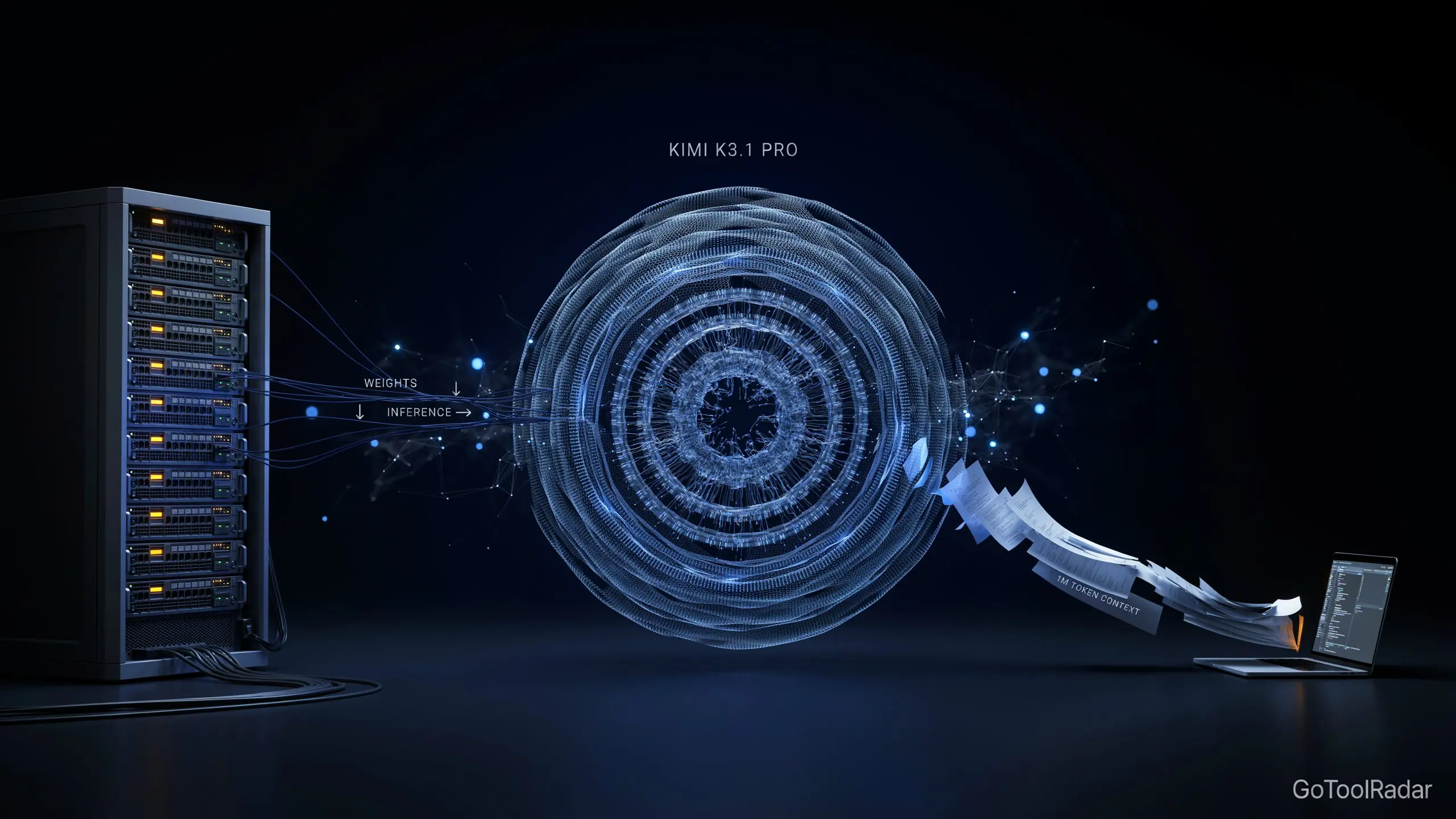
Kimi K3.1 Pro Review 2026: How to Use an Open-Weight Giant You Can't Run at Home
Moonshot published the weights on November 4, but they weigh about 1.56 TB. Here is what the benchmarks, the license, and the price list actually say, and where owning the model and running it part ways.
This Kimi K3.1 Pro review has to start by separating three claims that headlines tend to merge. A one-million-token context window is about what the model can read. Open weights are about what you may download. Neither says anything about what you can run, and for this model the gap is wide: the published checkpoint is reported at roughly 1.56 TB.
Moonshot AI introduced the model on October 23, 2026 through its apps and API, and published the weights on Hugging Face on November 4, as it had promised. Since then, the useful question is no longer whether the model is good. It is who benefits from a download this large, and how far the company's own numbers can be trusted. We read Moonshot's announcement, checked its claims against independent leaderboards, and scored the model with the ToolRadar weighted formula, with no claim of hands-on testing. Our earlier coverage of the family is in our Kimi K2.6 review.

- Specs, benchmark tables, and the cyber-safety changes come from Moonshot's announcement. Those are company-reported numbers, and Moonshot says several of its tests are internal.
- Independent figures come from the Vals AI leaderboard (read November 5) and from Artificial Analysis results as summarized by Latent Space. Prices come from two third-party summaries dated October 24 and 25 that cite Moonshot's price list, because we could not open the pricing page itself.
- The Hugging Face repository and license text could not be opened in our session. Weight size, shard count, and license clauses are reported by OrcaRouter, an API-routing company with its own commercial interest, so read the repository and its license before acting on them. We ran nothing ourselves and publish no speed or quality figures of our own.
What Kimi K3.1 Pro Is
K3.1 Pro is a post-trained upgrade of Kimi K3, which Moonshot introduced in July. Moonshot credits the gains to more post-training compute and a reworked reinforcement-learning stack, according to VKTR's coverage. It accepts text and images and replies in text, and it is aimed at coding and multi-step agent work.
Two versions exist. The standard model is kimi-k3.1-pro in the API. A Highspeed variant, kimi-k3.1-pro-highspeed, is marketed at two to three times the speed, a figure that comes from Moonshot. You can reach the model through Kimi's web and mobile apps, the Kimi Work desktop app, Kimi Code, and the API. On Kimi Enterprise, administrators must switch it on, because it is off by default.
Open Weights and the License
According to OrcaRouter, the repository is moonshotai/Kimi-K3.1-Pro, ungated, with 96 safetensors shards totaling about 1,561 GB. The same report says Moonshot never shipped a BF16 checkpoint: the weights are MXFP4 with MXFP8 activations, produced through quantization-aware training. That matters because earlier coverage estimated 5.6 TB at BF16, a number that turns out to describe a file that does not exist.
"Open-weight" is the right word, and "open-source" is not. The license is custom and not approved by the Open Source Initiative, per OrcaRouter, with the repository metadata reading license: other. The terms it summarizes are these:
- Model-as-a-service: if a company gives third parties inference or fine-tuning access and its group revenue exceeds $20 million over any 12 consecutive months, it needs a separate agreement with Moonshot first. Embedding the model in a product feature is carved out.
- Attribution: commercial products above 100 million monthly active users, or $20 million in monthly revenue, must display "Kimi K3.1-Pro" prominently.
- Exemptions: internal use that does not expose the model or its outputs to third parties, and use through Moonshot's official products and certified inference partners.
For a startup or a developer, those thresholds are far away. For a company that sells hosted access to models, they are not. Treat this as a summary and read the license text yourself. The previous generation set the pattern: Simon Willison noted in July that the K3 license "no longer calls itself 'modified MIT'" and added a separate-agreement requirement for large service businesses, as he wrote in his post on K3. Whether K3.1 Pro's license is word-for-word the same, we could not confirm.
The Benchmarks
This table is Moonshot's own, relayed by VKTR, so treat it as a claim and not a result. Moonshot states it ran at maximum reasoning effort, temperature 1.0 and top-p 0.95, and that some rival scores came from third-party leaderboards or technical reports.
| Benchmark (Moonshot-reported) | Kimi K3.1 Pro | Claude Opus 5.5 | GPT-6 Astra |
|---|---|---|---|
| Terminal-Bench 4.0 | 65.7 | 66.4 | 58.2 |
| SWE Marathon v1.1 | 51.7 | 46.3 | 42.5 |
| OfficeQA Pro v2 | 64.4 | 62.2 | 54.4 |
| BenchCAD, with tools | 92.7 | 96.2 | 95.9 |
| Program Bench | 31.5 | 65.0 | 50.0 |
| Terminal-Bench-Science 0.1 | 38.1 | 63.3 | 68.1 |
The pattern is a split verdict. Kimi is within 0.7 points of Opus 5.5 on Terminal-Bench 4.0 and ahead on two rows, and it is well behind on Program Bench and the science variant. The rows that favor it are the ones a developer might care about most, which is not a reason to ignore the rows that do not.
Independent numbers are thinner but point the same way. On the Vals AI leaderboard, K3.1 Pro scored 62.52% on the Vals Index, ranked 9th of 32 on the page we read, and 63.64% on Terminal-Bench 4.0, ranked 3rd. It was far lower on others: 37.5% on Legal Research Bench (43rd of 89) and 24.87% on Tax Agent Bench (42nd of 80). Latent Space's October 24 roundup reports Artificial Analysis placing it fourth on its Intelligence Index at 55, at about $1.98 per index task. Those index numbers change with the index version, and a later article cites a different, lower score on a newer version, so do not compare figures across versions.
One more caution from the same roundup: Vals found that for the earlier K3 model, accuracy on a legal test varied by provider, 60.6% through Baseten versus 75.8% through Moonshot. If you route K3.1 Pro through a third-party host, test that host, not the model in the abstract.
Running It Yourself
This is where the headline and the reality separate. Per OrcaRouter's summary of the vLLM recipe, self-hosting needs vLLM 0.34.0 or newer and a single group of eight GPUs, described as one B300 node or two GB300 trays. An eight-GPU H200 node, with about 1.13 TB of memory in total, falls short of the 1.56 TB of weights before any KV cache is counted. Weight size is only part of the memory bill, because the context cache grows with length and concurrent users.
The same source estimates a suitable node at roughly $550,000 to $650,000 and compares that to API list prices. It sells API routing, so its conclusion favors the API, and the estimate leaves out power, staff, and idle time. We cannot verify it, but it is directionally consistent with a model of this size. The practical reading is simple: no consumer machine runs this, so tools like Ollama are not the route. If you want to rent GPUs instead, our notes on RunPod's real cost and Modal's serverless GPUs show how rented capacity gets priced, and our guide to running AI agents 100% locally covers models that do fit at home.
What the open weights do buy is control. An organization with the hardware can audit the model, fine-tune it, and keep data inside its own walls. Everyone else gets the main benefit indirectly: competition, and a price floor for hosted access.
Pricing and Highspeed
API prices below match across the two summaries we read, both dated October 24 to 25, which cite Moonshot's price list. Verify them on the live page before building a budget.
| Per 1M tokens | K3.1 Pro | K3.1 Pro Highspeed |
|---|---|---|
| Input (uncached) | $2.00 | $4.00 |
| Output (includes reasoning) | $10.00 | $20.00 |
| Cached input read | $0.20 | $0.20 |
| Cache write, 5 minutes | $2.00 | $4.00 |
| Cache write, 1 hour | $4.00 | $8.00 |
Highspeed charges double for a claimed two to three times the speed. That trade only makes sense where waiting costs you something, such as an interactive coding assistant. One summary says the Batch API guide did not list K3.1 Pro, so do not assume a batch discount. Kimi's subscription tiers exist, but the sources we read disagree on their prices and some quote annual rates as monthly, so check the live page. Subscriptions do not cover API usage, which is billed separately.
Cyber Limits and Privacy
Moonshot says it found cyber-related material in its mid-training data and its reinforcement-learning environments and removed it for the open release. On its internal xdev-bench-hard exploit suite, an unrestricted checkpoint solved 90.5%, the released model 81.0%, and the older K3 33.3%, according to Moonshot. Reuters covered the decision in an October 24 report. These are internal numbers with no independent reproduction. And a 9.5-point drop on a suite where the model still far exceeds its predecessor is a reduction, not a removal. Latent Space notes Artificial Analysis gave K3.1 Pro a 64% on its Cyber Index, second overall behind a trusted-access model at 69%.
On data, Moonshot offers Zero Data Retention for API customers. We could not verify the terms for any specific account. An API call sends your prompts to the provider, while self-hosted weights keep them in your own environment, and the Kimi apps should not be assumed to follow the API's retention rules. Moonshot also states that its hallucination benchmark, which showed claim-level errors falling from 23.4% to 8.3%, is a stress test that "does not represent" everyday error rates, and VKTR notes GPT-6 Astra scored 5.5% on the same test.
Pros and Cons
💡 What Reviewers Say
The first quote is about the earlier K3 license, and the second is a smoke test, not a benchmark, so neither settles anything. Together they show the mood: respect for the model, caution about the terms. The same Latent Space roundup records other reactions. Nathan Lambert noted the model scoring above some rivals on Artificial Analysis' index, and a poster known as giffmana warned against calling trillion-parameter models "local" because they need serious accelerators. Another poster reported a game-based test where performance resembled DeepSeek V4.1 Flash at a cost comparable to Argon, which Latent Space presents as one anecdote. We found no verified Hacker News thread with substantive comments to quote, so we cite none.
Who It Fits
✅ Choose Kimi K3.1 Pro if...
You build coding or agent products and want a strong model at a low per-token price, or you run an organization with GPU infrastructure and a reason to keep inference in-house. It also suits teams that want fine-tuning rights and can live with the license thresholds. Our comparison of Claude Fable 5.1 and GPT-6 Astra shows the closed models it is measured against.
❌ Look elsewhere if...
You want a model that runs on a laptop or one gaming GPU, you sell hosted model access above $20 million in revenue, or your work leans on Program Bench-style or science tasks where Moonshot's own table shows a gap. Small local models, like those in our Ollama review, fit the first case, and our Gemini 4 Argon review covers a closed rival at a similar price.
Expert Editorial Opinion
K3.1 Pro is a good example of a model whose story is partly about the model and partly about the file. The model side is encouraging: independent leaderboards put it in the upper tier on coding, and the price per token is modest. The file side is a reminder that "open" has levels. A 1.56 TB download is an act of transparency, and also a statement about who is expected to use it.
What I would watch is the distance between Moonshot's table and everyone else's. The company's numbers are self-reported, it picked the rows, and several tests are its own. That does not make them wrong. The Vals and Artificial Analysis results broadly agree that this is a top-tier open model. But they also show weak rows, and index versions that shift between weeks, so the sensible stance is to treat the model as promising and to run a trial before betting a product on it.
Now the pricing gap. The $2 and $10 list price is the number people quote, yet it is not the bill. Reasoning tokens count as output, agent loops resend context, Highspeed doubles the rate, and Artificial Analysis measured more output tokens per task than the previous model. The $0.40 example in this review is arithmetic for an imaginary job, not a forecast. Meanwhile the "free" in open weights is hardware worth hundreds of thousands of dollars for anyone who self-hosts.
Would it be worth paying for if there were no free tier and no cheap trial? For API use I think yes, if your workload is coding or agent work and a pilot confirms the numbers on your tasks, because the list price is lower than many frontier alternatives. For self-hosting, only if you already own the infrastructure or have a compliance reason that outweighs the cost. Anyone else should treat the open weights as a benefit that reaches them through providers and price competition, not through a download.
I also want to be fair to the company. Moonshot published footnotes, labeled internal benchmarks, and warned that its hallucination test is a stress test, and that is more candor than many launch posts offer. We scored the model as Competent but compromised, just under the Strong band, and we will revisit the number when more independent testing and real hosting experience accumulate.
Final Verdict
Kimi K3.1 Pro sits at the top of the Competent-but-compromised band (7.0 to 7.9 in our scale), a hair below Strong. The model is credibly near the front on coding, the API price is low, and the weights are public. The compromises are a custom license, a 1.56 TB checkpoint that most teams cannot host, benchmark claims that are mostly Moonshot's own, and a release only days old.
| Dimension | Weight | Score /10 | Why |
|---|---|---|---|
| Technical quality | 30% | 8.3 | 3rd on Vals Terminal-Bench 4.0 and 4th on Artificial Analysis at launch, but weak on some independent and Moonshot-reported rows. |
| Price-to-value | 25% | 8.3 | $2/$10 list price and cached reads at $0.20, offset by token-hungry runs and a doubled Highspeed rate. |
| Maturity & documentation | 20% | 7.4 | Detailed announcement and serving recipes, but a days-old weights release and unverified third-party summaries of the license. |
| Ceiling & flexibility | 15% | 7.9 | Downloadable weights, 1M context, and image input, against an enormous footprint and text-only output. |
| Honesty of positioning | 10% | 7.5 | Candid footnotes and stress-test warnings, against self-selected benchmarks and a loose "open" framing. |
Final score = (8.3 × 0.30) + (8.3 × 0.25) + (7.4 × 0.20) + (7.9 × 0.15) + (7.5 × 0.10) = 2.49 + 2.075 + 1.48 + 1.185 + 0.75 = 7.98, shown as calculated and not rounded up.
❓ Frequently Asked Questions
🔗 Related ToolRadar Reviews
- Is Kimi K2.6 actually king of AI in 2026?
- Gemini 4 Argon review: a closed rival at a similar price
- Ollama review: local AI is free, but your hardware is not
- How to run AI agents 100% locally
- What ChatGPT, Claude, Devin and more really cost
Official sources: Moonshot's announcement · Hugging Face repository · License text
Comments
Post a Comment