


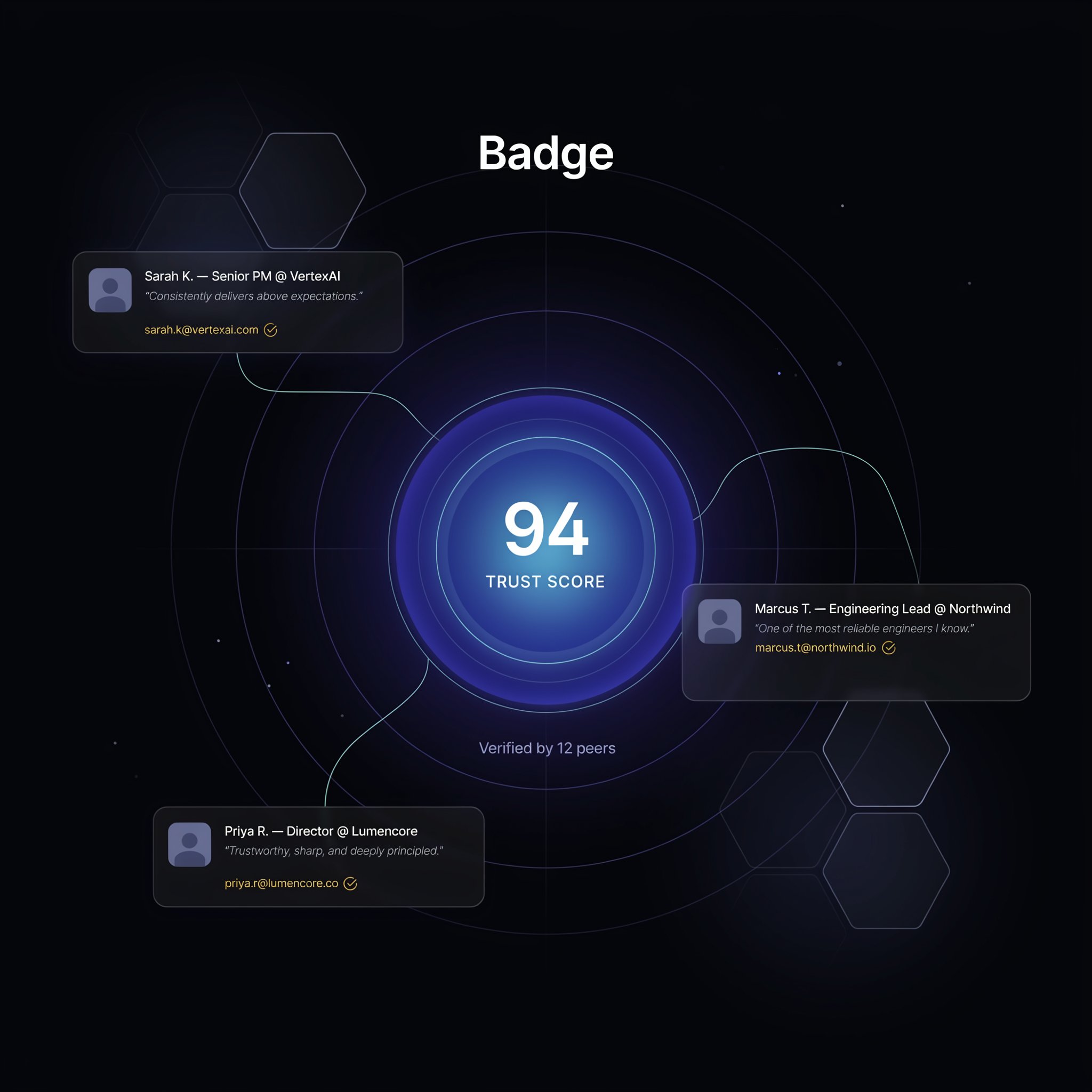
Badge Review 2026: The AI Agent That Collects Anonymous Peer Reviews and Builds a Portable Trust Score — In a World Where Resumes Can't Be Trusted
Built by a hiring manager who interviewed thousands of engineers over 15 years — Badge deploys AI agents to collect anonymous, verified peer reviews from real colleagues, builds a portable Trust Score that follows you everywhere, and gives recruiters a 30-second reference check that no AI-generated resume can fake.
By ToolRadar Editorial Team · Review methodology: technical evaluation, pricing analysis, and verified user feedback
In 2026, AI can write a polished resume in 30 seconds. It can generate LinkedIn recommendations that sound like a senior colleague wrote them after a decade of collaboration. It can produce cover letters, portfolio writeups, and skill endorsements that are indistinguishable from human-authored content. For recruiters, this means every candidate looks impressive on paper — and separating signal from noise has never been harder. For professionals, it means their actual performance — the way they really communicate, collaborate, and deliver — stays buried in old HR systems, forgotten Slack threads, and performance reviews no one outside the company can see.
Badge was built to fix both sides of this problem simultaneously. Founded by Lokesh Motwani — a hiring manager who spent 15 years hiring hundreds of engineers and interviewing thousands more — Badge launched on Product Hunt on July 14, 2026 with a clear thesis: in a world of AI-generated resumes, verified human signal is the only thing that matters. The platform deploys AI agents to collect anonymous, verified peer reviews from people a professional has actually worked with, synthesizes them into a portable Trust Score, and makes that score shareable on resumes, LinkedIn profiles, portfolios, and email signatures. For recruiters, it delivers the equivalent of a reference check — in 30 seconds, with authentic feedback from actual coworkers — before investing hours in interview cycles. Updated July 2026.
What Is Badge?
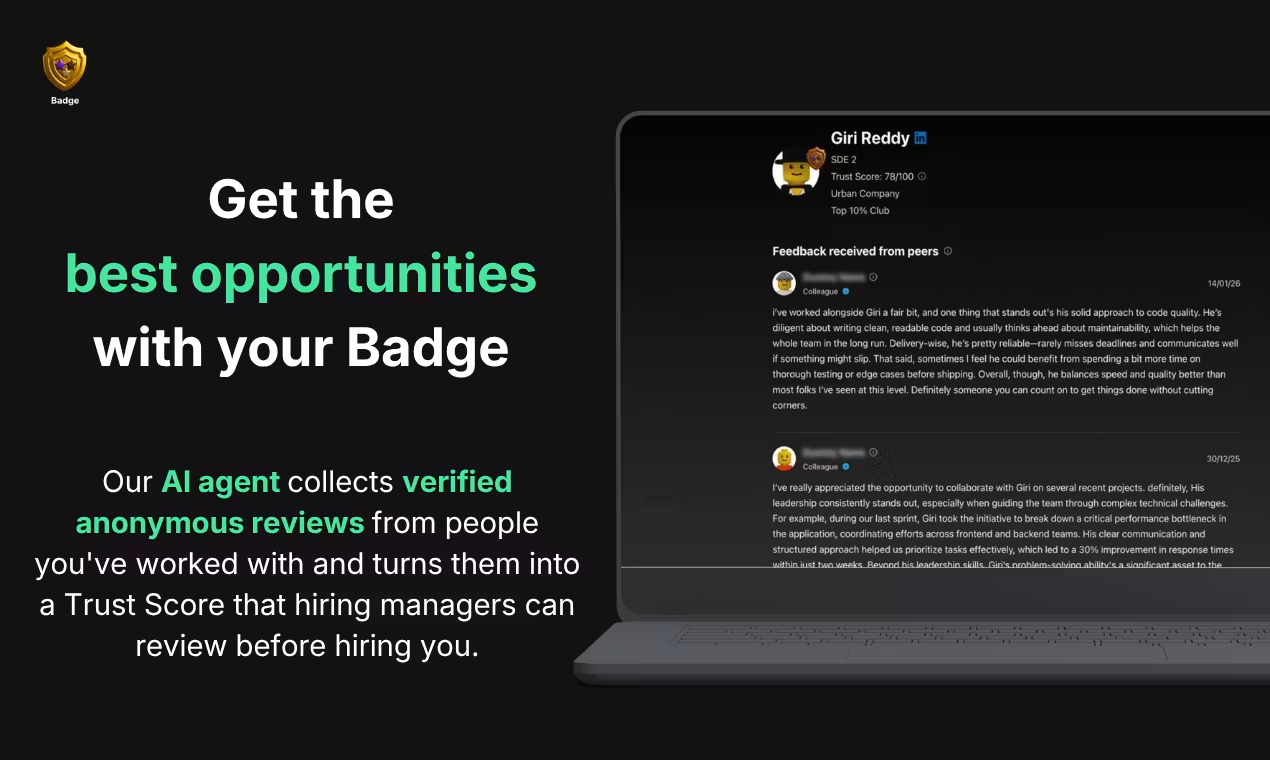
Badge is an AI-powered professional reputation platform that uses AI agents to collect anonymous, verified peer reviews from real colleagues and synthesizes them into a portable Trust Score — a hiring signal that reflects how a professional actually works, not just what they claim to have done. The platform works in two directions simultaneously. For job seekers, Badge connects to their contacts (via LinkedIn URL, email, or phone book access), identifies colleagues who worked at the same organization, and sends them targeted review requests. AI agents guide reviewers through structured questions — binary prompts that progressively probe for specific, detailed answers — making reviews substantive rather than generic. All reviews are anonymous, reducing social friction and increasing honesty. Reviews are verified through work email authentication (both reviewer and reviewee must share an organizational connection), earning a blue verification tick. The resulting Trust Score starts at 60 and grows with every verified review, covering five dimensions: communication, collaboration, ownership, reliability, and areas for growth. For recruiters and hiring managers, Badge delivers a 30-second reference check on any candidate — authentic feedback from actual coworkers before a single interview call is booked. Available on web, iOS, and Android.
Key Features
AI Agents That Collect Reviews Automatically
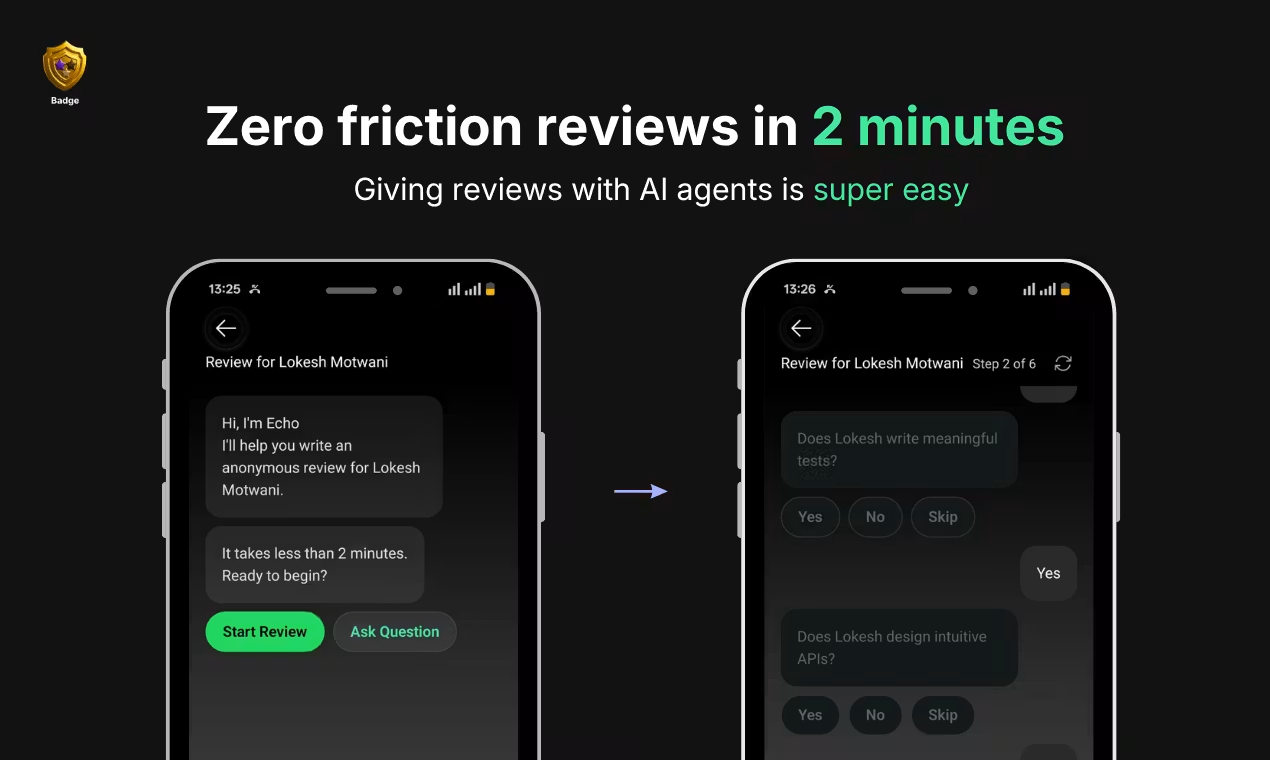
Connect your contacts, identify your real colleagues, and let Badge's AI agents handle the outreach. The agent sends review requests, follows up naturally, and guides reviewers through structured questions that produce detailed, honest feedback — not generic praise. You don't manually ask anyone. The agent does it.
Anonymous + Verified Reviews
Reviews are fully anonymous, so colleagues can be honest without social awkwardness. Work email verification confirms the reviewer genuinely shared an organization with you — not just a mutual connection or a friend doing a favor. The combination of anonymity and verification produces the most honest professional feedback signal currently available.
Portable Trust Score
Your Trust Score starts at 60 and grows with every verified review across five dimensions: communication, collaboration, ownership, reliability, and areas for improvement. Share it as a badge on your resume, LinkedIn profile, portfolio, or email signature. Your professional reputation is no longer stuck inside a company's HR system — it travels with you.
30-Second Recruiter Reference Check
Recruiters and hiring managers access Badge's platform (getbadge.in/recruiter/) to view a candidate's Trust Score and review summary before booking an interview. Real feedback from actual coworkers, verified through work email, available in under a minute — replacing hours of manual reference calls.
Pricing Plans
| Plan | Price | What You Get |
|---|---|---|
| Free | $0 | Web, iOS, and Android · Build your Trust Score · Collect verified reviews · Share your Badge on LinkedIn and resume · Access recruiter view for candidates |
| Paid Tiers | To be announced | Badge launched July 14, 2026 — paid tiers for recruiters, advanced analytics, and enterprise hiring team features expected as the product scales · Check getbadge.app for current pricing |
Note: Badge is free at launch for both job seekers and recruiters. The platform is in active early access. Check getbadge.app for current pricing as paid tiers are introduced for recruiter-facing features. Updated July 2026.
Build Your Trust Score Free on Badge →ToolRadar may earn a commission if you purchase through this link at no extra cost to you.
Pros & Cons
✓ What Works
- ✅ Anonymous + verified — the only combination that produces honest, credible professional peer reviews at scale
- ✅ AI agent does the outreach — you don't have to awkwardly ask former colleagues for recommendations yourself
- ✅ Portable Trust Score — your professional reputation travels with you, not locked in a previous employer's HR system
- ✅ Solves both sides — useful for job seekers building reputation AND recruiters needing fast, credible reference checks
✗ What Holds It Back
- ❌ Very early stage — launched July 14, 2026, still building the network effect that makes Trust Scores meaningful at scale
- ❌ Cold start challenge — a Trust Score with only 2–3 reviews is meaningful but limited; value grows significantly with more verified reviews over time
- ❌ Verification relies on org email — professionals at companies without clear work email infrastructure (freelancers, contractors, early startups) may face verification friction
- ❌ Recruiter adoption is the key unknown — the platform's full value to job seekers depends on recruiters actively checking Badge scores, which requires building the demand side simultaneously
💡 Community Feedback
Comparison: Badge vs Alternatives
| Feature | Badge | LinkedIn Recommendations | Traditional Reference Checks | Blind |
|---|---|---|---|---|
| Anonymity | YES — fully anonymous | NO — public and named | PARTIAL — referees known | YES — anonymous |
| AI-Guided Review Quality | YES — probing structured questions | NO — free-form generic | NO — unstructured calls | NO — free-form posts |
| Portable Trust Score | YES — shareable everywhere | NO — LinkedIn only | NO — not portable | NO — platform only |
| Verification | YES — work email org verification | NO | PARTIAL | NO |
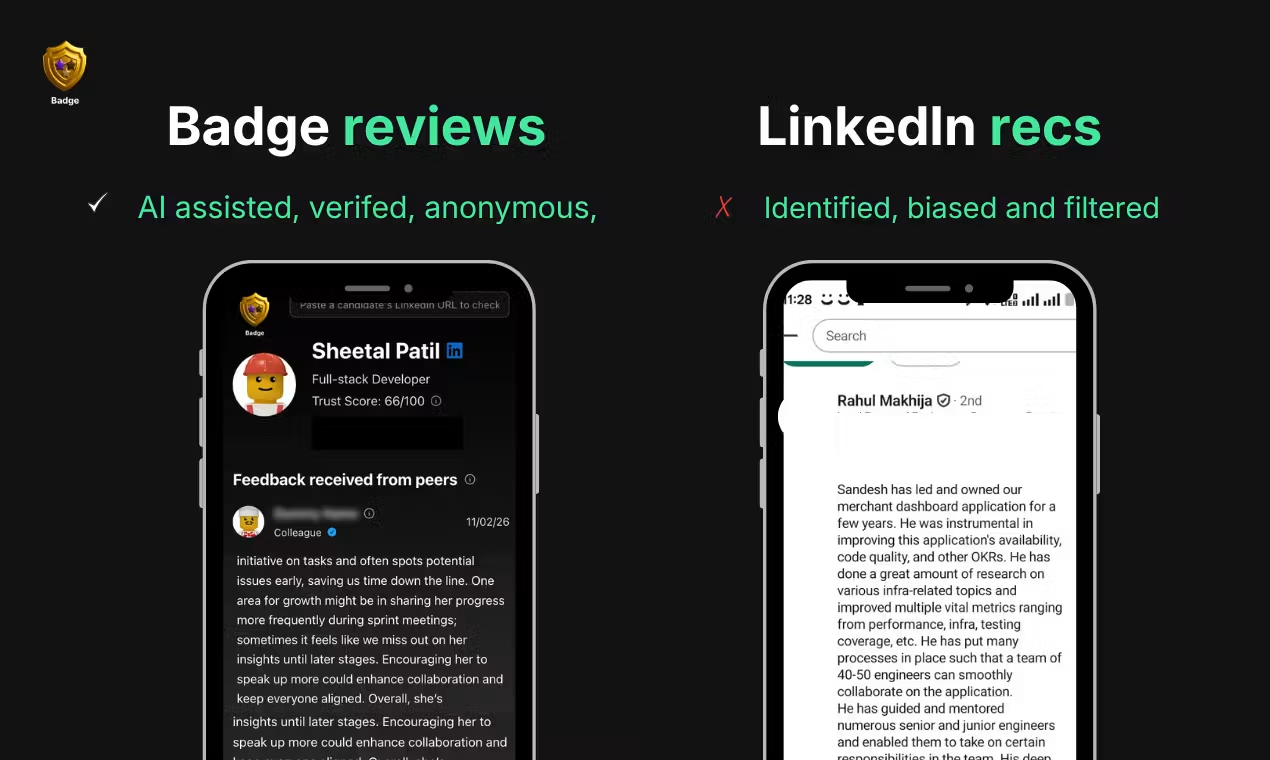
Analysis: Badge occupies a unique position in the professional reputation landscape. LinkedIn recommendations are named and unverified — resulting in reciprocal flattery rather than honest assessment. Traditional reference checks are verified but not anonymous — producing filtered positivity as referees know their comments are attributable. Anonymous platforms like Blind offer candor but lack verification — creating credibility questions about whether the reviewer actually worked with the person. Badge is the first product to combine all three elements correctly: anonymity (for honesty), work email verification (for credibility), and AI-guided probing questions (for substance). The tradeoff is network size — LinkedIn has 1 billion users, Blind has millions, and Badge launched on July 14, 2026. For early adopters willing to build their Trust Score before the network reaches critical mass, the signal quality advantage is significant.
Learning Curve
Badge is designed for minimal friction. The onboarding process connects to your LinkedIn profile or contacts, identifies colleagues who shared an organizational connection, and deploys the AI agent to send review requests automatically. No manual outreach, no awkward conversations, no spreadsheet tracking.
Compared to competitors, Badge has a significantly shallower learning curve than traditional reference check platforms (which require recruiter coordination, scheduling, and phone calls) and is comparable to LinkedIn in simplicity. The AI agent handles all reviewer communication, so the job seeker's only task is connecting their profile and waiting for reviews to come in. For recruiters, the 30-second reference check is accessed through a simple web interface at getbadge.in/recruiter/. Expect full setup within 10 minutes and a first Trust Score within 24–48 hours of colleague responses.
Who Should Use Badge
Best For: Software engineers, designers, product managers, marketers, sales professionals, consultants, and freelancers whose real value is demonstrated through how they work with people — not just what their resume lists. Job seekers tired of starting every search from scratch because their performance data is locked in former employers' HR systems. Recruiters and hiring managers who waste hours on screening calls with candidates who look great on paper but don't deliver. Anyone who has received LinkedIn recommendations and knows how little they reflect actual working relationships.
Consider Alternatives If: You need immediate, large-scale recruiter visibility — platforms like Peerlist have an established professional network that may offer more immediate discoverability while Badge builds its user base. You're a freelancer or contractor whose work history doesn't map cleanly to organizational email verification — Badge's verification model works best for employees of structured organizations. You need references for a specific role with specific skills — traditional targeted reference calls with a recruiter still offer tailored depth that a general Trust Score doesn't replace.
Expert Editorial Opinion
Badge's timing is precisely right. The AI resume generation wave that hit in 2025–2026 has created a genuine signal crisis for recruiters — candidates are indistinguishable on paper in a way that was impossible two years ago. At the same time, the professionals who genuinely perform well have watched AI-polished imposters crowd them out in early screening stages. Badge's thesis — that verified human signal from real colleagues is the only defensible hiring signal left — is not just directionally correct, it's increasingly urgent.
The product architecture reflects fifteen years of firsthand hiring pain. The decision to make reviews anonymous (so people are honest) AND verified through work email (so the honesty is credible) AND AI-guided with probing questions (so the detail is substantive) is the correct combination. Each element alone is insufficient. LinkedIn recommendations are named and unverified — resulting in reciprocal flattery. Traditional references are verified but not anonymous — resulting in filtered positivity. Anonymous platforms like Glassdoor are anonymous but unverified — resulting in credibility questions. Badge is the first product to combine all three correctly.
The critical variable in Badge's success is the network effect. A Trust Score with five verified reviews from real colleagues is a genuinely valuable hiring signal. A Trust Score with zero reviews tells a recruiter nothing. The platform's growth model — where job seekers invite colleagues to review them, colleagues experience the product as reviewers, and some convert to job seekers themselves — is a natural viral loop if the review experience is frictionless enough. Lokesh's confirmation that 2–3 reviews already produce a meaningful score lowers the barrier to early value, which is smart product design. The question is whether recruiter-side adoption keeps pace with candidate-side growth — and that's the bet worth watching in the second half of 2026.
Pricing Gap Analysis: Badge is free at launch for both job seekers and recruiters, which removes the primary barrier to adoption for a marketplace product. The challenge is not price — it's network density. A free product with no users is less valuable than a paid product with an active network. Badge needs to build both sides of the marketplace simultaneously, which is the hardest problem in product building. The eventual paid tiers for recruiters (advanced analytics, enterprise features, bulk candidate screening) are a natural monetization path once the network reaches sufficient density. For now, the free tier is generous enough to evaluate the product fully.
Does it work without a free tier? Badge does not have a free tier — it IS the free tier at launch. Every core feature is available at no cost: building your Trust Score, collecting verified reviews, sharing your Badge, and accessing recruiter views. This is the correct strategy for a pre-network marketplace product. Charging early would kill adoption before the network effect has a chance to form. The risk is that free users may not convert to paid recruiter tiers when they are introduced — but that's a problem for 2027, not for launch day. For July 2026, free is the only right price.
Final Verdict
Badge is the most architecturally correct professional reputation tool launched in 2026. The anonymous + verified + AI-guided combination produces a hiring signal that no resume, no LinkedIn recommendation, and no AI-generated credential can replicate. The founder's 15 years of firsthand hiring experience shows in every product decision. The free tier, iOS and Android availability, and low barrier to a first Trust Score (2–3 reviews) make evaluation risk-free. The network effect is the open variable — Badge needs both job seekers and recruiters to find value simultaneously, which is the hardest problem in marketplace product building. For professionals who want their real reputation to follow them, and for recruiters who want signal they can trust in an AI-flooded candidate market, this is an 8.8 out of 10 and the most timely professional tool to try in July 2026.
Technical Quality: 9.0/10 · Price-to-Value: 9.5/10 (free at launch) · Maturity & Documentation: 8.0/10
🔗 Related ToolRadar Reviews
More tools from AI Career Tools
- This AI Agent Works While You Sleep
- Can an AI Agent Really Replace Your Entire Team?
- I Gave an AI Agent Full Control of My Inbox
- I Let an AI Agent Make My Phone Calls for a Week
- The Search Engine Built for AI Agents
- Can an AI Agent Really Browse the Web for You?
- I Built an AI Agent Army Without Writing a Single Line of Code
- I Let an AI Agent Send 10,000 Cold Emails
❓ Frequently Asked Questions
What do your colleagues actually think of working with you?
In a world where AI can fake every credential on your resume, the only signal that can't be manufactured is what the people who actually sat next to you would say — if they could be honest. Badge gives them that voice. And it gives you a reputation that travels with you, not one that dies when you leave a company. The question isn't whether you need a Trust Score. The question is why you'd let your professional reputation stay locked in someone else's HR system for one more day.

Comments
Post a Comment