



Voxa Agents Review 2026: A 12-Year-Old Built an AI Agent Platform With Claude — And It's Already Handling Hundreds of Calls
Mana Jampala, a 12-year-old founder from British Columbia, Canada, built Voxa — an AI receptionist for small businesses — after watching her father's team miss calls every day. Then she built Voxa Agents so anyone could create their own AI agent with a plain-language prompt. No code. No team. Just Claude.
By ToolRadar Editorial Team · Review methodology: technical evaluation, founder interview analysis, and verified media coverage
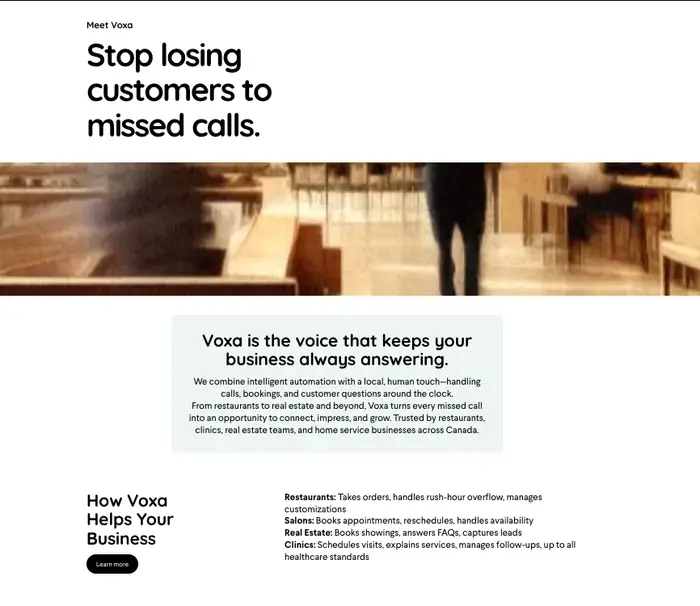
Most AI startup pitches start with a market size slide and a TAM calculation. Mana Jampala's started differently. She was 11 years old, sitting in her father's workplace in British Columbia, Canada, watching a small, busy team miss call after call. Not because they didn't care — because they were stretched thin and there weren't enough hands. That one observation turned into Voxa: a 24/7 AI receptionist built specifically for small businesses that can't afford to miss a customer.
Jampala launched Voxa in November 2025 at age 12. She built it using Claude (Anthropic's AI coding assistant) — not by generating an entire codebase at once, but by requesting small snippets, testing each one, fixing bugs, and building iteratively. The product handles inbound calls, books appointments, records restaurant orders, manages missed calls, and generates summaries after each conversation. It's already handling hundreds of calls. And then she built a second product: Voxa Agents — a platform that lets anyone create a custom AI agent using plain-language prompts, no coding required. Business Insider covered her story as part of their Young Geniuses series in July 2026.
What Is Voxa Agents?
Voxa is a two-product AI platform built by Mana Jampala, a 12-year-old founder from British Columbia, Canada. The first product — Voxa — is a 24/7 AI voice receptionist designed for small businesses: it answers incoming calls, books appointments, records restaurant orders, handles missed calls, and generates a summary of every conversation automatically. The second product — Voxa Agents — extends the platform to let any user create a custom AI agent by describing what they want in plain language. No code required. Users describe the agent's job, and the platform builds the workflow.
The vision, per Jampala's own roadmap: bootstrap for one to two years, apply to Y Combinator or an Andreessen Horowitz program, then raise venture capital and scale. She built the entire product using Claude as her coding partner — not to generate a full codebase, but to write and test small pieces of code one at a time, a development discipline that Kingy AI noted is smarter than the workflow many adult developers use.
Key Features
24/7 AI Voice Receptionist
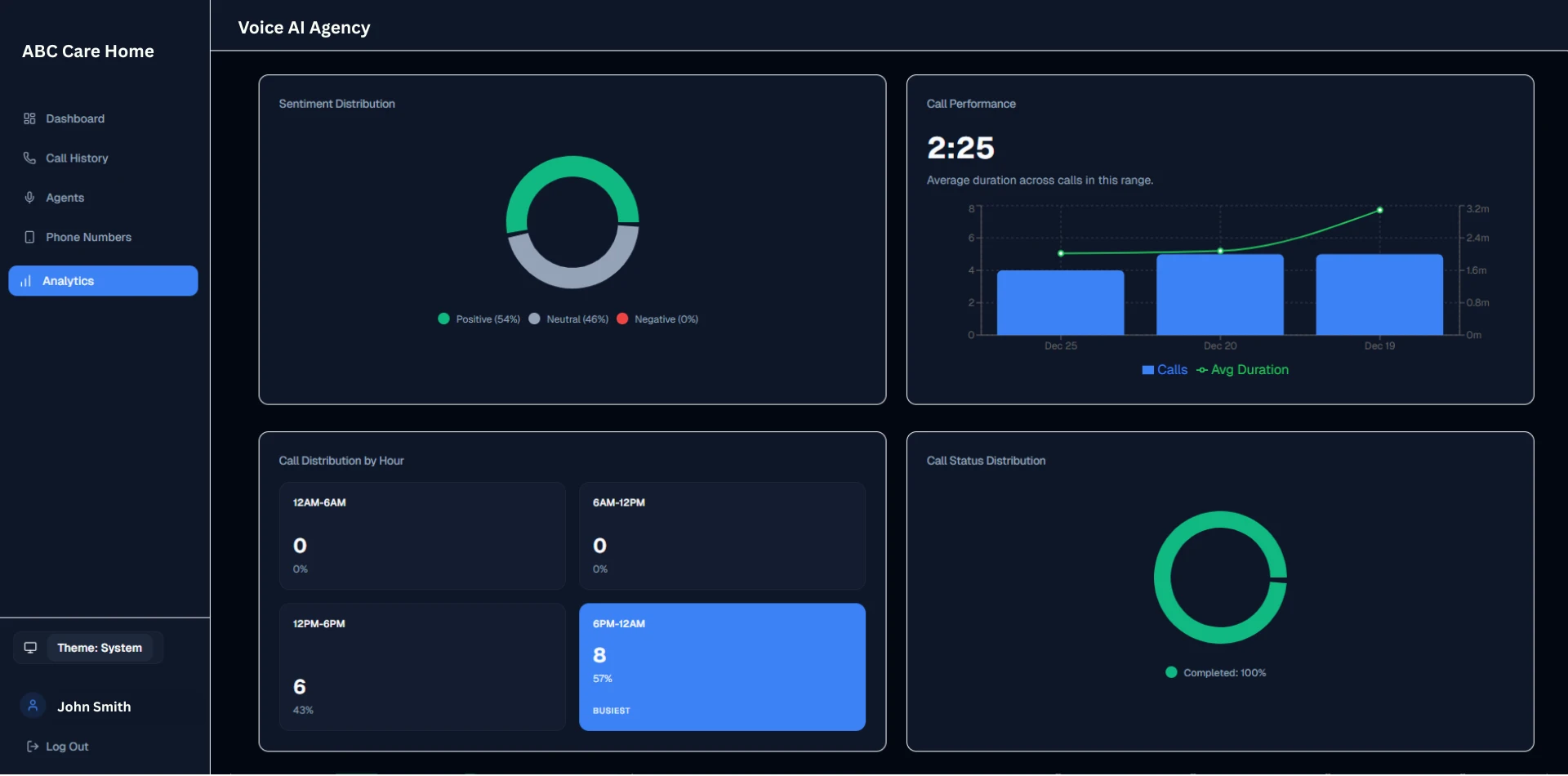
Voxa answers every inbound call around the clock — no hold music, no voicemail, no missed lead. Handles inquiries, qualifies callers, and routes or escalates when needed. Built for the small business owner who is too busy to answer every call while serving customers.
Automatic Appointment Booking
Books staff appointments directly during the call without human intervention. Syncs with the business calendar and confirms with the caller. No back-and-forth, no scheduling lag, no double bookings.
Call Summaries After Every Conversation
Generates a structured summary after every call — what was discussed, what was requested, what was booked, what needs follow-up. Owners wake up to a complete record of every customer interaction that happened while they were unavailable.
Voxa Agents — Build Your Own AI Agent With a Prompt
Describe what you want an AI agent to do in plain language. Voxa Agents generates the workflow. No code, no templates, no technical setup. The same philosophy Jampala used to build Voxa — plain language in, working automation out.
Pricing Plans
| Product | Price | Status |
|---|---|---|
| Voxa | Not yet publicly listed | Contact via voxaagents.com — the platform is pre-revenue and working toward its first paying customer as of July 2026 |
| Voxa Agents | Not yet publicly listed | Platform in active development — pricing expected as product matures and paying customers onboard |
Note: Voxa launched in November 2025 and is less than a year old. Mana Jampala confirmed in Business Insider that she is still working on securing the first paying customer as of July 2026. The platform is real and handling hundreds of calls — but pricing, billing infrastructure, and enterprise features are still being developed. Contact directly via the Voxa website for current access. Updated July 2026.
Learn More About Voxa Agents →ToolRadar may earn a commission if you purchase through this link at no extra cost to you.
Pros & Cons
✓ What Works
- ✅ Built on a real problem — observed firsthand, not invented from a trend report or a pitch competition
- ✅ Two products in one platform — voice receptionist + prompt-based agent builder cover complementary use cases
- ✅ Already handling hundreds of real calls — not a demo, not a prototype, a working product with real usage
- ✅ Built by a founder who codes iteratively and tests every piece — a development discipline that produces more reliable software than "vibe coding" the whole app
✗ What Holds It Back
- ❌ Pre-revenue — still working toward first paying customer as of July 2026; commercial viability is unproven
- ❌ No public pricing — businesses can't self-serve sign up and pay; requires direct contact
- ❌ One-person team at age 12 — bandwidth, reliability guarantees, and support availability are genuinely limited
- ❌ No published reliability data — call handling accuracy, edge case performance, and uptime metrics are not yet independently verified
💡 Community Feedback
Comparison: Voxa vs Competitors
| Feature | Voxa | Asmi AI | Vapi | Human Receptionist |
|---|---|---|---|---|
| Target User | Small business owners | Busy professionals | Developers | Any business |
| Made By | 12-year-old solo founder | Ex-Meta AI + DeepMind team | Developer platform team | Staffing agencies |
| Call Handling | YES inbound 24/7 | YES outbound tasks | YES via API | YES human |
| Pricing | Not yet listed | Free (early) | Usage-based | $3,000–5,000+/mo |
Analysis: Voxa occupies a unique position in the voice agent landscape. Asmi AI offers a free early product built by an ex-Meta AI and DeepMind team, targeting busy professionals with outbound task capabilities. Vapi is a developer-first platform with usage-based pricing and deep API customization. A human receptionist costs $3,000–5,000+ monthly but offers judgment, empathy, and complex problem-solving that AI still struggles with. Voxa's differentiator is not technical sophistication — it is founder authenticity and problem-first design. Jampala built for a specific pain point she witnessed daily, not a market opportunity she read about. The tradeoff is clear: Voxa lacks the engineering depth of Asmi AI, the platform flexibility of Vapi, and the human nuance of a real receptionist. But it offers something rarer — a founder who understands the user's pain because she lived next to it.
Learning Curve
Voxa is designed for non-technical small business owners. The setup process is reportedly straightforward — business owners describe their needs and Jampala configures the agent. For Voxa Agents, the prompt-based builder means users describe what they want in plain language rather than coding workflows. This is comparable to other no-code AI agent builders like Relevance AI or Voiceflow.
However, because Voxa is pre-revenue and run by a solo founder, there is no self-serve onboarding, no documentation library, and no community forum. Users work directly with Jampala, which means setup time depends on her availability. For a small business owner willing to invest 30–60 minutes in a call with the founder, the learning curve is shallow. For someone expecting instant deployment through a dashboard, the experience will feel slow. Expect 1–3 days from first contact to a working agent, depending on founder availability and business complexity.
Who Should Use Voxa
Best For: Small business owners — plumbers, restaurants, salons, dental clinics, local contractors — who miss calls because they're understaffed and don't have the budget for a full-time receptionist. Early adopters willing to support an early-stage AI product with a compelling origin story. AI community members and educators looking for a real-world example of what the next generation of founders is building. Anyone who wants to experiment with building custom AI agents via plain-language prompts on a platform still in active development.
Look Elsewhere If: You need a production-ready, enterprise-grade voice agent with published SLAs, pricing transparency, and a proven support team — Vapi, Retell.ai, or Daily Bots are more mature. You need immediate self-serve access without going through a founding team — Voxa is still in the direct-sales phase of customer acquisition. You need a phone agent with complex multi-system CRM integrations and compliance certifications — the product isn't there yet.
Expert Editorial Opinion
The most important thing about Voxa is not the product — it's the method. Business Insider reported that Jampala deliberately chose not to generate her entire codebase with AI in one shot. Instead: small snippet, read it, test it, fix it, move forward. That is the disciplined AI-assisted development workflow that most adult developers are still learning. The result is a product that works — hundreds of real calls handled, real businesses talking to it — rather than a demo that breaks the moment it leaves the presentation.
Voxa Agents, the second product, is the one worth watching strategically. The AI receptionist solves a specific, narrow problem for a specific, narrow market. Voxa Agents — a platform where anyone describes an AI agent they want in plain language and gets a working workflow — is the more horizontally ambitious bet. If the prompt-to-agent infrastructure works reliably, the addressable market expands well beyond small business phone calls. That's the product that, if it matures, could justify the Y Combinator application Jampala has openly discussed targeting.
The honest assessment is that Voxa is at the beginning of a very long road. Pre-revenue, one founder, age 12, no team, limited documentation, and no public pricing are all real constraints. But Kingy AI's framing is correct: the next meaningful signal is paying customer traction and evidence the product handles messy, unpredictable real-world calls reliably. Jampala has already demonstrated the rarest thing in any founder — she saw a real problem before she knew what AI was, built a solution before she had a team, and is pursuing customers the hard way (cold calls, warm intros, Chamber of Commerce calls) rather than waiting for inbound. The AI community should be watching.
Pricing Gap Analysis: Voxa has no public pricing, which creates genuine friction for interested businesses. Competitors like Asmi AI offer a free early product, Vapi has transparent usage-based pricing, and even a basic human receptionist has a clear cost structure. The absence of pricing means Voxa cannot be evaluated on price-to-value yet. This is understandable for a pre-revenue startup, but it is a real barrier for business owners who need to budget and compare options. Jampala will need to publish pricing before she can scale beyond early adopters willing to negotiate directly.
Does it work without a free tier? Voxa does not have a free tier, a paid tier, or any tier — it is currently in the direct-contact phase of customer development. For early adopters who believe in the founder and the vision, this is fine. For businesses that need to evaluate multiple options quickly, the lack of any self-serve path is a significant hurdle. The 7-day trial model that Octolens uses would be a natural evolution for Voxa once billing infrastructure is in place. Until then, interested users must be willing to invest time in a conversation with the founder.
Final Verdict
Voxa Agents is not the most polished AI platform reviewed on this site. It doesn't have public pricing, enterprise features, or a verified customer list. What it has is something rarer: a founder who identified a real problem at age 11, built a working solution at age 12, shipped two products before most people her age have written their first function, and is executing a disciplined go-to-market strategy that most adult founders don't manage.
The platform score reflects current maturity. The founder score is a different number entirely. For small businesses willing to try something early, and for anyone in the AI community who wants to see where the next generation of founders is headed, Voxa is an 8.2 out of 10 — and the most human story in AI this year.
Technical Quality: 7.5/10 · Price-to-Value: N/A (pre-revenue) · Maturity & Documentation: 6.5/10
🔗 Related ToolRadar Reviews
More tools from AI Startup Tools
- I Launched a Talking AI Agent With One Prompt
- The Voice Agent Platform That Solved My Support Nightmare
- The Hidden Cost Trap Behind $0.05 Voice Agents
- I Built an AI Agent Army Without Writing a Single Line of Code
- I Let an AI Agent Make My Phone Calls for a Week
- Can an AI Agent Really Replace Your Entire Team?
- This AI Agent Works While You Sleep
- I Gave an AI Agent Full Control of My Inbox
❓ Frequently Asked Questions
What were you building at age 12?
Mana Jampala was building an AI company. Not because someone told her to. Because she watched a problem happen every day and decided to fix it. The tools are getting cheaper. The barriers are getting lower. The only question left is what you will build next.

Comments
Post a Comment