


Can Mistral Voxtral 3 Replace Your Whole Voice Stack for Under 5 Cents a Minute?
Mistral's new speech family bundles transcription, expressive text-to-speech and a voice agent SDK. Here is what the list prices, the benchmarks and the first independent test actually support.
📋 Table of Contents
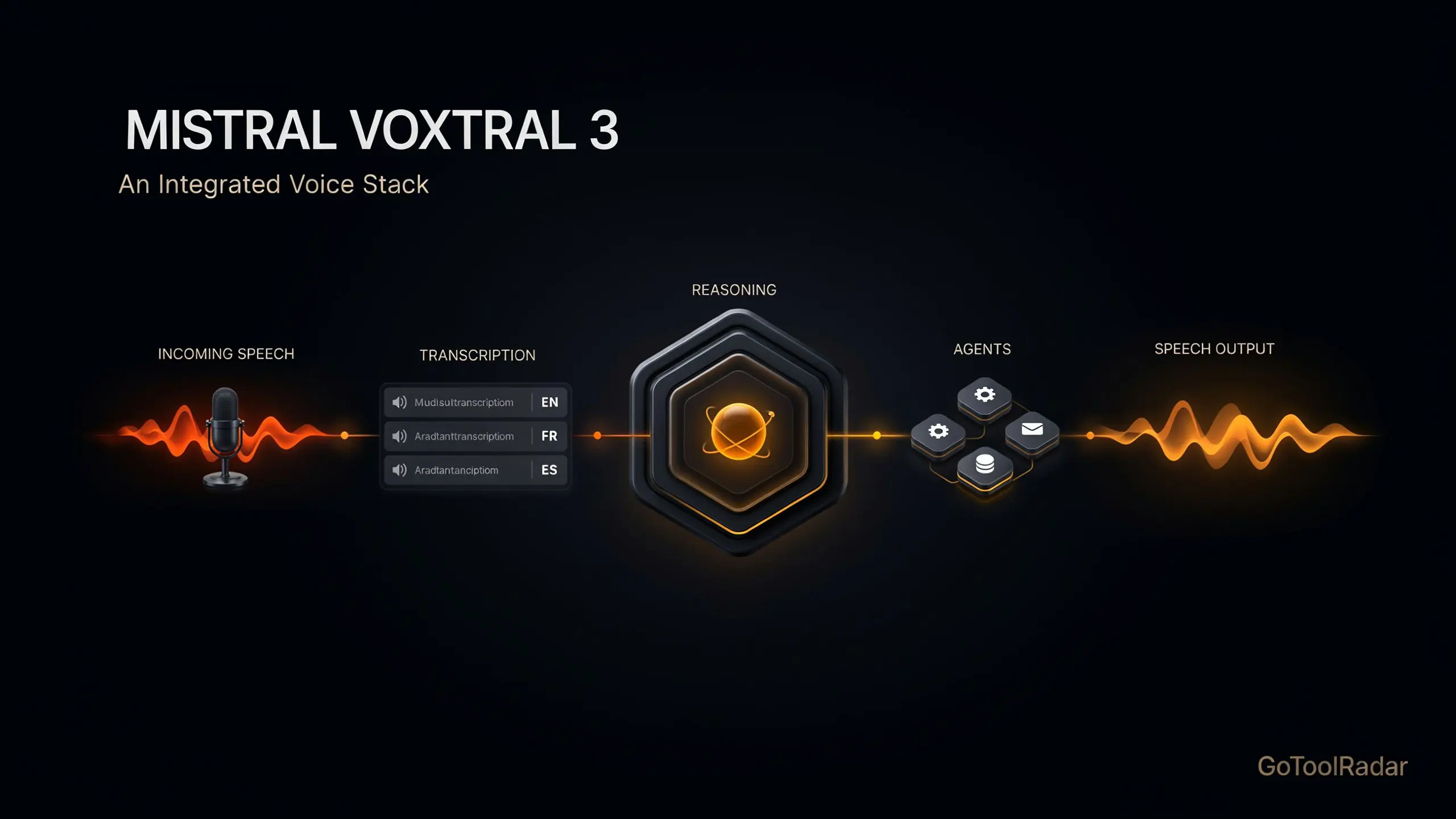
This Mistral Voxtral 3 review scores the voice stack 7.87 out of 10: cheap and strong where the numbers are proven, still unproven on messy real-world audio. Mistral announced Voxtral 3 on October 20, 2026, and it is easy to file it under "another speech-to-text model." That undersells it. It is a family of five audio models plus a voice agent SDK, designed so that listening, reasoning, tool calling and speaking run as one streaming pipeline.
The headline price is what travels on social media: batch transcription from $0.0035 a minute, and a full voice agent from $0.04. Both numbers are real, and both need context. This piece separates what Mistral has documented, what an independent tester has measured, and what nobody has shown yet. If you are weighing it against the setups we covered in our look at a voice agent platform or the cost traps in low per-minute voice agent pricing, the same habit applies: read the line items, not the headline.

The Five Models (and One SDK) Inside Voxtral 3
Voxtral Small Transcribe 3: the accuracy tier
The larger transcription model for recorded files, priced at $0.004 a minute. It handles 50 languages with speaker labels (diarization) and context biasing, where you hand the model key terms to improve recall. Third-party coverage places it third on the Artificial Analysis speech-to-text leaderboard. At launch it only transcribes: summaries and translation still go through a separate audio-in-chat route.
Voxtral Mini Transcribe 3: the default starting point
A 4-billion-parameter model at $0.0035 a minute, and the one Mistral's own docs tell you to start with. Segment-level timestamps are supported; word-level timestamps are not. Its context window of 65,536 tokens is shared between the audio and any vocabulary list you supply.
Voxtral Mini Transcribe Realtime 3: live audio
Built for captions and voice agents, at $0.008 a minute. You set the streaming delay per session, from 80 to 1,200 ms or 2,400 ms, and Mistral claims sub-500 ms latency in its announcement. It adds turn detection, which predicts when a speaker has finished. Two practical limits from the docs: diarization and turn detection cannot share one realtime session, and live transcripts carry no start or end times. Mistral's own pages also disagree on language coverage for this model (35 languages in the benchmark, 45 in the docs), so verify your language before building.
Voxtral TTS 3 and TTS Realtime 3: speech generation
Text-to-speech for 35+ languages and 50+ dialects at $13 per million input characters, with a streaming variant for live calls. You steer delivery with emotion and pace tags, and the model also reads emotion from the conversation. Preset voices are limited per language (Arabic has one), so other voices mean cloning.
The voice agent SDK: the actual product
Built on LiveKit, it chains realtime transcription, a reasoning model that can call tools, and speech output. It answers and places calls over SIP, runs in browsers and apps over WebRTC, and lets you swap the language model or voice without rewriting the agent. Mistral says each turn completes in under a second and that the agent stops talking when the caller interrupts. That is a vendor claim about its own setup, not a guarantee for yours.
Pro Voice: custom voice adaptation
For brand voices, Mistral offers an adaptation tier that reproduces a speaker's style across languages from about 30 minutes of audio. The announcement also mentions cloning from 30+ minutes of sampled audio, while the API docs describe zero-shot cloning, so confirm which path your plan includes. Either way, cloning someone's voice needs their consent.
What Voxtral 3 Actually Costs
| Component | List price | Per hour / unit | Worth knowing |
|---|---|---|---|
| Mini Transcribe 3 (batch) | $0.0035 / min | $0.21 / hour | 50 languages, diarization, context biasing |
| Small Transcribe 3 (batch) | $0.004 / min | $0.24 / hour | Higher accuracy; transcription only at launch |
| Mini Transcribe Realtime 3 | $0.008 / min | $0.48 / hour | Live audio, adjustable delay, turn detection |
| Mini TTS 3 (batch and realtime) | $13 / 1M characters | $0.013 / 1,000 characters | Priced on input text, not audio length |
| Voice agent API, Mistral Small 4 | $0.04 / min | $2.40 / hour | Default reasoning model |
| Voice agent API, larger model | $0.08 / min | $4.80 / hour | Double the rate for a bigger reasoning model |
These are Mistral's list prices as published on October 20, 2026, verified on October 23. The per-hour column is simple multiplication, not a quote. For reference, one independent tester put OpenAI's Whisper and gpt-4o-transcribe at roughly $0.006 a minute, or $0.36 an hour, on the same date. Running on-premises or in a private cloud is handled by talking to Mistral's team, and no price for it is published. If you have been stitching together separate APIs, as in this experiment with replacing several speech APIs, the interesting question is how much of your bill sits outside these rows.
How Hard Is It to Build With Voxtral 3?
Transcription is the gentle slope. Mistral's quickstart is a single API call to the batch model, and options like pinning a language, requesting speaker labels or adding custom vocabulary are parameters rather than projects.
Voice agents are a different climb, and it is not Mistral's fault. You are now designing conversation flow, deciding which tools the agent may call, handling interruptions, wiring SIP or WebRTC, and monitoring calls in production. The SDK removes plumbing between three models; it does not remove the design work. Teams that have already compared realtime options, such as the ones in our realtime voice engine review, will find the concepts familiar.
Strengths and Weak Spots
💡 What the First Independent Test Found
That test pitted the Mini batch model against OpenAI's whisper-1 and gpt-4o-transcribe on two synthetic narrations. In English the error rates were within half a point of each other. In Vietnamese, full of English product names, Voxtral's word error rate was about a quarter of the OpenAI models', and it got 37 of 39 listed names and terms right against 16 and 21.
The authors are upfront about the limits: clean synthetic speech, one run per file, no noise, no accents, no crosstalk. It is a useful signal for mixed-language content, not evidence about call-center audio. They also note the Free plan only unlocks the Studio playground, while API keys require paid credits or a plan.
✅ Choose Voxtral 3 if...
You transcribe a lot of recorded audio across many languages, or you are prototyping a phone or web voice agent and want to swap the language model and voice later, with EU hosting as an option.
❌ Look elsewhere if...
You need downloadable weights for on-device use, word-level timestamps, proven accuracy on a specific Arabic dialect, or the lowest possible error rate in live streaming.
Expert Editorial Opinion
The interesting thing about Voxtral 3 is not any single model. It is that Mistral has stopped selling parts and started selling a pipeline. Transcription, reasoning, speech and tool calls arrive as one product with one set of docs, and the pitch is that you can change any stage without rebuilding the rest. That is a smarter strategy than winning one benchmark, because the benchmark you win this month is usually lost next quarter.
The evidence is good, with an asterisk. The transcription charts are strong and the diarization numbers are competitive. Mistral's own chart shows Small at 18.4% on a combined speaker-attribution error metric, ahead of a dedicated diarization pipeline at 19.0%. On the other side, most of the speech-generation comparisons are labeled internal evaluations judged by another AI model. We would call those promising marketing, not proof.
Where we hesitate is the realtime story. A voice agent lives or dies on the live model, and that is the part where Mistral's own chart shows the biggest gap: the fastest setting trades a lot of accuracy for responsiveness. If you are choosing between this and the faster-moving specialists we have covered, like Cartesia or ElevenLabs v3, run the same ugly call recordings through each.
Then there is the pricing gap. A $0.0035 transcription minute and a $0.04 agent minute are different animals, and the second one does not include everything a production deployment needs: phone connectivity, monitoring, storage, retries. Anyone who has read about how voice infrastructure is being built knows where the extra cost tends to appear.
Would it be worth paying for if there were no free tier at all? For batch transcription, yes: the price is low enough that testing costs pennies. For an agent, only after you have pushed your own worst audio through it. The free playground is enough to learn that cheaply, which is the sensible first step. This is a tool to follow closely and trial seriously, not yet one to bet a contact center on.
Final Verdict
A score of 7.87 sits in the 7.0–7.9 band: competent but compromised, a strong fit for a specific user rather than the majority. The specific user is a developer or team that transcribes a lot of multilingual audio, or wants to prototype a voice agent with a swappable model stack. The compromises are real: a days-old product in public preview according to some coverage, thin independent testing, a weaker showing in low-latency realtime, and unanswered questions on weights and on-prem pricing. We did not round up for brand name or momentum.
| Dimension | Weight | Score /10 | Why |
|---|---|---|---|
| Technical quality | 30% | 8.4 | Strong published results and a top-three independent ranking, held back by weaker low-latency realtime accuracy. |
| Price-to-value | 25% | 8.7 | Low batch prices and a clear agent rate, minus unpublished extras like telephony and on-prem costs. |
| Maturity & documentation | 20% | 6.5 | Detailed docs and a migration guide, but days old with several internal inconsistencies. |
| Ceiling & flexibility | 15% | 7.5 | Swappable models and regional endpoints, offset by no announced weights and a paid-only API. |
| Honesty of positioning | 10% | 7.5 | Charts are labeled, including internal evals, but "state-of-the-art" framing leans on vendor-chosen comparisons. |
Calculation: (8.4 × 0.30) + (8.7 × 0.25) + (6.5 × 0.20) + (7.5 × 0.15) + (7.5 × 0.10) = 2.520 + 2.175 + 1.300 + 1.125 + 0.750 = 7.87.
What does your worst audio sound like?
Every number above comes from clean benchmarks or clean synthetic speech. Before you trust any of it, take the noisiest recording you own, with an accent, a crosstalk moment and a product name nobody can spell, and run it through the playground. If the transcript survives that, the price starts to matter.
❓ Frequently Asked Questions
🔗 Related ToolRadar Reviews
Official sources: Mistral's Voxtral 3 announcement and the Mistral audio documentation. Prices and specs change quickly while a product is this new, so confirm them there before you build.
Comments
Post a Comment