


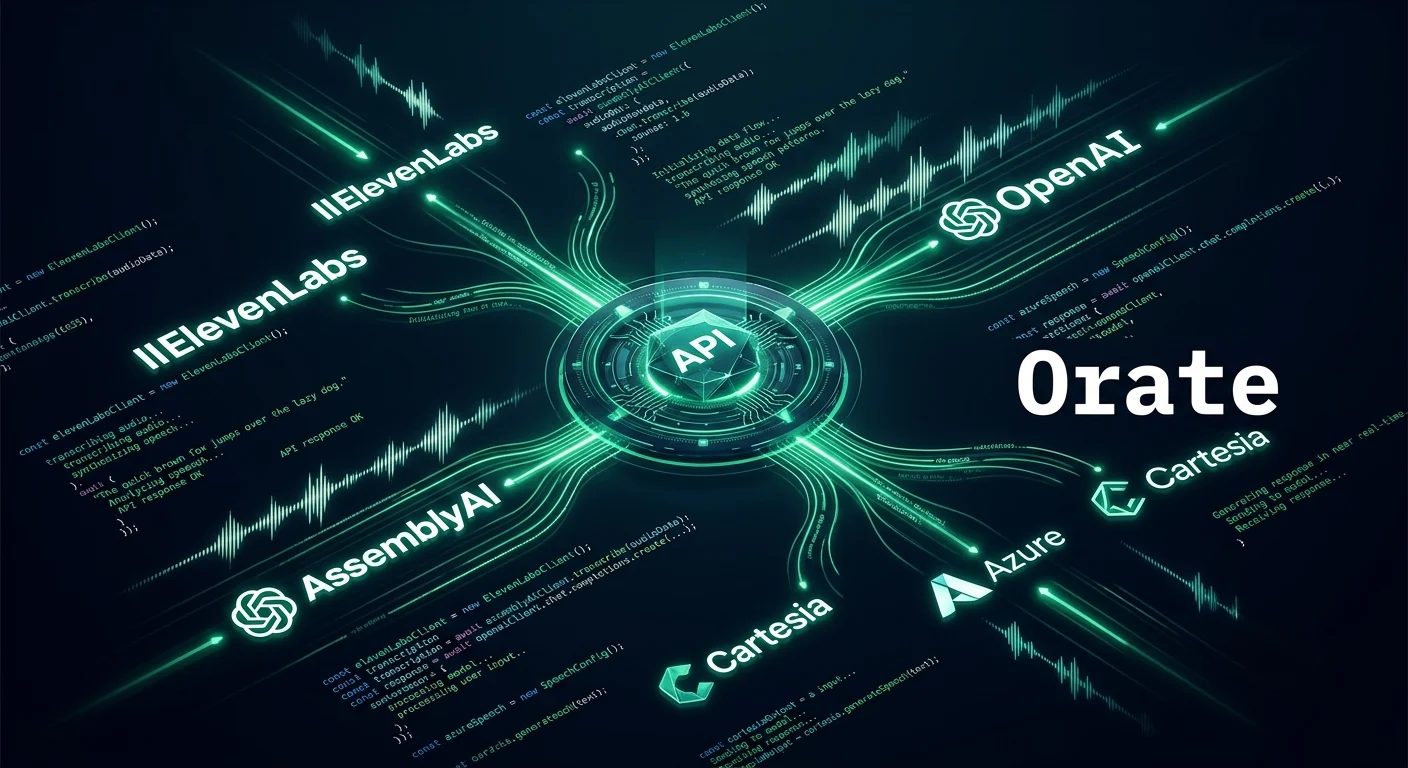
Orate Review 2025: The Open-Source TypeScript SDK That Unifies Every Speech AI Provider Into One Simple API
Built by the creators of next-forge and designed for TypeScript-first developers, Orate gives you TTS, STT, voice isolation, and voice transformation from ElevenLabs, OpenAI, AssemblyAI, Azure, and more — through a single, consistent interface. Free forever.
Every TypeScript developer building a voice-enabled app hits the same friction: ElevenLabs has the best TTS. Deepgram has the best STT. Azure has enterprise compliance. OpenAI's Whisper is good enough for most things. But stitching them all together means four different SDKs, four different API authentication patterns, four different error handling models, and four separate bills to manage. Orate was built to eliminate that mess entirely.
Orate is a free, open-source TypeScript SDK that wraps the world's best speech AI providers — ElevenLabs, OpenAI, AssemblyAI, Azure, LMNT, Cartesia, and Rime — behind four clean primitives: speak() for text-to-speech, transcribe() for speech-to-text, change() for voice transformation, and isolate() for voice isolation. Swap providers with one line of code. Pay only the provider's own API rates — no markup, no subscription, no usage limits. It's the "shadcn for speech AI" — an opinionated, zero-abstraction toolkit that gives you full control without managing infrastructure.
What Is Orate?
Orate is an open-source TypeScript SDK that provides a unified API for all major speech AI capabilities — text-to-speech generation, speech-to-text transcription, voice transformation (speech-to-speech), and voice isolation — by wrapping leading providers including ElevenLabs, OpenAI, AssemblyAI, Azure Cognitive Services, LMNT, Cartesia, and Rime behind a consistent interface. The design philosophy mirrors shadcn/ui and the Vercel AI SDK: zero abstraction overhead, full TypeScript autocomplete, framework-agnostic (Next.js, React, Node.js, Bun, Express), and provider-swappable with a single import change.
You bring your own API keys, Orate handles the interface consistency. There is no Orate cloud, no plan to subscribe to, and no data routed through Orate's servers — your API calls go directly to your chosen provider. This architecture means zero vendor lock-in: if ElevenLabs raises prices or changes terms, you switch to Cartesia or Rime with one import change and zero refactoring. The SDK is built by the same team behind next-forge, one of the most starred Next.js SaaS boilerplates on GitHub, and follows the same opinionated, convention-over-configuration design philosophy.
Key Features
speak() — Unified TTS
Generate human-like speech from text using ElevenLabs, OpenAI, LMNT, Cartesia, or Rime through a single function call. Model and voice selection via typed parameters with full IDE autocomplete — no provider-specific SDK required. Switch from OpenAI's TTS to ElevenLabs for voice cloning with one import change.
transcribe() — Unified STT
Transcribe audio files or streams using OpenAI Whisper, AssemblyAI, Azure Speech, or Deepgram with identical function signatures across all providers. Switch from Whisper to AssemblyAI for speaker diarization and accuracy-critical workloads with one import change — no refactoring your audio pipeline.
change() — Voice Transformation
Convert speech from one voice to another using ElevenLabs' voice conversion or other supported providers. Pass audio in, get transformed audio out — no DSP expertise required. Perfect for dubbing, voice cloning workflows, and accessibility tools that need to preserve speech content while changing the speaker's voice.
isolate() — Voice Isolation
Separate a voice from background noise or music in a recording using AI-powered isolation models. Clean up audio for transcription, podcasting, or content production without a DAW. Remove background chatter, music, or ambient noise from any audio file in seconds.
Pricing Plans
| Service | Price | What's Included |
|---|---|---|
| Orate SDK | Free forever | MIT license. Full SDK access — speak, transcribe, change, isolate — with any supported provider. Framework-agnostic (Next.js, React, Node.js, Bun, Express). Full TypeScript autocomplete. |
| ElevenLabs TTS (via Orate) | From $0 (free tier: 10K chars/mo) then $5/mo+ | Best voice quality, voice cloning, emotional control, multilingual support. Billed directly by ElevenLabs at their standard rates. |
| OpenAI Whisper STT (via Orate) | $0.006/min of audio | $0.01/min for GPT-4o Transcribe | General-purpose transcription, best for English, fast turnaround. Billed directly by OpenAI at their standard rates. |
| AssemblyAI STT (via Orate) | From $0.37/hr of audio (Best tier) | Speaker diarization, sentiment analysis, advanced speech features, high-accuracy transcription. Billed directly by AssemblyAI at their standard rates. |
| Azure Speech (via Orate) | $1/hr for standard TTS; $1/hr for STT (Neural) | Enterprise HIPAA/SOC 2 compliant workloads, custom voice models, real-time transcription. Billed directly by Azure at their standard rates. |
Note: Orate itself costs nothing. You pay only the API providers you choose to use at their standard published rates. Bring your own API keys — Orate never touches billing or routes your API calls through its own servers.
Start Building With Orate Free →Pros & Cons
✓ What Works
- ✅ 100% free and open-source — no subscription, no usage fees, no Orate cloud billing ever
- ✅ Swap providers with one line — identical function signatures across every supported provider
- ✅ Bring-your-own-keys — your API calls go directly to providers, no data routing through Orate
- ✅ Built by the next-forge team — production-tested TypeScript conventions, full IDE autocomplete
- ✅ Four clean primitives cover the complete speech AI lifecycle — TTS, STT, transformation, isolation
✗ What Holds It Back
- ❌ TypeScript-only — Python developers should use a provider SDK directly or Daily Bots / Pipecat
- ❌ No real-time streaming audio support yet — designed for file-based and request-response workflows, not live voice pipelines
- ❌ Provider support is curated, not exhaustive — Deepgram, Google Cloud Speech, and AWS Polly not yet supported natively
- ❌ No built-in audio UI components — purely a backend SDK, frontend audio handling is your responsibility
💡 Community Feedback: What Developers Say
How It Compares to Alternatives
| Feature | Orate | Vercel AI SDK | Daily Bots / Pipecat |
|---|---|---|---|
| Purpose | Unified speech SDK | Unified LLM + speech SDK | Real-time voice agent platform |
| Real-Time Voice | NO — file-based | PARTIAL streaming | YES — WebRTC native |
| Price | Free forever | Free (Vercel Gateway optional) | $0.02/min infrastructure |
| TypeScript Native | YES | YES | Python-first (Pipecat) |
| Voice Transformation | YES — change() | NO | PARTIAL (via provider) |
| Voice Isolation | YES — isolate() | NO | NO |
The comparison reveals a clear ecosystem positioning: Orate owns the speech-first, file-based workflow layer for TypeScript developers; the Vercel AI SDK owns the LLM-first layer with some speech capabilities; and Daily Bots / Pipecat owns the real-time, streaming voice agent layer. These are complementary tools, not competitors. Many production applications use all three: Orate for content generation and processing pipelines, the Vercel AI SDK for LLM orchestration, and Pipecat for real-time conversational agents. The choice depends on your primary use case — content pipeline (Orate), LLM agent (Vercel), or live voice agent (Pipecat/Daily Bots).
Who Should Use Orate?
Best For: TypeScript and Next.js developers building voice features into SaaS products — AI assistants, audiobook generators, podcast tools, accessibility readers, transcription services, and voice transformation apps. Teams who want to ship voice features fast without locking into a single provider. Indie hackers and startup founders who want to start with OpenAI Whisper and upgrade to AssemblyAI or ElevenLabs without refactoring their audio pipeline. Teams that value provider flexibility and want to avoid vendor lock-in in the rapidly evolving speech AI market.
Consider Alternatives If: You need real-time, low-latency voice AI for a conversational agent or phone system — use Daily Bots / Pipecat or Vapi. You're building in Python — use the provider SDKs directly or Daily Bots. You need a no-code or low-code voice integration — Zapier or Make with ElevenLabs native integrations are simpler. You need Google Cloud Speech or AWS Polly — Orate doesn't support these yet; use their official SDKs. You need built-in audio UI components like waveform players or recording widgets — Orate is backend-only; pair it with a frontend audio library.
Expert Editorial Opinion
Orate occupies a clever, underserved position in the developer tools ecosystem: it's not trying to be a voice AI platform, and it's not trying to be another SDK wrapper for a single provider. It's doing exactly what shadcn/ui did for UI components and what the Vercel AI SDK did for LLMs — providing a convention-over-configuration interface that makes the easy path the right path, without hiding complexity when you need it.
The four primitives (speak, transcribe, change, isolate) are well-chosen. They cover the complete lifecycle of audio content in an AI application — generation, transcription, transformation, and cleanup — without over-engineering the abstraction. The provider-swap-with-one-import model is genuinely useful in practice: most developers start with OpenAI Whisper for STT because it's familiar, then need to switch to AssemblyAI for speaker diarization or AssemblyAI Universal for better accuracy. With Orate, that migration is a five-second edit.
The current limitation is real-time support. Orate is fundamentally a request-response SDK — you send audio in, get audio or text out. This is fine for the majority of voice feature use cases (voiceovers, transcription, voice cloning, audio cleanup), but for live conversational AI with sub-500ms latency requirements, you need a streaming pipeline like Pipecat or Vapi. The good news is these use cases are complementary, not competing — Orate for your content pipeline, Pipecat for your live agent. For TypeScript developers shipping voice features in 2025, Orate belongs in the standard toolkit.
Final Verdict
Orate is the best open-source TypeScript SDK for developers who want unified access to the world's top speech AI providers without managing multiple SDKs, multiple API authentication patterns, or multiple billing relationships. The zero-cost model, provider-agnostic architecture, and clean four-primitive API make it the lowest-friction way to add TTS, STT, voice transformation, and audio isolation to any TypeScript or Next.js application. The lack of real-time streaming support is the only meaningful limitation for a narrow class of live voice use cases. For everything else, this is an 8.8 out of 10.
🔗 Related ToolRadar Reviews
More tools from AI Developer Tools
- Can an AI Agent Really Browse the Web for You?
- I Built an AI Agent Army Without Writing Code
- This AI Agent Works While You Sleep — Here's How
- I Gave AI a 47-Page Spec and Watched It Build
- The Search Engine Built for AI Agents
- I Replaced My Brittle Playwright Scripts With Something Better
- Is Aider the Best Free AI Coding Assistant?
- Can an AI Agent Really Replace Your Entire Team?
❓ Frequently Asked Questions
What voice feature would you ship if you didn't have to manage five different speech APIs?
The biggest barrier to building voice-enabled applications isn't the AI quality — it's the integration complexity. Orate removes that barrier entirely, giving you one clean API for every speech capability you need. The only question left is what you'll build with it.

Comments
Post a Comment