


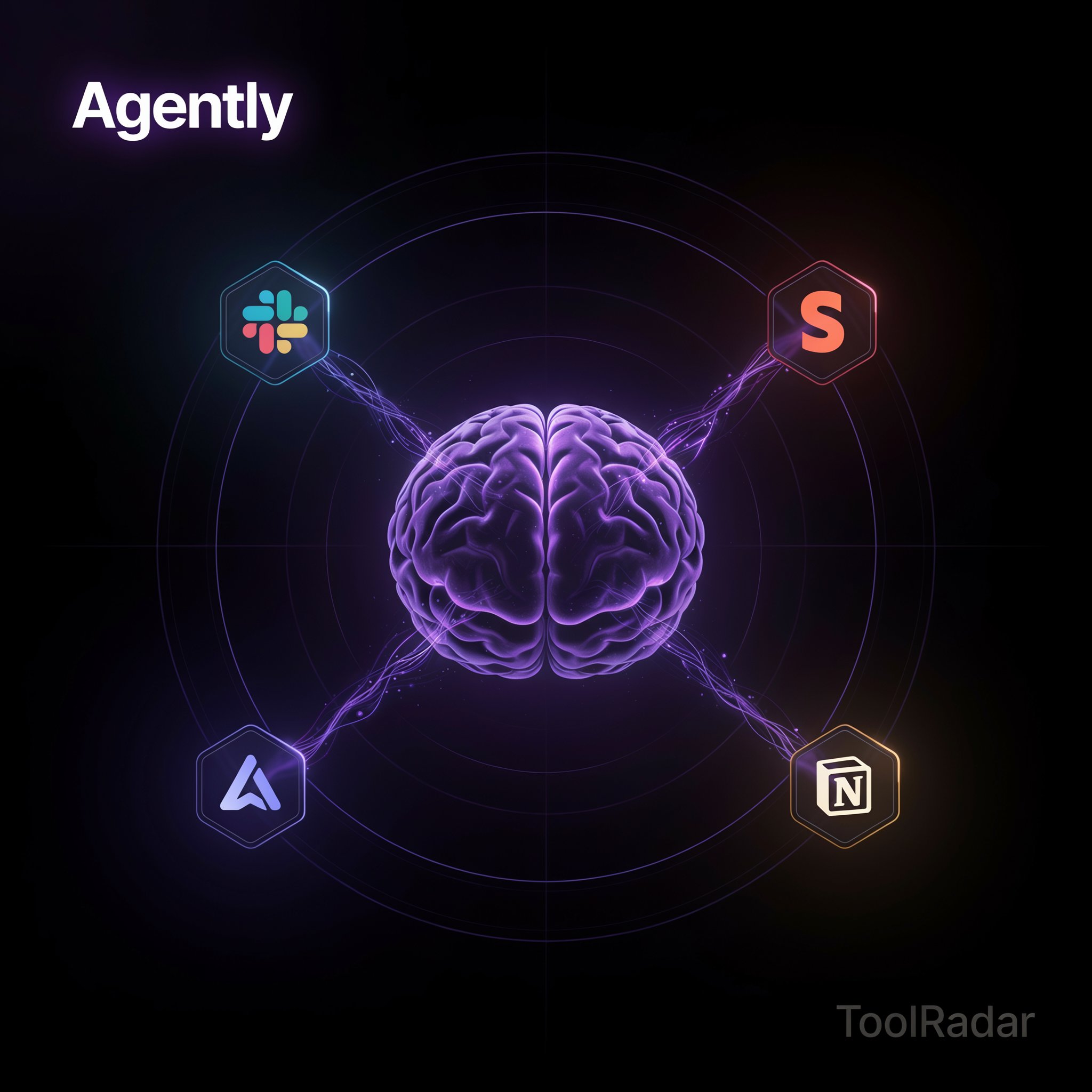
Can an AI Agent Really Run Your Company's Entire Brain?
Agently is an AI Chief of Staff platform that builds a persistent company knowledge graph across 100+ tools, then dispatches autonomous agents to execute work end-to-end. But is it ready for your startup?
Review by ToolRadar Editorial Team · Based on official documentation and verified launch-day feedback
Every startup founder has had the same thought at 2 AM: "If only something could just handle all of this." The Slack threads, the stale Linear tickets, the Stripe charge that failed, the HubSpot deal that went quiet, the Google Drive folder nobody organizes. Agently is the latest tool claiming to be that something — not a chatbot you ask questions, but an autonomous system that builds a living model of your company and dispatches agents to fix problems before you notice them.
Founded by Omar Ghandour and CTO Ahmad Hajj, Agently launched on Product Hunt on July 15, 2026, and won Launch of the Day with 238 upvotes. The pitch is ambitious: connect your entire stack, let the system build a "temporal knowledge graph" of your company, and watch an orchestrator called Jarvis spin up specialized agents to handle the work. The agents do not get your whole company stuffed into a prompt. Instead, they retrieve context as a tool call when needed — a design choice the team says reduces hallucination and keeps agents grounded in real company state.
What Is Agently and Why the Hype
Agently operates on a premise that most AI tools ignore: the agent itself is replaceable, but the persistent memory of how your company works is the actual asset. While typical automation tools execute one task and forget everything, Agently builds an entity-resolved knowledge graph that tracks how your customers, deals, tickets, and documents relate to each other across time. The same customer might appear as "Acme Corp" in Stripe, "acme-team" in Slack, and "ACME-2026" in Linear. Agently spent roughly eight months solving entity resolution alone — the problem of recognizing that these are the same entity — because getting it wrong breaks every downstream decision.
The system connects to over 100 tools via two-way MCP connectors with OAuth and live updates. Once connected, Jarvis reads the graph, identifies what work needs doing, and dispatches agents with specific roles: a Revenue agent that monitors churn risk, a Growth agent that ranks leads, a CX agent that triages support tickets. Every action produces an auditable receipt. Users set guardrails: agents can run fully autonomously, or pause for human approval on anything that sends, pays, or posts. The outputs land as real artifacts — docs, presentations, spreadsheets, HTML pages — not chat logs.
Pros and Cons
✓ What Works
- ✅ Persistent company knowledge graph with entity resolution across 100+ tools
- ✅ Jarvis orchestrator dispatches specialized agents with clear roles and receipts
- ✅ Retrieval-as-tool-call design reduces hallucination vs. stuffing context into prompts
- ✅ Granular autonomy controls: full auto, approval-required, or human-in-the-loop
- ✅ Two-way MCP connectors with OAuth and live updates for real-time sync
- ✅ Outputs land as real artifacts (docs, decks, sheets) not chat logs
- ✅ Founding rate of $69/month locked for life is aggressively priced
- ✅ Data encrypted in transit and at rest; never used for model training
✗ What Holds It Back
- ❌ Product is days old — no long-term usage data or battle-tested reliability records
- ❌ No freemium tier; $69/month minimum with no trial period mentioned
- ❌ Entity resolution at scale is notoriously difficult; eight months of dev time does not guarantee accuracy across all company shapes
- ❌ Web-based only — no desktop app, no offline mode
- ❌ Over 100 connectors sounds impressive, but edge-case integrations often break in practice
- ❌ "Autonomous" agents making real changes to Stripe, Gmail, and GitHub require deep trust that takes months to earn
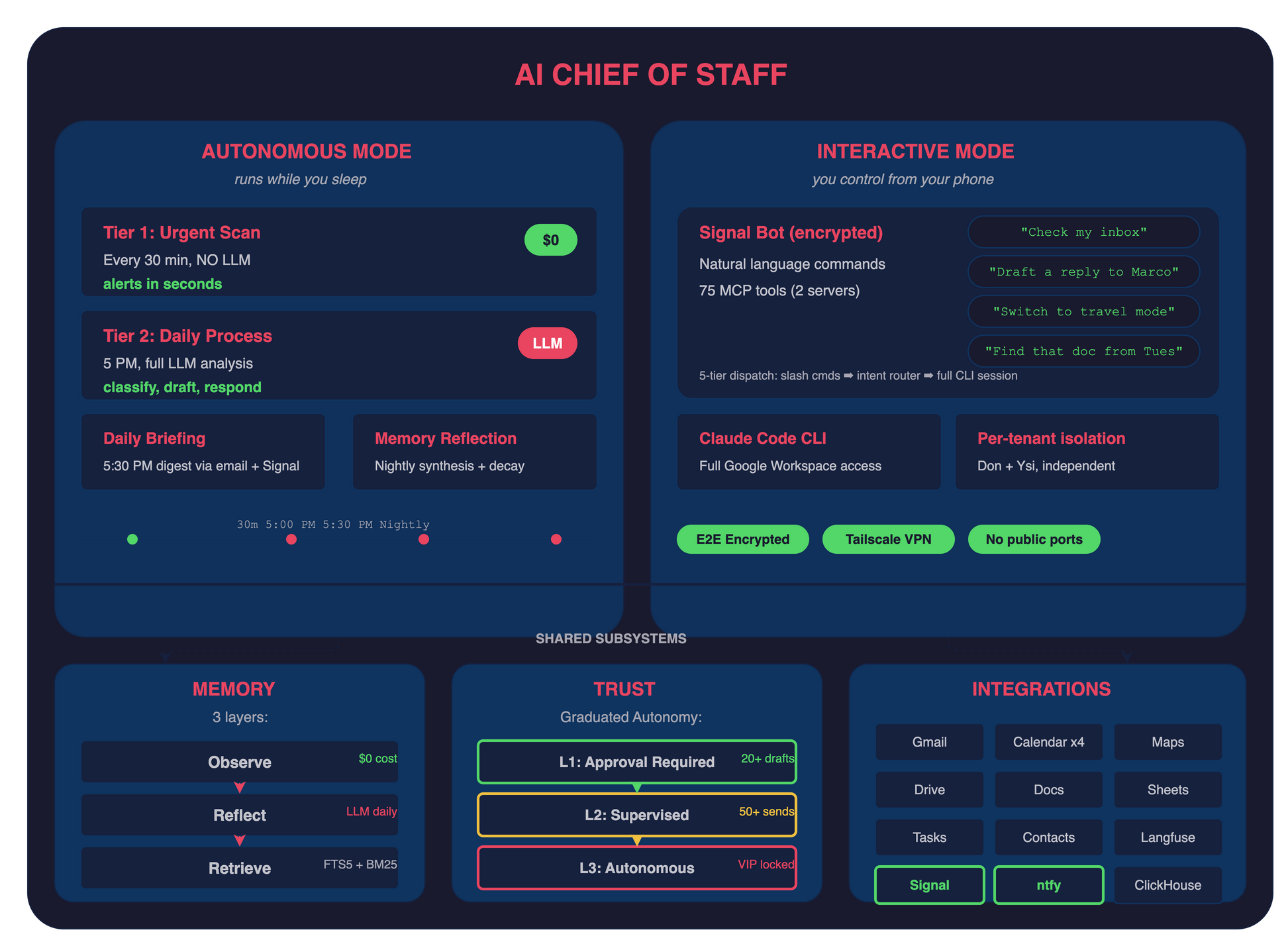
Core Features That Set It Apart
Temporal Knowledge Graph
Agently does not just index your tools — it builds a time-aware graph of entity relationships. A customer in Stripe is linked to the same customer in Slack and Linear, with history preserved. This is the foundation everything else runs on, and the team spent eight months getting entity resolution right before shipping.
Jarvis Orchestrator
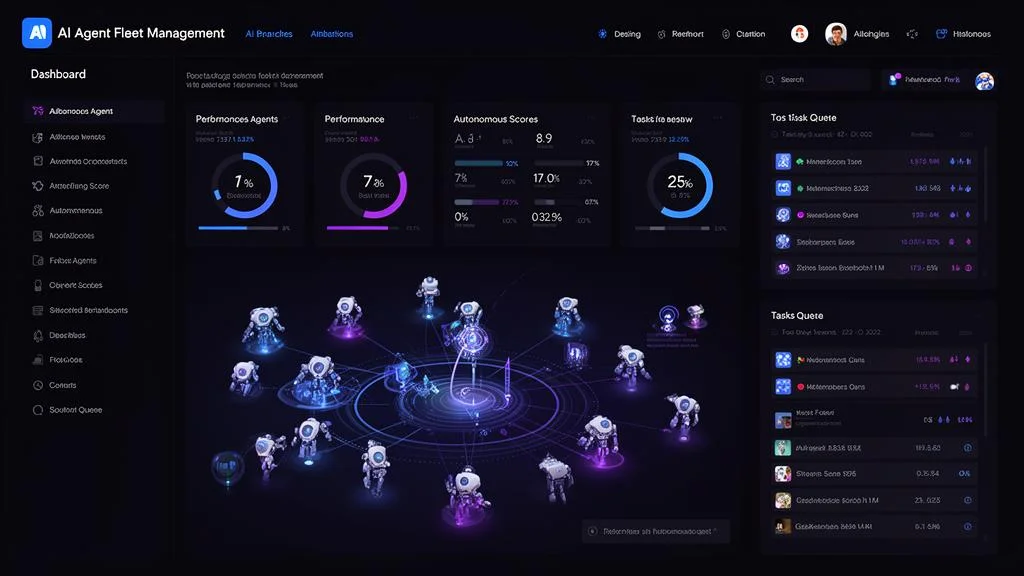
Jarvis is the command center that reads the company graph, decides what work needs doing, and routes tasks to specialized agents. You see a live board with tasks triggered, running, and shipped. Each agent has a defined role — Revenue, Growth, CX — and operates within guardrails you set.
100+ Two-Way MCP Connectors
Connect Slack, Linear, Notion, Google Drive, Stripe, HubSpot, GitHub, Gmail, Figma, PostHog, Asana, Jira, and 90+ more. All connections are OAuth-based with live updates, so the brain stays current without manual refreshes.
Real Output, Not Chat
Agents produce docs, presentations, spreadsheets, and HTML pages that your team can actually ship. A Weekly Brief agent drafts a status document every Monday at 9 AM. A Revenue agent flags churn risk and drafts a save sequence. The work lands where your team already works.
Pricing and Plans
| Plan | Price | What You Get |
|---|---|---|
| Founding Rate (Early Access) | $69/month | All 100+ connectors, Jarvis orchestrator, unlimited agents, unlimited Pages output. Rate locked for life while subscribed. |
| Freemium / Free Tier | Not Available | No free tier exists. Minimum entry is the $69/month founding rate. |
| Enterprise / Custom | Contact Sales | Not publicly detailed. Likely includes SSO, audit logs, custom connectors, and dedicated support. |
ToolRadar may earn a commission if you sign up through partner links. This does not affect our editorial independence.
💡 Community Feedback

Agently vs Zapier vs Glean
| Feature | Agently | Zapier | Glean |
|---|---|---|---|
| Core Model | Autonomous company brain + agents | Deterministic if-then automation | Enterprise search + answers |
| Persistent Memory | Temporal knowledge graph | None (stateless per zap) | Search index, not reasoning |
| Entity Resolution | Built-in across tools | Manual field mapping | Limited |
| Autonomy Level | Full auto to approval-required | Fully deterministic | Read-only (no actions) |
| Output Format | Real artifacts (docs, decks, sheets) | Data moves between apps | Search results + summaries |
| Integrations | 100+ two-way MCP | 8,000+ apps | 100+ enterprise sources |
| Pricing (Entry) | $69/mo founding (locked) | $19.99/mo (750 tasks) | Enterprise-only |
| Maturity | Days old | 10+ years | 5+ years |
The comparison reveals three fundamentally different philosophies. Zapier is the reliable plumber: it moves data between apps with deterministic precision, but it has no memory and no judgment. Glean is the librarian: it finds everything across your stack, but it does not act. Agently is the chief of staff: it remembers, reasons, and executes — but it is also the youngest and least proven of the three. For simple, high-volume data moves, Zapier remains the pragmatic choice. For enterprise search, Glean is established. For autonomous company operations, Agently is making the most ambitious bet.
Learning Curve
Agently markets itself as requiring no technical experience: connect tools via OAuth and the brain builds itself. For a small team with a standard stack (Slack, Notion, Stripe, GitHub), this claim holds up. The initial setup is genuinely one-click per connector. Where the curve steepens is in trust calibration. Deciding which agents can run autonomously, which require approval, and which should stay manual is not a technical problem — it is a governance problem that takes weeks to get right. The founders acknowledge this by making guardrails granular, but the real learning is organizational: teaching your team to trust an AI with access to Stripe charges and Gmail sends. For teams already comfortable with Zapier, the mental model shift from "automation triggers" to "autonomous agents with memory" is the steeper hill. Budget 2-3 weeks for full adoption, not 2-3 days.
Who Should Use It
Ideal for: Startup founders and small teams (5-50 people) drowning in operational overhead across multiple tools. Teams with a modern SaaS stack who want an AI layer that remembers context across Slack, Linear, Notion, Stripe, and HubSpot. Founders who would rather pay $69/month than hire a $120K operations hire. Teams comfortable with early-stage products and willing to iterate on guardrails.
Look elsewhere if: You need proven reliability for mission-critical financial operations. You are a large enterprise requiring SOC 2 Type II compliance and dedicated support SLAs. Your team is deeply invested in Zapier with 50+ active zaps that work fine. You are not comfortable giving an AI tool write access to Stripe, Gmail, or GitHub. You need a free tier to evaluate before committing.
Expert Editorial Opinion
Agently is making one of the most intellectually honest claims in the current AI agent market: the agent is a commodity, but the persistent memory of how your company works is the product. This is a refreshing departure from tools that stuff a system prompt with context and call it an agent. The temporal knowledge graph, entity resolution, and retrieval-as-tool-call architecture are genuine technical differentiators, not marketing labels.
The eight months spent on entity resolution is telling. Omar Ghandour and Ahmad Hajj understand that the hard part of building a company brain is not connecting APIs — it is recognizing that "Acme Corp" in Stripe and "acme-team" in Slack are the same entity, and that getting this wrong poisons every downstream decision. This is the kind of problem that separates serious infrastructure from demo-ware.
However, we must be direct about the maturity gap. Agently launched on July 15, 2026. As of this writing, it has been live for mere days. The Product Hunt upvotes and Launch of the Day badge are genuine signals of interest, but they are not signals of reliability. No long-term usage data exists. No independent security audits have been published. The 100+ connectors are impressive on paper, but anyone who has built integrations knows that the last 20% of edge cases consume 80% of the effort.
The pricing gap is where Agently makes its most aggressive move. At $69/month with a locked founding rate, it undercuts the cost of a single operations hire by orders of magnitude. For a 20-person startup paying $1,200/month for Zapier, Notion, and a part-time ops contractor, Agently's value proposition is clear. But the absence of a free tier or trial period is a friction point. Buyers are being asked to trust a days-old product with write access to their most sensitive tools, and to pay upfront for the privilege.
Does it deserve attention without a free tier? It does, but with eyes open. The founding rate is fair for what is promised, but the risk is not the money — it is the access. Our recommendation: start with read-only connectors, observe the brain's accuracy for two weeks, then gradually enable write permissions on low-risk agents. The $69 is not the barrier; the trust curve is.
Final Verdict
Agently is one of the most conceptually ambitious AI tools to launch in 2026. The knowledge graph architecture, entity resolution, and Jarvis orchestrator represent genuine technical depth, not feature-list padding. The founding pricing is aggressive and fair. But the product is days old, with no long-term track record, no free tier for cautious evaluation, and no published security audits. For founders who are comfortable being early adopters and have the governance discipline to manage autonomous agents, Agently offers a compelling vision of what a company brain could be. For everyone else, it is worth watching closely — but not betting the farm on yet. The score reflects high potential tempered by very real immaturity.
Technical Quality: 8.0/10 · Price-to-Value: 8.5/10 · Maturity & Documentation: 7.0/10
🔗 Related ToolRadar Reviews
More tools from AI Chief of Staff
- I Replaced My $200K Chief of Staff With a $99 AI Tool
- I Replaced My Operations Team With an AI Agent
- This AI Agent Works While You Sleep
- I Let an AI Agent Send 10,000 Cold Emails
- I Built an AI Email Assistant That Never Sleeps
- I Let an AI Agent Make My Phone Calls For Me
- Can an AI Agent Really Replace Your Entire Team?
- I Gave an AI a 47-Page Spec and Watched It Build
❓ Frequently Asked Questions
Would you let an AI hold the keys to your entire company stack?
Agently is betting that the answer is yes — eventually. The brain is built. The agents are dispatched. The only variable left is whether founders are ready to trust a machine with the memory of everything their company has ever done.
Comments
Post a Comment