



FLUX 3 Video vs SANA-Video 2.0: The New AI Video Battle Nobody Saw Coming — Same Day, Two Totally Different Visions
On July 23, 2026, Black Forest Labs and NVIDIA both dropped major AI video releases on the same day. FLUX 3 Video brings native audio, 20-second clips, and a unified multimodal architecture. SANA-Video 2.0 brings 3.2× speed advantage, 720p on a single GPU, and competitive VBench scores at a fraction of the compute. Here is what each one actually is — and who should care.
Reviewed by the ToolRadar Editorial Team · Independent analysis based on official documentation and verified sources
July 23, 2026, will be remembered as the day AI video split into two parallel futures. In Freiburg, Germany, Black Forest Labs opened early access for FLUX 3 Video — the first natively multimodal model that generates video, audio, and images within a single unified architecture. Twelve hours later, NVIDIA Research and MIT published SANA-Video 2.0 on arXiv — an open-source video diffusion transformer that achieves an 84.30 VBench score in 13.2 seconds on a single H100, running 3.2× faster than full-softmax baselines at a fraction of the compute cost.
These are not two versions of the same product. They are two fundamentally different answers to the question of what AI video should become. FLUX 3 Video is a commercial product built for creators, developers, and enterprises who want a finished pipeline with native audio, long clips, and multimodal output. SANA-Video 2.0 is a research foundation built for ML engineers and researchers who want efficient, scalable, open-source video generation they can run on their own infrastructure. Understanding which one matters to you starts with understanding that they are not competitors in the traditional sense. They are parallel visions. Updated July 2026.
What Each Model Actually Is
FLUX 3 Video — The Commercial Multimodal Product
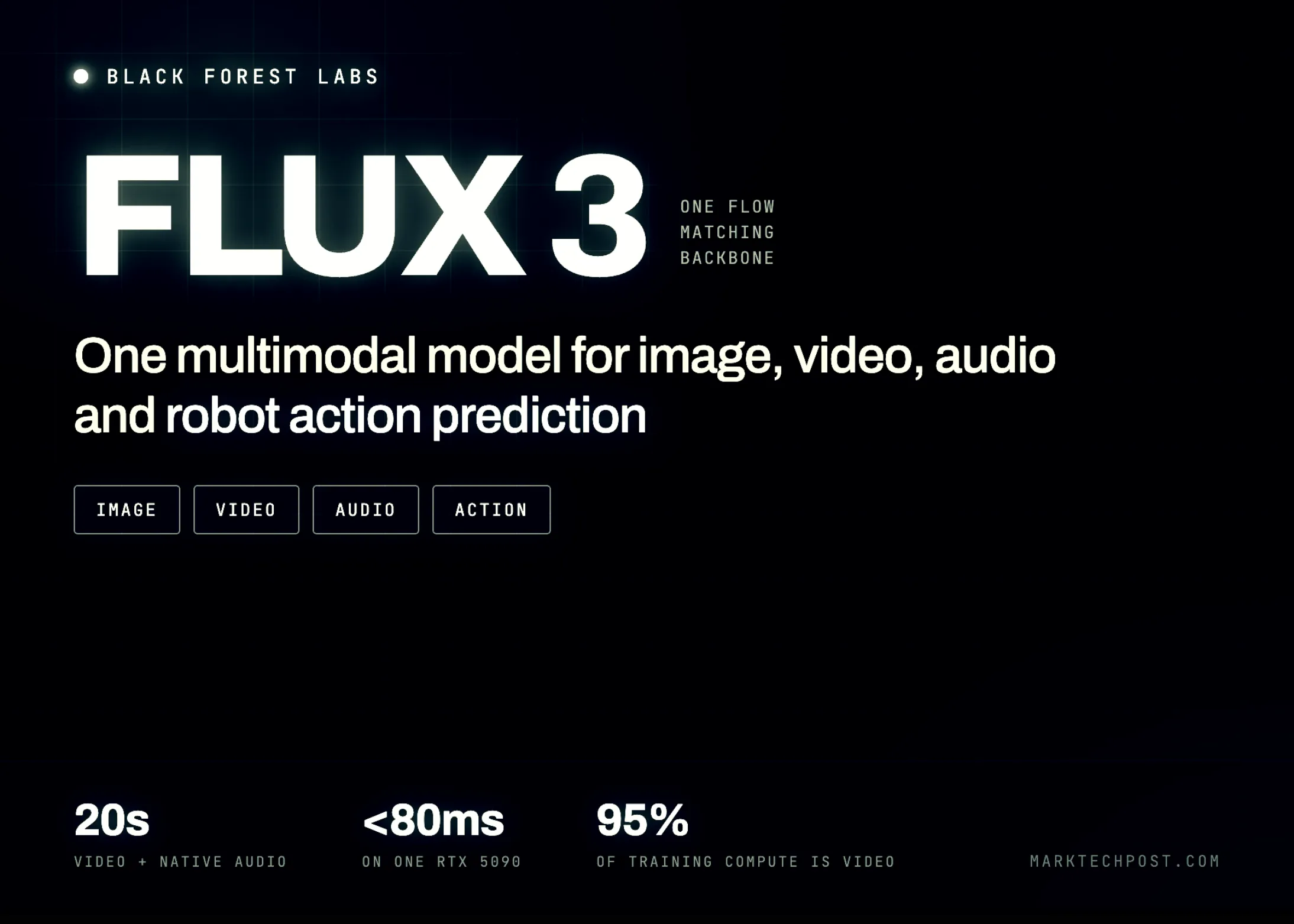
FLUX 3 Video is the video generation product from Black Forest Labs (BFL), the Freiburg-based team founded in August 2024 by the researchers who built latent diffusion and Stable Diffusion at Stability AI. Released on July 23, 2026, as gated early access, it is the first product in BFL's FLUX 3 family — a unified multimodal architecture jointly trained on images, video, and audio in a single model with shared weights. This is not three separate models marketed under one name. It is one backbone that generates video, audio, images, and even robot actions through what BFL calls a "Self-Flow" architecture.
The model generates clips up to 20 seconds long at 720p resolution — double the 10-second maximum of Runway, Kling, and Luma. It supports aspect ratios from 9:16 to 21:9. Native audio generation is its headline feature: dialogue, sound effects, and ambient noise are all produced in the same inference pass as the video, not stitched on afterward. It also supports text-to-video, image-to-video, video-to-video, keyframe-controlled transitions, audio continuation, and multilingual dialogue. Early access partners include Canva, Burda, Magnific (Freepik), and Krea. A 1080p upgrade and open-weight FLUX 3 Dev release are planned for later in 2026.
SANA-Video 2.0 — The Open-Source Research Foundation
SANA-Video 2.0 is a research paper and open-source model from NVIDIA Research and Professor Song Han's lab at MIT, published on arXiv (2607.21553) on the same day — July 23, 2026. It is not a consumer product. It is a hybrid video diffusion transformer available at 5 billion and 14 billion parameter scales, released under the NVIDIA Open Model License with full weights on GitHub. The architecture centers on Hybrid Linear-Softmax Attention, which combines gated linear attention (O(N) complexity) with periodic gated-softmax anchors at a 3:1 ratio, plus Block Attention Residuals that increase effective rank by approximately 12%.
The numbers are striking. With 40-step sampling, SANA-Video 2.0 achieves a VBench score of 84.30 in 13.2 seconds at 480p on a single H100. At 720p with a 5-second clip, it runs in 13.06 seconds using the 5B pipeline with Sol-Engine optimization. That is 3.2× faster than a full-softmax baseline at 720p/60s, and the Sol-Engine full-stack acceleration adds another 3.58× on top. The model also supports QAT quantization with MXFP4 weights and MXFP8 activations that match BF16 baseline quality on VBench. It has been fine-tuned on approximately 5,000 hours of robot and egocentric video for physical AI applications. But there is no interface, no SaaS, and no native audio. It is a model for researchers and engineers with GPU infrastructure.
Head-to-Head Comparison
| Feature | FLUX 3 Video | SANA-Video 2.0 | Runway Gen-4 |
|---|---|---|---|
| Type | Commercial product | Open-source research | Commercial product |
| Made By | Black Forest Labs | NVIDIA Research + MIT | Runway ML |
| Release Date | July 23, 2026 | July 23, 2026 | Earlier 2026 |
| Max Video Length | 20 seconds | Scales with GPU | 10 seconds |
| Native Audio | YES — same inference pass | NO | Post-processing only |
| Resolution | 720p (1080p coming) | Up to 720p | Up to 1080p |
| Speed Benchmark | Not published yet | 13.2s at 480p on H100 | Cloud-based, variable |
| VBench Score | Preliminary only | 84.30 (paper-verified) | Competitive |
| Access | Gated early access | Open weights on GitHub | Subscription SaaS |
| Pricing | Not announced | Free (own GPU required) | $28–$76/month |
| Open Source | Planned (FLUX 3 Dev) | YES — now | NO |
| Robotics Support | YES (FLUX-mimic at Audi) | Fine-tuned for physical AI | NO |
| Who It Is For | Creators, devs, enterprises | ML researchers, GPU owners | Creative professionals |
The table reveals the core truth: FLUX 3 Video and SANA-Video 2.0 are not fighting for the same user. FLUX 3 Video is optimized for creative output and commercial deployment — native audio, long clips, partnerships with platforms like Canva and Krea. SANA-Video 2.0 is optimized for research reproducibility and compute efficiency — open weights, verified benchmarks, linear attention that scales. Runway Gen-4 sits in the middle as the incumbent SaaS option, but neither new release is trying to be Runway. FLUX 3 is trying to redefine what a video model can generate. SANA-Video 2.0 is trying to redefine how efficiently a video model can run. Updated July 2026.
What Makes Each One Unique
FLUX 3: Native Audio in One Pass
Every major competitor — Runway, Luma, Kling — assembles audio and video through separate pipelines or attaches audio as post-processing. FLUX 3 Video is the first to generate both video and synced audio (dialogue, SFX, ambient noise) in the same inference pass. This is not a feature addition. It is an architectural decision that changes what the model understands about temporal coherence.
SANA-Video 2.0: Linear Attention at Scale
The Hybrid Linear-Softmax Attention breaks the O(N²) bottleneck of traditional transformers. By combining gated linear attention with periodic softmax anchors at a 3:1 ratio, SANA-Video 2.0 achieves competitive quality with far larger models while running 3.2× faster. The gap widens as clip length increases — making it the clear choice for long-form video research.
FLUX 3: From Video to Robotics
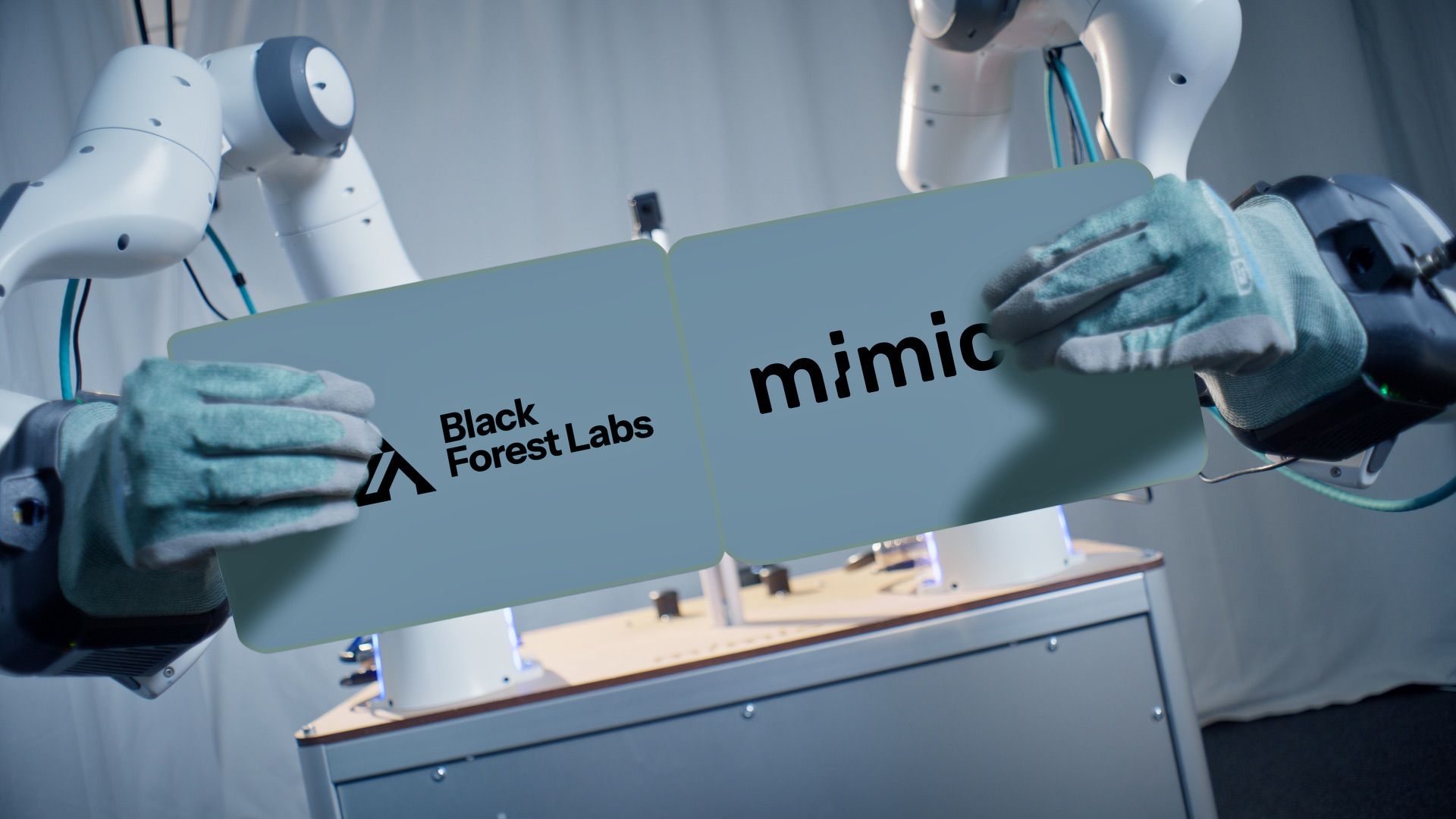
The same unified backbone that generates video and audio also powers FLUX-mimic, a robotics model currently being tested in live Audi production lines. This is not a separate project. It is the same model weights applied to action generation — a signal of where BFL believes multimodal AI is headed.
SANA-Video 2.0: Quantization Without Loss
QAT with MXFP4 weights and MXFP8 activations matches BF16 baseline quality on VBench. On NVIDIA GB200, a single forward pass for an 81-frame video takes 11 milliseconds. This is not just fast. It is fast enough to embed video generation into real-time applications that were previously impossible.
Pros & Cons
✓ FLUX 3 Video — Strengths
- ✅ First natively multimodal model — video, audio, images, and actions in one architecture
- ✅ 20-second clips — double the length of Runway, Kling, and Luma
- ✅ Native synced audio generation — dialogue, SFX, and ambient noise in one pass
- ✅ Enterprise partnerships with Canva, Burda, Magnific, and Krea signal real adoption
✗ FLUX 3 Video — Limitations
- ❌ Gated early access — invite-only, no public pricing, no guaranteed timeline for open release
- ❌ Preliminary benchmarks only — BFL explicitly states results are early and methodology is not fully published
- ❌ 720p at launch — 1080p is promised but not yet available
✓ SANA-Video 2.0 — Strengths
- ✅ Open-source weights under NVIDIA Open Model License — fully reproducible research
- ✅ 84.30 VBench score verified in peer-reviewed paper with full methodology
- ✅ 3.2× speed advantage over full-softmax baseline; 3.58× with Sol-Engine
- ✅ Runs on a single H100 — no GPU farm required for competitive quality
✗ SANA-Video 2.0 — Limitations
- ❌ No consumer interface — requires ML engineering expertise to deploy
- ❌ No native audio generation — video only, no dialogue or sound effects
- ❌ Research paper, not a product — no support, no SLA, no guaranteed updates
Who Should Use Which
Choose FLUX 3 Video if: You are a creator, developer, or enterprise building commercial video products and you need a finished pipeline with native audio, long clips, and multimodal output. You want to integrate video generation into an existing product through an API. You value partnerships with platforms like Canva and Krea as a signal of ecosystem maturity. You are willing to apply for early access and wait for pricing announcements. You need video-to-video, image-to-video, and keyframe-controlled transitions in a single model.
Choose SANA-Video 2.0 if: You are an ML researcher, a startup with GPU infrastructure, or an engineer building custom video generation pipelines. You need open-source weights you can fine-tune, quantize, and modify. You care about compute efficiency and want to run competitive video generation on a single H100 instead of a GPU cluster. You are working on physical AI, robotics video, or long-form generation where linear attention's O(N) scaling matters. You do not need a consumer interface and are comfortable with research-grade code.
Look elsewhere if: You need a tool today with a credit card and a web interface — neither of these is fully available to casual users yet. FLUX 3 is gated; SANA-Video 2.0 requires infrastructure. For immediate production use, Runway Gen-4 or Kling AI remain the more accessible options.
💡 What the Sources Say
Learning Curve & Access
Accessing FLUX 3 Video requires applying through BFL's early access portal at bfl.ai/models/flux-3. The process is invite-only, with API access and private weights distributed to selected partners. For developers already integrated with BFL's FLUX image models, the transition is straightforward — the API structure is consistent across the FLUX 3 family. For new users, the learning curve is minimal if you receive access; the model is designed as a commercial product with documentation and support. The uncertainty is not the interface — it is the wait time and the undisclosed pricing.
SANA-Video 2.0 requires a fundamentally different profile. You download weights from GitHub, configure a CUDA environment on an H100 (or equivalent), and run inference through research-grade code. The NVIDIA project page at nvlabs.github.io/Sana/Video2/ provides the paper, the weights, and the code, but no hand-holding. The Sol-Engine optimizations require additional setup. The learning curve is steep for anyone without ML engineering experience, but trivial for researchers already running diffusion models. The 5B model is more accessible for limited GPU memory; the 14B model requires more VRAM but delivers higher quality. Updated July 2026.
Expert Editorial Opinion
The simultaneous release of FLUX 3 Video and SANA-Video 2.0 on July 23, 2026, is not a coincidence — it is a convergence. Both teams recognized that the next frontier in AI video is not simply higher resolution or longer clips. It is modality and efficiency. BFL chose modality: one model that understands video, audio, and action as a single representation. NVIDIA and MIT chose efficiency: one model that achieves competitive quality with linear attention and aggressive quantization. Both are correct. Both are necessary. And neither makes the other obsolete.
Technically, FLUX 3 Video's multimodal architecture is the more ambitious bet. Training a single model on images, video, audio, and robot actions requires a shared latent space that can represent fundamentally different signal types. If BFL succeeds, FLUX 3 becomes not just a video generator but a general-purpose world model — the kind of foundation that robotics companies like Audi are already betting on with FLUX-mimic. The risk is that multimodal training is harder to scale and harder to debug. Preliminary benchmarks with unpublished methodology are a yellow flag, though BFL's track record with Stable Diffusion warrants patience.
SANA-Video 2.0's technical contribution is more immediately verifiable. The VBench score of 84.30 is published, peer-reviewed, and reproducible. The 3.2× speed advantage over full-softmax baselines is measured against explicit baselines in the paper. The linear attention mechanism is not new in theory, but SANA-Video 2.0 is the first to demonstrate it at this scale with this quality level. For the research community, this is a landmark paper. For practitioners, it is a foundation they can build on without licensing fees or API rate limits.
The pricing gap analysis reveals two entirely different economies. FLUX 3 Video has not announced pricing, which creates uncertainty for teams budgeting around it. Early access models from BFL have historically been expensive — FLUX image API pricing was premium at launch. For enterprises, the cost may be justified by the native audio feature alone, which eliminates the need for a separate audio pipeline. SANA-Video 2.0 is free in terms of licensing, but the infrastructure cost is real: a single H100 costs approximately $2–4 per hour on cloud providers, and running inference at scale requires engineering time that is not free. The total cost of ownership for SANA-Video 2.0 is lower for teams that already have GPU infrastructure and higher for teams that would need to rent it.
Is FLUX 3 Video worth the wait and the undisclosed pricing? For teams building consumer-facing video products where native audio and 20-second clips are competitive differentiators, yes. The feature set is genuinely ahead of Runway and Kling in specific dimensions. For researchers and startups optimizing for cost-per-pixel and reproducibility, SANA-Video 2.0 is the clear choice — not because it is better, but because it is the right tool for a different job. The real story of July 23 is not which model won. It is that AI video now has two mature, credible paths forward — and for the first time, creators and researchers do not have to choose the same tool.
Final Verdict
FLUX 3 Video and SANA-Video 2.0 are not competitors. They are complementary visions of what AI video can become. FLUX 3 Video is the product bet: multimodal, commercial, and integrated. It offers native audio, 20-second clips, and a unified architecture that extends into robotics. For creators and enterprises building video products, it represents the most feature-complete pipeline available in mid-2026 — with the caveat that pricing is undisclosed and access is gated. SANA-Video 2.0 is the research bet: open, efficient, and verifiable. It offers an 84.30 VBench score at 3.2× the speed of larger models, running on a single H100 with open weights. For researchers and engineers with GPU infrastructure, it is a foundation to build on rather than a product to consume.
The choice is not which model is better. The choice is which problem you are solving. If you need a video product with audio today, FLUX 3 Video is the only credible option. If you need a video model you can own, modify, and deploy at scale, SANA-Video 2.0 is the only credible option. The industry is healthier for having both.
🔗 Related ToolRadar Reviews
More tools from AI Video Generation
- Is Runway Gen-4 the Best AI Video Tool of 2026?
- Is Hunyuan Video the Best Open-Source AI Video Model?
- Forget Sora — Seedance 2.0 Is Shockingly Good
- Hollywood on a Budget: SkyReels V4 Says Yes
- The AI 3D Generator That Beat 9 Competitors
- China's AI Video Tool Just Shocked the Industry
- Luma Dream Machine 2.0 Review: Hollywood in Your Browser
- Kling AI Review 2026: Best AI Video Generator?
❓ Frequently Asked Questions
Which future of AI video are you building toward — the one you can use today, or the one you can own forever?
FLUX 3 Video and SANA-Video 2.0 dropped on the same day with opposite answers to that question. The only wrong choice is pretending they are the same thing.

Comments
Post a Comment