


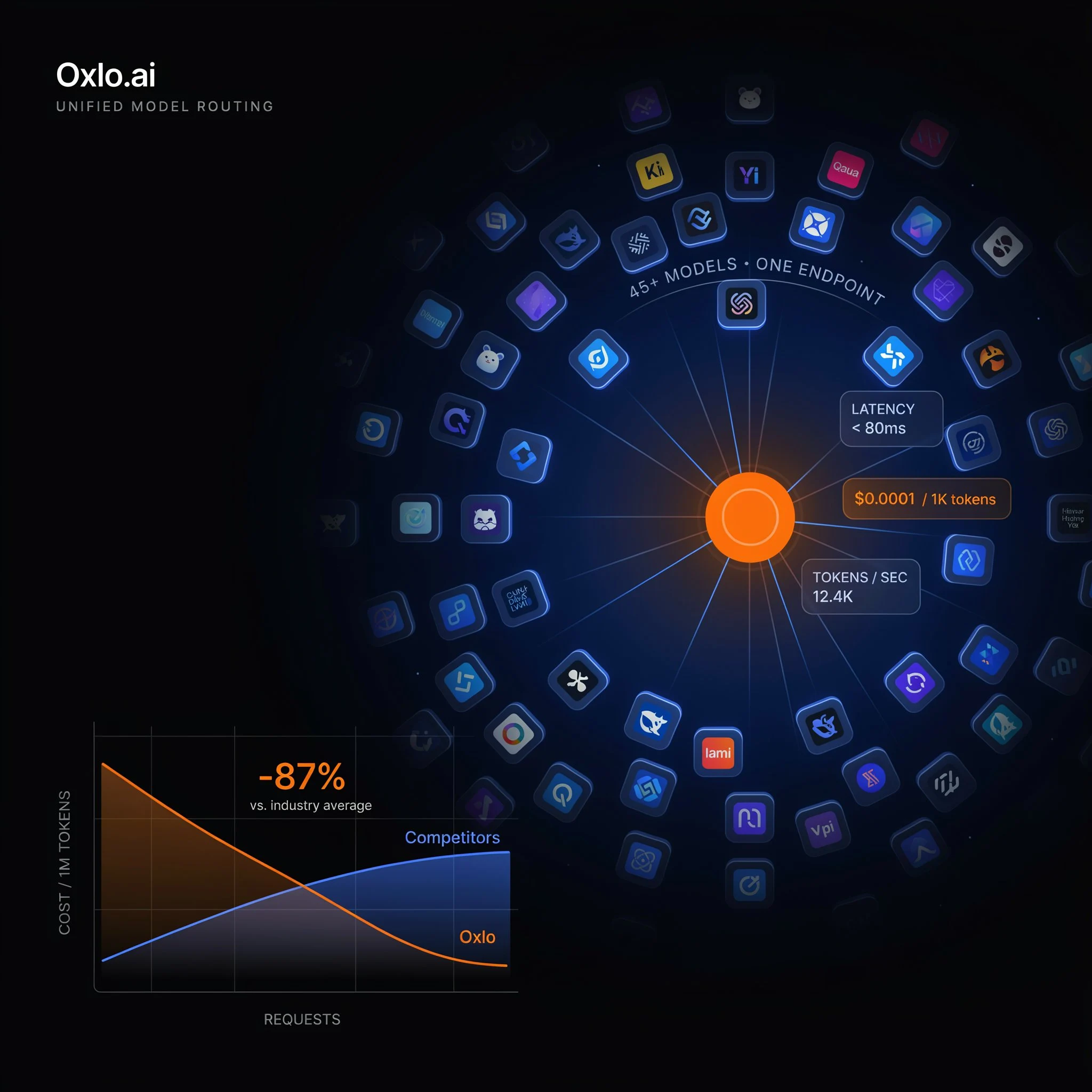
Oxlo.ai Review 2026: The Flat-Rate AI Inference API That Saves Long-Context Teams Up to 100x on Their Monthly Bill
Access 45+ frontier open-source models — DeepSeek R1, Kimi K2.6, Llama 3.3 70B, Qwen 3, Gemma 3, and more — through a single OpenAI-compatible API. Pay per request, not per token. Zero data retention. No training on your prompts. Free tier available.
Every developer who has built a production AI application knows the feeling: the demo works, users love it, and then the inference bill arrives. Token-based pricing was designed for simple Q&A — not for the reasoning chains, long-context document processing, multi-step agent workflows, and tool-call loops that real production AI requires. A single reasoning trace can consume 50,000 tokens. Multiply that by thousands of users and a per-token bill becomes completely unpredictable. Oxlo.ai was built to eliminate that unpredictability entirely.
Launched in March 2026 and hitting Product Hunt Product of the Day shortly after, Oxlo.ai is a developer-first AI inference platform that flips the pricing model: instead of charging per token, it charges a flat rate per API request — regardless of prompt length. A 100-token prompt costs the same as a 50,000-token prompt. The platform provides access to 45+ curated open-source and frontier models across 7 categories — text, code, vision, image generation, audio, embeddings, and detection — through a single OpenAI-compatible API endpoint, with zero data retention and no training on customer prompts. For teams running long-context or agentic workloads, the savings compared to Together AI, Fireworks AI, or OpenRouter can reach 10–100x. Updated July 2026.
What Is Oxlo.ai?
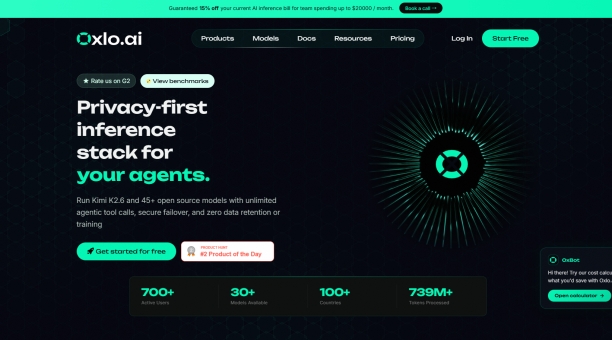
Oxlo.ai is a developer-first AI infrastructure platform that provides request-based access to 45+ curated open-source and frontier AI models through a unified, OpenAI-compatible HTTP API — without token-based billing, without managing GPU infrastructure, and without data retention or model training on customer data. The platform abstracts GPU-backed inference infrastructure behind a single API layer, enabling small teams and startups to build production-ready AI features at predictable cost. Developers choose their model explicitly per request — Oxlo does not auto-route or silently switch models — giving full control over quality, latency, and cost tradeoffs. The model library spans 7 categories: Text/Chat (Qwen 3 32B, Llama 3.3 70B, DeepSeek R1 671B, Kimi K2.6, GLM 5, Minimax M2.5, DeepSeek V4 Flash), Code (Qwen 3 Coder 30B, DeepSeek Coder 33B), Vision (Gemma 3 27B, Kimi VL), Image Generation (Oxlo Image Pro, SDXL, SD 3.5 Large), Audio (Whisper Large v3, Kokoro 82M TTS), Embeddings (BGE-Large, E5-Large), and Detection (YOLOv9, YOLOv11). Integration takes minutes — sign up via the Oxlo Portal, generate an API key, and swap your existing OpenAI base URL.
Key Features
Request-Based Flat Pricing
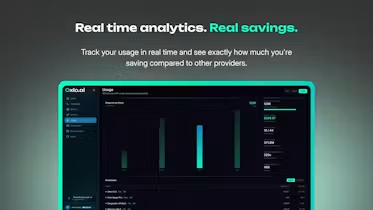
Every API call costs the same flat rate regardless of prompt or response length. A 100-token prompt costs the same as a 50,000-token prompt. No token counting, no surprise bills, no runaway costs from a single long reasoning trace. Daily request limits replace per-token meters.
45+ Frontier Models, 7 Categories
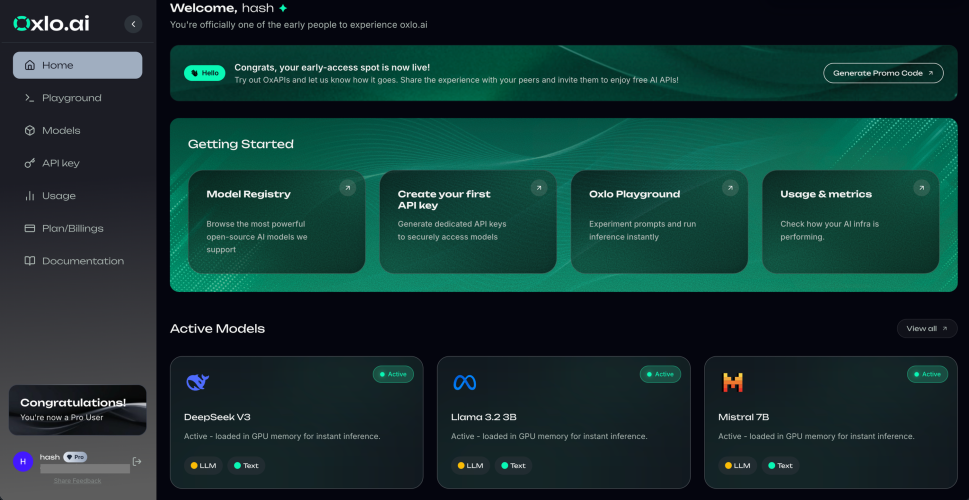
Text, code, vision, image generation, audio (STT + TTS), embeddings, and computer vision detection — all through one OpenAI-compatible API endpoint. New models added continuously including Kimi K2.6, DeepSeek V4 Flash, and Minimax M2.5.
Zero Data Retention & No Training
Oxlo never stores your prompts, never sells your data, and never trains models on your API calls. Privacy-first by design — confirmed explicitly in terms and reiterated on the Product Hunt launch page by the founding team.
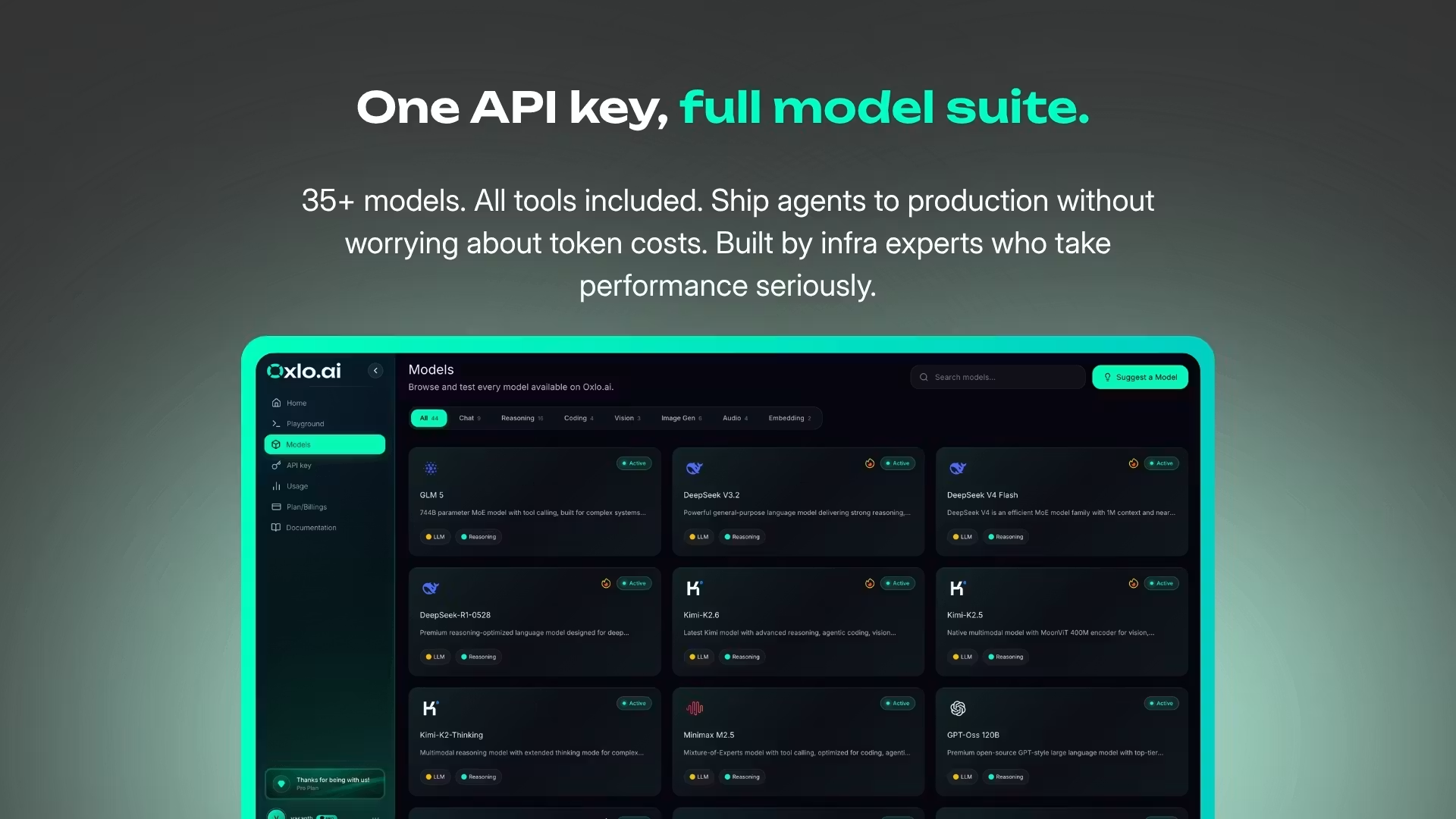
OpenAI-Compatible API
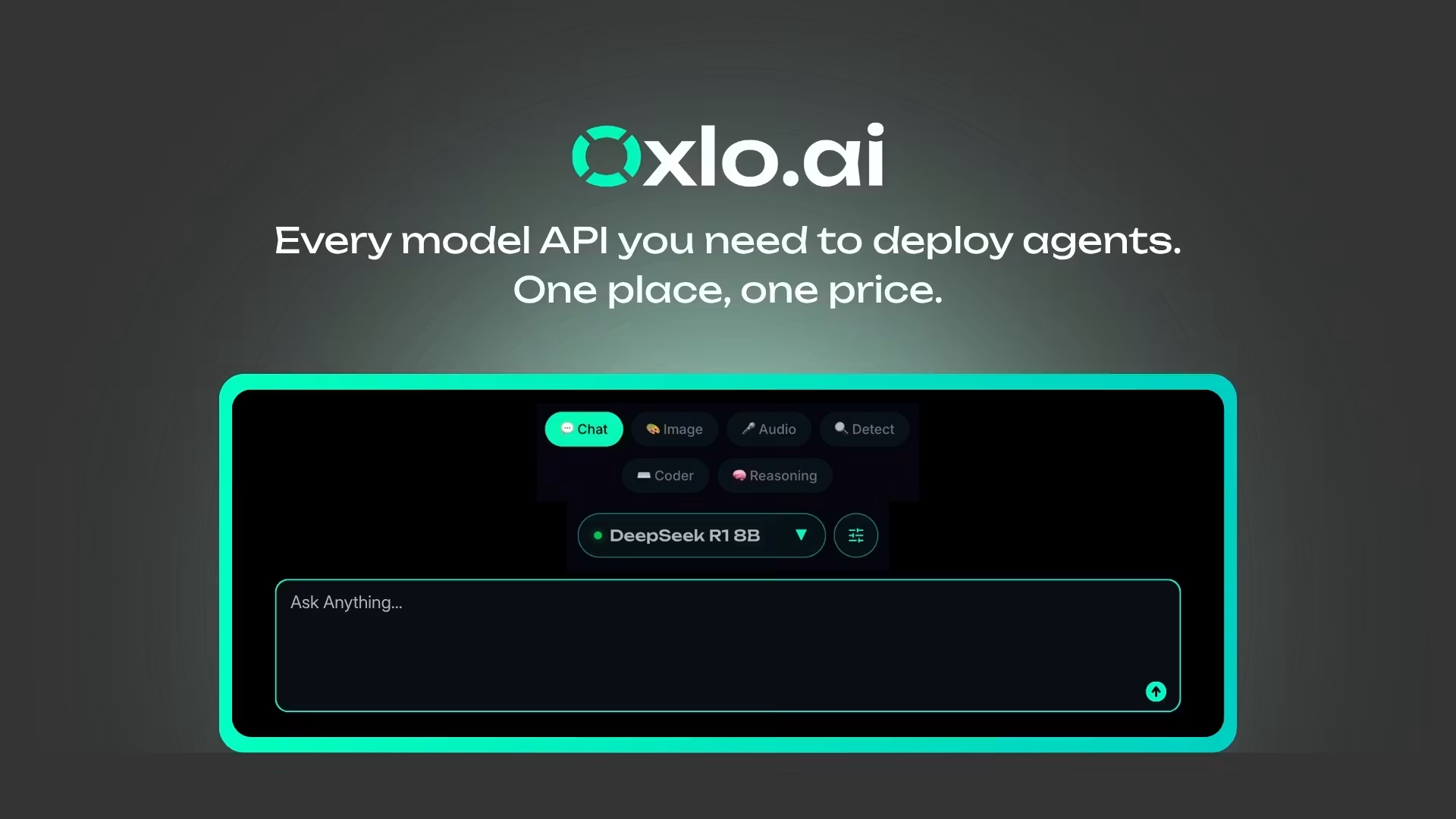
Drop-in replacement for OpenAI, Together AI, Fireworks, or OpenRouter. Change your base URL and API key — your existing code works without modification. Includes a model comparison tool and parameter calibration playground before moving to production.
Pricing Plans
| Plan | Price | What's Included |
|---|---|---|
| Free | $0 — no credit card required | 60 requests/day, 16+ models including Llama 3.3 70B, Mistral 7B, Gemma 3 — permanent free tier |
| Pro | $80/month | 1,000 requests/day across all 45+ models, 1-day free trial included before committing, all model categories |
| Premium | $350/month | 5,000 requests/day across all 45+ models, priority infrastructure, full model library |
| Enterprise | Custom — guaranteed 15% savings | Teams spending up to $20,000/month on AI inference with any current provider — minimum savings guaranteed in writing |
Pros & Cons
✓ What Works
- ✅ Flat request-based pricing eliminates token math — 10–100x cheaper than token-based providers on long-context and agentic workloads
- ✅ 45+ models across 7 categories in one OpenAI-compatible API — text, code, vision, image, audio, embeddings, detection
- ✅ Zero data retention and no training on prompts — confirmed by founding team explicitly
- ✅ No overage charges ever — daily limits queue rather than bill, making costs structurally predictable
✗ What Doesn't
- ❌ No automatic model routing — developers must explicitly select a model per request; no cost-aware auto-routing yet (roadmap item per founder comments)
- ❌ Free tier (60 requests/day) is limited for meaningful production testing — meaningful evaluation requires the Pro plan ($80/month)
- ❌ Flat pricing favors long-context workloads — for very short prompts at low volume, per-token providers can be cheaper
- ❌ Newer platform — launched March 2026, smaller community and ecosystem than Together AI or Fireworks AI
💡 Real User Pulse: Community Feedback
How It Compares to Alternatives
| Feature | Oxlo.ai | Together AI | Fireworks AI | OpenRouter |
|---|---|---|---|---|
| Pricing Model | Flat per request | Per token | Per token | Per token |
| Long-Context Cost (50K tokens) | SAME as short | 10–100x more expensive | 10–100x more expensive | 10–100x more expensive |
| Data Training | NO — never | VARIES | NO | NO |
| Free Tier | YES 60 req/day | YES limited | YES limited | YES limited |
Together AI remains the established leader in open-source model hosting with the deepest GPU infrastructure and the largest community of developers. Fireworks AI offers strong performance optimization and is widely trusted for production workloads. OpenRouter provides the most flexible routing layer, automatically selecting the cheapest provider per request. But all three share the same fundamental pricing model: per token. For long-context workloads — document processing, RAG pipelines, reasoning agents, multi-step tool calling — that model becomes structurally expensive and unpredictable. Oxlo.ai's flat-per-request pricing is the only alternative that makes costs deterministic regardless of prompt length. The tradeoff is explicit model selection (no auto-routing) and a smaller ecosystem. For teams that value cost certainty over convenience, the math is compelling.
Who Should Use Oxlo.ai?
Best For: Startups and development teams building AI-powered SaaS products with long-context workloads — document processing, RAG pipelines, reasoning agents, multi-step tool-calling workflows, and any application where prompt length is variable and hard to forecast. Teams spending $500–$20,000/month on Together AI, Fireworks AI, or OpenRouter who want predictable infrastructure costs and a guaranteed savings path. Developers who want access to frontier open-source models (DeepSeek R1, Kimi K2.6, Qwen 3) without managing their own GPU infrastructure.
Consider Alternatives If: Your workloads consist of very short prompts at low volume — per-token providers like Together AI may be cheaper at low context lengths. You need GPT-4o, Claude Sonnet, or Gemini 2.5 Pro specifically — Oxlo.ai focuses on open-source and frontier open models, not closed commercial APIs. You need automatic model routing or cost-aware inference optimization — OpenRouter's routing layer or custom LLM gateways like LiteLLM may be better fits. You need a playground-first, no-code AI interface rather than a developer API — Oxlo.ai is developer-facing only.
Learning Curve
Oxlo.ai is designed for developers who already know how to call an API. The learning curve is minimal — if you've integrated OpenAI, Together AI, or Fireworks, you already know how to use Oxlo.ai. The integration is literally two lines changed: your base URL and your API key. The model comparison tool and parameter calibration playground help teams evaluate which model fits their specific task before committing to production — a useful addition that most providers don't offer. The main learning curve is conceptual: internalizing that flat-per-request pricing means you no longer need to optimize prompt length for cost. Teams accustomed to token-counting discipline (trimming context, summarizing history, compressing prompts) can stop worrying about that layer and focus on output quality instead. For teams new to AI infrastructure, the free tier provides a risk-free sandbox. For experienced teams, the switch from token-based to request-based thinking takes a few days of billing analysis to fully internalize.
Expert Editorial Opinion
Oxlo.ai's pricing insight is correct and well-timed. The token-based billing model was designed when LLMs were used for simple, short completions. The 2025–2026 shift to agentic applications — where a single user action triggers reasoning chains, tool calls, retries, and multi-step model interactions — has broken the economics of per-token pricing for production teams. An agent that handles a complex user request might consume 50,000–200,000 tokens in a single workflow. At Together AI or Fireworks rates, that single interaction can cost $0.10–$0.60. Multiply by thousands of daily users and the bill becomes structurally unpredictable and nearly impossible to budget. Flat-per-request pricing solves this at the pricing layer rather than the engineering layer.
The model library is genuinely impressive for a platform launched in March 2026. Access to Kimi K2.6, DeepSeek R1 671B, DeepSeek V4 Flash, Minimax M2.5, Qwen 3 32B, Llama 3.3 70B, GLM 5, and the full suite of vision, audio, embedding, and detection models — all through one OpenAI-compatible endpoint — is the kind of multi-modal model access that previously required separate integrations with half a dozen providers. The explicit model selection philosophy (no auto-routing that could silently change behavior) is the right call for production teams that care about deterministic behavior, reproducibility, and quality control.
The honest limitation is the savings curve. Flat-per-request pricing is unambiguously better for long-context and agentic workloads. For short-prompt, high-volume workloads — think simple classification or keyword extraction at thousands of requests per hour with 200-token prompts — the math may favor per-token providers. The Oxlo.ai team acknowledges this transparently in their pricing FAQ. Smart teams will model their specific workload against both pricing models before committing. For any team running reasoning models, RAG pipelines, or autonomous agents at scale, the savings case is compelling and the switching cost is minimal — it's a base URL change. Does it deserve a paid plan without a more generous free tier? The free tier (60 requests/day) is genuinely useful for evaluation and small projects. The Pro plan at $80/month for 1,000 requests/day is competitive with any token-based provider at equivalent volume, and the Premium plan at $350/month for 5,000 requests/day offers enterprise-grade throughput.
Final Verdict
Oxlo.ai is the best flat-rate AI inference API available for development teams building long-context and agentic applications in 2026. The request-based pricing model solves a real and growing pain point, the 45+ model library covers every major open-source frontier model across 7 categories, the OpenAI-compatible API makes switching frictionless, and the zero data retention policy is non-negotiable for any team handling sensitive data. The free tier (60 requests/day, no credit card) makes evaluation risk-free. For teams spending $500+/month on token-based providers with long-context workloads, this is an 8.9 out of 10 — and the ROI calculation is worth running before your next billing cycle.
🔗 Related ToolRadar Reviews
More tools from AI Developer Tools
- Is Kimi K2.6 Actually the King of AI in 2026?
- Is Claude 4 Worth $75 Per Million Tokens?
- Gemini 3.5 Pro: Did Google Finally Get It Right?
- Grok 3 Review: Elon Musk's AI That Reads Everything
- This AI Agent Works While You Sleep — Full Review
- I Gave AI a 47-Page Spec and Watched It Build the Whole Thing
- Can an AI Agent Really Browse the Web for You?
- I Replaced My Operations Team With an AI Agent — Here's the Real Cost
❓ Frequently Asked Questions
When was the last time your AI infrastructure bill was exactly what you expected?
Oxlo.ai doesn't just lower your costs — it removes the uncertainty that makes AI infrastructure unbudgetable. For teams building the next generation of agentic applications, that certainty might be worth more than the savings.

Comments
Post a Comment