


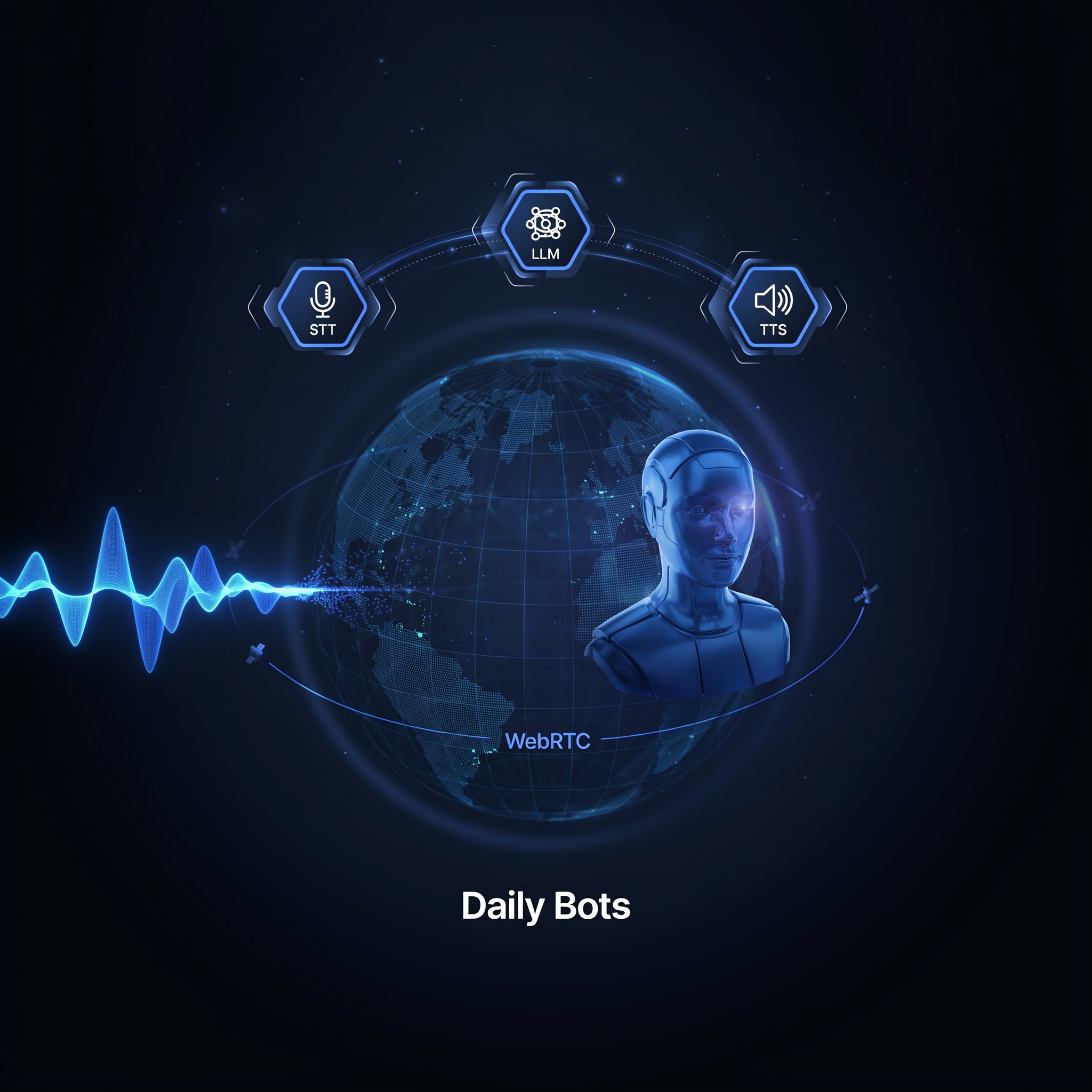
Daily Bots Review: The Open-Source Voice AI Platform That Lets You Launch a Talking Agent With One API Call
Built by Daily — the WebRTC infrastructure company behind Pipecat — Daily Bots lets developers ship real-time voice, vision, and video AI agents on enterprise-grade global infrastructure, starting at $0.02/min with no plan fees.
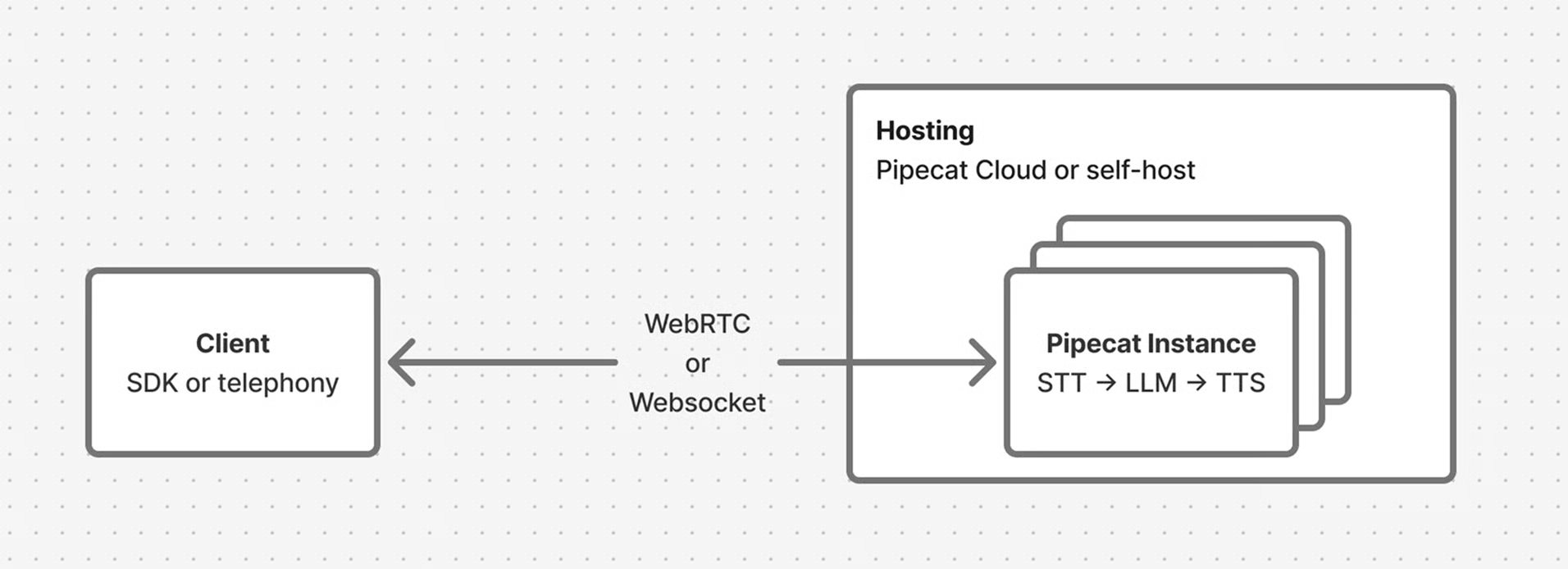
Building a real-time voice AI agent sounds simple until you're three weeks deep in WebRTC debugging, audio pipeline configuration, and latency optimization — and still haven't shipped a single conversation. Daily Bots exists to solve that. Built by Daily — the company that has powered enterprise real-time video and audio since 2016 — it gives developers a fully managed, open-source cloud to deploy voice AI agents in minutes, not months.
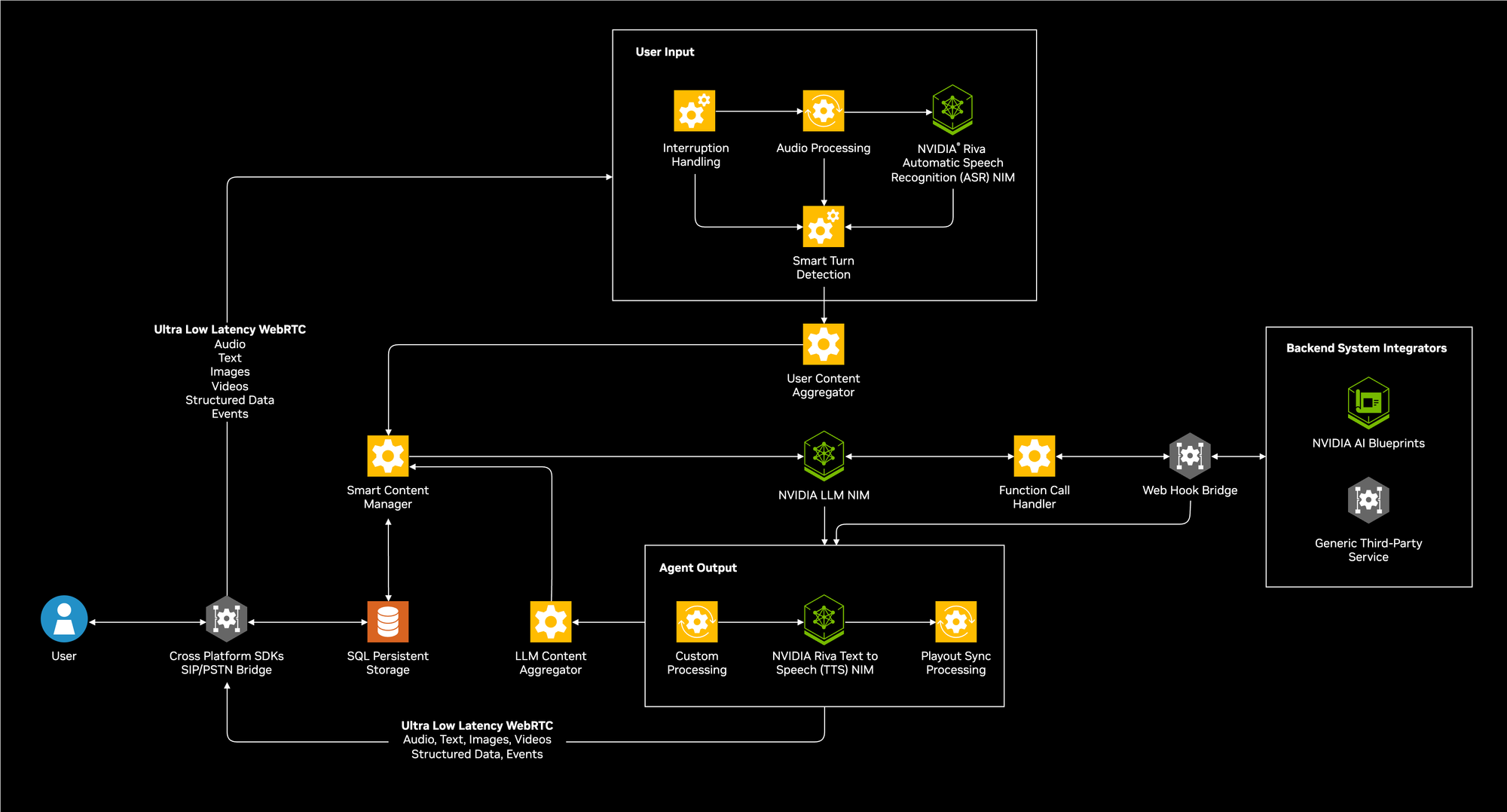
Daily Bots is the hosted platform built on top of Pipecat, Daily's open-source Python framework for voice and multimodal conversational AI. Together they form the most developer-friendly and infrastructure-mature voice AI stack available today: Pipecat handles the pipeline orchestration (STT → LLM → TTS), Daily handles the global WebRTC transport and hosting, and Daily Bots ties it all together with pre-configured bot profiles, integrated service billing, and a single API call to start a session. With $62M raised, a 150-person engineering team that includes authors of WebRTC standards, and 100M+ hours of annual voice traffic, this is not a startup experiment — it's battle-tested infrastructure.
What Is Daily Bots?
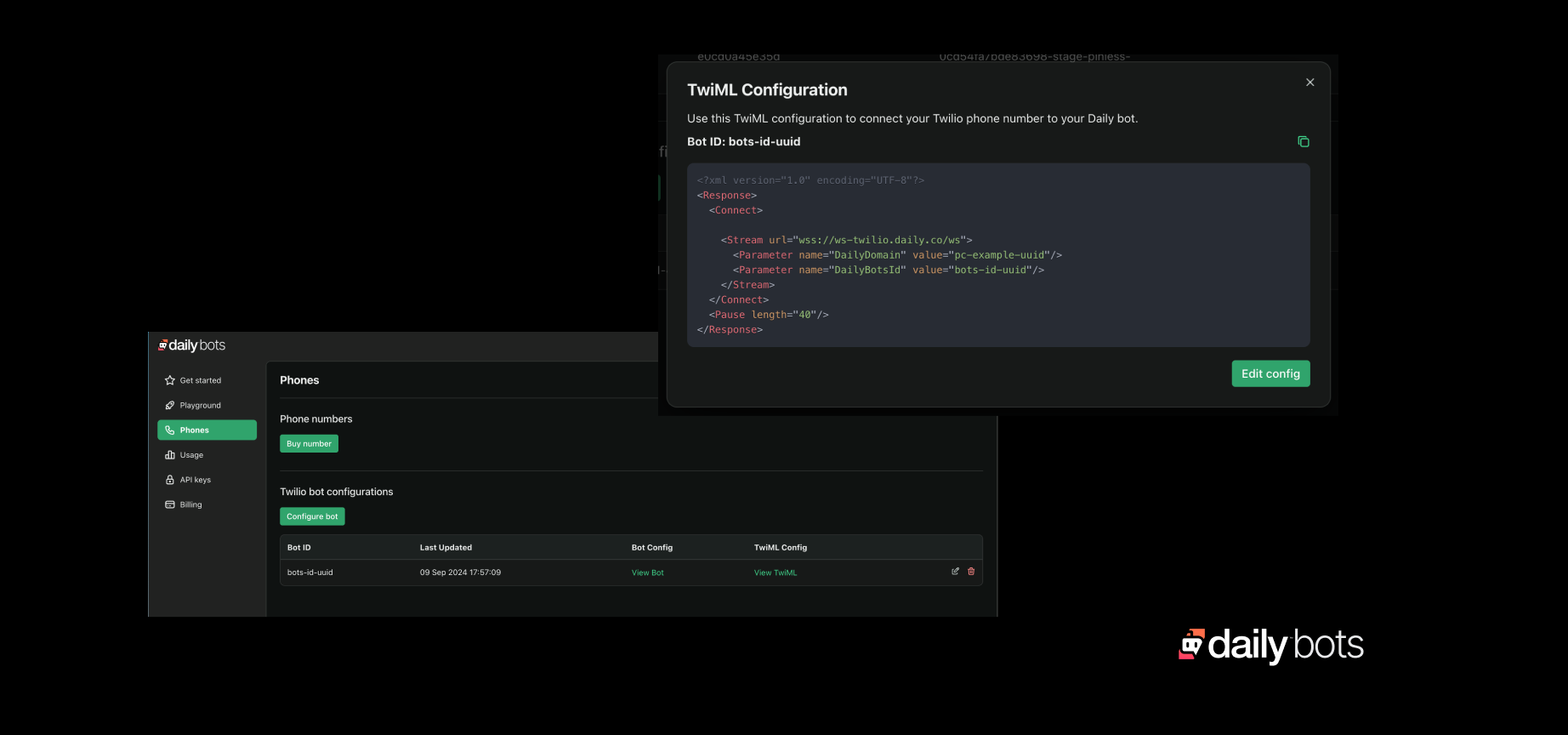
Daily Bots is a hosted cloud platform that lets developers deploy real-time voice AI agents built on Pipecat — the open-source Python framework for conversational AI maintained by Daily. The platform abstracts away the hardest parts of voice AI infrastructure: WebRTC transport, audio pipeline orchestration, STT/LLM/TTS service chaining, turn detection, interruption handling, and global scaling. Developers start a real-time AI session with a single call to /api/v1/bots/start, configure their preferred LLM (Claude, GPT-4, Gemini, Llama, Mistral, or any OpenAI-compatible API), choose their STT and TTS providers, and Daily Bots handles everything else.
The platform implements the open RTVI standard (Real-Time Voice Inference) for vendor-neutral client SDKs across web, mobile, and telephone — meaning your code isn't locked to Daily's infrastructure and can be moved to another platform or self-hosted at any time. This is a critical differentiator in a market where most voice AI platforms create proprietary lock-in through custom protocols and closed orchestration layers. With Daily Bots, you own your pipeline logic and your data flow.
Key Features
One-Call Agent Launch
Start a fully configured real-time voice AI session with a single API call — /api/v1/bots/start. Pre-built bot profiles handle common STT/LLM/TTS combinations so you don't configure pipelines from scratch every time. A developer can go from zero to a live voice conversation in under 10 minutes.
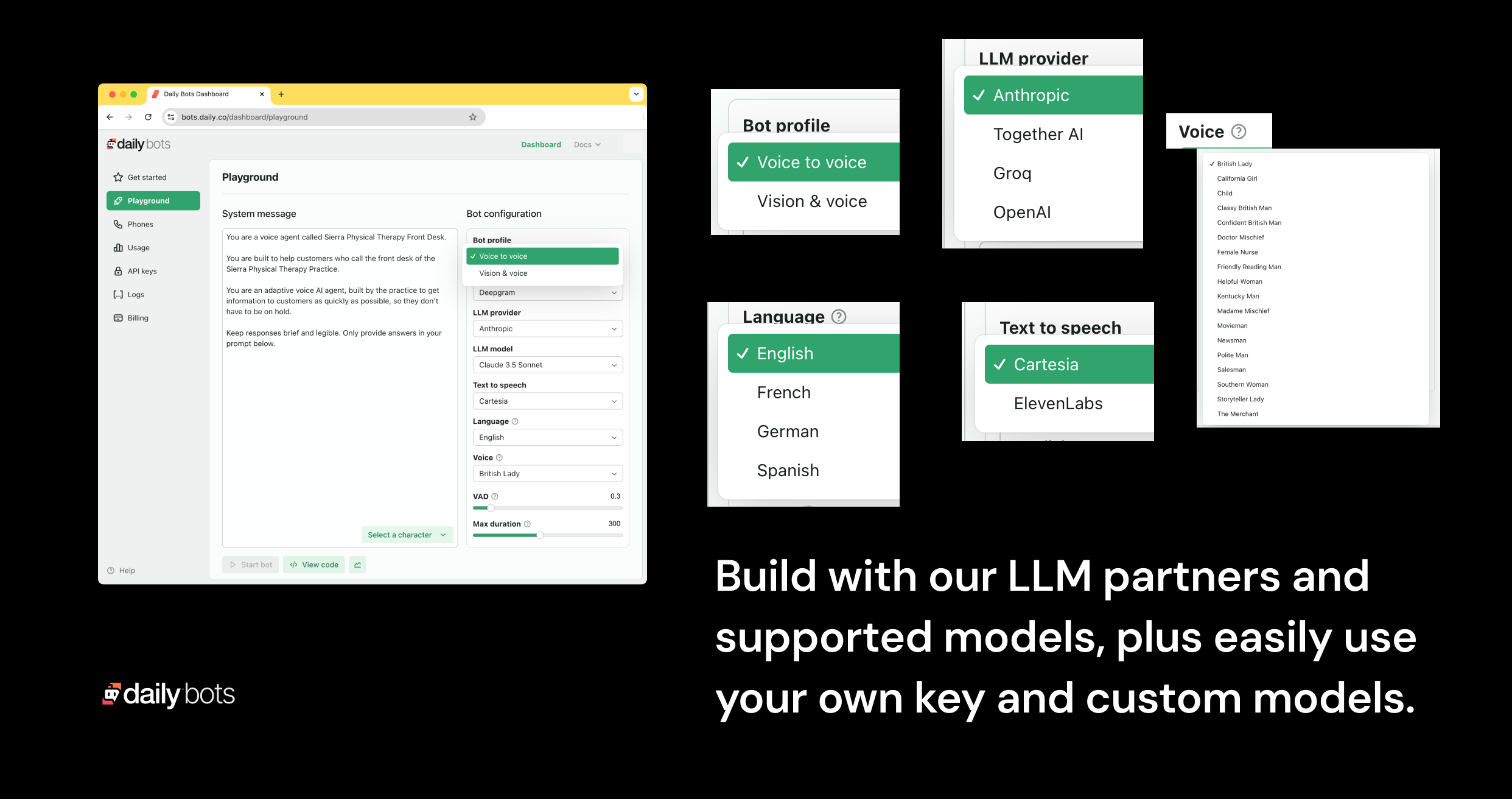
80+ Integrated Service Providers
Connect to Anthropic, OpenAI, Google Gemini, Deepgram, ElevenLabs, Cartesia, Rime, and 75+ more providers for STT, TTS, and LLM — or bring your own API keys at no markup. Daily handles billing for integrated services so you get one unified invoice instead of managing five separate vendor accounts.
Smart Turn Detection (12ms CPU)
Daily's SmartTurn v3 provides native audio semantic VAD with 12ms CPU inference latency — accurate end-of-turn detection that knows the difference between a mid-sentence pause and a completed thought. This eliminates the awkward cutoffs that ruin voice UX and makes conversations feel genuinely natural.
Global WebRTC Infrastructure
Deploy on Daily's global mesh network with unlimited concurrency, multi-region autoscaling, Krisp noise cancellation, and HIPAA/GDPR compliance. Enterprise infrastructure used by healthcare, fintech, and social platforms since 2016. Accenture, Pinterest, and Vapi itself run on this transport layer.
Pricing Plans
| Service | Rate | Notes |
|---|---|---|
| Daily Bots (Pay-as-you-go) | $0.02/min | No plan fees. Scale to any volume. Discounts available. $10 starter credit applied to first bill. |
| STT Services (Integrated) | Deepgram: $0.0059/min | Billed at provider rates via Daily. Bring your own key or use Daily's partnership pricing. |
| TTS Services (Integrated) | Cartesia: $0.000038/char · ElevenLabs: $0.000099/char | Billed at provider rates via Daily. Bring your own key or use Daily's partnership pricing. |
| LLM Services (Integrated) | Claude 3.5 Sonnet: $3 input / $15 output per MTok | Billed at provider rates via Daily. Bring your own key or use Daily's partnership pricing. |
| Pipecat Cloud (Advanced) | Starts at $0.02/min base | Custom agent profiles, telephony (PSTN/SIP), monitoring. HIPAA-compliant, containerized, unlimited concurrency. |
| Enterprise | Custom pricing | Bundled inference billing. Contact Daily for high-volume deals, dedicated support, and SLAs. |
Pros & Cons
✓ What Works
- ✅ One API call to launch — fastest time-to-first-voice-agent in the market
- ✅ 100% open-source foundation (Pipecat BSD-2) — no vendor lock-in, self-host anytime
- ✅ 80+ integrated providers — connect any LLM, STT, or TTS without extra plumbing
- ✅ SmartTurn v3 — 12ms CPU inference for accurate turn detection, no GPU required
- ✅ Global WebRTC mesh network in production since 2016 — proven enterprise reliability
✗ What Holds It Back
- ❌ Python-first pipeline (Pipecat) — JavaScript developers need the client SDK layer, not native Python alternatives
- ❌ Pricing complexity — total cost depends on your LLM + STT + TTS choices on top of the $0.02/min base rate
- ❌ No no-code or low-code interface — entirely developer-facing, not accessible to non-technical users
- ❌ Telephony features (PSTN/SIP) are in Pipecat Cloud tier, not base Daily Bots
💡 Community Feedback: What Developers Say
How It Compares to Alternatives
| Feature | Daily Bots | LiveKit Agents | Vapi |
|---|---|---|---|
| Open-Source | YES — BSD-2 (Pipecat) | YES — Apache-2.0 | NO — Proprietary |
| Base Price | $0.02/min | $0.01/min (Cloud) | ~$0.05/min |
| LLM-Agnostic | YES — Any OpenAI-compatible | YES — Any provider | PARTIAL — Managed list + BYO |
| WebRTC Infrastructure | YES — Built-in since 2016 | YES — Built-in | NO — Relies on third-party |
| No-Code Interface | NO — Code-only | NO — Code-only | YES — Dashboard + API |
| Telephony (PSTN/SIP) | YES — Pipecat Cloud tier | YES — Native SIP (2025) | YES — First-class |
The comparison reveals a clear pattern: Daily Bots and LiveKit Agents occupy the infrastructure-first, open-source end of the spectrum, while Vapi sits at the managed, product-complete end. For engineering teams that value control and flexibility, Daily Bots' combination of Pipecat's open-source pipeline with Daily's native WebRTC transport creates a uniquely powerful stack. Vapi wins on developer speed and no-code accessibility but charges a premium for that convenience — roughly 2.5x the base infrastructure rate. LiveKit offers similar open-source philosophy but requires more self-hosted infrastructure management, whereas Daily Bots provides the managed cloud layer on top of its open foundation.
Who Should Use Daily Bots?
Best For: Python and full-stack developers building real-time voice AI products — customer support bots, AI companions, voice-first apps, interactive storytelling, healthcare agents, and phone qualification systems. Teams who want production-grade voice infrastructure without managing WebRTC servers, audio pipelines, or service integrations. Companies that need HIPAA or GDPR compliance for voice AI out of the box. Startups that want to avoid vendor lock-in and maintain the option to self-host their pipeline at any time.
Consider Alternatives If: You're a non-technical user who needs a drag-and-drop voice bot builder — Synthflow or Vapi's no-code tier is a better fit. You need a TypeScript-native orchestration layer — LiveKit Agents has a strong JS story. You want a fully managed end-to-end voice agent platform with pre-built industry workflows — Retell.ai or Bland.ai handle more of the product layer for you. Your primary use case is outbound dialing at massive scale — Bland AI's campaign tooling is purpose-built for that.
Expert Editorial Opinion
 Independent Analysis
Daily Bots occupies a unique position in the voice AI market: it's the infrastructure layer built by the same team that has been doing real-time WebRTC infrastructure longer and more seriously than almost anyone else. While newer voice AI platforms are building on top of others' transport layers — and dealing with the reliability and latency penalties that come with that — Daily Bots runs on Daily's own global mesh network that has been battle-tested since 2016 across healthcare, social, and fintech applications. The infrastructure credibility is real, and it's backed by $62M in funding and a 150-person engineering team that includes authors of WebRTC standards.
The Pipecat open-source ecosystem is Daily Bots' biggest strategic advantage. With 80+ integrated providers, active enterprise partnerships (NVIDIA, Anthropic, Deepgram, ElevenLabs), and a vendor-neutral RTVI standard that works across platforms, developers aren't building on a proprietary moat — they're building on open infrastructure they can move, modify, or self-host at any time. SmartTurn v3's 12ms CPU inference for turn detection is a genuinely impressive technical achievement that directly improves conversation quality at the layer that matters most: knowing when to talk. The model supports 23 languages and runs on CPU without GPU dependency, making it deployable at scale without specialized hardware.
The limitation of Daily Bots today is the same limitation of any developer-infrastructure tool: it requires real engineering skill to configure well. The $0.02/min base rate is compelling, but total cost depends heavily on your LLM, STT, and TTS choices — and getting the pipeline configuration right for production conversations (interruption handling, turn detection, noise cancellation, latency optimization) takes time. For teams that clear that bar, Daily Bots is the most flexible, most open, and most infrastructure-mature voice AI platform available. For teams that want faster onboarding with less configuration, Vapi or Retell.ai provide a more product-complete experience at a higher price. The question every team should ask: does the engineering investment justify the long-term savings and flexibility? For most production voice AI products, the answer is yes.
Final Verdict
Daily Bots is the best open-source voice AI infrastructure platform for developers who want production-grade WebRTC infrastructure, full provider flexibility, and no vendor lock-in. The $0.02/min base rate, 80+ integrated services, Pipecat's BSD-2 open-source foundation, and SmartTurn v3's 12ms turn detection make this the strongest technical choice for engineering teams building real-time voice AI products. The tradeoff is configuration depth — this is infrastructure for developers, not a plug-and-play product. For teams with the engineering capability to configure it, this is a 9.0 out of 10.
🔗 Related ToolRadar Reviews
More tools from AI Developer Tools
- The Voice Agent Platform That Solved Real-Time Latency
- The Hidden Cost Trap Behind $0.05 Voice Agents
- Can an AI Agent Really Replace Your Entire Team?
- Is VoiceAI Actually the Best Real-Time Voice Platform?
- Can PlayHT's New Voices Really Replace Voice Actors?
- Is Cartesia the Fastest AI Voice Engine in 2026?
- I Built an AI Agent Army Without Writing Code
- This AI Agent Works While You Sleep — Here's How
❓ Frequently Asked Questions
What would you build if your voice agent could talk as naturally as a human?
The gap between "working prototype" and "production voice AI" is wider than most teams expect. Daily Bots closes that gap with infrastructure that has been battle-tested since 2016. The only question left is what you'll build with it.

Comments
Post a Comment