


Baseten Review 2026: The Inference Engine Behind Cursor's Billion Daily AI Calls
A $13 billion platform processing 1B+ inference calls daily across 87 global clusters. Does Baseten's custom kernel stack justify the hype — or is Modal the smarter pick for most teams?
- What Is Baseten and Why Does It Matter?
- Core Features: The Baseten Inference Stack Explained
- Pricing Breakdown: Free Tier to Enterprise GPU Compute
- Pros & Cons: Where Baseten Shines and Stumbles
- Community Feedback: What Engineers Actually Say
- Baseten vs Modal vs RunPod: The 2026 Comparison
- Who Should Use Baseten — and Who Should Skip It
- Expert Editorial Opinion
- Final Verdict
- Related ToolRadar Reviews
- Frequently Asked Questions
Here is the uncomfortable truth most AI startups learn the hard way: training a model is the easy part. Getting that model to serve predictions reliably, cheaply, and at scale in production — that is where the real engineering battle begins. Baseten, a San Francisco-based inference infrastructure platform founded by Tuhin Srivastava, Phil Howes, and Amir Haghighat, built its entire business around this exact insight. While the world obsesses over frontier model training, Baseten quietly became the backbone that keeps some of the most demanding AI products online.
The numbers tell part of the story. Baseten processes more than one billion inference calls per day across 87 global clusters spanning 18 cloud providers. Its customer list reads like a who's-who of AI-native companies: Cursor routes parts of its coding assistant through Baseten, Notion relies on it for document intelligence, Abridge uses it for clinical decision support, and Clay leans on it for recruiting automation. In June 2026, the company raised $1.5 billion in a Series F at up to a $13 billion valuation — just five months after a $300 million round at $5 billion. Revenue is growing roughly 20 times year over year. Updated July 2026, this review examines whether Baseten's performance stack lives up to the valuation hype, and whether it is the right choice for your team.
What Is Baseten and Why Does It Matter?
Baseten is not a model provider like OpenAI or Anthropic. It is an inference infrastructure layer — a platform purpose-built to serve open-source, custom, and fine-tuned AI models at production scale. The company operates on a fundamental premise: the infrastructure needed to train a model and the infrastructure needed to serve it in production are fundamentally different engineering problems. Training is batch-oriented, fault-tolerant, and compute-heavy. Inference is real-time, latency-sensitive, and cost-critical at scale.
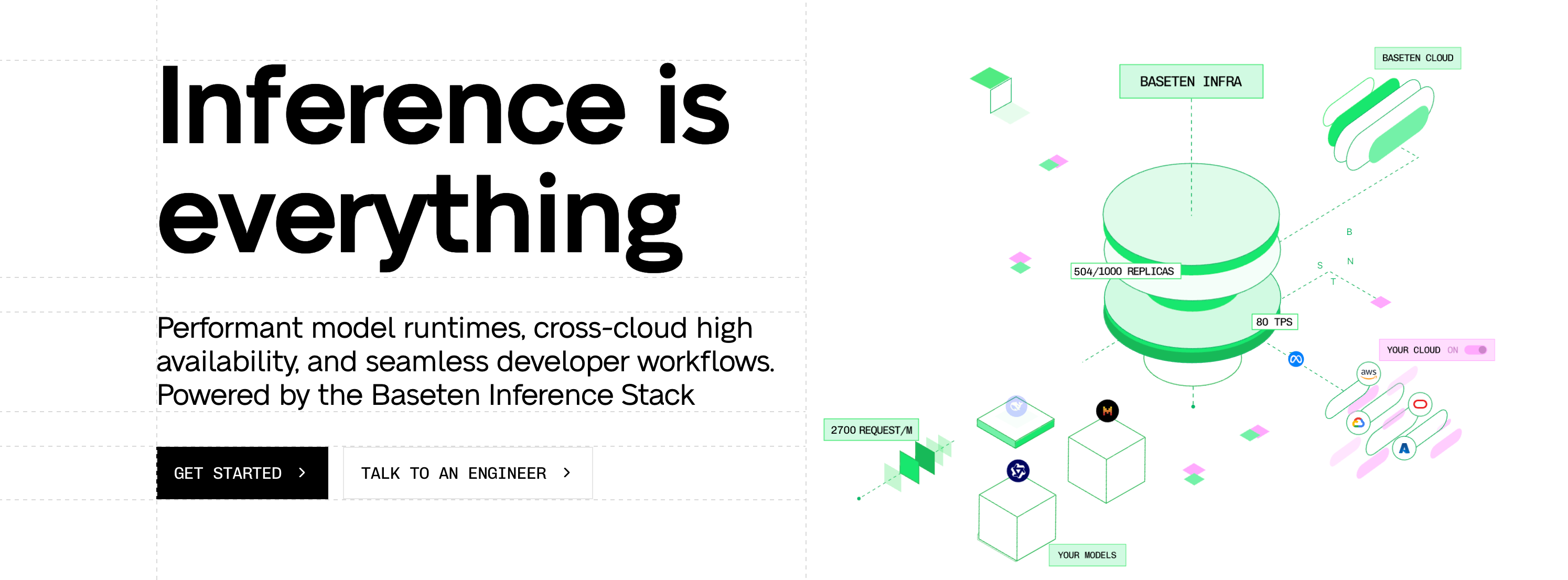
Baseten's platform addresses this through three core pillars. First, the Baseten Inference Stack, which combines open-source frameworks like TensorRT-LLM and SGLang with proprietary custom CUDA kernel optimizations and decoding strategies to extract maximum performance from every GPU. Second, Baseten Chains, a system for granular hardware allocation and autoscaling specifically designed for compound AI systems — multi-model pipelines where one model's output feeds into another's input. Third, Baseten Embeddings Inference (BEI), which the company claims delivers over 2x higher throughput and 10% lower latency than any competing solution on the market.
Core Features: The Baseten Inference Stack Explained
Baseten Inference Stack
Layers custom CUDA kernels, TensorRT-LLM, and SGLang atop raw GPU hardware to squeeze latency and cost savings competitors cannot match. Powers models like Qwen, DeepSeek, GLM, and gpt-oss with high throughput and consistently low latency across 87 global clusters.
Baseten Chains
Enables granular hardware allocation and intelligent autoscaling for compound AI systems — pipelines where multiple models chain together. Delivers 6x better GPU utilization and cuts end-to-end latency in half compared to naive deployment strategies.
Real-Time Audio Streaming
Built for AI phone calls, voice agents, and real-time translation with industry-low time-to-first-byte. Includes fast, accurate transcription and speaker diarization — critical for voice-first products where every millisecond of latency degrades user experience.
Enterprise Security & Compliance
SOC 2 Type II certified, HIPAA and GDPR compliant. Never stores model inputs or outputs. Supports VPC deployment with hybrid cloud spillover, giving enterprises full control over where their data lives and how it flows.
Baseten Embeddings Inference (BEI)
Delivers over 2x higher throughput and 10% lower latency than competing embedding inference solutions. For RAG pipelines, semantic search, and recommendation systems processing millions of documents, this performance delta compounds into real cost savings.
Multi-Cloud Failover
Spans 18 cloud providers across 87 clusters with automatic workload rerouting during outages. Colin McGrath, Baseten's head of infrastructure, described an incident where the system self-healed before the on-call engineer even checked their pager.
Pricing Breakdown: Free Tier to Enterprise GPU Compute
| Plan | Cost | What's Included |
|---|---|---|
| Basic (Free) | $0 + starter credits | Access to shared GPU inference, starter API credits, community support, basic monitoring dashboards |
| Pro | Custom pricing | Dedicated GPU instances, priority support, advanced autoscaling, custom model deployments, SLA guarantees |
| Enterprise | Custom pricing | VPC deployment, hybrid cloud spillover, dedicated infrastructure team, HIPAA/GDPR compliance audit support, custom SLAs |
Beyond plan tiers, GPU compute is billed per minute with no monthly minimums on the Basic plan. Rates range from $0.63 per hour for a T4 GPU up to $9.98 per hour for a B200. Popular open-source models served via API are billed per-million-tokens, while custom deployments run on dedicated GPU or CPU instances billed per minute of uptime. Baseten prices model access at more than 50% below OpenAI-comparable rates, making it an attractive option for teams running high-volume inference on open-source alternatives to GPT-4 or Claude.
Pros & Cons: Where Baseten Shines and Stumbles
✓ What Baseten Gets Right
- ✅ Custom kernel optimizations deliver class-leading latency and throughput that generic GPU clouds cannot match
- ✅ Multi-cloud failover across 18 providers with automatic self-healing during outages
- ✅ Baseten Chains enables sophisticated compound AI pipelines with 6x better GPU utilization
- ✅ Enterprise-grade security: SOC 2 Type II, HIPAA, GDPR, zero data retention by default
- ✅ Prices open-source model access at 50%+ below OpenAI-comparable rates
- ✅ Real-time audio streaming with industry-low time-to-first-byte for voice AI products
✗ Where It Falls Short
- ❌ Per-replica-per-hour billing creates cost surprises for redundant or spiky workloads
- ❌ H100 effective rate (~$6.50/hour) is notably higher than Modal's ~$3.95/hour
- ❌ Truss deployment abstraction creates real switching costs once teams are locked in
- ❌ Requires significant in-house ML engineering expertise — not a plug-and-play solution
- ❌ No transparent public pricing for Pro and Enterprise tiers; everything is custom-quoted
💡 Community Feedback: What Engineers Actually Say
Baseten vs Modal vs RunPod: The 2026 Comparison
| Feature | Baseten | Modal | RunPod |
|---|---|---|---|
| Pricing Model | Per replica/hour + per token | Per second compute + serverless | Per hour GPU rental |
| H100 GPU Rate | ~$6.50/hour | ~$3.95/hour | ~$2.49/hour |
| Inference Optimizations | Custom kernels, TensorRT-LLM, SGLang | Standard optimizations | Minimal — raw GPU access |
| Multi-Cloud Failover | 18 providers, 87 clusters, auto-reroute | Single cloud per deployment | Single cloud per deployment |
| Enterprise Compliance | SOC 2, HIPAA, GDPR, VPC | SOC 2, basic compliance | Limited compliance options |
| Developer Experience | Truss abstraction, steeper learning curve | Python-native, minimal boilerplate | Docker-based, familiar workflow |
| Compound AI Systems | Baseten Chains with 6x GPU efficiency | Basic pipeline support | Manual orchestration required |
| Best For | Enterprise ML teams, high-availability AI | Rapid prototyping, small-to-mid teams | Budget-conscious, GPU-heavy training |
The comparison reveals three distinct philosophies. Baseten optimizes for production resilience and inference performance at scale — you pay a premium per GPU hour, but you get custom kernels, multi-cloud failover, and enterprise compliance baked in. Modal optimizes for developer velocity and cost efficiency, with a Python-native experience that gets models deployed in minutes rather than days. RunPod strips everything down to raw GPU rental at the lowest possible price, leaving all optimization and orchestration to the user. The right choice depends entirely on whether your bottleneck is engineering time, inference cost, or production uptime.
Who Should Use Baseten — and Who Should Skip It
Ideal users: ML engineering teams at growth-stage startups and enterprises that need to deploy custom or open-source models at scale with strict latency, compliance, and reliability requirements. Teams building voice agents, clinical AI systems, high-throughput content generation pipelines, or compound AI systems with multiple chained models will find Baseten's Inference Stack and real-time audio streaming particularly valuable. Companies already spending $10K+ per month on inference who can amortize the per-replica pricing across predictable traffic patterns.
Look elsewhere if: You are a solo developer or small team without dedicated ML engineering expertise. If your inference needs are sporadic, unpredictable, or experimental, Modal's per-second serverless pricing will likely cost significantly less. If you are purely price-sensitive and comfortable managing your own optimizations, RunPod's raw GPU rates are unbeatable. If you need a plug-and-play solution with minimal configuration, Baseten's Truss abstraction and infrastructure complexity will frustrate more than it helps.
Expert Editorial Opinion
Baseten occupies a fascinating position in the AI infrastructure landscape. It is not trying to be the cheapest option, nor the easiest to use. Instead, it has staked its claim on being the most reliable and performant option for teams that cannot afford downtime or latency spikes. The evidence supports this positioning: Cursor, a product whose entire value proposition depends on sub-second code completion, routes inference through Baseten. Notion, serving millions of users, trusts it for document intelligence. Abridge, handling sensitive clinical data, relies on its HIPAA compliance.
The pricing gap between Baseten and Modal is real and meaningful. At ~$6.50 per hour for an H100 versus Modal's ~$3.95, a team running two replicas 24/7 pays roughly $124 more per day on Baseten — about $3,700 per month in pure compute differential. For a startup burning through runway, that is not trivial. But Baseten's argument is that the custom kernel optimizations, multi-cloud failover, and enterprise support deliver enough value to justify the premium. For a company like Cursor, where a single hour of degraded inference could cost more than that monthly differential in lost user trust, the math checks out.
The question every team must answer is whether they are in the "Cursor camp" — where inference is the product and downtime is existential — or the "experimentation camp" where cost and developer velocity matter more than five-nines reliability. Baseten is unapologetically built for the former. The Truss deployment abstraction, while powerful, creates genuine switching costs that should give teams pause before committing. And the lack of transparent public pricing for Pro and Enterprise tiers means smaller teams may find themselves in a sales cycle they did not anticipate.
Does Baseten justify its $13 billion valuation? From a pure infrastructure perspective, the technology is undeniably sophisticated. The Inference Stack represents genuine engineering depth that competitors like Modal and RunPod have not matched at the same level. But valuation is as much about market narrative as technology, and Baseten's narrative — "the platform that makes inference reliable at scale" — is compelling in a market where every AI product lives or dies by its latency and uptime. Whether that narrative sustains depends on whether the company can maintain its performance edge as the market matures and competitors catch up.
One final consideration: Baseten's free Basic plan is genuinely useful for evaluation, but the jump from free to custom-quoted Pro is steep. Teams without predictable, high-volume inference needs should think carefully before moving beyond the starter credits. The per-replica billing model rewards consistency and punishes volatility — a design choice that reflects Baseten's enterprise DNA but may alienate the very startups that fuel AI innovation.
Final Verdict
Baseten earns an 8.2 out of 10 for its exceptional inference performance, enterprise-grade reliability, and sophisticated compound AI orchestration through Baseten Chains. The custom kernel stack and multi-cloud failover are genuinely best-in-class, and the customer roster — Cursor, Notion, Abridge — validates the platform's production credentials. The 0.8-point deduction comes from the per-replica pricing model that punishes spiky workloads, the H100 rate premium over Modal, the Truss lock-in risk, and the steep expertise barrier that excludes smaller teams. For enterprise ML teams where inference is the product and downtime is unacceptable, Baseten is the clear choice. For everyone else, Modal or RunPod likely offer better value.
🔗 Related ToolRadar Reviews
More tools from AI Infrastructure
- The Search Engine Built for AI Agents: Is It Worth the Hype?
- Can an AI Agent Really Browse the Web for You in 2026?
- I Gave an AI Agent Full Control of My Workflow — Here's What Happened
- This AI Agent Replaced My Entire Team's Manual Work
- Your AI Agents Have Security Holes — This Tool Fixes Them
- I Built an AI Agent Army Without Writing a Single Line of Code
- Can an AI Agent Really Replace Your Entire Backend?
- I Replaced My Operations Team With an AI Agent — Here's the Real Cost
❓ Frequently Asked Questions
Is your inference stack the bottleneck you have not named yet?
Most teams optimize their models for weeks but accept whatever latency their infrastructure delivers. If inference is the product — not the model — maybe it is time to treat it like one.

Comments
Post a Comment