


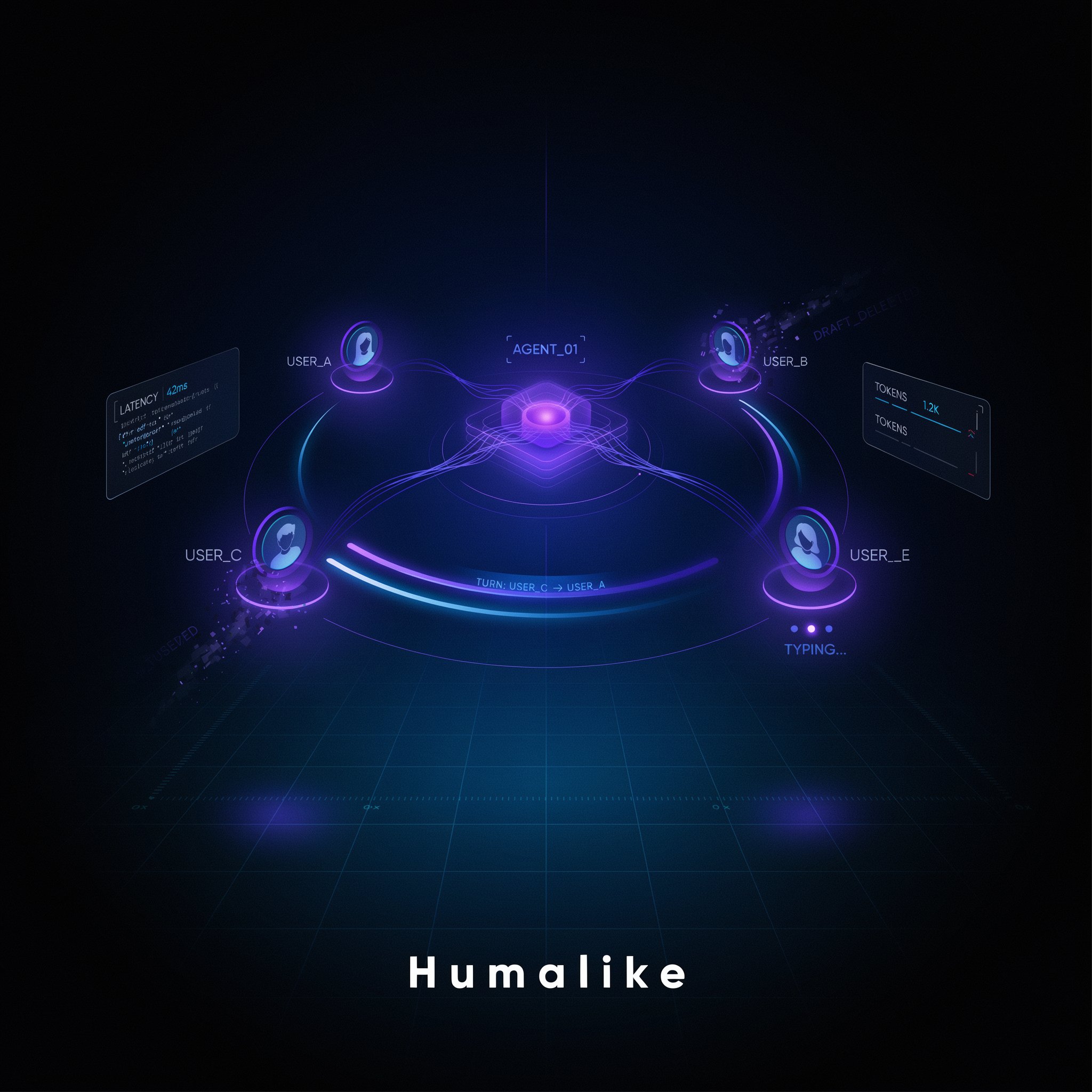
Humalike Review 2026: The API That Gives Your AI Agents Real Social Intelligence
Ranked #7 Best Product of July 2026 on Product Hunt with 449 upvotes and 767 followers — Humalike is the developer API that adds the social layer every AI agent is missing: turn-taking, group conversation dynamics, deleted draft signals, removed reactions, typing indicators, and the subtle human behavioral patterns that make agents feel native in messaging environments.
Put an AI agent in a 1:1 chat and it handles itself reasonably well. Put it in a group of five people going back and forth — and it either spams every message or freezes and says nothing. One developer on the Humalike Product Hunt launch page described exactly this: running a 2,000-person Discord, deploying an agent in busy channels, and watching it fail the moment the conversation had more than two participants. That failure mode is not a model problem. It is a social intelligence problem. And no amount of prompting fixes it.
Humalike launched publicly on Product Hunt on July 1, 2026, winning #2 Product of the Day with 449 upvotes — and ranked #7 Best Product of July 2026 overall with 767 followers. The product is a stack-agnostic developer API that adds social intelligence to AI agents across any messaging platform: turn-taking logic that knows when a human is actually done speaking (not just pausing), group conversation dynamics that manage multi-participant messaging without spamming or silence, and signal interpretation for behavioral events that existing agents are completely blind to — deleted drafts, removed reactions, typing indicators that stop mid-thought, edit histories. These signals carry real social meaning. Humalike interprets them.
What Is Humalike?
Humalike is a developer API that adds a social intelligence layer to AI agents deployed in messaging environments — chat platforms, voice applications, customer support bots, Discord communities, dating apps, companion AIs, and any context where agents interact with humans in real or near-real time. The API is stack-agnostic and LLM-agnostic: it works alongside any existing agent framework (LangChain, Mastra, AutoGen, custom) and any LLM (Claude, GPT-4, Gemini, open-source models). The core insight is that current AI agents are trained on content — the text of conversations — but completely blind to the behavioral and social signals that surround that content in real messaging environments. Humalike intercepts and interprets those signals: the Turn-Taking API handles conversational timing with social awareness (not just acoustic VAD — it factors in whether a thought is actually complete); the Group Dynamics engine manages multi-participant conversation flow without inappropriate interruptions or paralysis; and the Signal Interpretation layer decodes behavioral events (deleted drafts, removed reactions, edited messages, typing indicators that stop) that platforms forward as events but no current agent framework knows how to interpret.
Key Features
Turn-Taking API — Social-Aware Timing
Goes beyond acoustic Voice Activity Detection to understand whether a conversational turn is actually complete — factoring in semantic signals, not just audio gaps. Prevents agents from cutting off users mid-thought in voice apps. Handles long, uneven pauses typical of older users, non-native speakers, and group conversations where multiple people are contributing.
Group Conversation Dynamics
Manages multi-participant messaging so agents do not spam every message or fall silent when five people are talking simultaneously. Determines when to respond, when to wait, who the response is directed at, and how to handle overlapping contributions — the behaviors that make agents feel native in group chats rather than disruptive.
Behavioral Signal Interpretation
Interprets the social meaning of messaging platform events that agents currently ignore: deleted drafts (a changed mind or reconsideration), removed reactions (a shift in sentiment), typing indicators that stop (hesitation or distraction), message edits (correction or emphasis shift). The platform forwards these events; Humalike interprets what they mean in context.
Stack-Agnostic, LLM-Agnostic Integration
Drops into any existing agent stack without requiring framework changes or LLM switching. Works alongside LangChain, Mastra, AutoGen, custom pipelines, and any LLM. Receives platform events, interprets social context, and returns structured signals your agent can act on — without owning the agent logic itself.
Pricing Plans
| Plan | Price | What's Included |
|---|---|---|
| Free / Developer | Free | Core API access — Turn-Taking, basic group dynamics, signal interpretation — for prototyping and small-scale deployments |
| Pro | Pricing at humalike.ai | Full API access — advanced group dynamics, high-throughput signal processing, priority support, SLA |
| Enterprise | Custom pricing | Custom integration support, compliance, dedicated engineering, high-concurrency deployments, voice platform partnerships |
Humalike launched publicly July 1, 2026. Full pricing details are available at humalike.ai. The free developer tier provides meaningful access for prototyping and evaluation. Production deployments at scale require the Pro or Enterprise tier — check humalike.ai for current pricing as the product matures post-launch.
Start Building With Humalike Free →Pros & Cons
✓ What Works
- ✅ Solves a genuinely unique problem — social intelligence in group messaging and voice, not addressed by any LLM or agent framework natively
- ✅ Stack-agnostic and LLM-agnostic — drops into any existing agent architecture without requiring a rebuild
- ✅ Turn-Taking API with semantic completion detection — goes beyond VAD to understand whether a thought is actually finished
- ✅ Behavioral signal interpretation — the only API that decodes deleted drafts, removed reactions, and typing indicators as social context
✗ What Needs Work
- ❌ Very early stage — launched July 1, 2026, no published pricing yet, enterprise features still maturing
- ❌ The Turn-Taking problem in group conversations is acknowledged by the team as "not solved well by anyone yet" — expectations should be calibrated accordingly
- ❌ Value depends on platform API access — platforms must forward behavioral events (deleted messages, reactions, typing indicators) to Humalike for interpretation; not all platforms expose these
- ❌ Small team, limited public documentation at launch — developers will need to engage directly with the team for complex integration use cases
💡 Community Feedback: What Developers Say
How It Compares to Alternatives
| Capability | Humalike | Custom Prompting | VAD Libraries |
|---|---|---|---|
| Group Conversation Awareness | YES — native API | PARTIAL — prompt engineering | NO — agents fail |
| Behavioral Signal Interpretation | YES — deleted drafts, reactions, edits | NO | NO |
| Semantic Turn Completion | YES — factors in thought completion | NO — acoustic only | NO — acoustic only |
| Stack Agnostic | YES — any LLM/framework | YES | YES |
The comparison table reveals a clear pattern: Humalike occupies a unique position in the agent infrastructure stack. Custom prompting can adjust tone and style, but it cannot give an agent awareness of behavioral platform events or real group dynamics. VAD libraries handle acoustic silence detection, but they are blind to semantic completion and completely unaware of messaging platform signals like deleted drafts or removed reactions. The "silence" approach — doing nothing — is what most agents currently do in group contexts, and it is why they fail. Humalike is not competing with these alternatives; it is filling a gap they cannot address.
Who Should Use Humalike?
Best For: Developers building AI agents for group messaging platforms (Discord, Slack, WhatsApp groups, Telegram), voice AI applications where turn-taking quality matters (elderly care, customer support, language learning), companion AI products where social realism is a core product requirement, and any team that has deployed an agent in a multi-user context and watched it fail socially — spamming, interrupting, or going silent. AI labs and startups building the next generation of socially-aware agents who want to buy rather than build this infrastructure.
Consider Alternatives If: Your agent only operates in 1:1 text chat where basic prompting handles turn-taking adequately — the overhead of a social intelligence API may not be justified. You are building voice AI on a platform that does not expose behavioral event APIs (deleted drafts, reactions) — Humalike's signal interpretation layer requires platform event forwarding to function. You need a complete agent framework rather than a social intelligence layer — Mastra, LangChain, or Daily Bots provide the broader orchestration context Humalike does not cover.
Expert Editorial Opinion
Humalike is identifying a real and underappreciated failure mode in deployed AI agents. The academic and benchmark-focused AI community measures agents on task completion, factual accuracy, and reasoning quality. But the practitioners deploying agents in real messaging environments encounter a completely different class of failure: the agent that interrupts constantly, the one that goes silent when a group conversation heats up, the one that misses the social signal that a user just deleted their draft and had second thoughts. These failures are not model failures — they are social intelligence failures. No amount of RLHF or benchmark improvement fixes them.
The Turn-Taking API is the most technically interesting component because it targets the hardest version of the problem. Acoustic VAD — detecting silence in audio — is a solved problem for simple cases. The hard case is semantic turn completion: a human who pauses mid-sentence to find a word, an older user with slower speech patterns, a non-native speaker constructing a complex thought, a group conversation where multiple people are overlapping. The developer building voice AI for elderly users who flagged this on Product Hunt — and the Humalike team's honest acknowledgment that it is "a hard problem, not solved well by anyone yet, especially in group conversations" — reflects the kind of intellectual honesty about technical difficulty that predicts a team will actually make progress on it.
The market timing is excellent. The wave of agent deployment in 2025–2026 has moved AI from research and single-user productivity tools into group contexts — Discord communities, customer support queues, team collaboration tools, social platforms, companion apps. Every one of those deployments is hitting the same social intelligence wall. Humalike's bet is that the social layer will be bought, not built — that agent developers will treat social intelligence the way they treat STT, TTS, or embedding models: as infrastructure they integrate rather than implement. With 449 Product Hunt upvotes, 767 followers, and a #7 ranking in Best of July 2026 for a deeply technical infrastructure tool, the early signal is that the developer community agrees.
The pricing gap is worth noting. The free developer tier is genuinely useful for prototyping, but production deployments at scale will need Pro or Enterprise pricing — which, as of July 2026, has not been published. For teams evaluating Humalike, the question is not whether the social intelligence layer is worth paying for (it is), but whether the pricing will align with the value it creates in their specific use case. The absence of published Pro pricing is a friction point that should resolve as the product matures post-launch.
Does Humalike justify its existence without a free tier? The free tier exists, so the question is moot for evaluation. But the deeper question is whether a developer would pay for this once the free tier limits are hit. For voice AI applications where turn-taking quality directly impacts user trust (elderly care, companion AI, customer support), the answer is almost certainly yes. For simple Discord bots in low-stakes communities, the value proposition is less clear. The ideal customer is the team that has already watched their agent fail socially and understands that the fix is not more prompting — it is infrastructure.
Final Verdict

Humalike is the most intellectually distinctive developer API launched in July 2026. The social intelligence problem it solves — turn-taking in group conversations, behavioral signal interpretation, multi-participant dynamics — is real, widespread, and currently unaddressed by every major LLM provider and agent framework. The stack-agnostic, LLM-agnostic architecture makes it additive rather than competitive to existing agent stacks. The Turn-Taking API's semantic completion detection is the right approach to a genuinely hard problem. The product is early, the documentation is thin, and the hardest version of the turn-taking problem is by the team's own admission not yet fully solved. For developers building agents that live in group messaging or voice environments, this is a 9.1 out of 10 — the most important infrastructure layer to evaluate before your next agent deployment in a social context.
🔗 Related ToolRadar Reviews
More tools from AI Developer Tools
- The Voice Agent Platform That Solved Real-Time Conversational AI
- I Built an AI Agent Army Without Writing a Single Line of Code
- Your AI Agents Have Security Holes — This Tool Fixes Them
- Beyond the Hype: Google ADK 2026 AI Agent Framework Review
- This AI Agent Replaced My Entire Team's Workflow
- The Search Engine Built for AI Agents
- I Gave an AI Agent Full Control of My Workflow
- The Hidden Cost Trap Behind $0.05 Voice Agent Pricing
❓ Frequently Asked Questions
What happens when your AI agent enters a group chat and nobody taught it how humans actually talk?
That is the question Humalike was built to answer. The social intelligence layer is no longer optional — it is the difference between an agent that participates and one that paralyzes.
Comments
Post a Comment