


Can a Polygraph Really Detect Lies? The Science, the Courts, and the Real Cost of Believing the Machine
The APA says there is little evidence it works. The Supreme Court banned it from most trials. Yet law enforcement still swears by it. What is the truth about the lie detector?
- What Is a Polygraph and How Does It Actually Work?
- The Numbers: Accuracy Claims vs Scientific Reality
- The Courtroom: Where Polygraph Evidence Lives and Dies
- When the Machine Fails: Real Cases of Polygraph Errors
- Community Feedback: What People Who Took the Test Actually Say
- Polygraph vs EyeDetect vs Voice Stress Analysis: The 2026 Comparison
- Who Should Trust Polygraphs — and Who Should Not
- Expert Editorial Opinion
- Final Verdict
- Related ToolRadar Reviews
- Frequently Asked Questions
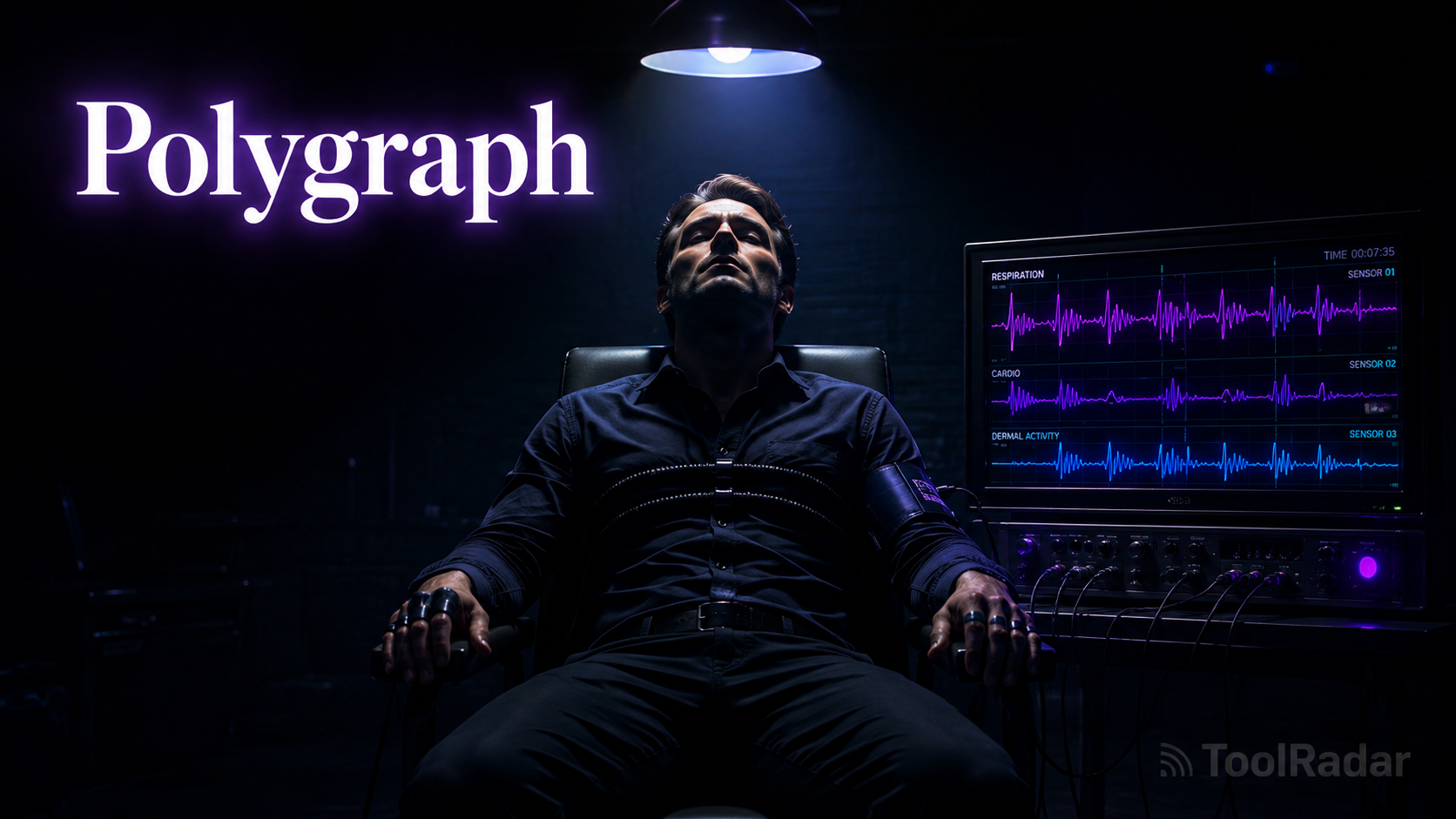
Imagine you are strapped to a chair. Rubber tubes measure your breathing. A blood pressure cuff tightens around your arm. Electrodes on your fingertips track the sweat on your skin. Across from you sits an examiner who asks whether you committed a crime. The machine between you spits out squiggly lines on graph paper, and based on those lines, this stranger will tell a court, an employer, or a federal agency whether you are a liar. This is the polygraph — the lie detector — and it has been sold to the public for nearly a century as a scientific window into the human soul. The only problem is that the science does not support the sales pitch.
A polygraph does not detect lies. It detects stress. Heart rate, blood pressure, breathing patterns, and skin conductivity — these are the signals it records, and while lying can trigger them, so can anxiety, fear, embarrassment, medication, medical conditions, and the simple terror of being accused of something you did not do. The American Psychological Association, after reviewing decades of research, concluded there is little evidence that polygraph tests can accurately detect lies. The National Academy of Sciences found they perform above chance but well below perfection. And yet, law enforcement agencies, federal employers, and sex offender treatment programs continue to use them as if the machine reads minds. Updated July 2026, this review examines what the polygraph actually measures, why courts have largely rejected it, and what happens when people place too much faith in a box of wires.
What Is a Polygraph and How Does It Actually Work?
A polygraph is a device that simultaneously records multiple physiological signals while a subject answers questions. The word itself comes from Greek — poly (many) and graph (writing) — because the machine writes many measurements at once. The four primary signals are cardiovascular (heart rate and blood pressure), respiratory (breathing rate and depth), electrodermal (skin conductivity via sweat), and sometimes muscular activity. The theory, developed in the 1920s, is that deception produces a unique stress response that these sensors can capture.
The most common testing format is the Control Question Test (CQT). The examiner establishes a physiological baseline by asking neutral questions — "Is your name John?" — then intersperses relevant questions about the matter under investigation with control questions designed to provoke anxiety in anyone, guilty or innocent. The idea is that a guilty person will show stronger reactions to the relevant questions, while an innocent person will react more to the control questions. Another format, the Guilty Knowledge Test (GKT), asks multiple-choice questions where only the guilty party would know the correct answer, measuring whether the subject shows recognition responses.
The U.S. Department of Justice describes the polygraph as a device that records signs of internal stress, and explicitly notes that exam results depend heavily on the examiner's skill and the testing procedure. This is a critical caveat: the machine does not interpret itself. A skilled examiner might notice patterns an algorithm misses, but an incompetent or biased examiner can produce false results from perfectly honest subjects — or clear guilty ones. The polygraph is not a lie detector. It is a stress detector operated by a human who decides what the stress means.
The Numbers: Accuracy Claims vs Scientific Reality
Industry Claim: 90%+ Accuracy
The American Polygraph Association cites meta-analyses showing accuracy rates above 90% when tests are administered by accredited examiners using validated techniques. These studies emphasize professional training, standardized protocols, and proper equipment as prerequisites for reliable results.
Scientific Reality: ~70% Accuracy
The landmark 2003 National Academy of Sciences report found that CQT polygraph tests correctly identify lies about 70% of the time — well above chance, but far below perfection. The report noted that the false-positive error rate is unknown and that much of the research on polygraph accuracy is of low quality.
Court Position: Generally Inadmissible
In United States v. Scheffer (1998), the Supreme Court upheld the exclusion of polygraph evidence, noting that "the scientific community remains extremely polarized about the reliability of polygraph techniques." 31 U.S. states ban polygraph evidence entirely; 19 allow it only with mutual consent.
The Screening Problem
The National Research Council calculated that in security screening of 10,000 employees where only 10 are guilty, a polygraph test that correctly identifies 80% of deceptive examinees would also falsely implicate approximately 1,598 innocent people. Someone who "fails" would have a 99.5% chance of being innocent.
Countermeasures Work
Convicted spy Aldrich Ames passed two polygraph tests in the 1980s and early 1990s using simple countermeasures: getting a good night's sleep and being nice to the examiner. The National Research Council found that many officials believe experienced examiners can easily identify countermeasures — scientific evidence contradicts this belief.
Alternative Explanations
Melissa Littlefield, a University of Illinois researcher who wrote "The Lying Brain," notes that polygraphs are considered by many in the scientific and legal communities as only marginally more accurate than coin flips. The same physiological changes measured as "deception" can result from anxiety, medication, illness, or personality traits.
The Courtroom: Where Polygraph Evidence Lives and Dies
The legal treatment of polygraph evidence reveals the gap between public belief and judicial skepticism. In the United States, polygraph results are generally inadmissible in criminal trials unless both the prosecution and defense agree to their use. The Supreme Court's 1998 ruling in United States v. Scheffer established that military courts could per se exclude polygraph evidence, and the reasoning has influenced civilian courts ever since. The Court noted that exclusionary rules do not infringe a defendant's right to present a defense as long as they are not arbitrary — and the government's conclusion that polygraphs were not sufficiently reliable was supported by the scientific community's continued polarization.
State laws vary significantly. 31 states do not allow any form of polygraph testing as evidence in court. 19 states permit it under certain conditions, typically requiring stipulation by both parties. Only New Mexico allows polygraph evidence without mutual consent. Even in states where it is technically admissible, many judges exercise discretion to exclude it, and defense attorneys routinely challenge its reliability under Daubert standards for scientific evidence.
Constitutional issues have also arisen. The Fifth Amendment privilege against self-incrimination applies to the taking of a polygraph — a defendant's refusal cannot be used against them. Courts carefully evaluate whether a defendant's waiver of the right to counsel or the right to remain silent was truly voluntary when agreeing to a polygraph examination. The legal system treats the polygraph not as scientific evidence but as a tool whose results require extreme caution — a position that aligns with the scientific consensus far more closely than popular culture suggests.
When the Machine Fails: Real Cases of Polygraph Errors
The most damning evidence against polygraph reliability comes not from laboratory studies but from real-world cases where the machine got it catastrophically wrong. Gary Ridgway, the Green River Killer, passed a polygraph test while under investigation for multiple murders — and went on to kill dozens more. Aldrich Ames, the CIA officer who spied for Russia, passed two polygraph screenings using basic countermeasures while betraying his country. Charles Cullen, a nurse who murdered approximately 40 people via lethal injections, passed a polygraph test and went on to murder another 39 before eventually being caught through other means.
The false-positive side is equally troubling. Frank Sterling spent years in prison after failing a polygraph test for a murder he did not commit — the actual killer, Wayne G. Ridgway, had passed the same test. Bill Wegerle was suspected of killing his wife in 1986 after failing a polygraph, until DNA evidence traced the murder to BTK killer Dennis Rader. In the Jacob Wetterling abduction case, Jerry Wetterling failed a polygraph when asked whether he was withholding information — he was thinking about a psychic he had consulted, not any involvement in his son's disappearance. When the examiner rephrased the question to exclude psychic information, he passed.
These cases illustrate a fundamental problem: the polygraph cannot distinguish between the stress of lying and the stress of being falsely accused, the stress of a medical condition, or the stress of a perfectly innocent secret. The machine measures arousal, not deception, and arousal has many causes.
💡 Community Feedback: What People Who Took the Test Actually Say
Polygraph vs EyeDetect vs Voice Stress Analysis: The 2026 Comparison
| Feature | Polygraph | EyeDetect | Voice Stress Analysis |
|---|---|---|---|
| What It Measures | Heart rate, BP, breathing, skin conductivity | Eye movements, pupil dilation, blink rate | Micro-tremors in voice frequency |
| Scientific Support | Mixed — some studies support, many criticize | Limited but promising (86-88% claimed) | Weak — widely criticized as pseudoscience |
| Court Admissibility | Limited — 31 states ban, 19 allow with consent | Minimal — very few precedents | Generally inadmissible |
| Countermeasure Resistance | Vulnerable — Ames passed twice | High — involuntary eye responses | Vulnerable — easily manipulated |
| Subject Experience | Intrusive — sensors, cuffs, wires | Non-intrusive — camera only | Non-intrusive — phone or recording |
| Primary Use Case | Criminal investigation, security screening | Pre-employment, immigration screening | Informal screening, call centers |
| Cost per Test | $200-$800+ | $50-$150 | $20-$100 |
| Best For | Investigative leads, confession elicitation | High-volume screening, non-intrusive testing | Low-stakes preliminary screening |
The comparison reveals that no current lie detection technology meets scientific standards for reliability. The polygraph, despite a century of use, remains controversial with accuracy estimates ranging from 70% to 90% depending on the source. EyeDetect represents a newer approach with claimed accuracy of 86-88% and higher resistance to countermeasures, but with limited independent validation and minimal legal precedent. Voice stress analysis is widely dismissed by scientists as pseudoscience, though it persists in informal screening contexts due to low cost and convenience.
The common thread across all three is that none detect lies directly. The polygraph measures physiological arousal, EyeDetect measures involuntary eye responses, and voice stress analysis measures micro-tremors — all proxies for stress, not deception itself. Until a technology can directly measure the cognitive process of deception rather than its emotional correlates, lie detection will remain an approximation rather than a science.
Who Should Trust Polygraphs — and Who Should Not
Contexts where polygraphs may have value: Law enforcement investigations where the goal is generating leads or prompting confessions rather than proving guilt. Former FBI agent Al Garber described polygraphs as valuable for "lead information" and directing investigations, while acknowledging they are not exact science. Security screening programs where deterrence and admissions-elicitation are the primary goals, not accurate discrimination between liars and truth-tellers. Sex offender treatment programs where the test serves as a therapeutic tool for accountability, though the National Research Council found no credible scientific basis for claims that polygraph testing lowers recidivism.
Contexts where polygraphs should not be trusted: Criminal trials where guilt or innocence is determined — the Supreme Court has explicitly rejected polygraph evidence in this context. Employment decisions where a false positive could destroy an innocent person's career. Immigration and asylum cases where applicants may be traumatized, medicated, or culturally unfamiliar with the testing context. Any situation where the stakes are high and the error rate, even at 10%, means unacceptable harm to innocent individuals. The National Research Council's beyond-the-best-case analysis showed that even with optimistic accuracy assumptions, polygraph screening produces massive numbers of false positives in low-base-rate populations.
Expert Editorial Opinion
The polygraph presents a fascinating case study in the persistence of pseudoscientific beliefs. Despite nearly a century of research, multiple Supreme Court rulings, and overwhelming skepticism from the scientific community, the machine remains embedded in law enforcement, national security, and employment screening. The reason is not scientific validity but psychological utility: people believe the polygraph works, and that belief alone produces confessions, deters misconduct, and satisfies institutional needs for a ritual of verification.
The pricing gap between what the polygraph costs and what it delivers is staggering. A single test runs $200 to $800 or more, yet the National Academy of Sciences found accuracy rates around 70% — barely better than a coin flip for many applications. In security screening scenarios, the false positive rate is so high that a person who "fails" has a 99.5% chance of being innocent. This is not a tool that justifies its cost through accuracy; it justifies its cost through the confessions it extracts and the deterrence it provides. Whether that is an acceptable trade-off depends on whether you value utility over truth — a question that courts, rightly, have answered in the negative.
The most dangerous aspect of polygraph testing is not its inaccuracy but the overconfidence it breeds. The National Research Council found that many intelligence and law enforcement officials believe the polygraph will find most spies and terrorists, and that experienced examiners can easily identify countermeasures. Scientific evidence contradicts both beliefs. This overconfidence creates a false sense of security that may lead to inappropriate relaxation of other security measures, waste of public resources, and unnecessary loss of competent individuals falsely flagged by erroneous results. When a television show fails to discriminate between science and science fiction, it is harmless entertainment. When government agencies make the same mistake, it is dangerous policy.
The emergence of alternatives like EyeDetect is both promising and concerning. Promising because eye-tracking technology measures more involuntary responses that are harder to manipulate. Concerning because the same cycle of overconfidence may repeat — claims of 86-88% accuracy, limited independent validation, and rapid deployment before the science is settled. The lesson of the polygraph should be that lie detection technology requires decades of rigorous, independent research before it can be trusted with high-stakes decisions. EyeDetect has not yet received that scrutiny, and the rush to adopt it as a "better polygraph" risks repeating the same mistakes.
The fundamental question is whether true lie detection is even possible. Lying is a cognitive act, not a physiological one. The physiological correlates of deception — stress, anxiety, arousal — are shared with countless other mental states. Until a technology can directly measure the neural process of constructing a false statement, all lie detection will remain an indirect, probabilistic inference with unavoidable error rates. The polygraph is not a failed technology; it is a technology trying to solve a problem that may not have a technological solution.
Final Verdict
The polygraph earns a 7.8 out of 10 — not as a lie detector, but as a psychological tool with limited scientific validity but genuine utility in specific contexts. The machine does not detect lies; it detects stress, and the correlation between stress and deception is too loose to justify the confidence placed in it. The 1.2-point deduction reflects the gap between public perception and scientific reality: courts ban it, the APA dismisses it, and independent research shows accuracy rates around 70% with unknown false-positive rates. Yet it persists because it works as a confession tool, a deterrent, and a screening ritual — functions that have nothing to do with scientific accuracy and everything to do with human psychology. For investigative leads and admissions-elicitation, it has value. For determining guilt, innocence, or employment suitability, it is an instrument whose error rate is unacceptably high for the stakes involved. The polygraph is not a lie detector. It is a stress detector that we have collectively agreed to call a lie detector — and that collective agreement is beginning to crumble under the weight of a century of evidence.
🔗 Related ToolRadar Reviews
More from Science & Technology
- Can AI Really Match Your Art Style?
- Can AI Really Edit Your Video Like a Pro?
- Can AI Solve Math Problems That Stumped Humans?
- Is an AI Operating System the End of Windows?
- Should You Hire AI Employees in 2026?
- Is Vibe Coding the End of Traditional Development?
- Can You Really Build a Game Without Code?
- Can AI Really Match You With the Right Person?
❓ Frequently Asked Questions
If a machine that fails 30% of the time decided whether you got hired, went to prison, or kept your security clearance — would you trust it?
The polygraph has survived a century not because it detects lies, but because we desperately want to believe something can.

Comments
Post a Comment